💡 Diffusion and Adoption of Innovations -- Process, Stages, Attributes and Adopter Categories
Complete guide to diffusion and adoption of agricultural innovations covering the five-stage AIETA model, seven-stage NAID TEA model, Rogers' KPDIC innovation decision process, six perceived attributes, five adopter categories with percentages, and S-curve for IBPS AFO, NABARD Grade A, and FCI exams.
In the previous lesson, we explored communication models and elements -- how messages travel from source to receiver. Now we examine what happens when those messages carry something new: an innovation. How does a new farming practice spread from one pioneering farmer to an entire community?
This lesson covers:
- Core concepts -- adoption, diffusion, innovation, and perception
- Six perceived attributes of innovation and their correlation with adoption
- Three adoption models -- AIETA, NAID TEA, and KPDIC
- Five adopter categories with percentages and characteristics
- Adoption and diffusion curves -- bell-shaped and S-shaped
These concepts are among the most frequently tested in exams.
From One Farm to a Million: How Innovation Spreads
In the 1960s, a few progressive farmers in Punjab adopted IR8 rice and Mexican dwarf wheat varieties. Their neighbours saw the dramatically higher yields and followed suit. Within a decade, the Green Revolution had spread across India. This is diffusion of innovation -- the process by which a new idea spreads from its source to millions of adopters, transforming agriculture along the way.
Pro Content Locked
Upgrade to Pro to access this lesson and all other premium content.
₹99 charged monthly · Cancel anytime
- All Agriculture & Banking Courses
- AI Lesson Questions (100/day)
- AI Doubt Solver (50/day)
- Glows & Grows Feedback (30/day)
- AI Section Quiz (20/day)
- 22-Language Translation (100/day)
- Recall Questions (20/day)
- AI Quiz (15/day)
- AI Quiz Paper Analysis (100/day)
- AI Step-by-Step Explanations (100/day)
- Spaced Repetition Recall (FSRS)
- AI Tutor
- Immersive Text Questions
- Audio Lessons — Hindi & English
- Mock Tests & Previous Year Papers
- Summary & Mind Maps
- XP, Levels, Leaderboard & Badges
- Generate New Classrooms
- Voice AI Teacher (AgriDots Live)
- AI Revision Assistant
- Knowledge Gap Analysis
- Interactive Revision (LangGraph)
🔒 Secure via Razorpay · Cancel anytime · No hidden fees
In the previous lesson, we explored communication models and elements -- how messages travel from source to receiver. Now we examine what happens when those messages carry something new: an innovation. How does a new farming practice spread from one pioneering farmer to an entire community?
This lesson covers:
- Core concepts -- adoption, diffusion, innovation, and perception
- Six perceived attributes of innovation and their correlation with adoption
- Three adoption models -- AIETA, NAID TEA, and KPDIC
- Five adopter categories with percentages and characteristics
- Adoption and diffusion curves -- bell-shaped and S-shaped
These concepts are among the most frequently tested in exams.
From One Farm to a Million: How Innovation Spreads
In the 1960s, a few progressive farmers in Punjab adopted IR8 rice and Mexican dwarf wheat varieties. Their neighbours saw the dramatically higher yields and followed suit. Within a decade, the Green Revolution had spread across India. This is diffusion of innovation -- the process by which a new idea spreads from its source to millions of adopters, transforming agriculture along the way.
Core Concepts
| Concept | Definition | Level |
|---|---|---|
| Adoption | Decision to make full use of an innovation as the best course of action; a continuous mental process | Individual |
| Diffusion | Process by which an innovation is communicated through certain channels over time among members of a social system; a special type of communication about new ideas | Community/Social system |
| Innovation | An idea, practice, or object perceived as new by an individual (novelty is in the eye of the beholder) | -- |
| Perception | Activity through which an individual becomes aware of objects and events; shapes interpretation of new information | -- |
- Normal rate of adoption requires 6-10 years from introduction to widespread use throughout a community.
Agricultural example: When a farmer first learns about growing HYV crops that were unknown to them earlier, that is an innovation for them -- regardless of how long ago the variety was developed.
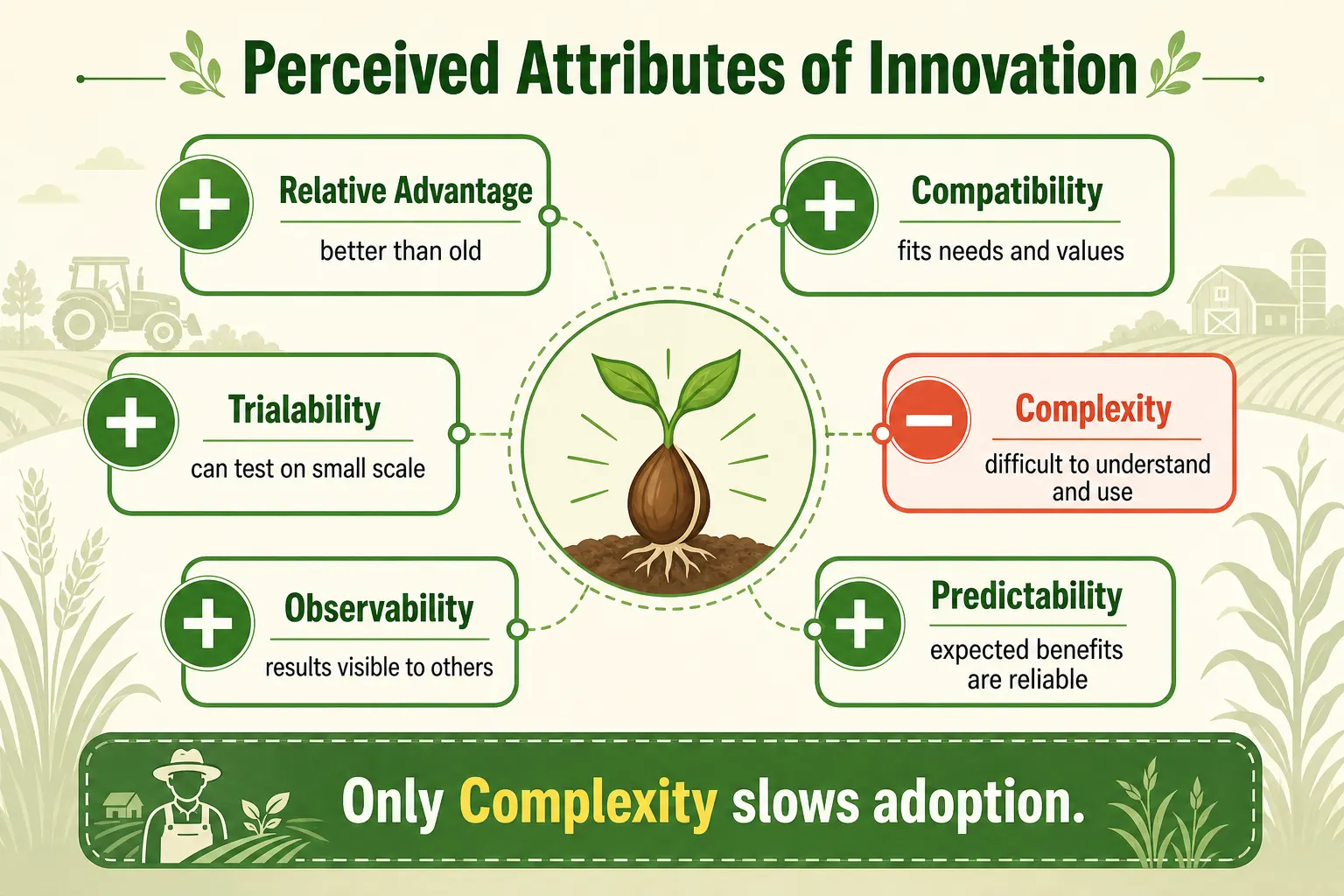
Perceived Attributes of Innovation
Communication is most effective when source and receiver are alike (principle of homophily). The attributes of an innovation are most important for potential adopters.
| Attribute | Definition | Correlation with Adoption | Example |
|---|---|---|---|
| Relative Advantage | Degree to which an innovation is perceived as better than the idea it replaces | Positive (+) | New cotton variety giving 30% higher yield |
| Compatibility | Degree of consistency with client's needs, existing practices, socio-cultural values | Positive (+) | New crop variety suiting local agro-climatic conditions and farmer's beliefs |
| Complexity | Degree to which an innovation is perceived as difficult to understand and use | Negative (-) | HYV requiring balanced nutrition, plant protection, and better management |
| Trialability | Degree to which it can be experimented on a limited basis; reduces risk | Positive (+) | Free seed and fertiliser samples for testing |
| Observability | Degree to which results are visible to others | Positive (+) | Green colour boost from nitrogen fertiliser is immediately visible |
| Predictability | Degree of certainty of receiving expected benefits | Positive (+) | Reliable yield increase every season |
IMPORTANT
Complexity is the ONLY attribute with a negative correlation to adoption rate. All other five attributes show positive correlation -- more of each leads to faster adoption.
Compatibility Dimensions
- Situational compatibility -- suits physical and environmental conditions
- Cultural compatibility -- aligns with values, beliefs, and social norms
Special Concepts
| Concept | Meaning |
|---|---|
| Preventive Innovation | Adopted to prevent a future unwanted event (e.g., crop insurance, vaccination); has low adoption rate due to low observability -- the benefit is an event that does NOT happen |
| Innovation Negativism | Bad experience with one innovation makes a client reject future innovations, even unrelated ones |
Three Models of the Adoption Process
Different scholars have proposed models describing the mental stages a farmer goes through before adopting an innovation. Each model adds nuance -- from the basic 5-stage AIETA to Rogers' comprehensive KPDIC with its emphasis on confirmation and discontinuance.
1. Five-Stage Model -- AIETA
Given by the North Central Rural Sociology Sub-committee (1955)
| Stage | Name | Description | Information Source |
|---|---|---|---|
| 1 | Awareness | Learns innovation exists but lacks detailed information | Mass media |
| 2 | Interest | Actively seeks knowledge; rapport building needed | Extension contact |
| 3 | Evaluation | Mentally weighs pros and cons; judges worth | Personal reflection |
| 4 | Trial | Makes full use but on limited scale | Hands-on testing |
| 5 | Adoption | Decides to continue full use; info source = self-experience from trial | Self-experience |
TIP
Mnemonic: A-I-E-T-A = "Any Intelligent Extension Teaches Adoption"
- Over-adoption is due to insufficient knowledge -- adopting beyond recommended scope.
2. Seven-Stage Model -- NAID TEA
Given by Singh & Pareek. Y.P. Singh added Need as the first stage.
| Stage | Name |
|---|---|
| 1 | Need |
| 2 | Awareness |
| 3 | Interest |
| 4 | Deliberation |
| 5 | Trial |
| 6 | Evaluation (moved after Trial) |
| 7 | Adoption |
- Stages are dynamic, not static -- a person can move back and forth.
3. Innovation Decision Process -- KPDIC
Given by Rogers. The most comprehensive modern model.
| Stage | Name | Nature | Key Facts |
|---|---|---|---|
| 1 | Knowledge | Cognitive (knowing) | Three types: awareness, how-to, principles |
| 2 | Persuasion | Affective (feeling) | Perceived attributes most important here; individual is most psychologically involved; dissonance should NOT occur; chief concern is "How-to" information |
| 3 | Decision | Choosing | Alternatives: adoption or rejection |
| 4 | Implementation | Action | Innovation put to use; re-invention = modification by user during implementation |
| 5 | Confirmation | Reinforcement | Seeks validation; conflicting information must be avoided; discontinuance occurs here |

- Innovation decision period = time required to pass through the entire process (a gestation period)
- Dissonance = uncomfortable mental state from conflicting beliefs/actions; reduced by changing behaviour to align with attitude
Communication channels in the process:
- Mass media channels are more important at the knowledge stage
- Interpersonal channels are more important at the persuasion stage
TIP
Three Adoption Models Compared: 5-Stage (AIETA) | 7-Stage (NAID TEA, by Singh & Pareek) | Innovation Decision Process (KPDIC, by Rogers). The 7-stage model adds "Need" at the start and moves Evaluation after Trial.
Five Adopter Categories
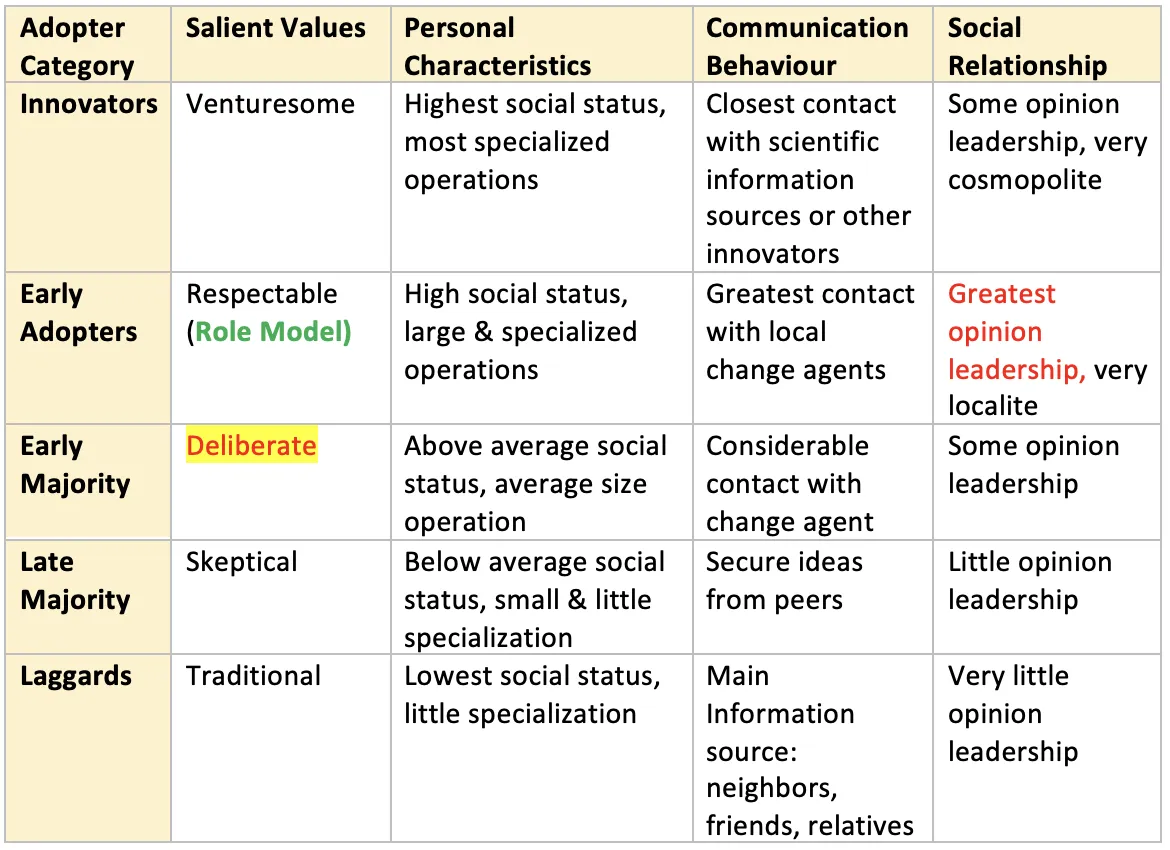
Not everyone adopts an innovation at the same time. Rogers classified the population into five categories based on how quickly they adopt, creating one of the most important frameworks in extension science.
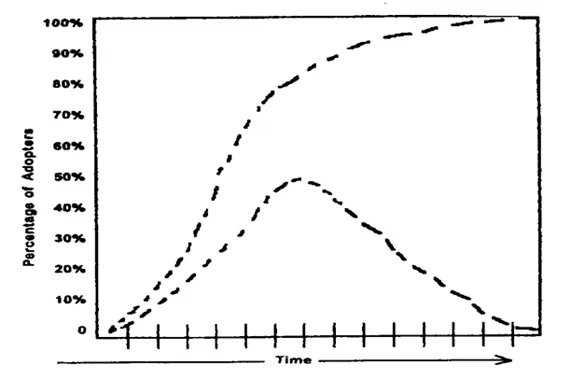
Classified on the basis of innovativeness -- the degree to which an individual is relatively earlier in adopting new ideas. Based on mean and standard deviation of a normal bell-shaped curve.
| Category | Also Called | Percentage | Statistical Range | Key Characteristics |
|---|---|---|---|---|
| 1. Innovators | Venturesome | 2.5% | -∞ to X-2σ | First to try; risk-takers; cosmopolite; viewed as deviant by others |
| 2. Early Adopters | Respectable | 13.5% | X-2σ to X-σ | Opinion leaders; do legitimization; lesser dogmatic, higher empathy; "men to check with" |
| 3. Early Majority | Deliberate | 34% | X-σ to X | Adopt just before average; considered friends and neighbours; motto: "Be not the last nor the first" |
| 4. Late Majority | Skeptical | 34% | X to X+σ | Adopt after most peers; driven by economic necessity or peer pressure |
| 5. Laggards | Traditional | 16% | X+σ to X+2σ | Adopt last; past-oriented; little education; custodians of indigenous knowledge |
TIP
Percentage Memory Aid: 2.5 -- 13.5 -- 34 -- 34 -- 16
- Early Majority + Late Majority = 68% (middle)
- Innovators + Early Adopters = 16% (same as Laggards!)
- Curve is symmetrical: 16% on each tail, 68% in the middle
Adoption Curves
- Frequency of adopters over time follows a normal/bell-shaped curve
- Cumulative frequency follows an S-shaped curve
- The S-curve increases at an increasing rate for innovators, early adopters, and early majority
Agricultural Examples of Adopter Categories
| Category | Agricultural Example |
|---|---|
| Innovators | First farmers to try SRI method of rice cultivation in their district |
| Early Adopters | Village sarpanch who adopted drip irrigation after seeing demonstration; others follow his lead |
| Early Majority | Farmers who adopted Bt cotton after neighbours showed good results for 2-3 seasons |
| Late Majority | Farmers who switched to mechanised harvesting only after combine harvesters became common and affordable |
| Laggards | Elderly farmers still using traditional broadcast sowing despite line-sowing being proven better |
Exam Tips and Mnemonics
IMPORTANT
Exam-critical associations:
- Innovators = Venturesome (2.5%) -- viewed as deviant
- Early Adopters = Respectable (13.5%) -- opinion leaders, do legitimization
- Laggards = Traditional (16%) -- adopt last, custodians of indigenous knowledge
- Complexity = ONLY negative attribute
- Over-adoption = insufficient knowledge
- Mass media best at knowledge stage; Interpersonal best at persuasion stage
- Adoption = individual level; Diffusion = social system level
- Normal adoption takes 6-10 years
Summary Cheat Sheet
| Concept | Key Fact |
|---|---|
| Adoption | Individual mental process; continuous |
| Diffusion | Social system level; communication about new ideas |
| Normal adoption time | 6-10 years |
| Five-stage model | AIETA (North Central Rural Sociology, 1955) |
| Seven-stage model | NAID TEA (Singh & Pareek); added Need, dynamic stages |
| Innovation Decision Process | KPDIC (Rogers) |
| Only negative attribute | Complexity |
| Positive attributes | Relative advantage, Compatibility, Trialability, Observability, Predictability |
| Preventive innovation | Low adoption due to low observability |
| Frequency curve | Bell-shaped (normal) |
| Cumulative curve | S-shaped |
| Innovators | 2.5% -- Venturesome |
| Early Adopters | 13.5% -- Respectable, Opinion leaders |
| Early Majority | 34% -- Deliberate |
| Late Majority | 34% -- Skeptical |
| Laggards | 16% -- Traditional |
| Dissonance | Uncomfortable mental state from conflicting beliefs |
| Re-invention | Modification of innovation during implementation |
| Discontinuance | Stopping use at confirmation stage |
TIP
Next: The next lesson covers Extension Programme Planning -- how extension agencies systematically plan, implement, and evaluate programmes using the SOPS framework.