👨🏻💻 Extension Programme Planning -- SOPS Framework, Objectives, Evaluation and Plan of Work
Master extension programme planning covering SOPS framework (Situation, Objectives, Problems, Solutions), felt vs unfelt needs, 11 planning principles, 8-step planning process, plan of work (5Ws and 1H), process evaluation, and calendar of operations for exams.
Visual Overview
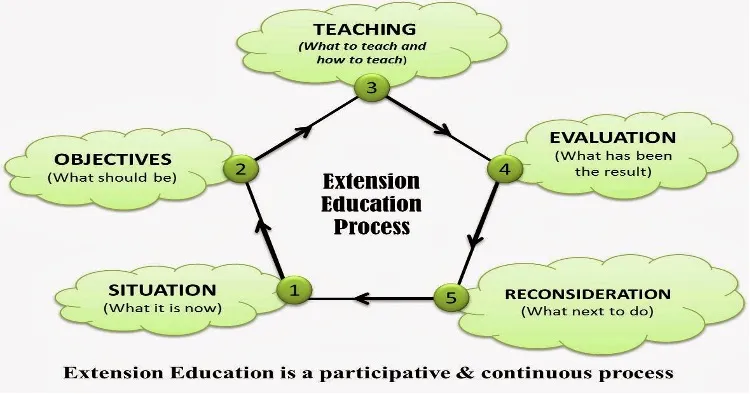
In the previous lesson, we studied how innovations diffuse through a social system and how individuals adopt new practices. But diffusion does not happen by accident -- it requires systematic planning. This lesson covers how extension agencies design, implement, and evaluate their programmes.
This lesson covers:
- SOPS framework -- Situation, Objectives, Problems, Solutions
- Needs assessment -- felt vs unfelt needs, sociometric method
- Planning hierarchy -- Vision, Aim, Objective, Goal
- 11 principles and 8 steps of programme planning
- Plan of work (5Ws and 1H) and calendar of operations
- Evaluation -- process, summative, and formative
These concepts form the backbone of extension management questions in exams.
Extension Programme
- According to Kelsey and Hearne (1967), an extension programme is a statement of situation, objectives, problems and solutions (SOPS). It is relatively permanent but requires constant revision. This definition highlights that an extension programme is not a one-time activity but a living document that must be regularly updated to reflect changing conditions and emerging challenges in the community.
Situation
A statement of affairs that include the cultural, social, economic & physical conditions in which a particular group of people find themselves at a given period of time. Understanding the situation is the starting point of any extension programme because it provides the baseline against which progress will be measured. A thorough situation analysis reveals what resources are available, what constraints exist, and what opportunities can be leveraged.
Pro Content Locked
Upgrade to Pro to access this lesson and all other premium content.
₹99 charged monthly · Cancel anytime
- All Agriculture & Banking Courses
- AI Lesson Questions (100/day)
- AI Doubt Solver (50/day)
- Glows & Grows Feedback (30/day)
- AI Section Quiz (20/day)
- 22-Language Translation (100/day)
- Recall Questions (20/day)
- AI Quiz (15/day)
- AI Quiz Paper Analysis (100/day)
- AI Step-by-Step Explanations (100/day)
- Spaced Repetition Recall (FSRS)
- AI Tutor
- Immersive Text Questions
- Audio Lessons — Hindi & English
- Mock Tests & Previous Year Papers
- Summary & Mind Maps
- XP, Levels, Leaderboard & Badges
- Generate New Classrooms
- Voice AI Teacher (AgriDots Live)
- AI Revision Assistant
- Knowledge Gap Analysis
- Interactive Revision (LangGraph)
🔒 Secure via Razorpay · Cancel anytime · No hidden fees
Visual Overview
In the previous lesson, we studied how innovations diffuse through a social system and how individuals adopt new practices. But diffusion does not happen by accident -- it requires systematic planning. This lesson covers how extension agencies design, implement, and evaluate their programmes.
This lesson covers:
- SOPS framework -- Situation, Objectives, Problems, Solutions
- Needs assessment -- felt vs unfelt needs, sociometric method
- Planning hierarchy -- Vision, Aim, Objective, Goal
- 11 principles and 8 steps of programme planning
- Plan of work (5Ws and 1H) and calendar of operations
- Evaluation -- process, summative, and formative
These concepts form the backbone of extension management questions in exams.
Extension Programme
- According to Kelsey and Hearne (1967), an extension programme is a statement of situation, objectives, problems and solutions (SOPS). It is relatively permanent but requires constant revision. This definition highlights that an extension programme is not a one-time activity but a living document that must be regularly updated to reflect changing conditions and emerging challenges in the community.
Situation
A statement of affairs that include the cultural, social, economic & physical conditions in which a particular group of people find themselves at a given period of time. Understanding the situation is the starting point of any extension programme because it provides the baseline against which progress will be measured. A thorough situation analysis reveals what resources are available, what constraints exist, and what opportunities can be leveraged.
Problem
- Problem is a condition that the people after study, with or without outside help, have decided needs changing. A problem is not simply a difficulty -- it is a recognized gap that the community acknowledges and wants to address.
- Simple problem: If number of causes are few & easy to identify. For example, a single pest outbreak in a crop where the cause and solution are straightforward.
- Complex problem: If the problems are interrelated, causes are many & difficult to identify. For example, declining farm incomes may involve soil degradation, poor market access, lack of credit, and inadequate irrigation all at once.
Need
- Concept of need given by Leagan (1961)
- Need implies a gap between what is, the existing situation; and what ought to be, the desired situation. In extension work, identifying needs accurately is the most critical step because the entire programme is built around addressing these needs.
- The gap between the situation and objective is need.
- Sociometric method is most effective method in identifying real rural needs. This method involves studying the social relationships and interactions within a community to understand their true priorities, rather than relying only on formal surveys.
TIP
Remember the hierarchy: Vision > Aim > Objective > Goal. Vision is the broadest, Goal is the most specific and time-bound.
- From a psychological standpoint, need may classified into two categories:
1. Felt Need:
- The need of which people are aware of.
- Also called consciously recognised need. These are needs that the community members themselves can articulate -- for instance, a farmer saying they need better seeds or access to a market.
2. Unfelt Need:
- The need of which the people are not aware of at present.
- Also called unrecognized need. These are needs that exist but the community does not yet realize them. For example, farmers may not be aware of soil nutrient deficiency until an extension worker conducts a soil test. A key role of extension is to convert unfelt needs into felt needs through education and awareness.
Solution
- Solution is a course of proposed action to change an unsatisfactory condition to one that is more satisfying. Solutions in extension are action-oriented and must be practical, feasible, and culturally acceptable to the community.
Vision
- Articulation of desired end results. A vision provides the long-term direction and inspiration for the extension programme. It answers the question: "What does success look like?"
Aim
- Aim is generalised and broad statement of directions with respect to given activities. Aims are wider in scope than objectives and provide the overall framework within which specific objectives and goals are set.
- Ex. Improvement of farmers' economic condition, increasing the average wheat yield etc.
- Aim includes several objectives & goal is a part of objective.
Objective
- Objectives are expression of the ends towards which our efforts are directed. Unlike aims, objectives are specific, measurable, and time-bound. They provide clear targets that extension workers can work towards.
- Ex. To increase the average yield of wheat by from 40 quintal to 50 quintal per hectare.
- Three levels of objective:
1. Fundamental or all-inclusive objectives of society
- People's participation in planning at the grass roots level. These are the broadest societal goals that extension contributes to, such as democracy, equity, and empowerment.
2. General but more definite social objective
- Mandatory creation of Panchayat Raj bodies in the States. These are institutional-level objectives that create the structures needed for grassroots participation.
3. Working or specific objectives:
- Enactment of suitable laws relating to Panchayats, holding Panchayat elections in time, providing funds and facilities to the Panchayat Raj bodies etc.
- This operates at field extension work. Working objectives are the ones that extension workers deal with on a day-to-day basis and they should be concrete enough to be directly actionable.
Goal
- Goal is distance in any direction one expects to go during a given period of time. Goals are quantified and time-bound milestones that help measure progress towards objectives.
- Ex. To raise the yield of wheat by 5 quintals per hectare in the current year.
Principles of Extension Programme Planning
These 11 principles serve as the guiding framework for effective extension programme planning. Following them ensures that programmes are relevant, participatory, and impactful.
- Extension programme should be based on an analysis of the facts in a situation. Decisions must be data-driven, not based on assumptions.
- Extension programme planning selects problems based on people's interests and needs. The community's priorities, not the extension worker's preferences, should drive programme selection.
- Extension programme planning determines definite objectives and solution, which offers satisfaction.
- Extension programme planning has permanence with flexibility. The programme framework should be stable, but specific activities must be adaptable to changing circumstances.
- Extension programme planning has balance with emphasis. All aspects of farming and rural life should receive attention, but more emphasis should be given to the most pressing needs.
- Extension programme planning has a definite plan of work.
- Extension programme planning is an educational process. The planning itself is a learning experience for all participants.
- Extension programme planning is a continuous process. It does not end with the creation of a plan -- it is an ongoing cycle of planning, implementation, evaluation, and revision.
- Extension programme planning is a co-ordinating process. It brings together multiple agencies, departments, and stakeholders to work towards common goals.
- Extension programme planning involves local people and their institutions. People's participation is not optional -- it is essential for programme ownership and sustainability.
- Extension programme planning provides for evaluation of results. Without evaluation, there is no way to know whether the programme achieved its objectives.
Steps in Extension Programme Planning
Knowing the principles is not enough -- extension professionals must follow a structured step-by-step process to translate principles into action. The 8-step process below covers the complete cycle from data collection to programme revision.
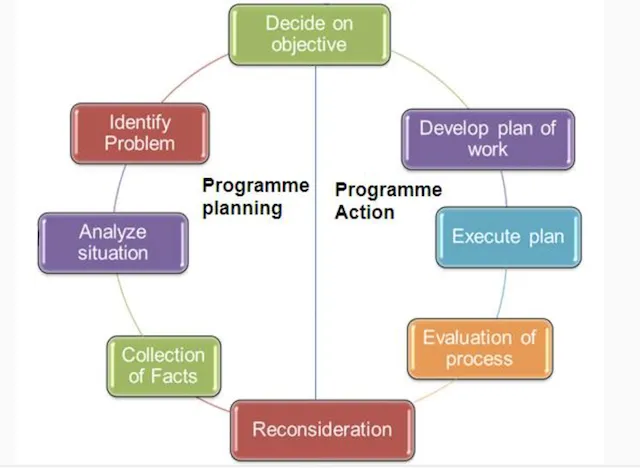
The planning process can be broadly divided into three phases: Programme Determination, Programme Implementation, and Evaluation. Each phase has specific steps that build upon the previous ones.
Programme Determination/ Programme Planning
1. Collection of facts
- Local situation acts a bench mark for starting programme planning. The first step is to gather comprehensive data about the community's agricultural practices, economic conditions, social structure, and available resources. This becomes the baseline against which all future progress will be measured.
2. Analysis of situation
- The extension work grow out of situation. The collected facts are systematically analysed to identify patterns, trends, and underlying causes. This analysis helps extension workers understand why things are the way they are.
3. Identification of problems
- Based on the analysis, the most important problems are identified and prioritised. Problems should be identified in consultation with the community to ensure buy-in and relevance.
4. Determination of objectives and goal
- Clear, measurable objectives and specific goals are set to address the identified problems. These objectives become the benchmarks for evaluating programme success.
Programme Implementation/Programme action
5. Developing plan of work and calendar of operations
Plan of Work
- An outline of activities so arranged as to enable efficient execution of the programme. The plan of work is the operational blueprint that translates objectives into concrete actions.
- The plan of work indicates: 5Ws & 1H i.e. what is to be done, who is to do it, how it is to be done, when & where it is to be done, who are to be served or reached and how the results will be evaluated. This comprehensive framework ensures that nothing is left to chance and every aspect of implementation is thought through.
Calendar of work
- It is a plan of activities to be undertaken in a particular time sequence. The calendar arranges activities in chronological order, aligned with agricultural seasons and community schedules.
- When plan of work arranged chronologically is called calendar of work.
6. Follow through plan of work and calendar of work
- Execution of plan should be carried out without change. During implementation, it is important to follow the plan closely while being alert to any unexpected challenges that may require adaptation.
7. Evaluation of progress
8. Reconsideration and revision of the programme
- Based on evaluation findings, the programme is revised and updated. This step ensures that the programme remains relevant and effective over time.
Evaluation
- Latin word: 'valerie' which means to be strong or valiant. The etymological origin reminds us that evaluation is about strengthening programmes, not just judging them.
- It is measuring performance against predetermined goals.
- Evaluation of any programme should be based on objectives of the programme. This means the objectives set during the planning phase serve as the yardstick for measuring success.
- Purpose of evaluation is to identify strong and weak points and to identify gaps and errors.
- The main objective of evaluation in extension is to facilitate effective decision making without jumping to conclusion.
- Evaluation carried during project is known as process evaluation. This type of evaluation assesses how the programme is being implemented in real-time, allowing for course corrections before the programme ends.
NOTE
Process evaluation = during project | Summative evaluation = after project completion | Formative evaluation = to improve the programme while it is still ongoing.
Evaluation of Extension Programmes
- Evaluation is the process by which the effectiveness of extension is assessed. It is more than simply finding out what happened; it involves passing judgement on what happened. Was the outcome of the programme good enough? Was it better or worse than expected? Could more have been achieved? These questions guide reflective practice and continuous improvement in extension work.
- The evaluation of agricultural extension programs implies the systematic collection of information about the activities, characteristics, and outcomes of a program to make judgments about the program, improve its effectiveness, and/or inform decisions about future programming.
Objectives of Evaluation
- To know the causes for success or failure of the programme, along with identifying the obstacles for success in the programme
- To inspire the workers for the evaluation of their objectives
- To know the merits and demerits of the programme
- To increase the self-confidence in both the rural people and extension worker
- To unearth the expenses and achievements of a programme
- To find out the usefulness of new experimental teaching methods
Quick Recap: 8 Steps of Programme Planning
Programme Determination: (1) Collection of facts, (2) Analysis of situation, (3) Identification of problems, (4) Determination of objectives & goals
Programme Implementation: (5) Developing plan of work & calendar, (6) Follow through, (7) Evaluation of progress, (8) Reconsideration & revision
Summary Cheat Sheet
| Concept / Topic | Key Details |
|---|---|
| SOPS framework | Situation, Objectives, Problems, Solutions; by Kelsey & Hearne (1967) |
| Need (Leagans, 1961) | Gap between what is and what ought to be |
| Felt need | Need people are aware of (consciously recognised) |
| Unfelt need | Need people are not aware of; extension converts unfelt → felt |
| Sociometric method | Most effective method to identify real rural needs |
| Hierarchy | Vision > Aim > Objective > Goal (broadest to most specific) |
| 3 levels of objectives | Fundamental (all-inclusive) → General (definite) → Working/Specific |
| 11 Planning Principles | Data-based, people's needs, definite objectives, permanence with flexibility, balance, plan of work, educational, continuous, coordinating, involves local people, evaluates results |
| 8 Planning Steps | (1) Collect facts (2) Analyse (3) Identify problems (4) Set objectives (5) Plan of work (6) Follow through (7) Evaluate (8) Reconsider & revise |
| Plan of Work | 5Ws & 1H: What, Who, How, When, Where, How to evaluate |
| Calendar of Work | Plan of work arranged chronologically |
| Evaluation (Latin: valerie) | Measuring performance against predetermined goals |
| Process evaluation | Conducted during the project |
| Purpose of evaluation | Identify strong/weak points, gaps, errors; facilitate effective decision making |
TIP
Next: The next lesson covers Famous Extension Programmes -- the major government schemes (MNREGA, PMKSY, NBS, Kisan Call Centres, and more) that put these planning principles into practice at national scale.