🧑🏫 Famous Extension Programmes -- MNREGA, PMKSY, PURA, ARYA, NBS, Kisan Call Centres
Comprehensive guide to major extension and rural development programmes including MNREGA (100 days employment), PURA, NRuM, Bharat Nirman, PMKSY (Per Drop More Crop), Kisan Call Centres, NBS scheme, ACABC, PM Kisan SAMPADA, and NMAET for IBPS AFO, NABARD Grade A, and FCI exams.
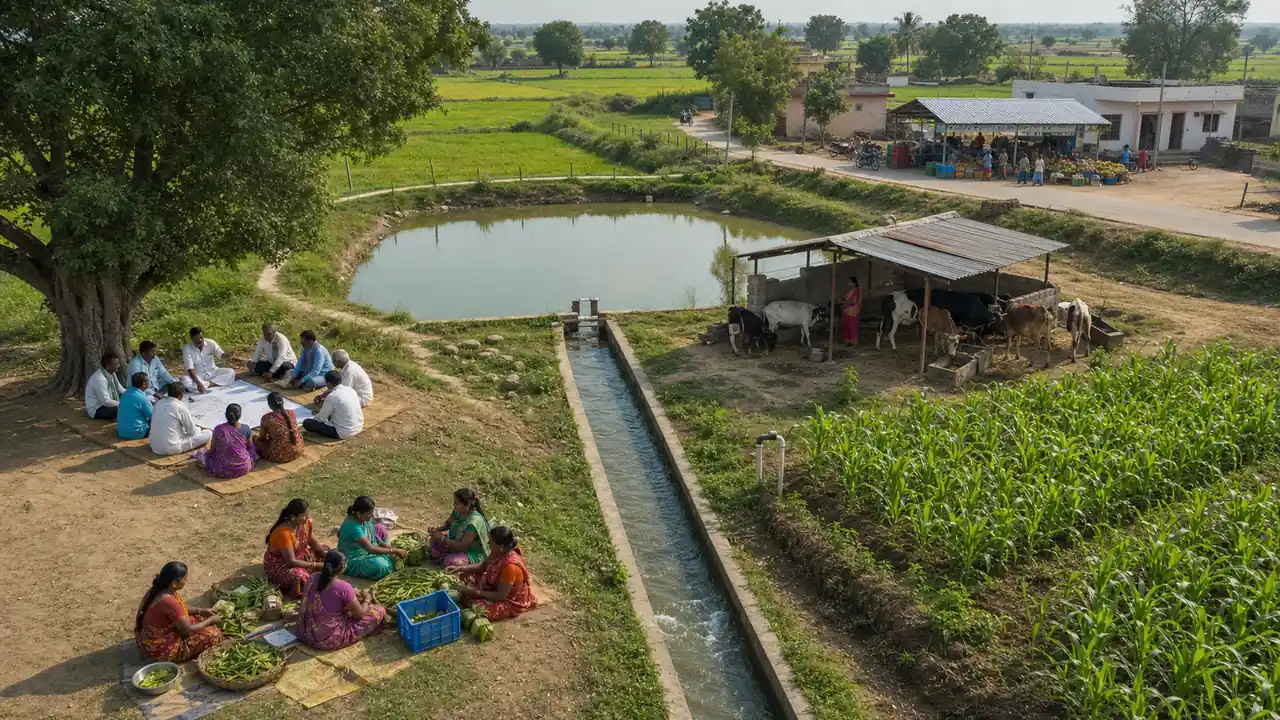
In the previous lesson, we studied the SOPS framework and the 8-step process for planning extension programmes. Now we examine the major government programmes that have been designed using these principles to address rural employment, infrastructure, sanitation, drinking water, agriculture, and farmer welfare.
This lesson covers:
- MNREGA -- 100 days guaranteed employment
- PURA and NRuM -- urban amenities in rural areas
- Rural infrastructure -- housing, roads, and Bharat Nirman
- Sanitation -- CRSP to Swachh Bharat Abhiyan
- Drinking water schemes
- Kisan Call Centres and NBS
- PMKSY -- Per Drop More Crop
- ARYA, ACABC, NMAET, and other extension projects
All programmes with their launch years, key features, and numerical facts are high-yield for IBPS AFO, NABARD Grade A, and FCI exams.
National Rural Employment Guarantee Scheme (NREGS)
-
It seeks to strengthen the livelihood resource base of the poor by providing 100 days Exams of guaranteed unskilled wage employment per year to each rural household whose adult members volunteer to do unskilled manual work. This is one of India's most ambitious rights-based social protection programmes, providing a legal guarantee of employment to rural households.
Pro Content Locked
Upgrade to Pro to access this lesson and all other premium content.
₹99 charged monthly · Cancel anytime
- All Agriculture & Banking Courses
- AI Lesson Questions (100/day)
- AI Doubt Solver (50/day)
- Glows & Grows Feedback (30/day)
- AI Section Quiz (20/day)
- 22-Language Translation (100/day)
- Recall Questions (20/day)
- AI Quiz (15/day)
- AI Quiz Paper Analysis (100/day)
- AI Step-by-Step Explanations (100/day)
- Spaced Repetition Recall (FSRS)
- AI Tutor
- Immersive Text Questions
- Audio Lessons — Hindi & English
- Mock Tests & Previous Year Papers
- Summary & Mind Maps
- XP, Levels, Leaderboard & Badges
- Generate New Classrooms
- Voice AI Teacher (AgriDots Live)
- AI Revision Assistant
- Knowledge Gap Analysis
- Interactive Revision (LangGraph)
🔒 Secure via Razorpay · Cancel anytime · No hidden fees
In the previous lesson, we studied the SOPS framework and the 8-step process for planning extension programmes. Now we examine the major government programmes that have been designed using these principles to address rural employment, infrastructure, sanitation, drinking water, agriculture, and farmer welfare.
This lesson covers:
- MNREGA -- 100 days guaranteed employment
- PURA and NRuM -- urban amenities in rural areas
- Rural infrastructure -- housing, roads, and Bharat Nirman
- Sanitation -- CRSP to Swachh Bharat Abhiyan
- Drinking water schemes
- Kisan Call Centres and NBS
- PMKSY -- Per Drop More Crop
- ARYA, ACABC, NMAET, and other extension projects
All programmes with their launch years, key features, and numerical facts are high-yield for IBPS AFO, NABARD Grade A, and FCI exams.
National Rural Employment Guarantee Scheme (NREGS)
-
It seeks to strengthen the livelihood resource base of the poor by providing 100 days Exams of guaranteed unskilled wage employment per year to each rural household whose adult members volunteer to do unskilled manual work. This is one of India's most ambitious rights-based social protection programmes, providing a legal guarantee of employment to rural households.
-
SGRY and NFWP have been subsumed in NREGA. Both the Sampoorna Grameen Rozgar Yojana and the National Food for Work Programme were merged into NREGA to create a single, unified employment guarantee scheme.
-
The scheme was introduced in the year 2005 through the National Rural Employment Guarantee Act, (NREGA) 2005 UPPSC 2021.
-
NREGS initially started in 200 districts on 2 Feb, 2006.
-
Job under NREG Act has to provide to registered job card holders within 15 days for 100 days. If employment is not provided within 15 days, the applicant is entitled to an unemployment allowance.
-
2 Oct, 2009, NREGA renamed as MNREGA. It was renamed to honour Mahatma Gandhi, reflecting the scheme's alignment with his vision of rural self-sufficiency.
-
Centre & State: 50:50
-
Mahatma Gandhi National Rural Employment Guarantee Scheme (MGREGS) is the most important among all the schemes of rural development.
-
Presently, it covers all the rural districts (716) of the country.
-
During the recent past, the scheme has emerged as the essential safety net for many rural workers who have been adversely affected by the COVID-19 pandemic.
-
Under this scheme during the year 2022-23, assets worth Rs. 7.10 crore were created through the generation of 253.11 crore person days benefiting 5.82 crore households up to February 10, 2023.
-
In the union budget 2023-24, the allocation for the MGNREGS has been slashed nearly by 33 per cent accounting for Rs. 60,000 crore as compared to Rs. 89,400 crore of revised expenditure of 2022-23.
-
The fall in allocation could be attributed to lower demand of works under MGNREGA due to the strong agricultural growth and a swift recovery from COVID-19 induced slowdown, resulting in better employment opportunities in rural areas.
-
In 2023-24, Mahatma Gandhi National Rural Employment Guarantee Scheme accounted for nearly 38 per cent of total expenditure on all centrally sponsored schemes of rural development.
PURA and Rurban Development
Providing Urban Amenities in Rural Areas (PURA)
- Launched in 2004, started by APJ Abdul Kalam. This visionary programme was conceptualized by the former President to bridge the urban-rural divide by bringing city-level facilities to villages.
- Vision / Mission Statement: Holistic and accelerated development of compact areas around a potential growth centre in a Gram Panchayat (or a group of Gram Panchayats) through Public Private Partnership (PPP) framework for providing livelihood opportunities and urban amenities to improve the quality of life in rural areas.
- Ministry: MoRD
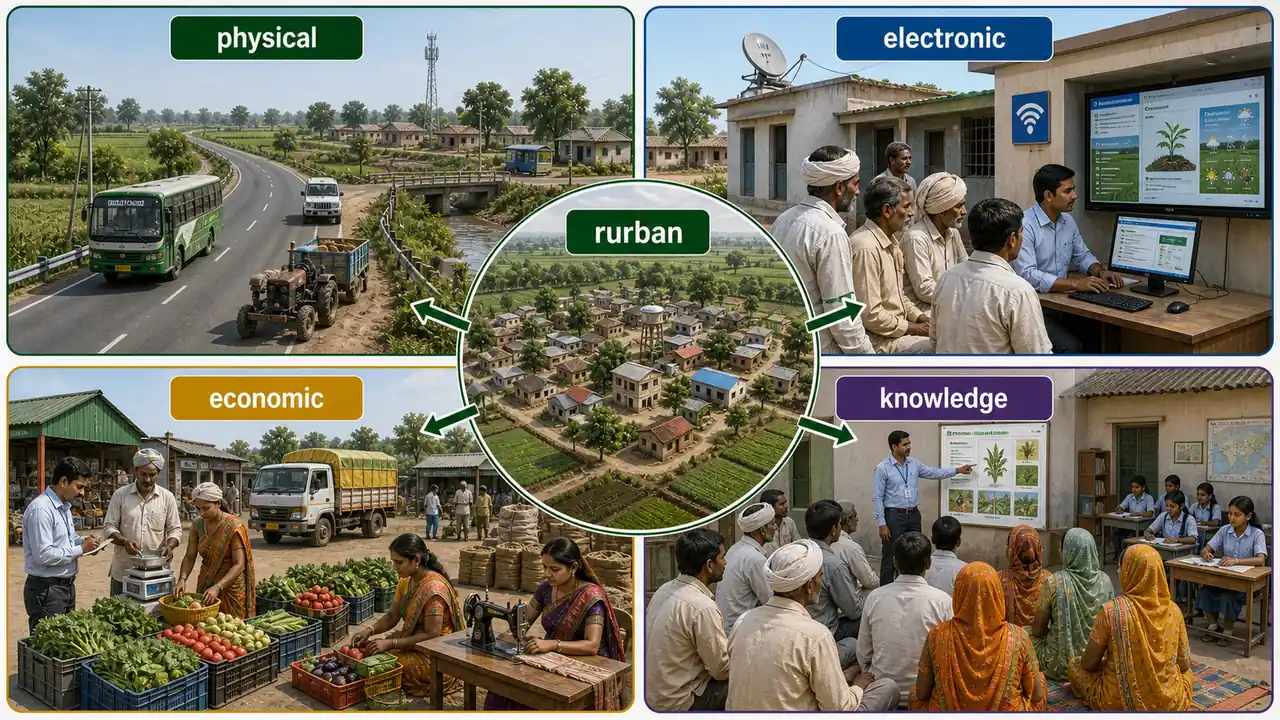
- It consists of providing four connectivity: Physical, Electronic, Economic and Knowledge. These four types of connectivity form the pillars of PURA -- connecting villages through roads, internet, markets, and educational institutions.
- The Shyama Prasad Mukherjee Rurban Mission is a successor to this mission.
National Rurban Mission (NRuM)
- The National Rurban Mission (NRuM) follows the vision of "Development of a cluster of villages" that preserve and nurture the essence of rural community life with focus on equity and inclusiveness without compromising with the facilities perceived to be essentially urban in nature, thus creating a cluster of "Rurban Villages". The concept of Rurban combines "rural" and "urban," aiming to create spaces that have the character of villages with the amenities of cities.
- Started on 21st Feb, 2016.
- Ministry: MoRD.
- The objective of the National Rurban Mission (NRuM) is to stimulate local economic development, enhance basic services, and create well planned Rurban clusters.
- The larger outcomes envisaged under this Mission are:
- Bridging the rural-urban divide-viz: economic, technological and those related to facilities and services.
- Stimulating local economic development with emphasis on reduction of poverty and unemployment in rural areas.
- Spreading development in the region.
- Attracting investment in rural areas
Rural Infrastructure
Physical infrastructure -- housing, roads, electrification, and telecommunications -- forms the backbone of rural development. Without these basics, no extension programme or livelihood scheme can succeed. The following schemes target different aspects of rural infrastructure.
Indra Awas Yojana (IAY)
- Indira Awaas Yojana was started in May 1985 as a sub-scheme of RLEGP to meet housing needs of the poor. It was one of the earliest rural housing schemes aimed at providing shelter to families living below the poverty line.
- In 1989-90, RLEGP merged with JRY.
- 1 January, 1996 it was separated from RLEGP and being implemented as an independent scheme.
- The ceiling on construction assistance under the IAY is Rs 35,000/- per unit.
Samagra Awaas Yojana (SAY)
- Launched in 1998.
- It is a comprehensive housing scheme launched with a view to ensuring integrated provision of shelter, sanitation and drinking water. Unlike IAY which focused solely on housing, SAY took a holistic approach by bundling three essential services together.
Pradhan Manthri Gram Sadak Yojana (PMGSY)
- Launched in December, 2000.
- PMGSY seeks to provide all-weather road connectivity to all eligible unconnected habitations, existing in the core network in rural areas of the country. Road connectivity is fundamental to rural development because without it, farmers cannot transport produce to markets, and villagers cannot access healthcare, education, and government services.
- The scheme has been allocated Rs 15,000 crore in 2021-22.
- The sharing of cost between centre and state is 100:00. This means it is 100% centrally funded, underscoring the national priority placed on rural road connectivity.
Bharat Nirman
- It was launched in 2005.
- It was a time bound business plan for creating and augmenting basic rural infrastructure. The targets aimed to be achieved by 2009. The name Bharat Nirman literally means "Building India," reflecting the programme's ambition to create foundational infrastructure.
- It comprises projects on irrigation, roads (Pradhan Mantri Gram Sadak Yojana), housing (Indira Awaas Yojana), water supply (National Rural Drinking Water Programme), electrification (Rajiv Gandhi Grameen Vidyutikaran Yojana) and telecommunication connectivity. These six components represent the most critical rural infrastructure needs.
- Under this 1.25 lakh un-electrified villages taken for electrification.
- 60 lakh additional houses to be constructed for rural poor.
- The plan aimed to cover 55,000 habitats not covered with pure drinking water.
- The all-weather road connects habitat with population above 1000.
Rajiv Awas Yojana
- Launched in 2011. This scheme aimed at creating a slum-free India by encouraging states and union territories to address urban housing needs, particularly for the economically weaker sections.
Rural Sanitation and Clean Village Programmes
Rural Sanitation
Sanitation is a critical determinant of rural health and productivity. India's approach to rural sanitation has evolved dramatically -- from a supply-driven model to a demand-driven, community-led approach. Understanding this evolution is important for exams.
Central Rural Sanitation Programme (CRSP)
- Launched in 1986
- Objective: of accelerating sanitation coverage in rural areas. This was India's first nationwide programme specifically targeting rural sanitation.
- CRSP was restructured in the year 1999 exhibiting a paradigm shift in the approach and Total Sanitation Campaign (TSC) was introduced. The shift was from a supply-driven approach to a demand-driven, community-led approach.
- Total Sanitation Campaign which was later renamed Nirmal Bharat Abhiyan by Prime Minister Manmohan Singh.
- Nirmal Bharat Abhiyan was restructured by Cabinet approval on 24 September 2014 as Swachh Bharat Abhiyan.
- Swachh Bharat Abhiyan was launched on 2nd October 2014, and aims to eradicate open defecation by 2nd October 2019 (150th Anniversary of MG), Swachh Bharat Abhiyan is a national campaign, covering 4,041 statutory cities and towns.
Evolution of Sanitation Programmes
CRSP (1986) → restructured into Total Sanitation Campaign / TSC (1999) → renamed Nirmal Bharat Abhiyan → restructured into Swachh Bharat Abhiyan (2014). Each iteration shifted from a supply-driven approach towards a more demand-driven, community-led sanitation model.
Swach Bharat Abhiyan
- The scheme aims to positively impact village cleanliness and generate wealth and energy from cattle and organic waste.
- The scheme also aims at creating new rural livelihood opportunities and enhancing income for farmers and other rural people.
- The Swachh Bharat Mission (Gramin) comprises two main components for creating clean villages -- creating open defecation free (ODF) villages and managing solid and liquid waste in villages.
- With over 3.5 lakh villages, 374 districts and 16 States/UTs of the country being declared ODF, the stage is set for ODF-plus activities, including measures to enhance solid and liquid waste management. ODF-plus goes beyond just toilet construction to address comprehensive village cleanliness.
- Ministry of Drinking Water and Sanitation launched the GOBAR (Galvanizing Organic Bio-Agro Resources - DHAN Scheme. exams-19
- The GOBAR-DHAN scheme, with its focus on keeping villages clean, increasing the income of rural households, and generation of energy from cattle waste, is an important element of this ODF-plus strategy. The scheme converts cattle dung and organic waste into biogas and compost, thereby turning a waste product into a valuable resource.
- The scheme envisages the implementation of 700 bio-gas units in different states of the country in 2018-19.
- Ministry of Drinking Water and Sanitation is now merged with Jal Shakti Ministry.
Drinking Water and Rural Access
Drinking Water Schemes
Access to safe drinking water is both a fundamental right and a prerequisite for rural health. India has launched multiple schemes since the 1970s, each building on the lessons of the previous one -- moving from centralised supply to community-managed models.
-
Accelerated Rural Water Supply Programme
- Launched in 1972-73.
- To provide drinking water in villages. This was one of the earliest programmes recognising safe drinking water as a critical rural need.
-
National Drinking Water Mission
- Launched in 1986.
- Renamed as Rajiv Gandhi National Drinking Water mission in 1991. The renaming reflected the programme's continued expansion and enhanced focus on reaching underserved rural habitations.
-
Million Well Scheme (MWS)
- Launched in 1988-89.
- It is a sub-scheme under JRY. Under this scheme subsidy for digging well is provided. The scheme specifically targeted small and marginal farmers and agricultural labourers to help them access groundwater for irrigation.
-
Ganga Kalyan Yojna (GKY)
- Launched in 1st Feb. 1997.
- It is a credit support scheme for small & marginal farmers under BPL started with the objective to provide irrigation though exploitation of ground water through tube wells and bore wells. The scheme provided financial assistance combined with institutional credit to make groundwater irrigation accessible to the poorest farmers.
-
"Swajaldhara" Rural Drinking Scheme
- Launched in 2002.
- It is a community-based rural drinking water supply programme. Unlike earlier top-down schemes, Swajaldhara adopted a demand-driven, community-managed approach where local communities took ownership of water supply infrastructure.
ICT-Based Farmer Advisory Support
Kisan Call Centres (KCC)
-
In order to harness the potential of ICT in Agriculture, Ministry of Agriculture & Farmers Welfare launched the scheme "Kisan Call Centres" (KCCs) on January 21, 2004. This was a pioneering initiative to use Information and Communication Technology (ICT) to deliver agricultural advisory services directly to farmers.
-
Main aim of the scheme is to answer farmers' queries on a telephone call in their own language. These call centres are working in 21 different locations in the country covering all the States and UTs.
-
A countrywide common eleven-digit Toll Free Number 1800-180-1551 UPPSC 2021 has been allotted for Kisan Call Centre. This number is accessible through mobile phones and landlines of all telecom networks including private service providers.
-
Replies to the farmers' queries are given in 22 local languages. This multilingual support ensures that language is not a barrier for farmers seeking expert advice.
-
Kisan Call Centre services are available from 6.00 AM to 10.00 PM [2 shifts x 8 hours] on all seven days of the week at each KCC location.
- Kisan Call Centre agents known as Farm Tele Advisors (FTAs), who are graduate or above (i.e. PG or Doctorate) in Agriculture or allied sectors (Horticulture, Animal Husbandry, Fisheries, Poultry, Bee-Keeping, Sericulture, Aquaculture, Agricultural Engineering, Agricultural Marketing, Bio-Technology, Home Science, etc.) and possess excellent communication skills in respective local language.
- Queries which cannot be answered by FTAs are transferred to higher level experts. These experts are Subject Matter Specialists (SMSs) of State Departments of Agriculture (SDAs), ICAR Institutes, KVKs and State Agricultural Universities (SAUs). This tiered response system ensures that even the most technical queries are eventually answered by the right expert.
Nutrient and Irrigation Support
Nutrient Based Subsidy (NBS)
- NBS scheme introduced in 1 April, 2010. This marked a significant policy shift from product-based subsidy to nutrient-based subsidy, aimed at promoting balanced fertilization.
- Under the NBS scheme, Government has amended subsidy per kg & per MT of fertilizers.
- It is provided for 4 nutrients: N, P, K & S. The subsidy is calculated based on the nutrient content of the fertilizer rather than the brand or product, encouraging manufacturers to produce more efficient formulations.
- First fertilizer under NBS was SSP. Single Super Phosphate was the first fertilizer to be covered under the NBS regime.

- MRP fixed for Urea in 2015-16: Rs 5,360/tone. Urea remains outside the NBS regime and continues under price control due to its critical importance in Indian agriculture.
- Budget estimated subsidy for all fertilizers in 2015-16: 79,530 Crore.
- Projection plan for 12th Five year plan for N, P, K: 33,516 MT.
Pradhan Mantri Krishi Sinchayee Yojana (PMKSY)
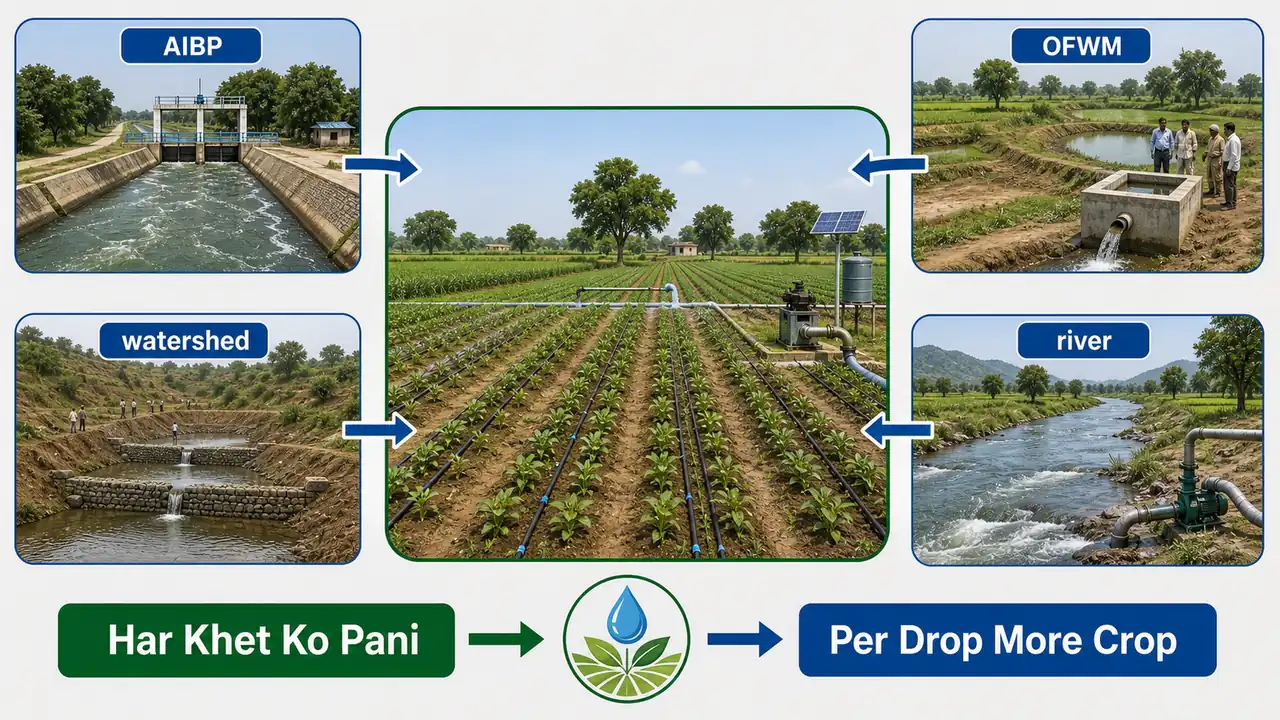
Irrigation is the single most impactful factor in determining farm productivity and income. PMKSY consolidates multiple earlier irrigation schemes into one comprehensive mission with the twin slogans "Har Khet Ko Pani" (water to every farm) and "Per Drop More Crop" (efficient water use).
- Out of about 141 m Ha of net area sown in the country, about 65 million hectare (or 45%) is presently covered under irrigation. Substantial dependency on rainfall makes cultivation in unirrigated areas a high risk, less productive profession. Empirical evidences suggest that assured or protective irrigation encourages farmers to invest more in farming technology and inputs leading to productivity enhancement and increased farm income. This data underscores why expanding irrigation coverage is one of the most impactful interventions for Indian agriculture.
The overreaching vision of Pradhan Mantri Krishi Sinchayee Yojana (PMKSY) is to ensure access to some means of protective irrigation to all agricultural farms in the country, to produce 'per drop more crop', thus bringing much desired rural prosperity.
- The Department of Agriculture & Cooperation, Ministry of Agriculture in January, 2006 as Centrally Sponsored Scheme on Micro Irrigation (CSS). In June, 2010, it was up-scaled to National Mission on Micro Irrigation (NMMI), which continued till the year 2013-14.
- From 1st April, 2014, NMMI was subsumed under National Mission on Sustainable Agriculture (NMSA) and implemented as "On Farm Water Management" (OFWM) during the financial year 2014-15.
- From 1st April 2015, Micro Irrigation component of OFWM has been subsumed under Pradhan Mantri Krishi Sinchayee Yojana. This chronology shows how multiple irrigation schemes were gradually consolidated into PMKSY for better coordination and impact.
Objectives
- Achieve convergence of investments in irrigation at the field level (preparation of district level and, if required, sub district level water use plans).
- Har Khet Ko Pani: Enhance the physical access of water on the farm and expand cultivable area under assured irrigation (Har Khet ko pani). This slogan -- meaning "water to every farm" -- captures the scheme's core aspiration.
- Integration of water source, distribution and its efficient use, to make best use of water through appropriate technologies and practices.
- Improve on - farm water use efficiency to reduce wastage and increase availability both in duration and extent.
- Enhance the adoption of precision - irrigation and other water saving technologies (More crop per drop).
- Enhance recharge of aquifers and introduce sustainable water conservation practices.
- Ensure the integrated development of rainfed areas using the watershed approach towards soil and water conservation, regeneration of ground water, arresting runoff, providing livelihood options and other NRM activities.
- Promote extension activities relating to water harvesting, water management and crop alignment for farmers and grass root level field functionaries.
- Explore the feasibility of reusing treated municipal waste water for peri - urban agriculture.
- Attract greater private investments in irrigation.
Programme implementation
-
Krishi Sinchayee Yojana with an outlay of Rs. 50,000 crores for a period of 5 years (2015-16 to 2019-20) is to achieve convergence of investments in irrigation at the field level.
-
PMKSY has been formulated amalgamating ongoing schemes viz.
- Accelerated Irrigation Benefit Programme (AIBP) of Ministry of Water Resources
- On Farm Water Management (OFWM) component of National Mission on Sustainable Agriculture (NMSA) of Department of Agriculture and Cooperation.
- River Development & Ganga Rejuvenation
- Integrated Watershed Management Programme (IWMP) of Department of Land Resources
-
PMKSY is to be implemented in an area development approach, adopting decentralized state level planning and projectised execution, allowing the states to draw their irrigation development plans based on district/blocks plans with a horizon of 5 to 7 years. States can take up projects based on the District/State Irrigation Plan.
-
All the States and Union Territories including North Eastern States are covered under the programme.
-
The National Steering Committee (NSC) of PMKSY under the chairmanship of Hon'ble Prime Minister, will provide policy direction to programme framework and a National Executive Committee (NEC) under the chairmanship of Vice Chairman of NITI Aayog will oversee the programme implementation at national level.
Programme Components
PMKSY has the following programme components:
A. Accelerated Irrigation Benefit Programme (AIBP)
- To focus on faster completion of ongoing Major and Medium Irrigation including National Projects. AIBP accelerates the completion of long-pending irrigation projects that have been stalled due to cost overruns or delays.
B. Har Khet ko Pani Exams
- Creation of new water sources through Minor Irrigation (both surface and ground water)
- Repair, restoration and renovation of water bodies, strengthening carrying capacity of traditional water sources, construction rain water harvesting structures (Jal Sanchay)
- Command area development, strengthening and creation of distribution network from source to the farm;
- Ground water development in the areas where it is abundant, so that sink is created to store runoff/ flood water during peak rainy season.
- Improvement in water management and distribution system for water bodies to take advantage of the available source which is not tapped to its fullest capacity (deriving benefits from low hanging fruits). At least 10% of the command area to be covered under micro/precision irrigation.
- Diversion of water from source of different location where it is plenty to nearby water scarce areas, lift irrigation from water bodies/rivers at lower elevation to supplement requirements beyond IWMP and MGNREGS irrespective of irrigation command.
- Creating and rejuvenating traditional water storage systems like Jal Mandir (Gujarat); Khatri, Kuhl (H.P.); Zabo (Nagaland); Eri, Ooranis (T.N.); Dongs (Assam); Katas, Bandhas (Odisha and M.P.) etc. at feasible locations. These indigenous water harvesting systems represent centuries of local knowledge adapted to specific geographic conditions.
C. Per Drop More Crop
- Programme management, preparation of State/District Irrigation Plan, approval of annual action plan, Monitoring etc.
- Promoting efficient water conveyance and precision water application devices like drips, sprinklers, pivots, rain - guns in the farm (Jal Sinchan); These micro-irrigation technologies can reduce water consumption by 30-50% compared to flood irrigation while often improving yields.
- Topping up of input cost particularly under civil construction beyond permissible limit (40%), under MGNREGS for activities like lining inlet, outlet, silt traps, distribution system etc.
- Construction of micro irrigation structures to supplement source creation activities including tube wells and dug wells (in areas where ground water is available and not under semi critical /critical /over exploited category of development) which are not supported under AIBP, PMKSY (Har Khet ko Pani), PMKSY (Watershed) and MGNREGS as per block/district irrigation plan.
- Secondary storage structures at tail end of canal system to store water when available in abundance (rainy season) or from perennial sources like streams for use during dry periods through effective on - farm water management.
- Water lifting devices like diesel/ electric/ solar pumpsets including water carriage pipes, underground piping system.
- Extension activities for promotion of scientific moisture conservation and agronomic measures including cropping alignment to maximise use of available water including rainfall and minimise irrigation requirement (Jal sarankchan).
- Capacity building, training and awareness campaign including low cost publications, use of pico projectors and low cost films for encouraging potential use water source through technological, agronomic and management practices including community irrigation.
- The extension workers will be empowered to disseminate relevant technologies under PMKSY only after requisite training is provided to them especially in the area of promotion of scientific moisture conservation and agronomic measures, improved/ innovative distribution system like pipe and box outlet system, etc. Appropriate Domain Experts will act as Master Trainers.
- Information Communication Technology (ICT) interventions through NeGP - A, to be made use in the field of water use efficiency, precision irrigation technologies, on farm water management, crop alignment etc. and also to do intensive monitoring of the Scheme.
D. Watershed Development
- Effective management of runoff water and improved soil & moisture conservation activities such as ridge area treatment, drainage line treatment, rain water harvesting, in - situ moisture conservation and other allied activities on watershed basis. The watershed approach treats the entire drainage basin as a single unit, enabling integrated land and water management.
- Converging with MGNREGS for creation of water source to full potential in identified backward rainfed blocks including renovation of traditional water bodies.
D D Kisan Channel
- DD Kisan is an Indian Agriculture 24 hour television channel, which is owned by Doordarshan and was launched on 26 May, 2015.
- The channel has been dedicated to agriculture and related sectors, which disseminates real-time input to farmers on new farming techniques, water conservation, organic farming, agri-mandi data, etc. DD Kisan serves as a mass media tool for agricultural extension, reaching millions of farming households with timely and relevant information in regional languages.
ARYA
- The ICAR has initiated a program on "Attracting and Retaining Youth in Agriculture (ARYA)" in selected districts through KVKs with an objective for entrepreneurial development of Youth in Rural Areas to take up various Agriculture, allied and service sector enterprises for sustainable income and gainful employment. This programme addresses the critical challenge of youth migration away from agriculture by making farming an attractive and profitable career option.
- Launched in 2014 by Ministry of Agriculture and Farmers' Welfare.
- The identified youth are trained on entrepreneurship development skills by providing a basket of options to start agriculture ventures for self-employment.
Objectives
- To increase the profitability of Agriculture.
- To improve the quality of life in Rural Areas.
- To transform Youths especially Rural into Agricultural Entrepreneurs.
- To implement scientific methods of farming in Agriculture.
- To increase production in Agriculture allied activities.
STUDENT READY
- The term READY refers to "Rural Entrepreneurship Awareness & Development Yojana".
- One year course for articulating concept of entrepreneurship has been added in undergraduate education of Agriculture & its allied sub sectors. This integration ensures that agricultural graduates leave university with practical entrepreneurial skills, not just theoretical knowledge.
Aims
- To provide rural entrepreneurship awareness, practical experience in real-life situation in rural agriculture and creating awareness to undergraduate students about practical agriculture and allied sciences.
- To provide opportunities to acquire hands-on-experience and entrepreneurial skills.
- The programme will help in building confidence, skill and acquire Indigenous Technical Knowledge (ITK) of the locality and thereby, preparing the pass-out for self-employment.
- Programme of Indian Council for Agricultural Research
National Agricultural Higher Education Project (NAHEP)
- ICAR, with the assistance of World Bank and Govt. of India on a 50:50 cost sharing basis has launched the National Agricultural Higher Education Project (NAHEP). The investment will be made on infrastructure, competency development of faculty, and attracting talented students to agriculture with a total cost of US$ 165 million (Rupees 1100 crore approximately) for four years starting from the financial year 2017-18 up to 2020-21. This project recognises that quality agricultural education is the foundation for all future progress in farming, research, and extension.
- The overall objective of the project is to support participating Agricultural Universities and ICAR in providing more relevant and higher quality education to agriculture university students.
Farmer FIRST
The new proposed project -- 'Farmer FIRST' is an ICAR initiative to move beyond the production and productivity and to privilege the complex, diverse & risk prone realities of majority of the farmers through enhancing farmers-scientists contact with multi stake holders-participation. The focus is on Farmer's Farm, Innovations, Resources, Science and Technology (FIRST). Many aspects are multiple or multi; multiple stakeholders, multiple perspectives, multiple realities, multi-functional agriculture, multi-method approaches. There are concepts and domains that are new or new in emphasis like food systems, trade, market chains, value chains, innovation pathways and most of all innovation systems. This initiative represents a paradigm shift from the traditional top-down approach to a farmer-centric, participatory model where the farmer's reality drives the research agenda.
Mera Gaon-Mera Gaurav
To enhance the direct interface of scientists with the farmers, an innovative initiative has been launched as "Mera Gaon - Mera Gaurav" which will hasten the lab to land approach. The name means "My Village, My Pride," reflecting the aspiration to make scientists proud stakeholders in village development. The objective of this initiative is to provide farmers with required information, knowledge and advisories on regular basis. Under this scheme, groups of scientists will select villages and will remain in touch with that village and provide information to farmers on technical and other related aspects in a time frame through personal visits or through telecommunication. In this way, 20,000 scientists of National Agricultural Research and Education System (NARES) can work directly in villages. This creates a direct scientist-to-farmer communication channel, bypassing traditional intermediaries.
PRADHAN MANTRI KISAN SAMPADA YOJANA
- Launched in Aug 2017 as Scheme For Agro-Marine Processing And Development Of Agro-Processing Clusters with an allocation of Rs. 6,000 crore.
- Ministry Of Food Processing Industries (MoFPI).
- SAMPADA is an umbrella scheme incorporating ongoing schemes of the Ministry like Mega Food Parks, Integrated Cold Chain and Value Addition Infrastructure, Food Safety and Quality Assurance Infrastructure, etc. and also new schemes like Infrastructure for Agro-processing Clusters, Creation of Backward and Forward Linkages, Creation / Expansion of Food Processing & Preservation Capacities. This scheme addresses the critical issue of post-harvest losses in Indian agriculture by building food processing infrastructure.
Three Pillars
- Minimizing the losses
- Mega Food Parks
- Cold Chain Plans
COMPONENTS
- Mega food parks
- Integrated cold chain and value addition infrastructure
- Food safety and quality assurance infrastructure
- Infrastructure for agro-processing clusters
- Creation of backward and forward linkages
- Creation / expansion of food processing & preservation capacities.
- Scheme for Human resources and institutions
Objective: To provide modern Infrastructure to FPI Financial assistance: 50% subsidy for project
National Mission on Agricultural Extension and Technology (NMAET)
- Started in 2014.
- Aim: to restructure and strengthen agricultural extension to enable delivery of appropriate technology and improved agronomic practices to farmers. NMAET is a comprehensive mission that consolidates multiple extension-related schemes under one umbrella for better coordination and impact.
- The Mission will have a total outlay of Rs. 13073.08 crore, with Government of India's share of Rs. 11390.68 crore and State share of Rs.1682.40 crore.
- Subsumed Modified Extension Reforms Scheme (2010) and Agriculture Technology Management Agency (ATMA) (2004-05)
- Implemented though ATMA which is in 676 districts of 29 states & 2 UTs of the country. ATMA (Agriculture Technology Management Agency) serves as the key institutional mechanism at the district level for technology dissemination.
- Ministry/Department: Department of Agriculture and Cooperation, Ministry of Agriculture & Farmers Welfare.
- Multi-agency Exyension Strategies: At least 10% of allocation on recurring activities at district level is to be used through non-governmental sector viz. NGOs, Farmers' Organisation (FOs), Panchayati Raj Institution (PRIs), par extension workers, agri-preneurs, input suppliers, corporate sector. This reflects the shift towards pluralistic extension involving multiple stakeholders.
- Mainstreaming Gender Concerns: It is mandated that at least 30% of resources on programmes and activities are utilized for women farmers and women extension functionaries. This gender mandate ensures that women, who constitute a large and growing share of the agricultural workforce, are adequately served by extension services.
SUB MISIONS
1. Sub-Mission on Agricultural Extension
- Focus on awareness creation and enhanced use of appropriate technologies.
- Increased penetration of extension functionaries.
- Use of interactive and innovative methods of information dissemination.
- Convergence brought among extension efforts under different program and schemes.
2. Sub-Mission on Seed and Planting Material (SMSP)
- Cover the entire gamut of seed chain from nucleus seed to supply to farmers for sowing. This means addressing every stage of the seed production process: breeder seed, foundation seed, certified seed, and finally the seed that reaches the farmer.
- Provide for support for infrastructure to create an enabling environment for development of the seed sector.
- Envisages strengthening of Protection of Plant Varieties and Farmers' Rights Authority (PPV&FRA).
3. Sub Mission on Agricultural Mechanization (SMAM)
- Focus on farm mechanization.
- Cater to the needs of the small and marginal farmers. Since the majority of Indian farmers operate on small holdings, this sub-mission promotes custom hiring centres and affordable machinery suited to small-scale operations.
4. Sub Mission on Plant Protection and Plant Quarantine (SMPP)
- Using scientific and environment friendly techniques through promotion of integrated pest management.
- Monitoring pesticide residues in food commodities and environmental samples.
- National Institute of Plant Health Management (NIPHM). NIPHM at Hyderabad is the premier institution for training and capacity building in plant health management.
Agri-Clinics & Agri-Business Centres (ACABC)
-
The Central Sector Scheme "Establishment of the Agri-clinics and Agri-business Centres (ACABC)" is under implementation since 2002. This scheme taps into the large pool of agriculture graduates to create a network of private agricultural advisory and business centres across rural India.
-
MANAGE is the implementing agency for training component under the Scheme through a network of identified Nodal Training Institutes (NITs) in various states. MANAGE (National Institute of Agricultural Extension Management) coordinates the training that equips graduates with entrepreneurship and business management skills.
-
NABARD is implementing subsidy component under the Scheme on the behalf of Government of India.
-
The credit-linked back-ended subsidy of 36% of the Total Financial Outlay (TFO) capital cost of the project funded through bank loan is available under the Scheme.
-
This subsidy is 44% in respect of candidates belonging to SC/ST, Women and all categories of candidates from North-Eastern and Hill States. The higher subsidy for these categories reflects the government's commitment to inclusive entrepreneurship.
IMPORTANT
ACABC Subsidy: General category gets 36% back-ended subsidy, while SC/ST/Women/NE & Hill State candidates get 44%. MANAGE handles training; NABARD handles subsidy disbursement.
- This programme aims to tap the expertise available in the large pool of Agriculture Graduates. Irrespective of whether you are a fresh graduate or not, or whether you are currently employed or not, you can set up your own AgriClinic or AgriBusiness Centre and offer professional extension services to innumerable farmers. Committed to this programme, the Government is now also providing start-up training to graduates in Agriculture, or any subject allied to Agriculture like Horticulture, Sericulture, Veterinary Sciences, Forestry, Dairy, Poultry Farming, and Fisheries, etc. Those completing the training can apply for special start-up loans for venture.
- 'Activities allied to Agriculture' , e.g. pisciculture , beekeeping, poultry , livestock , rearing , grading, sorting , aggregation agro industries, diary, fishery, agriclinics and agribusiness centers, food & agro-processing, etc (excluding crop loans, land improvement such as canals, irrigation, wells) and services supporting these, which promote livelihood or are income generating shall be eligible for coverage under PMMY in 2016-17 for loan upto 10 lakhs.
- Free Training: Initiated by SFAC, and co-ordinated by MANAGE, the course comprises Entrepreneurship and Business Management, as well as skill improvement modules in your chosen areas of activity.
Summary Cheat Sheet
| Concept / Topic | Key Details |
|---|---|
| MNREGA | 100 days guaranteed unskilled wage employment; Act 2005; renamed 2 Oct 2009 |
| MNREGA job provision | Within 15 days of application; else unemployment allowance |
| PURA | 2004 by APJ Abdul Kalam; 4 connectivities: Physical, Electronic, Economic, Knowledge |
| NRuM (Rurban Mission) | Started 21 Feb 2016; MoRD; develops clusters of "Rurban" villages |
| PMGSY | Dec 2000; all-weather roads; 100% centrally funded |
| Bharat Nirman | 2005; 6 components: irrigation, roads, housing, water, electrification, telecom |
| Swachh Bharat Abhiyan | Launched 2 Oct 2014; target ODF by 2 Oct 2019 |
| Sanitation evolution | CRSP (1986) → TSC (1999) → Nirmal Bharat Abhiyan → SBA (2014) |
| GOBAR-DHAN | Cattle dung/waste → biogas & compost; under Jal Shakti Ministry |
| Kisan Call Centre | Launched 21 Jan 2004; toll-free 1800-180-1551; 22 languages; 6 AM-10 PM |
| Farm Tele Advisors (FTAs) | Graduates in agriculture; unanswered queries → SMS/KVK/SAU experts |
| NBS (Nutrient Based Subsidy) | 1 April 2010; for N, P, K & S; first fertilizer = SSP |
| PMKSY | 2015; "Per Drop More Crop" & "Har Khet Ko Pani"; Rs 50,000 crore for 5 years |
| PMKSY components | AIBP, Har Khet Ko Pani, Per Drop More Crop, Watershed Development |
| DD Kisan | Launched 26 May 2015; 24-hour agriculture TV channel by Doordarshan |
| ARYA | 2014 by ICAR through KVKs; attracting youth to agriculture entrepreneurship |
| NMAET | 2014; implemented through ATMA in 676 districts; 30% resources for women |
| ACABC | Since 2002; subsidy 36% (general), 44% (SC/ST/Women/NE); MANAGE trains, NABARD disburses |
| PM Kisan SAMPADA | Aug 2017; Rs 6,000 crore; 50% subsidy; MoFPI; food processing infrastructure |
| Farmer FIRST | ICAR initiative; Farm, Innovations, Resources, Science & Technology |
| NAHEP | 2017-18; World Bank + GoI (50:50); US$ 165 million for agri higher education |
TIP
Next: The next lesson covers Recent Extension Programmes -- Krishonnati Yojana umbrella (12 sub-schemes), NMSA, PKVY, eNAM, NFSM, and DAY-NRLM with SHG-based livelihood models.