🦸🏼♂️ Recent Extension Programmes -- Krishonnati Yojana, NMSA, PKVY, eNAM, NFSM and DAY-NRLM
Comprehensive guide to recent extension and rural development programmes including Green Revolution-Krishonnati Yojana (12 sub-schemes), NMSA, Paramparagat Krishi Vikas Yojana, eNAM, NFSM, DAY-NRLM (SHGs), DDU-GKY, and ISAM for IBPS AFO, NABARD Grade A, and FCI exams.
Visual Overview
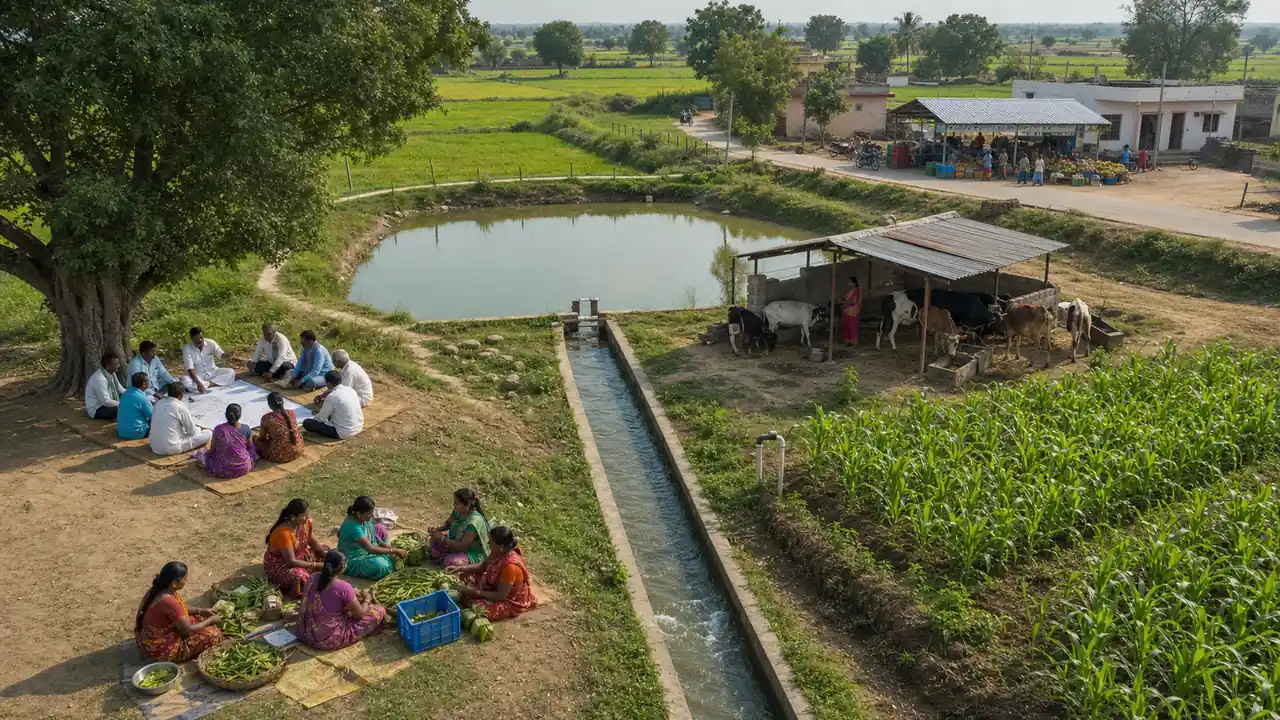
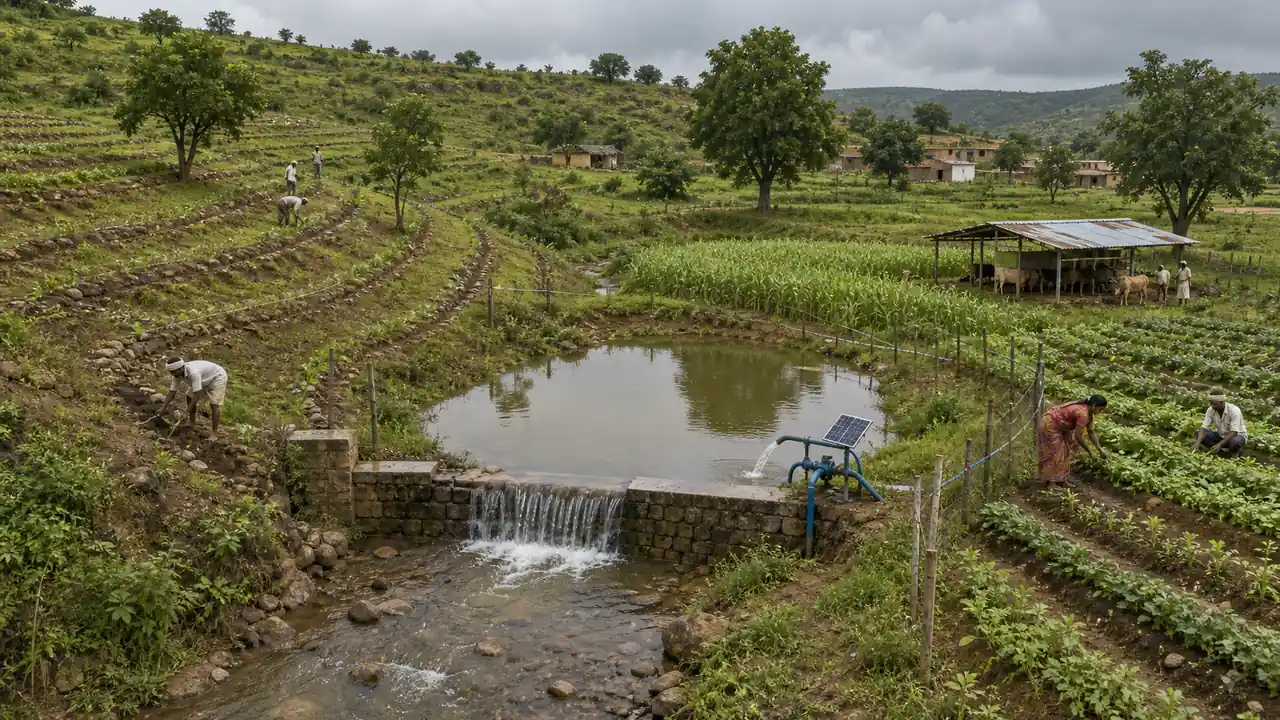
In the previous lesson, we covered established programmes like MNREGA, PMKSY, and Kisan Call Centres. This lesson focuses on the more recent government initiatives that address sustainable agriculture, organic farming, electronic marketing, food security, and rural livelihoods through self-help groups.
This lesson covers:
- Green Revolution - Krishonnati Yojana -- umbrella of 12 sub-schemes
- NMSA and its components -- sustainable agriculture in rainfed areas
- PKVY -- organic farming promotion
- eNAM -- electronic national agricultural market
- NFSM -- food grain production targets
- DAY-NRLM -- SHG-based livelihood mission
- DDU-GKY -- rural youth skill training
These schemes and their numerical details are among the most frequently tested topics in exams.
Green Revolution - Krishonnati Yojana
- The 'Green Revolution - Krishonnati Yojana' was approved coterminous with the period of the Fourteenth Finance Commission from 2017-18 to 2019-20. This umbrella scheme represents the government's comprehensive strategy for agricultural development, bringing multiple standalone schemes under one unified framework for better coordination and fund utilisation.
- It is an Umbrella Scheme comprising both Central Sector as well as Centrally Sponsored Schemes/Missions.
- Original Funding (2017-20): Rs 33,269 crore
- Budget 2026-27 allocation: Rs 11,200 crore — a 64% jump over previous year, signalling major push for food production and farm income
| Budget Year | Allocation | Remark |
|---|---|---|
| 2017-20 (total) | Rs 33,269 crore | Original umbrella outlay |
| 2025-26 | Rs 6,800 crore (approx) | Continued implementation |
| 2026-27 | Rs 11,200 crore | 64% increase; reflects expanded sub-scheme targets |
IMPORTANT
Pro Content Locked
Upgrade to Pro to access this lesson and all other premium content.
₹99 charged monthly · Cancel anytime
- All Agriculture & Banking Courses
- AI Lesson Questions (100/day)
- AI Doubt Solver (50/day)
- Glows & Grows Feedback (30/day)
- AI Section Quiz (20/day)
- 22-Language Translation (100/day)
- Recall Questions (20/day)
- AI Quiz (15/day)
- AI Quiz Paper Analysis (100/day)
- AI Step-by-Step Explanations (100/day)
- Spaced Repetition Recall (FSRS)
- AI Tutor
- Immersive Text Questions
- Audio Lessons — Hindi & English
- Mock Tests & Previous Year Papers
- Summary & Mind Maps
- XP, Levels, Leaderboard & Badges
- Generate New Classrooms
- Voice AI Teacher (AgriDots Live)
- AI Revision Assistant
- Knowledge Gap Analysis
- Interactive Revision (LangGraph)
🔒 Secure via Razorpay · Cancel anytime · No hidden fees
Visual Overview
In the previous lesson, we covered established programmes like MNREGA, PMKSY, and Kisan Call Centres. This lesson focuses on the more recent government initiatives that address sustainable agriculture, organic farming, electronic marketing, food security, and rural livelihoods through self-help groups.
This lesson covers:
- Green Revolution - Krishonnati Yojana -- umbrella of 12 sub-schemes
- NMSA and its components -- sustainable agriculture in rainfed areas
- PKVY -- organic farming promotion
- eNAM -- electronic national agricultural market
- NFSM -- food grain production targets
- DAY-NRLM -- SHG-based livelihood mission
- DDU-GKY -- rural youth skill training
These schemes and their numerical details are among the most frequently tested topics in exams.
Green Revolution - Krishonnati Yojana
- The 'Green Revolution - Krishonnati Yojana' was approved coterminous with the period of the Fourteenth Finance Commission from 2017-18 to 2019-20. This umbrella scheme represents the government's comprehensive strategy for agricultural development, bringing multiple standalone schemes under one unified framework for better coordination and fund utilisation.
- It is an Umbrella Scheme comprising both Central Sector as well as Centrally Sponsored Schemes/Missions.
- Original Funding (2017-20): Rs 33,269 crore
- Budget 2026-27 allocation: Rs 11,200 crore — a 64% jump over previous year, signalling major push for food production and farm income
| Budget Year | Allocation | Remark |
|---|---|---|
| 2017-20 (total) | Rs 33,269 crore | Original umbrella outlay |
| 2025-26 | Rs 6,800 crore (approx) | Continued implementation |
| 2026-27 | Rs 11,200 crore | 64% increase; reflects expanded sub-scheme targets |
IMPORTANT
This umbrella scheme contains 12 sub-schemes/missions. Memorise the list -- exams frequently ask which scheme falls under Krishonnati Yojana.
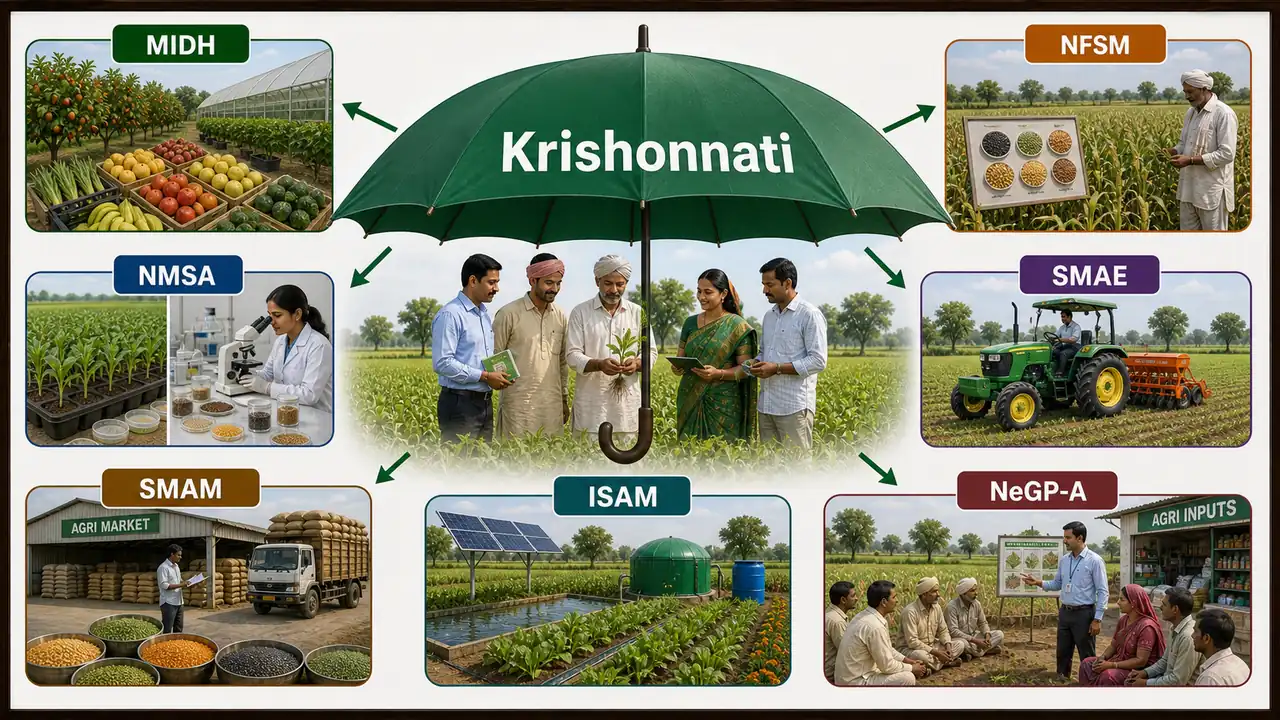
- This Umbrella Scheme has the following twelve Schemes/Missions:
- Mission for Integrated Development of Horticulture (MIDH)
- National Food Security Mission (NFSM)
- National Mission for Sustainable Agriculture (NMSA)
- National Mission on Oil Seeds and Oil Palm (NMOOP)
- Sub-Mission on Agriculture Extension (SMAE)
- Sub-Mission on Seeds & Planting Material (SMSP)
- Sub-Mission on Agricultural Mechanisation (SMAM)
- Sub-Mission on Plant Protection and Plant Quarantine (SMPPQ)
- Integrated Scheme on Agricultural Census, Economics and Statistics
- Integrated Scheme on Agricultural Cooperation
- Integrated Scheme on Agricultural Marketing (ISAM)
- National e-Governance Plan in Agriculture (NeGP-A)
National Mission on Sustainable Agriculture (NMSA)
- National Mission for Sustainable Agriculture (NMSA) has been formulated for enhancing agricultural productivity especially in rainfed areas focusing on integrated farming, water use efficiency, soil health management and synergizing resource conservation. Since nearly 55% of India's net sown area is rainfed, this mission addresses one of the most critical challenges in Indian agriculture.
- Made operational from 2014-15. From the year 2018-19, NMSA is being implemented as submission/sub-umbrella scheme under Umbrella Scheme of 'Green Revolution-Krishonnati Yojana'.
- NMSA derives its mandate from Sustainable Agriculture Mission which is one of the eight Missions outlined under National Action Plan on Climate Change (NAPCC) in 2008. This connection to NAPCC highlights that sustainable agriculture is not only about productivity but also about climate adaptation and mitigation.
Components
Centrally Sponsored Schemes
- Rainfed Area Development (RAD)
- Sub Mission on Agro Forestry (SMAF)
- Soil Health Management (SHM)
- Paramparagat Krishi Vikas Yojana (PKVY)
Central Sector Schemes
- Soil and Land Use Survey of India (SLUSI)
- National Rainfed Area Authority (NRAA)
- Mission Organic Value Chain Development in North Eastern Region (MOVCHNER)
- National Centre of Organic Farming (NCOF)
- Central Fertilizer Quality Control and Training Institute (CFQC&TI)
Sub-Mission on Agroforestry (SMAF)
- Launched in 2016-17 to encourage and expand tree plantation on farm land as a follow up to National Agroforestry Policy - 2014. India was the first country in the world to adopt a national agroforestry policy, recognising the importance of integrating trees with crops and livestock.
- It was approved for the period of four years 2016-17 to 2019-20.
- The SMAF with slogan "Har Medh Par Pedh" has the following broad objectives. The slogan means "A tree on every field bund," which captures the vision of making tree planting a routine part of farming.
- To encourage and expand tree plantation in complimentary and integrated manner with crops and livestock on farm land.
- To ensure availability of quality planting material.
- To popularize various Agroforestry practices/models.
- To provide extension and capacity building support to agroforestry sector.
- To create database, information and knowledge support in the area of Agroforestry.
National Rainfed Area Authority (NRAA)
- National Rainfed Area Authority (NRAA) was established as an attached office of DAC&FW on 3rd November, 2006. NRAA serves as the nodal body for coordinating and guiding the development of rainfed areas, which constitute a large share of India's farmland and are home to the most vulnerable farming communities.
National Centre for Organic Farming (NCOF)
- NPOF (National Project for Organic Farming) is being implemented by National Centre of Organic Farming at Ghaziabad (U.P.) and its six Regional Centres at Bangalore, Bhubaneshwar, Panchkula, Imphal, Jabalpur and Nagpur.
- Besides working for realization of targets under NPOF, NCOF and RCOFs are also performing specific roles in promotion of organic farming. These centres are responsible for quality control of organic inputs, development of biofertilizers and biopesticides, and capacity building for organic farming practices.
Quality Control of Fertilizers
- The GoI declared the fertilizer as essential commodity under Essential Commodity Act, 1955 and promulgated the Fertilizer Control Order, 1985 (FCO). The FCO regulates the manufacture, sale, distribution, and quality of fertilizers in India, ensuring that farmers receive products that meet specified nutrient standards.
Soil Health Management (SHM)
Will study in Soil Science
Parampragat Krishi Vikas Yojana
- First comprehensive scheme launched as a Centrally Sponsored Programme (CSP) from 2015-16 which now has been revised for next 3 years. The name Paramparagat means "traditional," reflecting the scheme's focus on promoting organic farming that draws on both traditional knowledge and modern science.
- The scheme is implemented with a 90 : 10 (GoI : State Govt.) funding pattern in 8 states and 3 hilly states of J & K, Himachal Pradesh, and Jharkhand, 100% in Union Territory and 60 : 40 funding pattern in remaining states of the county.
- The scheme PKVY is implemented by the State Government on per hectare basis for 500-1000 hectare area each cluster. The cluster-based approach ensures that contiguous areas are converted to organic farming, which is important because isolated organic farms can be contaminated by neighbouring conventional practices.
- A group of farmers having a total area of 20 hectare as far as possible in contiguous patch within a village.
- The farmer within a group can avail benefit to a maximum of 2 ha. and the limit of assistance is Rs 50,000 per hac., out of which 62% i.e., Rs. 31,000 is given as incentives to a farmer for organic conversion, organic inputs, on farm inputs, production infrastructure, etc.
Mission Organic Value Chain Development for North Eastern Region (MOVCDNER)
- Central Sector Scheme entitled "Mission Organic Value Chain Development"
- Implementation in NE states during 2015-16 to 2017-18. The North Eastern Region is well-suited for organic farming because many farmers there already practice low-input agriculture with minimal use of chemical fertilizers and pesticides. This mission aims to convert this natural advantage into a market opportunity.
Integrated Scheme on Agricultural Marketing (ISAM)
- Started in 2014.
- During 2017-18, National Agriculture Market Scheme popularly known as e-NAM scheme has also been made part of it.
- The ISAM has six sub-schemes namely
-
- Agricultural Marketing Infrastructure (AMI)
-
- Marketing Research and Information Network (MRIN)
-
- Strengthening of Agmark Grading Facilities (SAGF)
-
- Training, Research and Consultancy through Choudhary Charan Singh National Institute of Agricultural Marketing (NIAM)
-
- Agri-business Development through Venture Capital Assistance (VCA) and Project Development Facility
-
- National Agriculture Market (e-NAM)
-
National Agricultural Markets (e-NAM)
- Launched in April 2016.
- National Agriculture Market (eNAM) is a pan-India electronic trading portal which networks the existing APMC mandis to create a unified national market for agricultural commodities. By connecting mandis electronically, e-NAM enables farmers to access multiple buyers across the country, increasing competition and potentially fetching better prices for their produce.
- 1,656 mandis across 23 states + 4 UTs have been integrated (latest). Original target was 1,000 and the network was expanded later.
- Latest PIB figures place registration at about 1.80 crore farmers, 2.72 lakh traders, and 4,724 FPOs, with cumulative trade of roughly Rs 4.82 lakh crore.
- Small Farmers Agribusiness Consortium (SFAC) is the lead agency for implementing eNAM under the aegis of Ministry of Agriculture and Farmers' Welfare, Government of India.
Agricultural Market Infrastructure (AMI)
- The erstwhile two schemes viz. (i) Grameen Bhandaran Yojana (GBY) implemented since 01.04.2001, and (ii) Scheme for Strengthening Development of Agricultural Marketing Infrastructure, Grading & Standardization (AMIGS) implemented since 20.10.2004 have been subsumed into one scheme knows-Agricultural Marketing Infrastructure (AMI) w.e.f. 2014. This consolidation aimed to simplify administration and ensure integrated development of marketing infrastructure.
- The scheme had been stopped after 05.08.2014 for new projects of General category and after 31.012.2016 for new projects of SC/ST NER category.
- Now the Government has re-launched the scheme w.e.f. 22.10.2018.
National Food Security Mission (NFSM)
While sustainable agriculture focuses on long-term resource conservation, India also faces the immediate challenge of producing enough food grains. NFSM directly targets production increases in rice, wheat, pulses, and nutri-cereals through technology dissemination and input support.
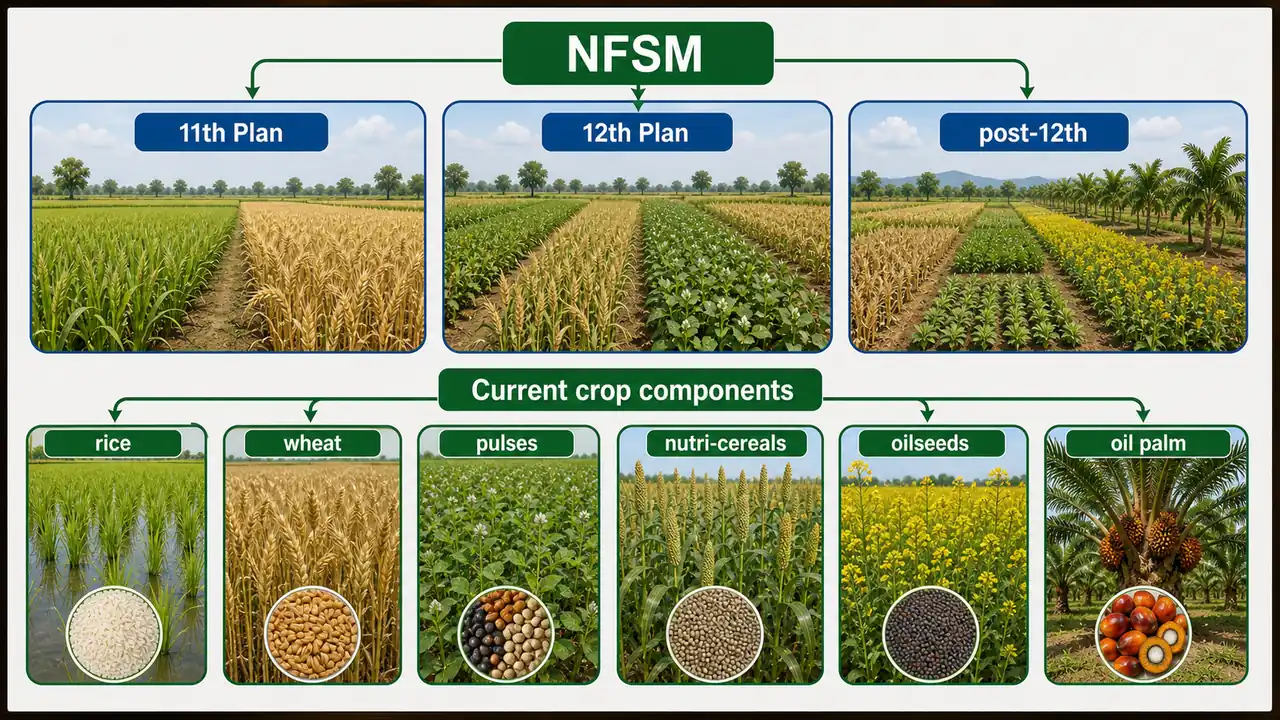
- NFSM was launched in October 2007 (10th Plan period) to increase the production of Rice, Wheat and Pulses by 10, 8 and 2 million tonnes, respectively by the end of 11th Plan. The mission has since been renamed as NFSNM (National Food Security & Nutrition Mission) to reflect the expanded focus on nutritional security.
- The mission was a response to the stagnation in food grain production that threatened India's food security.
- The Mission was continued during 12th Plan with new target of additional production of 25 million tonnes by the end of 12th plan.
- Beyond 12th Plan (2017-18 to 2019-20), continued with new targets: 13 million tonnes additional comprising Rice (5 MT), Wheat (3 MT), Pulses (3 MT), Nutri-cum-Coarse Cereals (2 MT).
- Oilseeds added: NFSM-Oilseeds and NFSM-Oil Palm now included, expanding scope beyond food grains to edible oil self-sufficiency.
- Funding pattern: 60:40 (Centre:State); 90:10 for NE states + 3 Himalayan states (from 2015-16).
- NFSM is being implemented in 638 districts across 29 states.
- Budget 2025-26: Rs 2,500 crore
| Plan Period | Target | Crops |
|---|---|---|
| 11th Plan (2007-12) | Rice +10 MT, Wheat +8 MT, Pulses +2 MT | Rice, Wheat, Pulses |
| 12th Plan (2012-17) | Additional 25 MT food grains | + Coarse/Nutri-Cereals |
| Post-12th (2017-20) | Additional 13 MT food grains | Rice, Wheat, Pulses, Nutri-Cereals |
| Current (2021+) | Production + Oilseeds self-sufficiency | + Oilseeds, Oil Palm |
- Components (Current)
- NFSM - Rice
- NFSM - Wheat
- NFSM - Pulses
- NFSM - Coarse cereals
- NFSM - Nutri-Cereals (Millets included from April 2018 — precursor to International Year of Millets 2023)
- NFSM - Oilseeds
- NFSM - Oil Palm
Components/activities of NFSM
- Demonstration of improved package of practices
- Demonstration of System of Rice Intensification (SRI). SRI is an innovative method that produces higher yields with less water and fewer seeds by modifying the way rice is planted and managed.
- Distribution of high yielding variety seeds of rice, wheat and pulses and hybrid rice.
- Soil ameliorants, such as gypsum/lime/micro nutrients to restore soil fertility for higher productivity.
- Integrated Pest Management (IPM)
- Improved farm machineries, including water-saving devices have been distributed.
- Farmers' field school (FFS) level trainings. Farmer Field Schools are a participatory method of extension where farmers learn by hands-on experimentation in their own fields under the guidance of facilitators.
- In addition several lakhs block demonstration has been conducted during the 2010 kharif under the A3P.
National Food Security Act, 2011
NMOOP — National Mission on Oilseeds & Oil Palm
NMOOP is one of the 12 components under Krishonnati Yojana, aimed at increasing domestic oilseed production and reducing India's dependence on imported edible oils.
3 Mini-Missions under NMOOP
| Mini-Mission | Focus |
|---|---|
| MM-I: Oilseeds | Production increase through HYV seeds, INM, IPM |
| MM-II: Oil Palm | Area expansion of oil palm (now under NMEO-OP) |
| MM-III: Tree-Borne Oilseeds | Promotion of TBOs like neem, mahua, sal |
NOTE
The Oil Palm component was upgraded to a separate scheme — National Mission on Edible Oils – Oil Palm (NMEO-OP) in August 2021, with a special focus on NE states and Andaman & Nicobar Islands. India imports ~60% of its edible oil needs, making oilseed self-sufficiency a national priority.
PM MUDRA Yojana (PMMY)
Pradhan Mantri MUDRA Yojana (PMMY) provides loans up to Rs 20 lakh to non-corporate, non-farm small/micro enterprises. While not agriculture-specific, it supports allied activities and agri-business like food processing, dairy units, and small-scale poultry.
MUDRA = Micro Units Development & Refinance Agency Ltd.
Loan Categories
| Category | Loan Amount | Target Segment |
|---|---|---|
| Shishu | Up to Rs 50,000 | Start-up/early stage enterprises |
| Kishor | Rs 50,000 – Rs 5 lakh | Mid-stage, seeking expansion |
| Tarun | Rs 5 lakh – Rs 10 lakh | Well-established, seeking growth |
| Tarun Plus | Rs 10 lakh – Rs 20 lakh | Established enterprises needing higher credit |
Key Features
- No collateral required for loans
- Available through banks, NBFCs, and MFIs
- Shishu category accounts for the highest number of loans disbursed
- Special focus on SC/ST, women, and minority entrepreneurs
- MUDRA Card facility for working capital management
TIP
Memory trick: Think of life stages — Shishu (infant/small), Kishor (adolescent/growing), Tarun (young adult/established), Tarun Plus (mature/expanded). Amounts scale: 0.5 → 5 → 10 → 20 lakh.
National Rural Livelihood Mission (NRLM) -- Aajeevika
Moving beyond agricultural production, India's rural development strategy also targets livelihoods and poverty reduction through community-based institutions. DAY-NRLM is the flagship programme for organising rural poor -- especially women -- into Self Help Groups (SHGs) and supporting them with financial services and skill training.
- N.R.L.M. was launched by the Ministry of Rural Development in June 2011. This mission represents a paradigm shift in India's approach to poverty reduction, moving from an individual beneficiary model to a community-driven, institution-based approach.
- This programme is supported by the World Bank with a credit of $1 Billion.
- Ministry of Rural Development, Government of India has launched National Rural Livelihood Mission (NRLM) by restructuring Swarnajayanti Gram Swarozgar Yojana (SGSY) replacing the existing SGSY scheme.
- NRLM set out with an agenda to cover 7 Crore rural poor households, across 600 districts, 6000 blocks, 2.5 lakh Gram Panchayats and 6 lakh villages in the country through self-managed Self Help Groups (SHGs) and federated institutions and support them for livelihoods collectives in a period of 8-10 years.
- In 2015 it was renamed as Deendayal Antyodaya Yojana - National Rural Livelihoods Mission (DAY-NRLM).
- Mission: The DAY-NRLM is the flagship programme of Government of India for promoting poverty reduction through building strong institutions of the poor, particularly women, and enabling these institutions to access a range of financial services and livelihoods.
- The mission will provide a continuous hand-holding support to the institutions of poor for a period of 5 -- 7 years till they come out of abject poverty.
- DAY-NRLM adopt a demand driven approach, enabling the States to formulate their own State specific poverty reduction action plans, It will be rolled out in a phased manner over the next 7 -- 8 years.
Key Features of DAY-NRLM
- DAY-NRLM would ensure adequate coverage of vulnerable sections of the society such that 50% of the beneficiaries are SC/STs, 15% are minorities and 3% are persons with disability, while keeping in view the ultimate target of 100% coverage of BPL families. These quotas ensure inclusive development that reaches the most marginalised communities.
- SHG Federations: All SHGs in a village come together to form a federation at the village level. These federated structures give SHGs greater bargaining power, economies of scale, and collective voice in dealing with banks, markets, and government agencies.
- Provision of Interest Subvention: DAY-NRLM has a provision for subvention on interest rate above 7% per annum for all eligible SHGs, who have availed loans from mainstream financial institutions.
- Funding Pattern: DAY-NRLM is a Centrally Sponsored Scheme and the financing of the programme would be shared between the Centre and the states in the ratio of 75 : 25 ( 90:10 in case of North Eastern States including Sikkim; completely from the Centre in case of UTs).
- Phased Implementation: DAY-NRLM would reach all districts by the end of 12th Five-year Plan.
- Rural Self Employment Training Institutes (RSETIs):
- Rural Development Self Employment Institute (RUDSETI) -- a collaborative partnership between SDME Trust, Syndicate Bank and Canara Bank. RUDSETI was the pioneering model for skill-based training of rural youth that was later scaled up as RSETIs across the country.
- DAY-NRLM would encourage public sector banks to set up RSETI all districts of the country, which is sponsered by Lead bank of the district.
- Trainees' between age of 18-35 years will be eligible for selected Skill and placement.
Financial Assistance to the SHGs
- Women SHGs under DAY-NRLM consist of 10-20 persons, this number may be a minimum of 5 persons.
- DAY-NRLM would provide Revolving Fund (RF) support to SHGs in existence for a minimum period of 3/6 months and follow the norms of good SHGs, i.e. they follow Panchasutra -- regular meetings, regular savings, regular internal lending, regular recoveries and maintenance of proper books of accounts. Only such SHGs that have not received any RF earlier will be provided with RF, as corpus, with a minimum of Rs 10,000 and up to a maximum of Rs 15,000 per SHG. The Panchasutra (five principles) is the foundation of effective SHG functioning and ensures financial discipline and transparency.
- As per latest circular of RBI, for loans to SHGs up to Rs 20 lakh, no collateral and no margin will be required and no lien will be marked. This collateral-free lending removes one of the biggest barriers to credit access for poor rural women.
Introduction of Interest subvention
- DAY-NRLM has a provision for interest subvention, to cover the difference between the Lending Rate of the banks and 7 %, on all credit from the banks/ financial institutions availed by women SHGs, for a maximum of 3,00,000/- per SHG.
- In 250 identified districts, banks will lend to the women SHGs @ 7 % up to an aggregated loan amount of 3,00,000/-. The SHGs will also get additional interest subvention of 3% on prompt payment, reducing the effective rate of interest to 4%. This means that disciplined SHGs that repay on time effectively get loans at just 4% interest, which is significantly below market rates.
- All women SHGs under DAY-NRLM will be eligible for interest subvention on prompt payment to the extent of difference between lending rates and 7 % for the loan up to Rs. 300,000/- subject to maximum of 5.5 % or as prescribed by the MoRD.
Deen Dayal Upadhyaya Grameen Kaushalya Yojana (DDU-GKY)
While DAY-NRLM focuses on self-employment through SHGs, DDU-GKY targets a complementary goal: equipping rural youth with market-relevant vocational skills that lead to wage employment in organised sectors.
- The Ministry of Rural Development (MoRD) announced the Deen Dayal Upadhyaya Grameen Kaushalya Yojana (DDU-GKY) Antyodaya Diwas, on 25th September 2014. DDU-GKY is a part of the National Rural Livelihood Mission (NRLM), tasked with the dual objectives of adding diversity to the incomes of rural poor families and cater to the career aspirations of rural youth. Kaushalya means "skill," and the scheme is specifically designed to equip rural youth with market-relevant vocational skills that lead to employment.
- DDU-GKY is uniquely focused on rural youth between the ages of 18 and 35 yearsExams from poor families.
- As a part of the Skill India campaign, it plays an instrumental role in supporting the social and economic programs of the government like the Make In India, Digital India, Smart Cities and Start-Up India, Stand-Up India campaigns. Over 180 million or 69% of the country's youth population between the ages of 18 and 35 years, live in its rural areas. Of these, the bottom of the pyramid youth from poor families with no or marginal employment number about 55 million. This massive pool of rural youth represents both a demographic challenge and an enormous economic opportunity if they can be equipped with the right skills.
RKVY-RAFTAAR (Rashtriya Krishi Vikas Yojana)
RKVY (Rashtriya Krishi Vikas Yojana) was launched in 2007 to incentivise states to increase public investment in agriculture. It was rebranded as RKVY-RAFTAAR in 2017-18 (RAFTAAR = Remunerative Approaches for Agriculture and Allied sector Rejuvenation).
| Feature | Detail |
|---|---|
| Original launch | 2007 (11th Plan; incentive-based additional central assistance) |
| Rebranded | RKVY-RAFTAAR in 2017-18 |
| Funding pattern | 60:40 Centre:State; 90:10 for NE + Himalayan states |
| Budget 2025-26 | Rs 1,500 crore |
| Approach | Cafeteria approach -- states choose activities from a pre-approved menu |
| Focus areas | Infrastructure, value chain, agri-startups, FPOs, innovation |
| Nodal ministry | Ministry of Agriculture & Farmers Welfare |
Key Features
1. Cafeteria Approach (State Flexibility)
- States select from a broad menu of permissible activities -- no rigid central mandate
- Activities span crop husbandry, horticulture, animal husbandry, fisheries, post-harvest management, agri-marketing
- Enables states to prioritise based on local agri challenges
2. Fund Allocation (within RKVY-RAFTAAR)
| Window | Share | Purpose |
|---|---|---|
| Regular RKVY | 70% | Infrastructure, value chain, crop development |
| RAFTAAR (Agri-startup) | 20% | Agri-entrepreneurship, innovation, incubation |
| Flexi Fund | 10% | State-specific emergencies or pilot activities |
3. Agri-Startup Support (RAFTAAR component)
- RKVY-RAFTAAR Agribusiness Incubation: funds R-ABIs (RKVY-RAFTAAR Agri Business Incubators) at agricultural universities
- Seed funding to agri-startups: up to Rs 5 lakh (ideation) and Rs 25 lakh (implementation stage)
- Over 1,500 agri-startups supported since 2017-18
4. Pre-conditions (original RKVY discipline)
- States must maintain baseline spending on agriculture (not substitute central funds for state funds)
- Expenditure on agriculture + allied sectors must not fall below the 3-year average
RKVY vs RAFTAAR: What Changed
| Feature | RKVY (2007-17) | RKVY-RAFTAAR (2017+) |
|---|---|---|
| Focus | Public investment + infrastructure | + Agri-startups, innovation, FPO support |
| Startup support | None | R-ABI incubation; seed grants |
| Flexibility | Cafeteria (already) | Retained + new startup window |
| Private sector | Not central | Integrated via startup and FPO routes |
Latest Developments
| Development | Detail |
|---|---|
| Convergence with AIF | RKVY-funded cold chain and storage projects now dovetail with AIF loans |
| Digital Agriculture | RKVY funds used for precision farming, drone pilots, soil testing digitisation |
| FPO linkage | RKVY supports FPO infrastructure complementing the 10,000 FPO scheme |
| Budget 2025-26: Rs 1,500 crore | Continued with enhanced startup incubation component |
TIP
Exam mnemonics:
- RAFTAAR = Remunerative Approaches For agri Transformation And Allied sector Rejuvenation
- Launch: 2007 (RKVY) → rebranded 2017-18 (RAFTAAR)
- Funding: 60:40 (general), 90:10 (NE/Himalayan)
- Budget 2025-26: Rs 1,500 crore
- Startup grants: Rs 5 lakh (ideation), Rs 25 lakh (implementation)
- Cafeteria approach = state flexibility from pre-approved activity menu
Current Policy and Schemes
High-Value Agriculture Mission
High-Value Agriculture Mission incentivises farmers to shift from low-income staple crops to high-income alternatives.
| Feature | Detail |
|---|---|
| Launch | Budget 2026-27 |
| Allocation | Rs 350 crore |
| Target crops | Cotton, pulses, vegetables, fruits (esp. coconut), spices |
| Key intervention | Replace old/senile orchards with high-yielding improved varieties |
| Nodal ministry | Ministry of Agriculture & Farmers Welfare |
Purpose: Structural shift in India's cropping pattern — away from water-intensive paddy/wheat monoculture in non-traditional zones toward high-value crops that generate more income per hectare.
Extension education link:
- Requires intensive farmer training and demonstration (adoption innovation cycle)
- KVKs and ATMAs will drive awareness and technology transfer for new high-value crops
- Complements MIDH (horticulture) and NMOOP (oilseeds) for diverse farming systems
TIP
Exam angle: High-Value Agriculture Mission = Budget 2026-27, Rs 350 crore. Crops = cotton, pulses, vegetables, fruits, spices. Key action = replacing old orchards. Extension link = KVK-led adoption + demonstration.
Key Schemes at a Glance
| Scheme | Launched | Key Feature |
|---|---|---|
| Krishonnati Yojana | 2017-18 | Umbrella of 12 schemes; Budget 2026-27: Rs 11,200 cr (64% jump) |
| NMSA | 2014-15 | Sustainable agriculture in rainfed areas |
| PKVY | 2015-16 | Organic farming, Rs 50,000/ha |
| eNAM | Apr 2016 | Electronic mandi portal; 1,656 mandis; 1.80 cr farmers; 2.72 lakh traders; 4,724 FPOs; Rs 4.82 lakh cr trade |
| NFSM | Oct 2007 | Rice+Wheat+Pulses+Nutri-Cereals+Oilseeds; Budget 2025-26: Rs 2,500 cr |
| RKVY-RAFTAAR | 2007 (rebranded 2017) | Cafeteria approach; 60:40; startup incubation; Budget 2025-26: Rs 1,500 cr |
| DAY-NRLM | 2011 (renamed 2015) | SHG-based livelihood, World Bank $1B |
| DDU-GKY | 25 Sep 2014 | Rural youth skill training, age 18-35 |
| High-Value Agriculture Mission | Budget 2026-27 | Cotton, pulses, fruits, spices; replace old orchards; Rs 350 crore |
Summary Cheat Sheet
| Concept / Topic | Key Details |
|---|---|
| Krishonnati Yojana | 2017-18 to 2019-20; umbrella of 12 sub-schemes; original Rs 33,269 crore; Budget 2026-27: Rs 11,200 crore (64% jump) |
| NMSA | Operational 2014-15; rainfed areas; under NAPCC (2008) |
| SMAF (Agroforestry) | 2016-17; slogan "Har Medh Par Pedh"; India = first national agroforestry policy (2014) |
| NCOF | At Ghaziabad (UP); implements NPOF with 6 regional centres |
| Fertilizer Control Order | 1985; under Essential Commodity Act, 1955 |
| PKVY (Organic Farming) | 2015-16; Rs 50,000/ha; cluster of 500-1000 ha; group = 20 ha contiguous; max 2 ha/farmer |
| MOVCDNER | 2015-16; organic value chain for North Eastern states |
| eNAM | 14 April 2016; 1,656 mandis (23 states + 4 UTs); 1.80 crore farmers; 2.72 lakh traders; 4,724 FPOs; trade Rs 4.82 lakh crore; grant Rs 75 lakh/mandi; lead agency = SFAC |
| ISAM | 2014; 6 sub-schemes including eNAM and AMI |
| NFSM | October 2007; crops: Rice, Wheat, Pulses, Coarse/Nutri-Cereals, Oilseeds, Oil Palm; funding 60:40 (90:10 NE); 638 districts in 29 states; Budget 2025-26: Rs 2,500 crore |
| NFSM 11th Plan targets | Rice +10 MT, Wheat +8 MT, Pulses +2 MT |
| NFSM post-12th Plan | Additional 13 MT: Rice 5 + Wheat 3 + Pulses 3 + Nutri-Cereals 2 MT |
| RKVY | Launched 2007 (incentive for state agri investment); rebranded RKVY-RAFTAAR in 2017-18 |
| RAFTAAR full form | Remunerative Approaches For Agriculture Transformation And Allied sector Rejuvenation |
| RKVY-RAFTAAR funding | 60:40 (Centre:State); 90:10 NE/Himalayan; Budget 2025-26: Rs 1,500 crore |
| RKVY cafeteria approach | States choose from pre-approved menu; 70% regular + 20% startup (R-ABI) + 10% flexi |
| RAFTAAR startup grants | Rs 5 lakh (ideation); Rs 25 lakh (implementation); 1,500+ startups supported |
| DAY-NRLM | Launched June 2011; renamed 2015; World Bank $1 billion; restructured SGSY |
| SHG size (DAY-NRLM) | 10-20 persons (min 5); follow Panchasutra (5 principles) |
| SHG Revolving Fund | Rs 10,000-15,000 per SHG; group must exist 3-6 months |
| SHG loans | Collateral-free up to Rs 20 lakh; interest subvention above 7%; prompt payment = 4% effective |
| DAY-NRLM coverage | 50% SC/ST, 15% minorities, 3% disabled; funding 75:25 |
| DDU-GKY | 25 Sep 2014; rural youth 18-35 years; part of Skill India; 180 million rural youth |
| High-Value Agriculture Mission | Budget 2026-27; outlay Rs 350 crore; crops = cotton, pulses, vegetables, fruits (coconut), spices; key action = replacing old orchards; KVK/ATMA-led extension for adoption |
TIP
Next: The next lesson covers the 10th Agricultural Census (2015-16) -- operational holdings, land fragmentation trends, average holding sizes, and state-wise distribution data that forms the statistical backbone of Indian agriculture.