🌾 ATMA & KVK
Agricultural Technology Management Agency (ATMA) and Krishi Vigyan Kendra (KVK) — structure, mandates, and key facts for IBPS AFO/NABARD exam.
Visual Overview
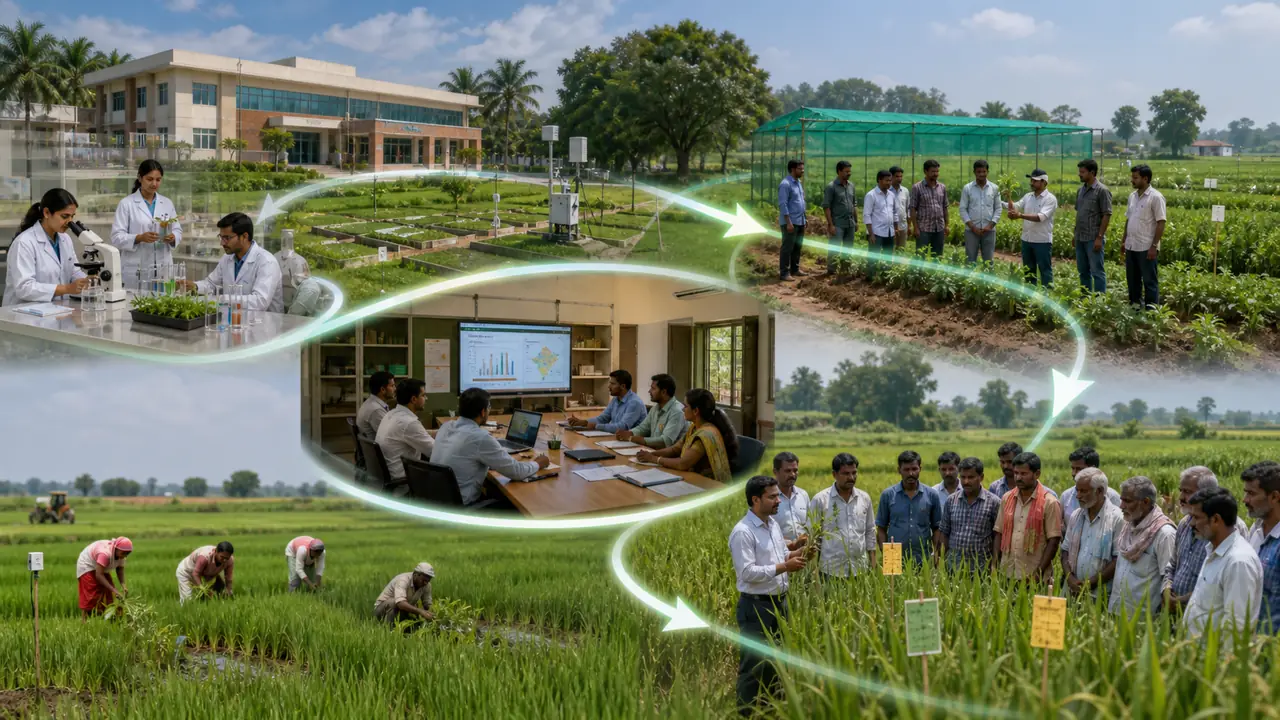
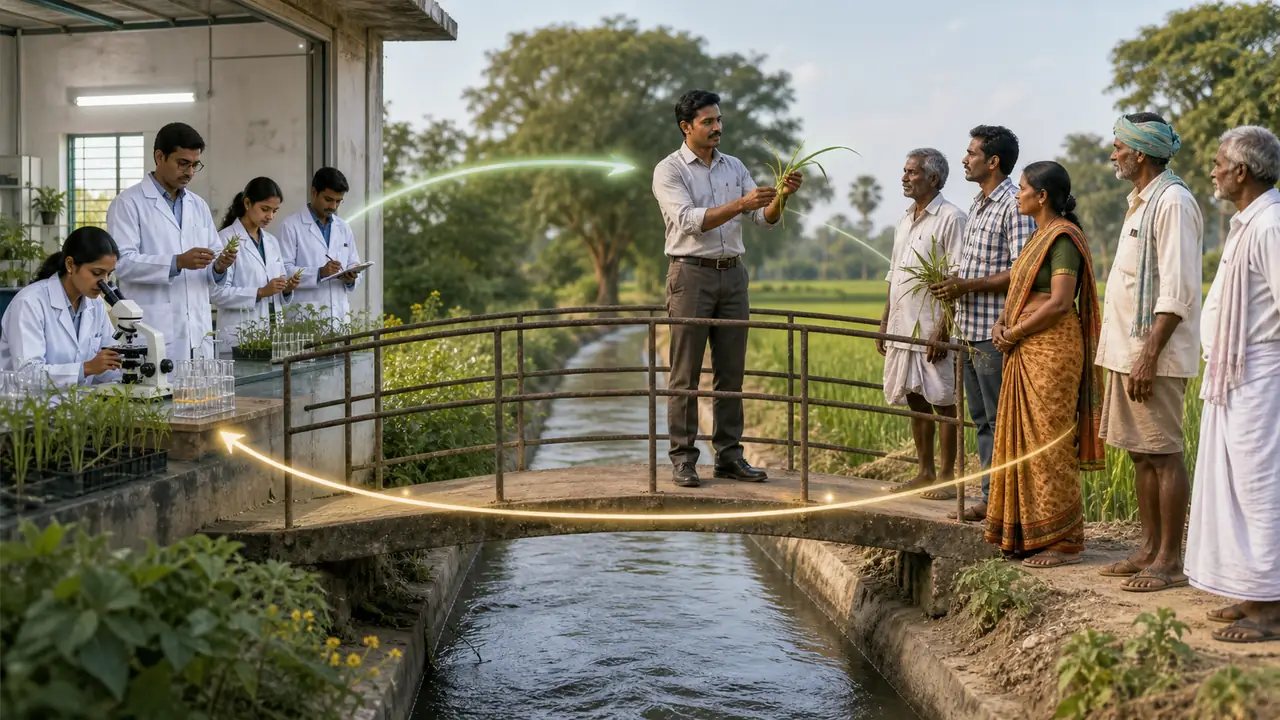
In the previous lesson, we explored the Panchayat Raj System — the three-tier governance framework that delivers administration to villages, blocks, and districts. Now we examine two institutions that operate within this framework to bring agricultural technology directly to farmers: ATMA at the district level and KVK at the block/district level.
This lesson covers:
- ATMA — structure, governing board, and district-level technology dissemination
- KVK — mandates, principles, and front-line demonstrations
- MANAGE — the national-level extension training institute
- Women Development Programmes — DWCRA, ICDS, and ministry associations
All topics are high-yield for exams.
Agricultural Technology Management Agency (ATMA)
ATMA is the primary institutional mechanism for decentralized agricultural extension in India. It operates as a registered society at the district level, bringing together all stakeholders — line departments, research organizations, NGOs, and farmers — under a single coordination umbrella. Before ATMA, extension was fragmented across multiple departments with no unified planning.
Pro Content Locked
Upgrade to Pro to access this lesson and all other premium content.
₹99 charged monthly · Cancel anytime
- All Agriculture & Banking Courses
- AI Lesson Questions (100/day)
- AI Doubt Solver (50/day)
- Glows & Grows Feedback (30/day)
- AI Section Quiz (20/day)
- 22-Language Translation (100/day)
- Recall Questions (20/day)
- AI Quiz (15/day)
- AI Quiz Paper Analysis (100/day)
- AI Step-by-Step Explanations (100/day)
- Spaced Repetition Recall (FSRS)
- AI Tutor
- Immersive Text Questions
- Audio Lessons — Hindi & English
- Mock Tests & Previous Year Papers
- Summary & Mind Maps
- XP, Levels, Leaderboard & Badges
- Generate New Classrooms
- Voice AI Teacher (AgriDots Live)
- AI Revision Assistant
- Knowledge Gap Analysis
- Interactive Revision (LangGraph)
🔒 Secure via Razorpay · Cancel anytime · No hidden fees
Visual Overview
In the previous lesson, we explored the Panchayat Raj System — the three-tier governance framework that delivers administration to villages, blocks, and districts. Now we examine two institutions that operate within this framework to bring agricultural technology directly to farmers: ATMA at the district level and KVK at the block/district level.
This lesson covers:
- ATMA — structure, governing board, and district-level technology dissemination
- KVK — mandates, principles, and front-line demonstrations
- MANAGE — the national-level extension training institute
- Women Development Programmes — DWCRA, ICDS, and ministry associations
All topics are high-yield for exams.
Agricultural Technology Management Agency (ATMA)
ATMA is the primary institutional mechanism for decentralized agricultural extension in India. It operates as a registered society at the district level, bringing together all stakeholders — line departments, research organizations, NGOs, and farmers — under a single coordination umbrella. Before ATMA, extension was fragmented across multiple departments with no unified planning.
Key Facts
- Started in: 2005 — initially piloted in 28 districts under the NATP project, then scaled nationwide
- Currently operational in: 676 districts across India, covering virtually all agricultural districts
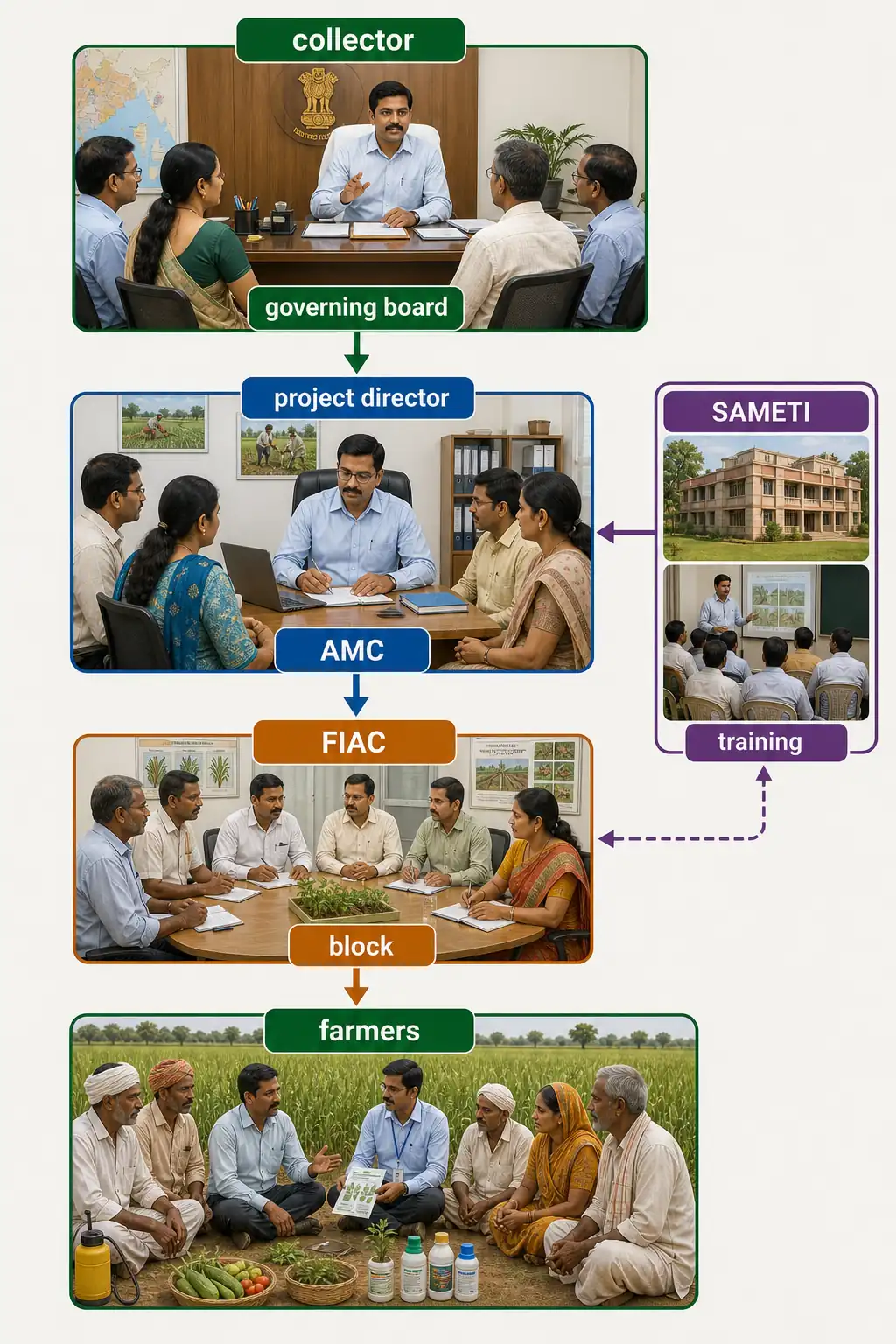
- The district collector is the chairman of the board of ATMA — this ensures administrative authority backs the extension agenda
ATMA Structure
1. Governing Board
- Acts as a policy-making body providing guidance and reviewing progress
- It is an Advisory Body
- Members: 16 members appointed for 2 years
2. ATMA Management Committee (AMC)
- Responsible for planning and executing day-to-day activities of ATMA
- Headed by: Project Director
- Members of AMC: 12
3. FIAC (Farmers Information & Advisory Centres)
- Operates at the Block level
- Provides farmers with direct access to information and advisory services
4. SAMETI
- State Agricultural Management & Extension Training Institute
- The apex training institute at state level to give training support to ATMA
TIP
ATMA Hierarchy (Top → Bottom): Governing Board (16, advisory, 2 yrs) → AMC (12, Project Director) → FIAC (Block level) → Farmer
Krishi Vigyan Kendra (KVK)
KVK (literally "Farm Science Centre") is a science-based extension institution that bridges the gap between agricultural research laboratories and farmers' fields. Unlike ATMA which coordinates existing departments, KVKs directly deliver vocational training, on-farm testing, and front-line demonstrations. India has 731 KVKs — at least one in almost every district — making them the largest network of agricultural extension centres in the world.
Key Facts
- First KVK established at: Pondicherry (under TNAU) in 1974 — Tamil Nadu Agricultural University hosted the first centre as a pilot project
- Credit for the success of KVK goes to: Dr. Chandrika Prasad — he championed the KVK concept and oversaw its expansion across India
- KVK functions on the principles of collaborative participation of scientists, subject matter experts, extension workers, and farmers — ensuring technologies are tested and refined with direct farmer input before wider recommendation
Three Fundamental Principles of KVK
- Agricultural production — the primary goal is to increase farm output through better technology
- Imparting training — farmers, farm women, and rural youth receive hands-on skill development
- Priority to weaker section of society — small and marginal farmers, SC/ST communities, and women are given preference in all KVK programmes
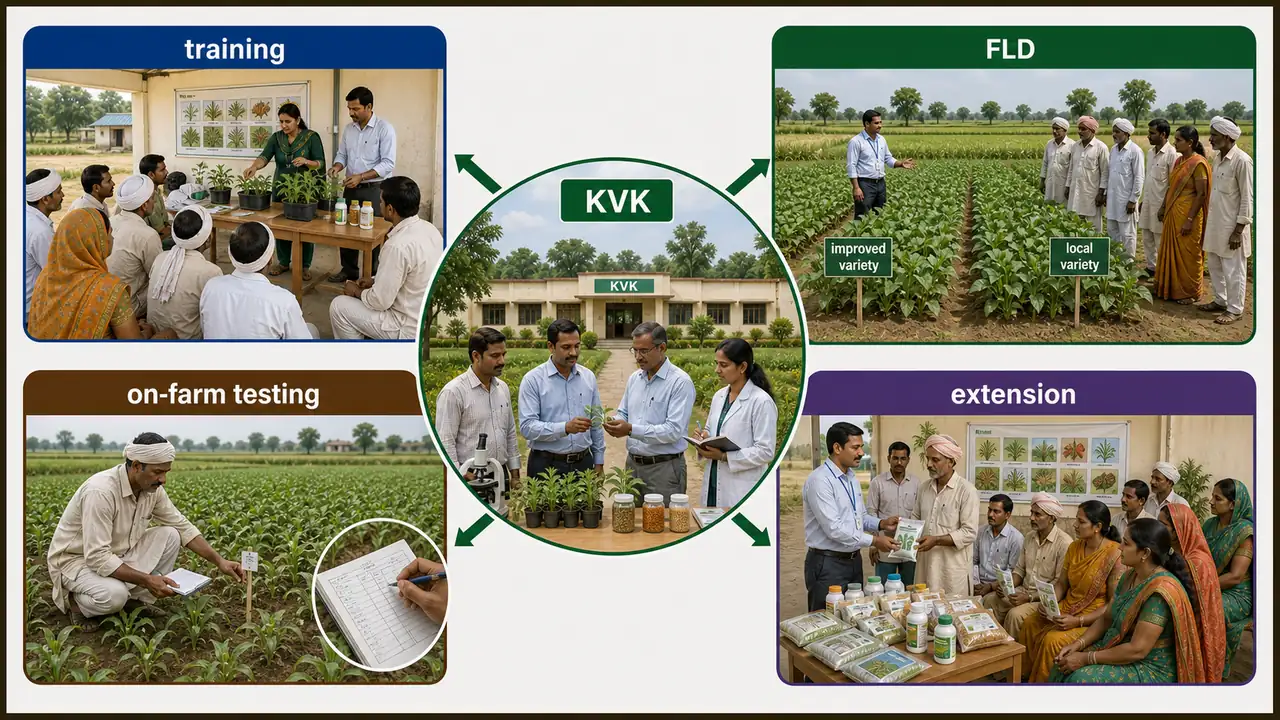
Four Mandates of KVK
- Training programme — vocational and skill-based training for farmers, farm women, and rural youth
- Front-line demonstration — demonstrating proven technologies on farmers' fields under scientist supervision
- On-farm testing — evaluating new technologies in real farm conditions before recommending them
- Other extension activities — awareness campaigns, farm advisories, seed and planting material distribution
IMPORTANT
- Front-line demonstration = field demonstration conducted under close supervision of scientists of NARS. It shows the genetic production potential of new technologies.
- On-farm testing = testing at farmer's field where appropriate technologies are not available for a particular agro-climatic situation.
Activities of KVK
- On-farm research — adaptive trials conducted at farmers' fields to test technologies under local agro-climatic conditions
- In-service training — upgrading the skills of existing extension personnel so they stay current with new developments
- Vocational training of farmers, farm women, rural youth — practical skill-building in areas like mushroom cultivation, vermicomposting, dairy management, and value addition
- Front-line demonstration and other extension activities — showcasing genetic production potential of new crop varieties and management practices
MANAGE
MANAGE is the apex institution for training and capacity building in agricultural extension management. It trains extension officers, programme managers, and policy makers who run the ATMA and KVK systems described above.
- Full form: National Institute of Agricultural Extension Management
- Location: Hyderabad
- Established: 1987 — to professionalize extension management as India's agricultural extension network expanded rapidly
- Functions under: Ministry of Agriculture and Cooperation
Women Development Programmes
Extension and rural development also target women through dedicated programmes. These schemes recognize that women perform a significant share of agricultural labour yet are often excluded from training and credit facilities.
| Programme | Year |
|---|---|
| DWCRA (Development of Women & Children in Rural Areas) | 1982 |
| ICDS (Integrated Child Development Services Scheme) | 1975 |
| Mahila Samridhi Yojana (MSY) | — |
NOTE
Ministry Associations (frequently asked):
- Ministry of Rural Development → NIRD, CAPART, MNREGA
- Ministry of Agriculture & Cooperation → MANAGE
- Department of Rural Development → TRYSEM
Summary Cheat Sheet
| Concept / Topic | Key Details |
|---|---|
| ATMA started | 2005; operational in 676 districts |
| ATMA Governing Board | 16 members, 2-year term; Advisory Body |
| ATMA Management Committee | 12 members; headed by Project Director |
| FIAC | Operates at Block level; direct farmer advisory |
| SAMETI | State Agricultural Management & Extension Training Institute; apex state-level training body for ATMA |
| First KVK | Pondicherry (under TNAU) |
| KVK success credit | Dr. Chandrika Prasad |
| 3 KVK Principles | Agricultural production, Imparting training, Priority to weaker sections |
| 4 KVK Mandates | Training, Front-line demonstration, On-farm testing, Other extension |
| Front-line demonstration | Under NARS scientists; shows genetic production potential |
| On-farm testing | Testing where appropriate technologies are not available for local conditions |
| MANAGE | National Institute of Agricultural Extension Management; Hyderabad; est. 1987 |
| DWCRA | Development of Women & Children in Rural Areas; 1982 |
| ICDS | Integrated Child Development Services Scheme; 1975 |
| Ministry of Rural Development | NIRD, CAPART, MNREGA |
| Ministry of Agriculture | MANAGE |
TIP
Next: Lesson 03-10b covers ICAR, agricultural organizations, and international institutions — the national research backbone that develops the technologies ATMA and KVK disseminate to farmers.