🏛️ ICAR, Agricultural Organizations & International Institutions
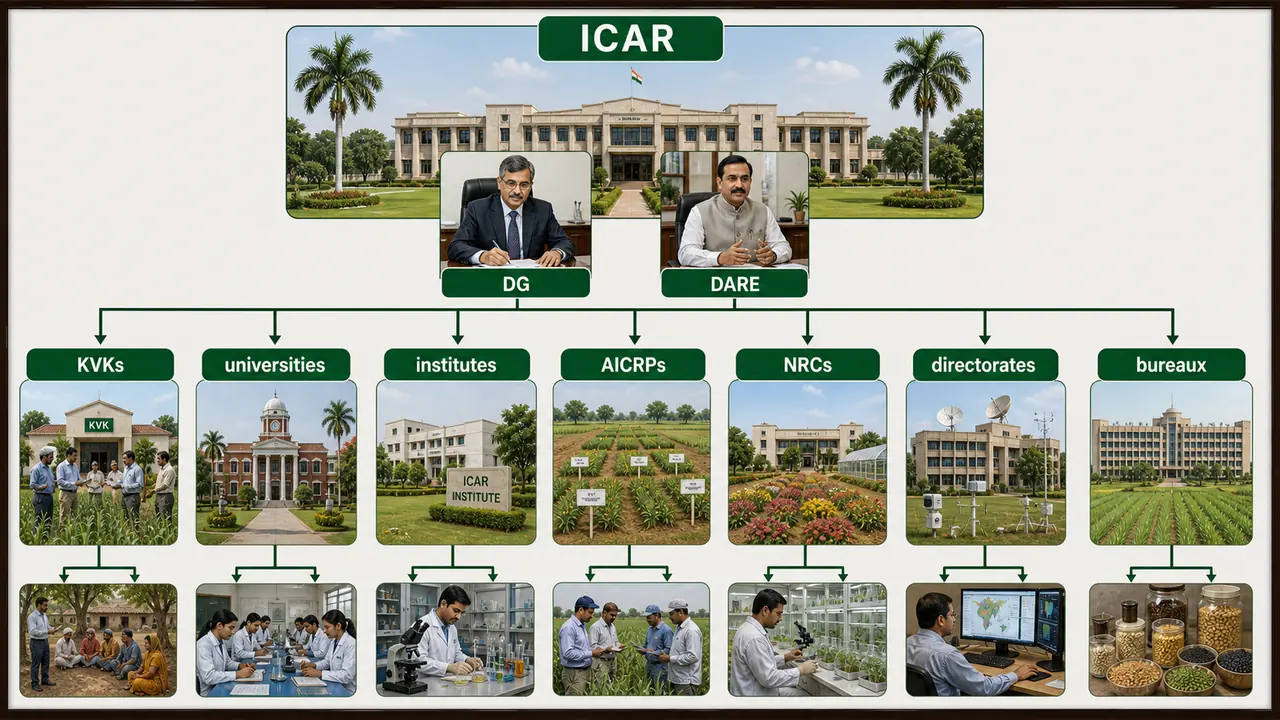
ICAR structure, Agricultural Universities, KVKs, ICAR Institutes, AICRPs, National Research Centres, Directorates, Commodity Boards, and International Organizations
Visual Overview
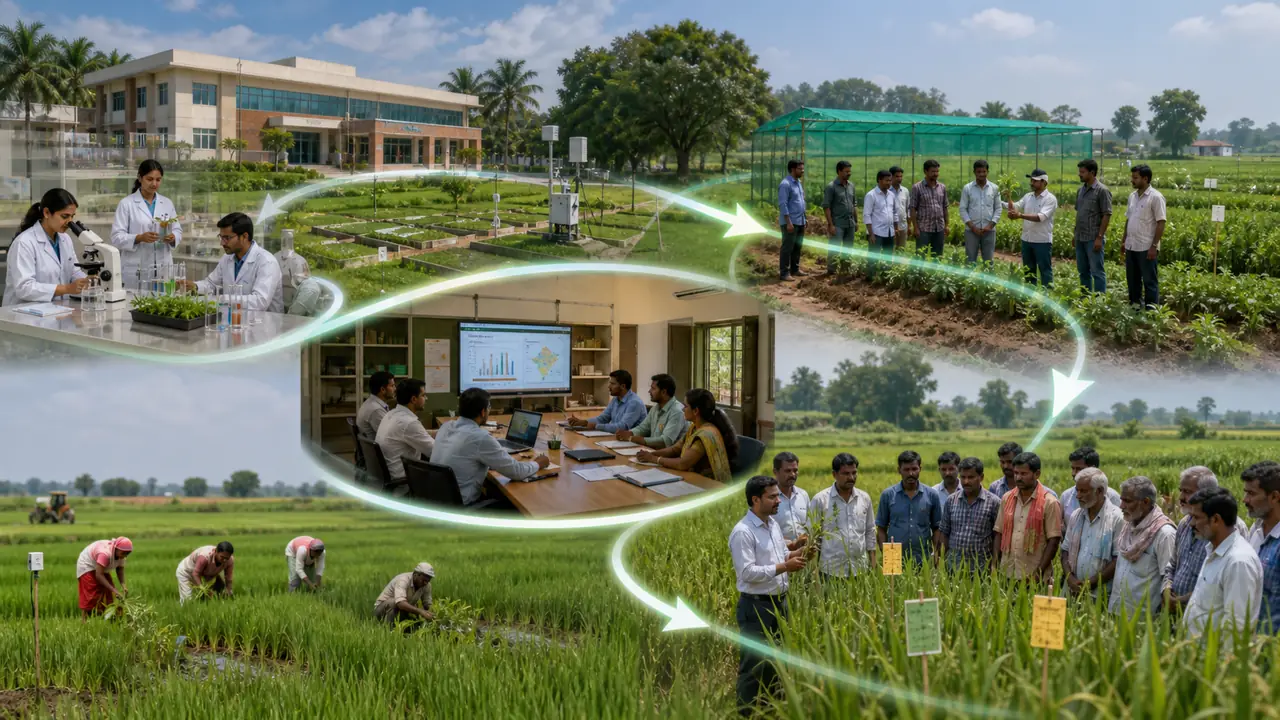
In the previous lesson, we explored ATMA and KVK — the district-level and block-level institutions that deliver agricultural technology to farmers. But where do these technologies come from? The answer is ICAR — the apex body that coordinates all agricultural research in India through a vast network of institutes, universities, and coordinated research projects.
When a farmer in Kanpur wants advice on the best chickpea variety for his field, he visits the nearest Krishi Vigyan Kendra (KVK) — one of 731 such centres spread across India, all coordinated by ICAR. When that KVK needs a new disease-resistant variety, it connects with the ICAR-Indian Institute of Pulses Research located in the same city. This network of research institutes, universities, and extension centres forms the backbone of India's agricultural knowledge system.
Pro Content Locked
Upgrade to Pro to access this lesson and all other premium content.
₹99 charged monthly · Cancel anytime
- All Agriculture & Banking Courses
- AI Lesson Questions (100/day)
- AI Doubt Solver (50/day)
- Glows & Grows Feedback (30/day)
- AI Section Quiz (20/day)
- 22-Language Translation (100/day)
- Recall Questions (20/day)
- AI Quiz (15/day)
- AI Quiz Paper Analysis (100/day)
- AI Step-by-Step Explanations (100/day)
- Spaced Repetition Recall (FSRS)
- AI Tutor
- Immersive Text Questions
- Audio Lessons — Hindi & English
- Mock Tests & Previous Year Papers
- Summary & Mind Maps
- XP, Levels, Leaderboard & Badges
- Generate New Classrooms
- Voice AI Teacher (AgriDots Live)
- AI Revision Assistant
- Knowledge Gap Analysis
- Interactive Revision (LangGraph)
🔒 Secure via Razorpay · Cancel anytime · No hidden fees
Visual Overview
In the previous lesson, we explored ATMA and KVK — the district-level and block-level institutions that deliver agricultural technology to farmers. But where do these technologies come from? The answer is ICAR — the apex body that coordinates all agricultural research in India through a vast network of institutes, universities, and coordinated research projects.
When a farmer in Kanpur wants advice on the best chickpea variety for his field, he visits the nearest Krishi Vigyan Kendra (KVK) — one of 731 such centres spread across India, all coordinated by ICAR. When that KVK needs a new disease-resistant variety, it connects with the ICAR-Indian Institute of Pulses Research located in the same city. This network of research institutes, universities, and extension centres forms the backbone of India's agricultural knowledge system.
This lesson covers:
- ICAR — history, structure, and key numbers
- Agricultural Universities — Central, Deemed, and state universities
- Milestones in Indian Agriculture — timeline from 1880 to 1987
- AICRPs, Institutes, NRCs, and Directorates — location-based exam facts
- International institutions — IRRI, CIMMYT, ICRISAT, FAO, CGIAR
- Commodity Boards — headquarters and patterns
All sections are high-yield for exams.
Indian Council of Agricultural Research (ICAR)
| Feature | Detail |
|---|---|
| Established | 1929 as the Imperial Council of Agricultural Research |
| Headquarters | New Delhi |
| Head | Director General |
| President of ICAR Society | Union Minister of Agriculture and Farmers' Welfare (ex-officio) |
| ICAR Day | 16th July |
| Works under | Department of Agricultural Research and Education (DARE) |
- Lord Curzon's period (1898–1905) is called the "Golden Period of Agriculture" — the Great Canal system of Western Punjab was constructed and IARI was started at Pusa, Bihar.
ICAR Structure at a Glance
| Category | Number |
|---|---|
| Agro-ecological Zones (NARP & ICAR) | 8 |
| Agro-ecological Zones (NBSSLUP) | 20 (previously 21) |
| KVKs (Krishi Vigyan Kendras) | 731 (as on 10.06.2025) |
| Highest KVK zone | Kanpur zone |
| State with highest KVKs | Uttar Pradesh |
| Agricultural Universities | 63 |
| ICAR Deemed Universities | 4 (IARI, IVRI, NDRI, CIFE) |
| Central Agricultural Universities | 3 |
| ICAR Institutes | 65 |
| National Research Centres | 15 |
| National Bureaux | 6 |
| Directorates | 13 |
| AICRPs | 60 |
TIP
Mnemonic for ICAR numbers: "731 KVKs, 65 Institutes, 63 Universities, 60 AICRPs, 15 NRCs, 13 Directorates, 6 Bureaux, 4 Deemed, 3 Central"
Agricultural Universities
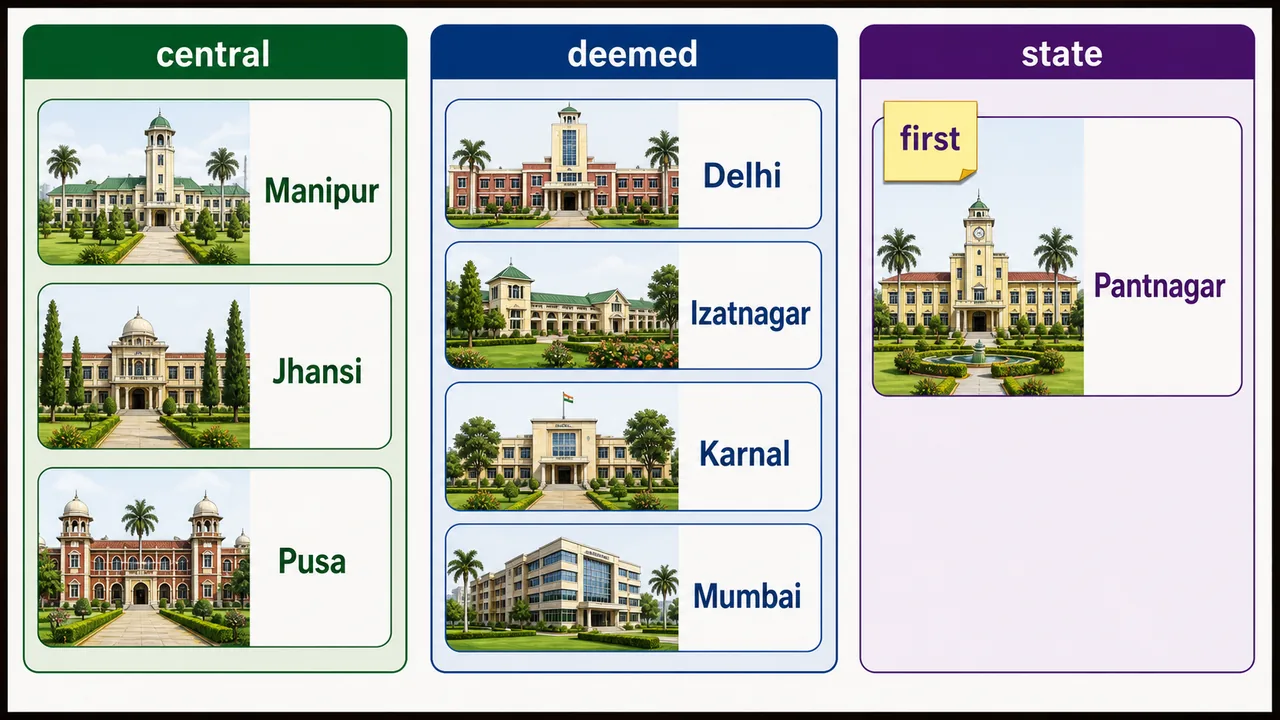
India's agricultural education system consists of central universities directly funded by the Union government, deemed universities under ICAR with full degree-granting authority, and state agricultural universities. Exam questions frequently ask about locations and the distinction between these categories.
Central Agricultural Universities
| University | Location |
|---|---|
| Central Agricultural University | Manipur |
| Rani Lakshmi Bai Central Agricultural University | Jhansi, UP |
| Dr. Rajendra Prasad Central Agricultural University | Pusa, Bihar |
ICAR Deemed Universities
| University | Location |
|---|---|
| IARI — Indian Agricultural Research Institute | New Delhi |
| IVRI — Indian Veterinary Research Institute | Izatnagar, Uttar Pradesh |
| NDRI — National Dairy Research Institute | Karnal, Haryana |
| CIFE — Central Institute of Fisheries Education | Mumbai |
IMPORTANT
The first Agriculture University in India was started in 1960 at Pantnagar (Uttarakhand), modeled after Land Grant Universities of the USA.
TIP
Mnemonic for 4 Deemed Universities: "I-I-N-C" — IARI (Delhi), IVRI (Izatnagar), NDRI (Karnal), CIFE (Mumbai).
Milestones in Indian Agriculture
Understanding the chronological development of Indian agriculture helps connect institutions to the problems they were created to solve. This timeline is a frequent source of "year-matching" MCQs.
| Year | Milestone | Agricultural Significance |
|---|---|---|
| 1880 | Department of Agriculture established | First government body for agriculture |
| 1890 | Higher education in agriculture at Pune | Beginning of formal agri. education |
| 1905 | IARI started at Pusa, Bihar | Premier research institute |
| 1906 | Forest Research Institute (FRI) at Dehradun | Forestry research hub |
| 1912 | Sugarcane Breeding Institute at Coimbatore | Sugarcane variety development |
| 1923 | NDRI established in Bangalore | Dairy research foundation |
| 1929 | ICAR established at New Delhi | Apex body for agri. research |
| 1935 | DMI (Directorate of Marketing and Inspection) | Agricultural marketing regulation |
| 1936 | IARI shifted to New Delhi | Due to earthquake in Bihar |
| 1943 | Bengal Famine (Helminthosporium oryzae) | Plant disease causing mass starvation |
| 1957 | Central Warehousing Corporation; First AICRP (Maize) | Storage and coordinated research began |
| 1958 | NAFED established | Cooperative marketing federation |
| 1960 | First Agri. University at Pantnagar | Modeled on US Land Grant system |
| 1965 | FCI and NDDB established | Food procurement and dairy development |
| 1965-67 | Green Revolution — HYV wheat and rice | Food self-sufficiency |
| 1975 | First RRB — Prathama Bank | Rural banking for farmers |
| 1982 | NABARD established | Apex rural credit institution |
| 1984 | National Horticulture Board | Horticulture promotion |
| 1986 | APEDA established | Agricultural export promotion |
| 1987 | MANAGE at Hyderabad | Extension management training |
All India Coordinated Research Projects (AICRPs) — 60
AICRPs are multi-location research projects that test and develop technologies across different agro-climatic zones. The headquarters of each AICRP is a frequently asked exam question.
Crop-based AICRPs (Selected Key Ones)
| AICRP | Headquarters |
|---|---|
| Maize | Ludhiana |
| Rice | Hyderabad |
| Chickpea | Kanpur |
| Pigeon Pea | Kanpur |
| Wheat & Barley | Karnal |
| Sorghum | Hyderabad |
| Pearl Millets | Jodhpur |
| Sugarcane | Lucknow |
| Cotton | Coimbatore |
| Groundnut | Junagadh |
| Soybean | Indore |
| Potato | Shimla |
| Spices | Calicut |
| Mushroom | Solan |
Resource Management AICRPs (Selected Key Ones)
| AICRP | Headquarters |
|---|---|
| Dryland Agriculture | Hyderabad |
| Weed Control | Jabalpur |
| Salt Affected Soils | Karnal |
| Soil Test with Crop Response | Bhopal |
| Agrometeorology | Hyderabad |
TIP
Location pattern: Hyderabad hosts AICRPs for Rice, Sorghum, Dryland, Agrometeorology. Kanpur hosts Chickpea, Pigeon Pea, MULLARP. Bhopal hosts soil-related AICRPs.
Key ICAR Institutes — 65
ICAR's 65 research institutes are the primary generators of new agricultural technologies in India. Each institute specializes in a specific crop, livestock species, or resource management area. Exam questions typically test institute-location pairs.
| Institute | Location |
|---|---|
| IARI — Indian Agricultural Research Institute | New Delhi |
| National Rice Research Institute | Cuttack, Odisha |
| Indian Institute of Wheat & Barley Research | Karnal, Haryana |
| Indian Institute of Maize Research | New Delhi |
| Indian Institute of Pulses Research | Kanpur, Uttar Pradesh |
| Indian Institute of Oilseeds Research | Hyderabad |
| Indian Institute of Sugarcane Research | Lucknow, Uttar Pradesh |
| Central Institute of Cotton Research | Nagpur, Maharashtra |
| Central Potato Research Institute | Shimla, Himachal Pradesh |
| Sugarcane Breeding Institute | Coimbatore, Tamil Nadu |
| Indian Institute of Rice Research | Hyderabad |
| Indian Institute of Millets Research | Hyderabad |
| Indian Institute of Seed Research | Mau, Uttar Pradesh |
| Central Marine Fisheries Research Institute | Kochi, Kerala |
| Central Research Institute for Dryland Agriculture | Hyderabad |
Agricultural example: When a farmer in Bihar faces rice blast disease, the National Rice Research Institute, Cuttack develops resistant varieties. When a potato grower in Shimla needs late blight management, the Central Potato Research Institute provides the solution. Each institute serves a specific crop or resource management need.
National Research Centres — 15
NRCs focus on specific commodities or themes that are too specialized for a full ICAR institute but important enough to need dedicated research. They are often located in regions where their focus commodity is naturally concentrated.
| NRC | Location |
|---|---|
| Banana | Trichy |
| Grapes | Pune |
| Litchi | Muzaffarpur |
| Pomegranate | Solapur |
| Camel | Bikaner |
| Equines | Hisar |
| Meat | Hyderabad |
| Mithun | Medziphema, Nagaland |
| Orchids | Pakyong, Sikkim |
| Pig | Guwahati |
| Seed Spices | Ajmer |
| Yak | West Kemang |
| Integrated Pest Management | New Delhi |
| Integrated Farming | Motihari |
| Plant Biotechnology | New Delhi |
TIP
NRC location shortcuts: Fruits are in Maharashtra (Grapes-Pune, Pomegranate-Solapur) and South India (Banana-Trichy). Livestock NRCs are in their natural habitat zones (Camel-Bikaner in Rajasthan, Mithun-Nagaland, Yak-West Kemang).
Directorates / Project Directorates — 13
| Directorate | Location |
|---|---|
| Groundnut Research | Junagadh |
| Soybean Research | Indore |
| Rapeseed & Mustard Research | Bharatpur |
| Mushroom Research | Solan |
| Onion and Garlic Research | Pune |
| Weed Research | Jabalpur |
| Floricultural Research | Pune |
| Poultry Research | Hyderabad |
Important International Institutions
India's agricultural research does not operate in isolation. It connects to a global network of institutions — mostly under the CGIAR umbrella — that develop improved varieties, share germplasm, and provide technical assistance. Knowing these institutions and their locations is a staple of IBPS AFO, NABARD, and FCI exams.
| Abbreviation | Full Name | Location | Focus |
|---|---|---|---|
| IRRI | International Rice Research Institute | Manila, Philippines | Rice improvement |
| CIMMYT | International Centre for Maize and Wheat | Mexico | Wheat and maize |
| ICRISAT | Intl. Crops Research for Semi-Arid Tropics | Patancheru, Hyderabad | Dryland crops |
| FAO | Food and Agricultural Organization | Rome | Food security |
| CGIAR | Consultative Group on Intl. Agri. Research | Washington D.C. | Research funding |
| ICARDA | Intl. Center for Agri. Research in Dry Areas | Beirut, Lebanon | Dryland research |
| CIP | International Potato Research Institute | Lima, Peru | Potato and sweet potato |
| IITA | Intl. Institute for Tropical Agriculture | Ibadan, Nigeria | Tropical crops |
| ILRI | International Livestock Research Institute | Nairobi, Kenya | Livestock |
| ICRAF | Intl. Centre for Research in Agroforestry | Nairobi, Kenya | Agroforestry |
TIP
Exam shortcuts: IRRI = Rice = Philippines. CIMMYT = Maize & Wheat = Mexico. ICRISAT = Semi-Arid Tropics = Hyderabad, India. FAO = Rome. CGIAR = Washington D.C. CIP = Potato = Peru.
Important Organizations — HQ, Head & Year
| Organization | HQ | Head | Est. |
|---|---|---|---|
| ICAR | New Delhi | Director General | 1929 |
| IARI | New Delhi | Director | 1905 |
| NITI Aayog | New Delhi | PM (Chairman) | 2015 |
| NABARD | Mumbai | Chairman | 1982 |
| FCI | New Delhi | CMD | 1965 |
| APEDA | New Delhi | Chairman | 1986 |
| CACP | New Delhi | Chairman | 1965 |
| MANAGE | Hyderabad | DG | 1987 |
| FAO | Rome | DG | 1945 |
| NAFED | New Delhi | MD | 1958 |
| NDDB | Anand, Gujarat | Chairman | 1965 |
| WTO | Geneva | DG | 1995 |
| IRRI | Philippines | DG | 1960 |
| CIMMYT | Mexico | DG | 1966 |
Commodity Boards in India
Commodity Boards are statutory bodies established by Acts of Parliament to promote the production, processing, and export of specific agricultural commodities. Their headquarters are typically located in the primary production regions of their commodity.
| Board | Headquarters |
|---|---|
| Coconut Development Board | Kochi, Kerala |
| Tea Board of India | Kolkata, West Bengal |
| Coffee Board of India | Bengaluru, Karnataka |
| Rubber Board of India | Kottayam, Kerala |
| Central Silk Board | Bengaluru, Karnataka |
| Spices Board of India | Kochi, Kerala |
| Tobacco Board | Guntur, Andhra Pradesh |
| Coir Board | Kochi, Kerala |
| National Horticulture Board | Gurugram, Haryana |
TIP
Commodity Board HQ pattern: Kerala dominates — Coconut, Rubber, Spices, Coir all in Kochi/Kottayam. Tea = Kolkata. Coffee & Silk = Bengaluru. Tobacco = Guntur (AP's tobacco belt).
ICAR Agricultural Sustainability Index
The ICAR Agricultural Sustainability Index measures the overall sustainability of agriculture across Indian states, factoring in productivity, resource use efficiency, and environmental impact.
| Parameter | Value |
|---|---|
| India's overall score | 0.49 — moderately sustainable |
| Category | States |
|---|---|
| Best performing | Mizoram, Kerala, Madhya Pradesh, Andhra Pradesh |
| Worst performing | Rajasthan |
TIP
Remember the sustainability index value 0.49 and that Mizoram tops the list — both are frequently tested in NABARD and RBI Grade B exams.
Exam Tips
IMPORTANT
Top 10 facts for exams:
- ICAR Day = 16th July, est. 1929
- KVKs = 731, highest in UP
- Agricultural Universities = 63
- ICAR Deemed Universities = 4 (IARI, IVRI, NDRI, CIFE)
- First Agri University = Pantnagar (1960)
- IARI shifted from Pusa, Bihar to New Delhi in 1936 (earthquake)
- First Deputy DG of Horticulture = Dr. K.L. Chadha
- Lord Curzon's period = "Golden Period of Agriculture"
- ICRISAT is in Hyderabad, India (only CGIAR centre in India)
- NABARD = Mumbai, FCI = New Delhi
Summary Cheat Sheet
| Concept / Topic | Key Details |
|---|---|
| ICAR established | 1929, New Delhi; originally Imperial Council of Agricultural Research |
| ICAR Day | 16th July |
| ICAR Head | Director General |
| Golden Period of Agriculture | Lord Curzon's period (1898-1905) |
| Total KVKs | 731; highest in Uttar Pradesh |
| ICAR Deemed Universities | 4 — IARI (Delhi), IVRI (Izatnagar), NDRI (Karnal), CIFE (Mumbai) |
| First Agri. University | Pantnagar, 1960 — modeled on US Land Grant system |
| Total ICAR Institutes | 65 |
| Total AICRPs | 60; first AICRP = Maize (1957) |
| Total NRCs | 15 |
| IARI shifted to Delhi | 1936 (earthquake in Bihar) |
| AICRP Rice / Sorghum | HQ at Hyderabad |
| AICRP Wheat & Barley | HQ at Karnal |
| AICRP Weed Control | HQ at Jabalpur |
| IRRI | Manila, Philippines — Rice improvement |
| CIMMYT | Mexico — Wheat and Maize |
| ICRISAT | Patancheru, Hyderabad — only CGIAR centre in India |
| FAO | Rome; NABARD = Mumbai; FCI = New Delhi |
| Tea Board | Kolkata; Coffee Board = Bengaluru |
| Commodity Boards in Kerala | Coconut, Rubber, Spices, Coir (Kochi/Kottayam) |
| ICAR Sustainability Index | India score: 0.49 (moderately sustainable) |
| Sustainability — Best states | Mizoram, Kerala, MP, Andhra Pradesh |
| Sustainability — Worst state | Rajasthan |
TIP
Next: Lesson 03-11 covers Rural Development Agencies and Programmes — the schemes (NATP, DPAP, IRDP, SGSY) that channel funds through these institutions to reach farmers on the ground.
Lesson Doubts
Ask questions, get expert answers