🏊 Pond Management
Fish pond types, water quality management, liming, fertilization, feeding schedules, and weed fish control
Fish Seed Rearing Methods
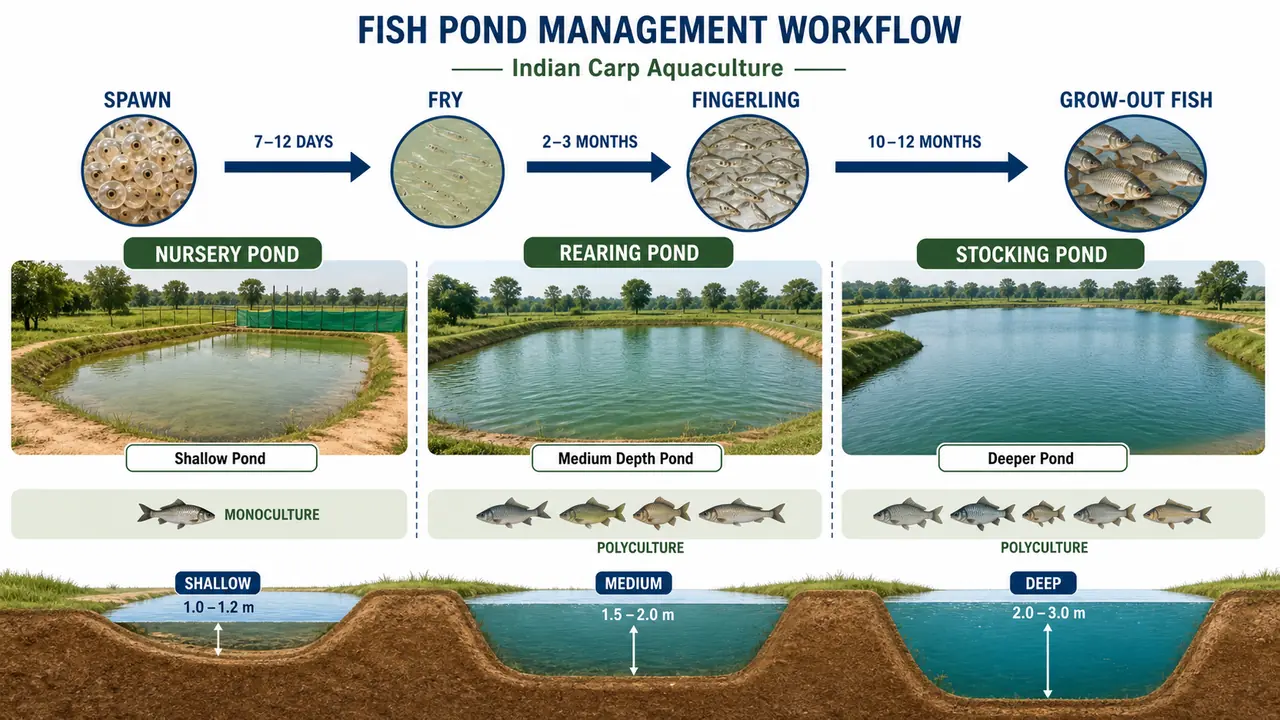
Fish seed rearing is the process of growing spawn (newly hatched fish larvae) up to the fingerling stage, which is the proper size for stocking in production ponds. There are two main methods of rearing fish seed:
1. Single Stage Rearing
In single stage rearing, the spawn is reared up to fingerling stage in a single pond without any intermediate transfer. The spawn is directly stocked in one pond and allowed to grow until they reach fingerling size. This method is simpler but may result in lower survival rates due to the varying requirements at different growth stages.
2. Double Stage Rearing
Double stage rearing is the method of rearing spawn to fingerling stage in two steps. This is the more commonly recommended method:
Pro Content Locked
Upgrade to Pro to access this lesson and all other premium content.
₹99 charged monthly · Cancel anytime
- All Agriculture & Banking Courses
- AI Lesson Questions (100/day)
- AI Doubt Solver (50/day)
- Glows & Grows Feedback (30/day)
- AI Section Quiz (20/day)
- 22-Language Translation (100/day)
- Recall Questions (20/day)
- AI Quiz (15/day)
- AI Quiz Paper Analysis (100/day)
- AI Step-by-Step Explanations (100/day)
- Spaced Repetition Recall (FSRS)
- AI Tutor
- Immersive Text Questions
- Audio Lessons — Hindi & English
- Mock Tests & Previous Year Papers
- Summary & Mind Maps
- XP, Levels, Leaderboard & Badges
- Generate New Classrooms
- Voice AI Teacher (AgriDots Live)
- AI Revision Assistant
- Knowledge Gap Analysis
- Interactive Revision (LangGraph)
🔒 Secure via Razorpay · Cancel anytime · No hidden fees
Fish Seed Rearing Methods
Fish seed rearing is the process of growing spawn (newly hatched fish larvae) up to the fingerling stage, which is the proper size for stocking in production ponds. There are two main methods of rearing fish seed:
1. Single Stage Rearing
In single stage rearing, the spawn is reared up to fingerling stage in a single pond without any intermediate transfer. The spawn is directly stocked in one pond and allowed to grow until they reach fingerling size. This method is simpler but may result in lower survival rates due to the varying requirements at different growth stages.
2. Double Stage Rearing
Double stage rearing is the method of rearing spawn to fingerling stage in two steps. This is the more commonly recommended method:
- Stage 1 (Nursery Phase): The spawn is first reared up to the fry stage in small nursery ponds. This stage takes about 7 to 12 days.
- Stage 2 (Rearing Phase): The fry are then transferred to relatively bigger ponds called rearing ponds, where they are grown up to the fingerling stage. This stage takes about 2-3 months.
TIP
Double stage rearing is preferred because it allows for better management at each growth stage. The smaller nursery ponds are easier to control for water quality, feeding, and predator protection during the most vulnerable early days.
The key growth stages of fish and their characteristics:
| Stage | Size | Duration | Key Feature |
|---|---|---|---|
| Hatchling | Newly hatched | 2-3 days | Has yolk sac, does not take external food |
| Spawn | After yolk absorption | - | Mouth formed, starts taking zooplankton and rotifers |
| Fry | 1-2 cm | 7-10 days from spawn | Assumes fish shape, feeds on smaller zooplankton |
| Fingerling | 10-15 cm | 30-60 days from fry | Size of a finger, proper size for stocking |
| Yearling | Varies | Up to 1 year of age | Development stage following fingerling |
IMPORTANT
In carps, it takes about 15-20 days to grow spawn to fry size in nursery ponds, and about 30-60 days for the fry to grow up to fingerling size.
Types of Fish Ponds
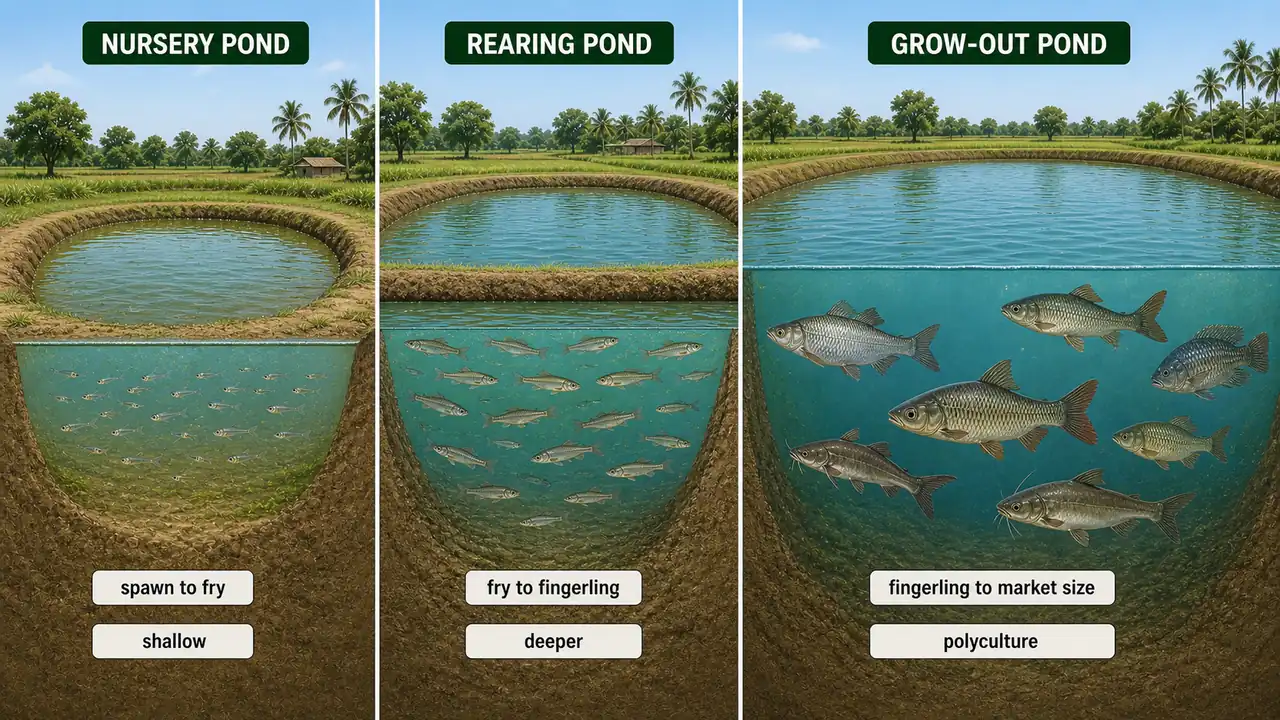
Fish ponds are categorized based on the stage of fish they rear. Each type has specific dimensions, depths, and stocking densities designed for optimal growth at that particular stage.
1. Nursery Pond
- Pond where spawn is reared to fry stage
- In carps, it takes about 15-20 days to grow spawn to fry size
- Size: 0.02 - 0.06 ha water area
- Depth: 1 to 1.5 metres
- Mono-culture is followed in nursery ponds
2. Rearing Pond
- Pond where fry is grown to fingerling size
- In carps, it takes about 2-3 months to rear fry to fingerling size
- Size: 0.06 - 0.10 ha
- Depth: 1.5 to 2.0 metres
- Mono-culture is generally followed, but polyculture may also be practiced when rearing space is limited
3. Grow-out Pond (Stocking Pond)
- Ponds where fingerlings are stocked and grown to harvestable/marketable size
- Carps grow from fingerlings to marketable size in about 10-12 months
- Size: 0.25 - 1.0 ha
- Depth: 2.0 to 2.5 metres
- Poly-culture of carps is followed in grow-out ponds
NOTE
Mono-culture is followed in nursery and rearing ponds to ensure uniform growth and reduce competition among fish of different sizes. Poly-culture is followed in grow-out ponds to utilize all available food niches in the pond.
Practical Size and Depth of Ponds (Source: FAO)
| Pond Type | Size (ha) | Depth - Irrigated/Command Areas (m) | Depth - Rainfed/Non-irrigated Areas (m) |
|---|---|---|---|
| Nursery pond | 0.02 - 0.06 | 1.0 - 1.5 | 1.5 - 2.0 |
| Rearing pond | 0.06 - 0.10 | 1.5 - 2.0 | 2.0 - 2.5 |
| Stocking pond | 0.25 - 1.0 | 2.0 - 2.5 | 2.5 - 3.5 |
Stocking Density
The number of fish stocked per unit area varies significantly depending on the type of pond:
| Type of Pond | Stocking Density |
|---|---|
| Earthen Nursery Pond | 300-500 per m2 |
| Cement Tanks | 1000-2000 per m2 |
| Rearing Pond | 20-30 per m2 |
| Grow-out Pond | 5000-10,000 per ha |
Suitable Slopes for Different Soil Types
The slope of the pond embankment depends on the soil type. Proper slopes prevent erosion and seepage.
| Soil Type | Slope (Horizontal : Vertical) |
|---|---|
| Clay | 1:1 to 2:1 |
| Clay loam | 1.5:1 to 2:1 |
| Sandy loam | 2:1 to 2.5:1 |
| Sandy | 3:1 |
Sandy soils require a gentler slope because they are more prone to erosion and have less cohesion compared to clay soils.
Water Quality Management
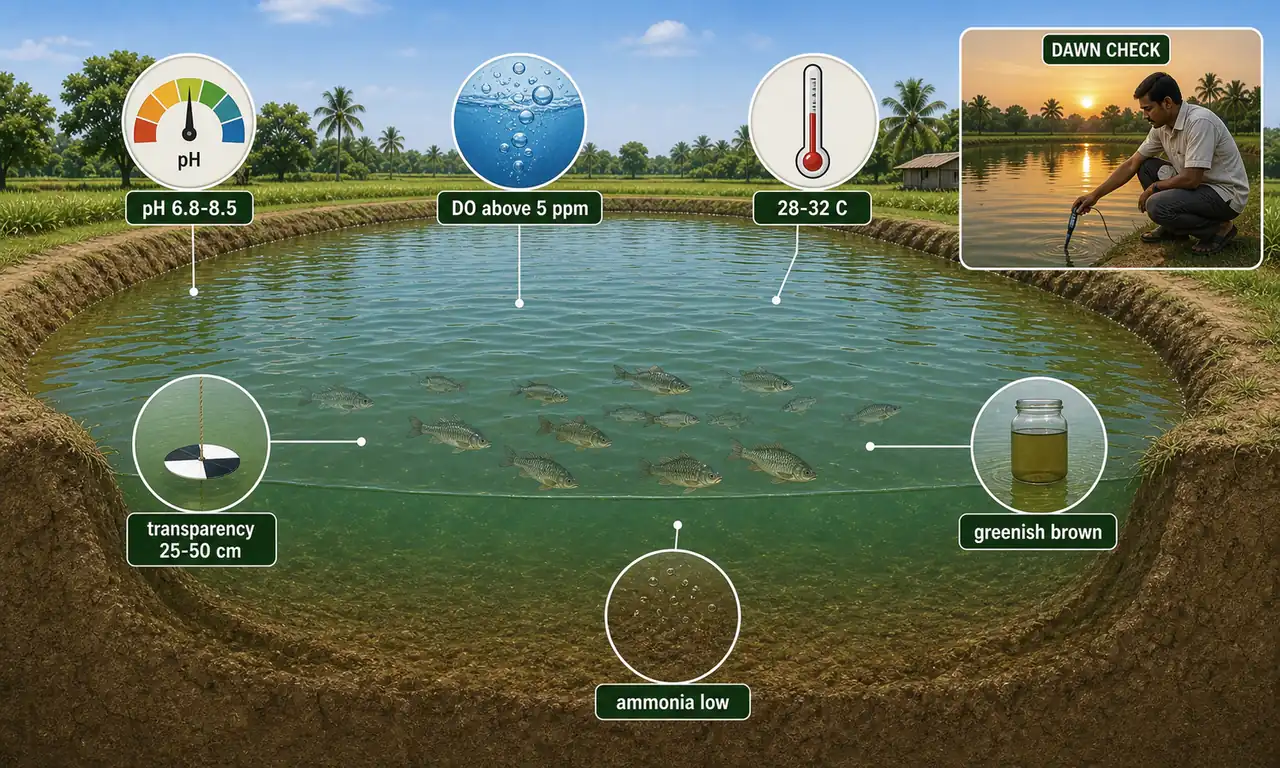
Maintaining optimal water quality is the most critical aspect of pond management. Poor water quality leads to stress, disease, slow growth, and mortality in fish. The following parameters must be regularly monitored and maintained within the optimal ranges.
Optimal Water Quality Parameters for Fisheries
| Parameter | Optimal Range |
|---|---|
| pH | 6.8 - 8.0 (up to 8.5) |
| Temperature | 28 - 32 degrees C |
| Dissolved Oxygen (DO) | Above 5 ppm |
| Phosphate | Less than 10 ppm |
| Total Alkalinity | 80 - 120 ppm |
| Salinity | 29 - 32 ppt |
| Unionized Ammonia | Less than 5 ppm |
| Ionized Ammonia | Less than 1.5 ppm |
| Free Carbon Dioxide | 15 ppm |
| Water Colour | Greenish brown |
| Transparency | 25 - 50 cm |
| Inorganic Nitrogen | 0.2 ppm |
| Inorganic Phosphorus | 0.2 ppm |
WARNING
Dissolved oxygen levels below 3 ppm cause severe stress in fish, and levels below 1 ppm can lead to mass mortality. Early morning is when DO levels are lowest, so always check DO levels at dawn. Aeration may be necessary in heavily stocked ponds.
Key points about water quality parameters:
- pH affects nutrient availability, toxicity of ammonia, and overall fish metabolism. The ideal range is 6.8-8.0, and the best growth occurs between pH 6-9.
- Temperature influences metabolic rate, feeding activity, and dissolved oxygen levels. Indian carps are warm-water fish (25-35 degrees C). Feeding decreases in winter below 20 degrees C.
- Dissolved Oxygen is essential for respiration. Oxygen depletion commonly occurs in early morning hours, in heavily stocked ponds, and during cloudy weather when photosynthesis is reduced.
- Transparency of 25-50 cm (measured by Secchi disc) indicates good plankton growth. Less than 25 cm means excessive plankton (risk of oxygen depletion at night), and more than 50 cm means insufficient plankton and low productivity.
- Ammonia in its unionized form (NH3) is toxic to fish. Ammonia toxicity increases with higher pH and temperature.
Liming
Liming is one of the most important pond management practices. It involves the application of lime (calcium compounds) to the pond soil or water to improve water quality and productivity.
Purpose of Liming
- Corrects acidic soil pH and raises it to the optimal range (6.5-8.5)
- Increases total alkalinity and buffering capacity of water
- Enhances nutrient availability for plankton growth
- Promotes decomposition of organic matter at the pond bottom
- Kills pathogens and parasites in the pond (when quick lime is used)
- Improves the effectiveness of fertilizers applied to the pond
- Precipitates suspended clay particles, improving water clarity
Types of Lime Used
| Type | Chemical Formula | Characteristics |
|---|---|---|
| Agricultural limestone (CaCO3) | Calcium carbonate | Safest, slow acting, most commonly used |
| Dolomite | CaMg(CO3)2 | Provides both calcium and magnesium |
| Quick lime (CaO) | Calcium oxide | Most reactive, used for pond disinfection, generates heat |
| Slaked lime / Hydrated lime Ca(OH)2 | Calcium hydroxide | Moderately reactive, used for pH correction |
IMPORTANT
Quick lime (CaO) should be used with caution as it generates intense heat and can kill fish if applied to a stocked pond. It is primarily used for pond preparation before stocking. Agricultural limestone (CaCO3) is the safest option for stocked ponds.
Lime Dose Based on Soil pH
The normal dose of lime ranges from 200 to 250 kg/ha. However, the actual dose depends on the soil pH:
| Soil pH | Lime Required (kg/ha) |
|---|---|
| 4.5 - 5.0 | 2,000 |
| 5.1 - 6.5 | 1,000 |
| 6.6 - 7.5 | 500 |
| 7.6 - 8.5 | 200 |
| 8.6 - 9.5 | Nil |
Lime Required to Change pH of Pond Soil (kg/ha)
This table shows the amount of lime required to raise the pH from the existing level to the desired level, based on soil type:
| Soil Type | Existing pH | Desired pH | Lime Requirement (kg/ha) |
|---|---|---|---|
| Clay loam | 5 | 6 | 1000 |
| Clay loam | 5.5 | 6.5 | 900 |
| Loam | 5 | 6 | 800 |
| Loam | 5.5 | 6.5 | 800 |
| Fine sandy loam | 5 | 6 | 800 |
| Fine sandy loam | 5.5 | 6.5 | 800 |
| Sandy loam | 5 | 6 | 400 |
| Sandy loam | 5.5 | 6.5 | 400 |
WARNING
Total amount of lime application in a month should not exceed 600 kg/ha. If a higher dose is required, it should be split across multiple months to avoid drastic pH changes that can stress or kill fish.
Timing of Lime Application
- Lime should be applied 15-20 days before stocking the pond
- Best applied on a dry pond bottom during summer for maximum effectiveness
- If applying to a water-filled pond, broadcast evenly over the surface
- Lime should be applied before fertilizer application, as it improves fertilizer efficiency
- Allow at least 7-10 days between liming and fertilizer application
Effects of pH on Fish
The pH of water has a profound effect on fish health, growth, and survival. Understanding the effects at different pH ranges is crucial:
| pH Range | Effect on Fish |
|---|---|
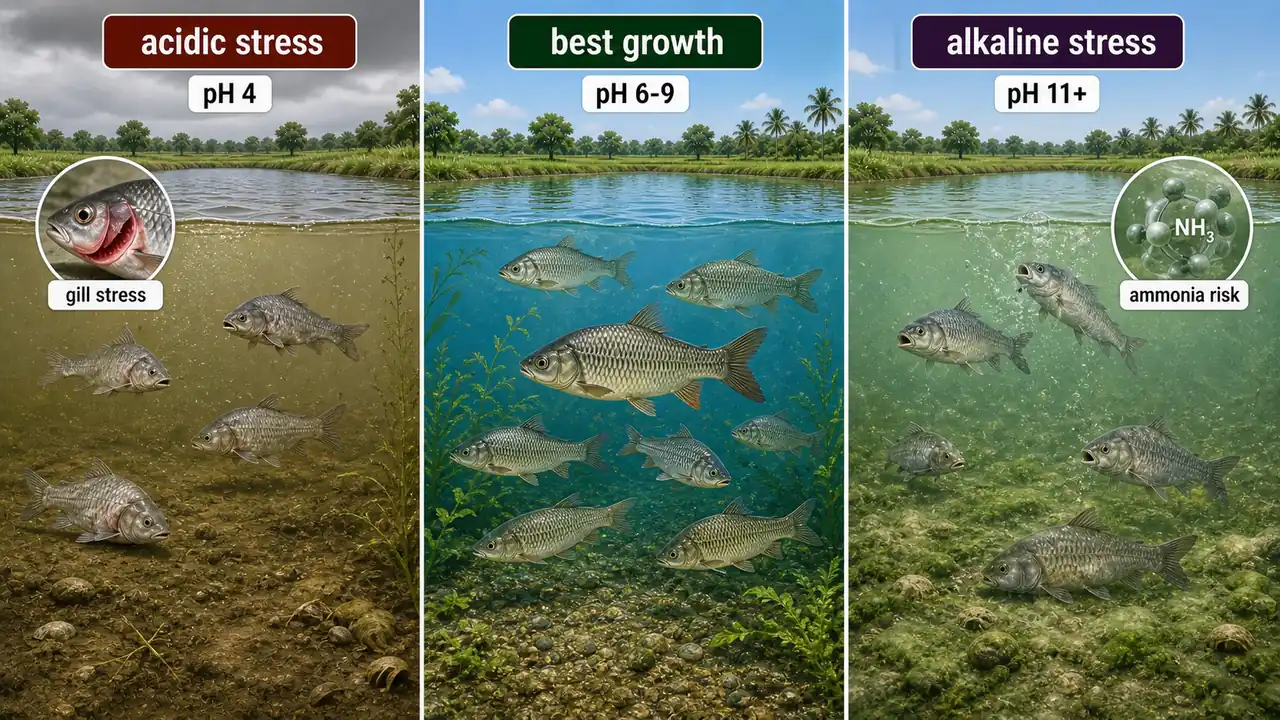
| 4.0 | Acid death point - Fish cannot survive |
| 4 - 6 | Slow growth, reduced feeding, impaired reproduction |
| 6 - 9 | Best range for growth - Optimal physiological function |
| 9 - 11 | Slow growth, lethal to fish over long period of time |
| 11+ | Alkaline death point - Fish cannot survive |
IMPORTANT
The acid death point is at pH 4.0 and the alkaline death point is at pH 11+. The best growth range for fish is between pH 6-9. These are frequently asked values in exams.
Key points about pH effects:
- At low pH (acidic conditions), the mucus on fish gills coagulates, making respiration difficult
- At very high pH (alkaline conditions), ammonia toxicity increases because more of the total ammonia is in the toxic unionized form (NH3)
- Daily pH fluctuation in ponds is normal due to photosynthesis (increases pH during day) and respiration (decreases pH at night)
- Sudden pH changes of more than 2 units within a day can cause fish stress or mortality
Fertilization
Fertilization of fish ponds is essential to enhance the natural productivity of the pond by promoting the growth of plankton, which serves as natural food for fish. Both organic and inorganic fertilizers are used.
Rate of Application of Fertilizer (kg/ha/year) - Source: FAO
| Fertilizer | High Productivity Pond | Medium Productivity Pond | Low Productivity Pond |
|---|---|---|---|
| Cattle dung | 5000-8000 | 8000-10000 | 10000-25000 |
| Urea (43-45%) | 112-155 | 156-225 | 226-260 |
| Ammonium sulphate (20.5%) | 225-330 | - | - |
| Calcium ammonium nitrate (20.5%) | - | 350-500 | 501-650 |
| Single super phosphate (16-20%) | 156-219 | 220-315 | 316-405 |
| Triple super phosphate (40-45%) | 54-75 | 76-110 | 111-145 |
NOTE
The amount of fertilizer required is inversely proportional to the natural productivity of the pond. Low productivity ponds need more fertilizer to achieve the desired plankton growth.
Generalized Fertilization Schedule for Stocking Ponds (CIFRI, 1985)
This schedule, recommended by the Central Inland Fisheries Research Institute (CIFRI), is one of the most widely referenced fertilization schedules for Indian fish ponds:
| Category | Item | Quantity (kg/ha) | Periodicity |
|---|---|---|---|
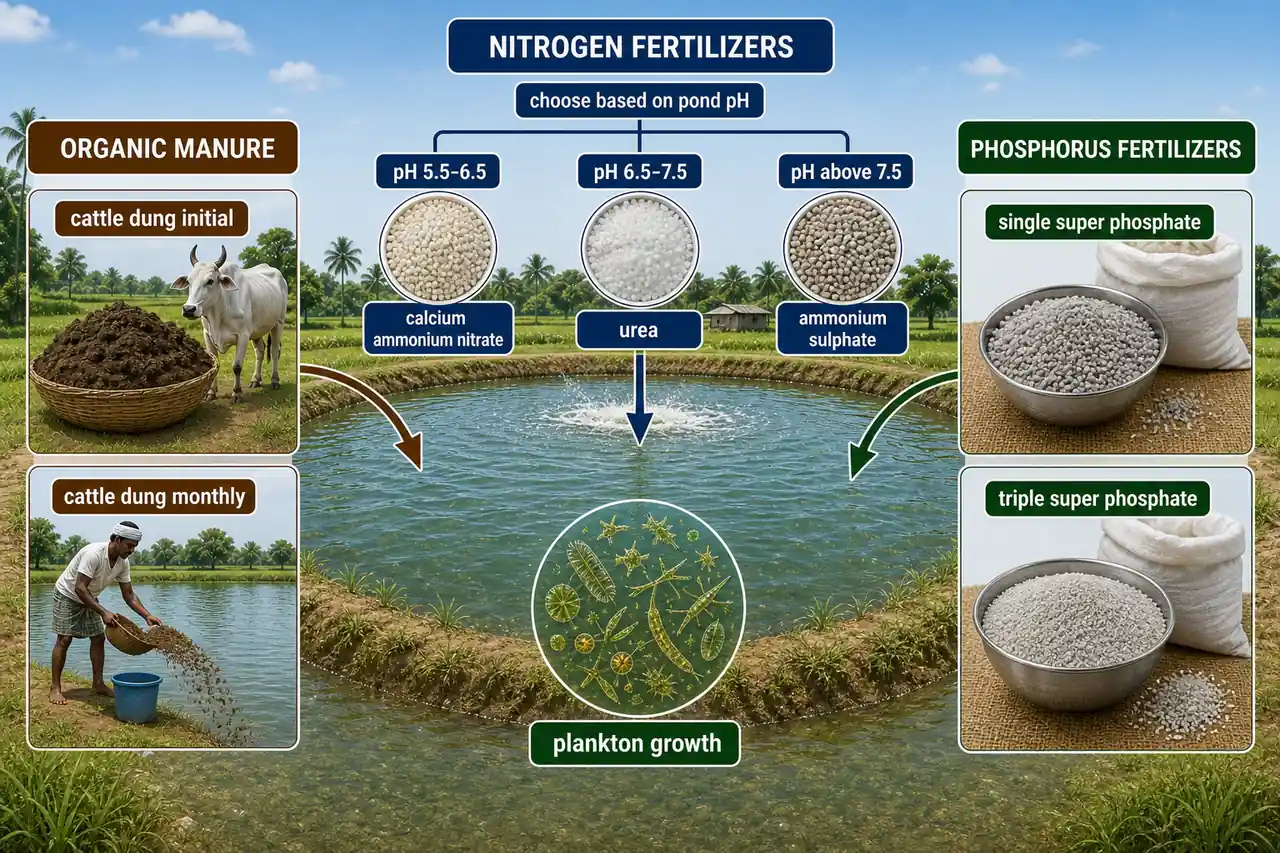
| A. Organic | Cattle dung (initial dose) | 2000 | Initial dose |
| Cattle dung (maintenance) | 1000 | Monthly | |
| B. Nitrogen | Urea (for pH 6.5-7.5) OR | 25 | Monthly |
| Ammonium sulphate (for pH above 7.5) OR | 30 | Monthly | |
| Calcium ammonium nitrate (for pH 5.5-6.5) | 30 | Monthly | |
| C. Phosphorus | Single super phosphate OR | 20 | Monthly |
| Triple super phosphate | 8 | Monthly |
TIP
The choice of nitrogenous fertilizer depends on the pond pH:
- Urea - for ponds with pH 6.5-7.5
- Ammonium sulphate - for ponds with pH above 7.5 (as it has an acidifying effect)
- Calcium ammonium nitrate - for ponds with pH 5.5-6.5 (as it has a liming effect)
Seasonal Requirement of Organic Manure (kg/ha)
The application of organic manure varies by season, with higher quantities applied during monsoon when dilution is greater and decomposition is faster:
| Manure Type | Monsoon (June-Aug) | Post Monsoon (Sep-Nov) | Winter (Dec-Feb) | Pre-Monsoon (Mar-May) | Total |
|---|---|---|---|---|---|
| Cow dung | 6000 | 4000 | 3000 | 2000 | 15000 |
| Pig dung | 5000 | 3000 | 2000 | 2000 | 12000 |
| Poultry manure | 4000 | 2000 | 1000 | 1500 | 8500 |
Note: This data is for ponds where the lowest water level will be greater than 1.2 m.
Supplementary Feeding
Natural food (plankton) produced through fertilization alone is often insufficient to support the stocking densities used in semi-intensive and intensive culture. Supplementary feeding bridges this gap and is essential for achieving economically viable fish production.
Common Supplementary Feed Ingredients
The most commonly used supplementary feed is a mixture of rice bran (or wheat bran) and groundnut oil cake (or mustard oil cake) in a 1:1 ratio by weight. Other ingredients include:
- Rice bran / Wheat bran
- Groundnut oil cake / Mustard oil cake
- Soybean meal
- Fish meal
- Rice polish
- Broken rice
Rates of Daily Supplementary Feeding at Various Stages of Culture
| Stage | Daily Feeding Rate |
|---|---|
| Spawn to Fry | 4-8 times the initial body weight |
| Fry to Fingerlings | 50-100% of the initial body weight |
| Growers | 1-2% of body weight |
| Brood Fish | 1-3% of body weight |
IMPORTANT
The feeding rate is highest during the spawn to fry stage (4-8 times body weight) because the tiny fish have very high metabolic rates and are growing rapidly. As fish grow larger, the relative feeding rate decreases to 1-2% of body weight for growers.
Feeding Schedule for Nursery Ponds
This schedule applies to nursery ponds stocked with spawn, showing the feeding rate and quantity for 0.1 million spawn:
| Period (Days from Stocking) | Rate of Feeding | Amount of Feed for 0.1 Million Spawn |
|---|---|---|
| Day 1-5 | 4 times the total initial weight | 560 g/day |
| Day 6-12 | 8 times the total initial weight | 1120 g/day |
| Day 13 | No feed | - |
| Day 14 | Harvesting | - |
NOTE
On Day 13, feeding is stopped to allow the fry to empty their gut before harvesting on Day 14. This practice improves the survival rate during transport, as fish with full stomachs are more stressed during handling and transit.
Feeding tips for nursery ponds:
- Feed should be finely powdered and mixed into a paste before broadcasting
- Feed should be applied along the pond margins where spawn tend to congregate
- Initial feeds include egg yolk, finely powdered oil cake, and rice bran
- Overfeeding must be avoided as uneaten feed decomposes and deteriorates water quality
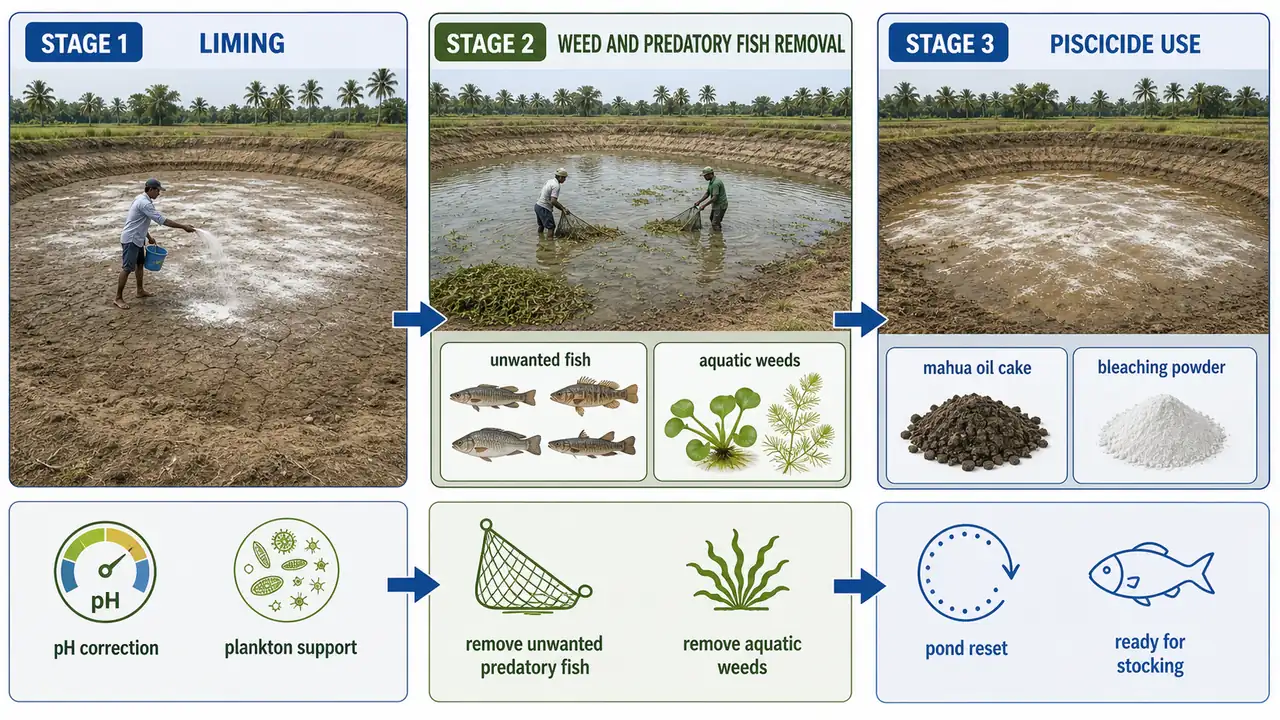
Eradication of Weed and Predatory Fishes
Before stocking a pond with desired fish species, it is essential to remove all unwanted fishes that compete for food, space, and dissolved oxygen, or that prey on the stocked fish. These unwanted fishes are classified into two categories: predatory fishes and weed fishes.
Predatory Fishes
Predatory fishes are those which predate on the spawn, fry, and fingerlings of cultured fishes. They are one of the most serious threats in fish culture operations.
Characteristics of predatory fishes:
- They enter cultured ponds through water inflow or are introduced along with fish seeds
- They breed easily in confined water, often earlier than carps, and grow bigger than the stocked carp
- They compete for food, space, and dissolved oxygen, resulting in poor growth of carps
- Their complete eradication using physical methods (like netting) is difficult
- They have the habit of burrowing in the mud bottom, making them hard to catch
Common predatory fishes include:
- Channa spp. (Snakeheads)
- Clarias batrachus (Walking catfish)
- Heteropneustes fossilis (Stinging catfish)
- Pangasius spp.
- Mystus sp.
- Ompok spp.
- Wallago attu (Freshwater shark)
- Glossogobius giuris
Weed Fishes
Weed fishes are uneconomical, small-sized fish that occur naturally or are introduced accidentally in ponds along with fish seeds.
Characteristics of weed fishes:
- They compete for food, space, and dissolved oxygen with cultured fish
- They have high fecundity (reproductive capacity) and breed well before major carps breed
- Many of them breed throughout the year
- Fish seeds collected from the wild may contain seeds of weed fishes
Common weed fishes include:
- Puntius sp., Oxygaster sp., Ambassis sp., Amblypharyngodon mola, Colisa sp., Rasbora sp., Aplocheilus sp., Laubuca sp., Esomus danricus, etc.
Methods of Removal
1. Repeated Netting
- Suitable only for ponds that have no fish other than carps
- It is not possible to catch predatory and weed fishes completely by netting alone
- Remaining fishes will breed and re-establish their population
2. Dewatering and Drying the Pond
- This is the best method for eradication of unwanted fishes
- Summer is the best time for this practice
- The pond bottom is completely dried, which kills all fish, eggs, and also helps in mineralization of the soil organic matter
3. Poisoning the Pond
- Used when dewatering and drying is not possible (e.g., perennial ponds)
- Various fish toxicants (piscicides) are applied to kill all existing fish before restocking
TIP
The recommended sequence of pond preparation is: Dewatering and Drying (summer) followed by Liming followed by Fertilization followed by Stocking. If the pond cannot be dewatered, use piscicides first, then lime and fertilize.
Fish Toxicants (Piscicides)
Fish toxicants or piscicides are chemical or plant-based substances used to kill unwanted fishes in ponds before stocking with desired species. The choice of piscicide depends on cost, availability, effectiveness, and whether the killed fish can be consumed.
A. Mahua Oil Cake (exams - 2020)
Mahua oil cake is the most commonly used plant-based piscicide in Indian fish culture.
- Contains about 4-6% saponin, which is the active toxic ingredient
- Kills fish at 200-250 ppm concentration in 6-10 hours
- Fishes killed by mahua oil cake are fit for human consumption
- Toxicity lasts for 15-20 days in water
- Applied at the rate of 2000-2500 kg/ha at one metre average depth
- The powdered cake is soaked in water and broadcast over the water surface
- After application, the pond is netted repeatedly for uniform mixing and to collect dead fishes
- Bonus benefit: Mahua cake subsequently acts as organic manure for the pond
B. Tea Seed Cake
- Crushed and powdered tea seeds are effective for controlling unwanted fishes
- Kills fish at 75-100 ppm
- Applied at 750-1000 kg/ha for every one metre average depth
- Toxicity lasts for 10-12 days
- Ultimately acts as fertilizer in the pond
- Treated fishes are suitable for human consumption
C. Ammonia (Anhydrous)
- Kills fish at 20-25 ppm
- Ammonia gas comes in cylinders
- Quite costly compared to other piscicides
- For application, the cylinder is held in position at the bottom of the pond and moved from one side to the other, releasing gas in a controlled way
- Sufficient protection should be provided to persons who apply the gas
D. Bleaching Powder
- Bleaching powder (calcium hypochlorite) is an effective and easily available fish toxicant
- Less costly than most other piscicides
- Kills fish at 25-30 ppm within 3-4 hours
- Dead fish float to the surface for easy collection
- Applied at 350 kg/ha (commercial bleaching powder with 30% chlorine)
- Alternative combination: Urea @ 100 kg/ha + Bleaching powder @ 175 kg/ha
- Toxicity lasts for about 7-8 days
- Additional advantage: Bleaching powder has a disinfecting and oxidizing effect on the decomposing matter at the pond bottom
E. Derris Root Powder
- Active ingredient is Rotenone
- It is a contact poison
- Lethal to other organisms also, such as zooplankton, benthos, and insects
- Dosage is 4-20 ppm (mg/l)
- The powder is mixed thoroughly with water and sprayed all over the pond
- Effective only on sunny days when the temperature is above 25 degrees C
- Less effective in cold waters
Recommended Doses of Fish Poisons
| Poison | Dose (kg/ha/m water depth) |
|---|---|
| Bleaching powder | 350 - 500 |
| Mohua oil cake | 2500 |
| Anhydrous ammonia | 20 - 30 |
| Powdered seed of Croton tiglium | 30 - 50 |
| Root powder of Milletia pachycarpa | 40 - 50 |
| Seed powder of Milletia piecidia | 40 - 50 |
| Seed powder of Barringtonia acutangula | 150 |
| Seed meal of tamarind (Tamarindus indica) | 1750 - 2000 |
| Tea seed cake (Camellia sinensis) | 750 |
IMPORTANT
Among all piscicides, Mahua oil cake is the most popular choice in India because: (1) killed fish are safe for consumption, (2) the cake later serves as manure, (3) it is relatively economical, and (4) it is effective. This topic has been asked in exams. Remember that Mahua cake contains 4-6% saponin and is applied at 2000-2500 kg/ha.
WARNING
After applying any piscicide, fish stocking should be done only after the toxicity period is over. For mahua oil cake, wait at least 15-20 days; for bleaching powder, wait 7-8 days; for tea seed cake, wait 10-12 days. Stocking new fish too early will result in their death.
Summary Cheat Sheet
| Concept / Topic | Key Details |
|---|---|
| Single stage rearing | Spawn → fingerling in one pond |
| Double stage rearing | Stage 1: spawn → fry (7–12 days); Stage 2: fry → fingerling (2–3 months) |
| Fish growth stages | Hatchling → Spawn → Fry → Fingerling → Yearling |
| Nursery pond | Spawn → fry; 0.02–0.06 ha; depth 1–1.5 m; monoculture |
| Rearing pond | Fry → fingerling; 0.06–0.10 ha; depth 1.5–2 m |
| Grow-out pond | Fingerling → market size; 0.25–1.0 ha; depth 2–2.5 m; polyculture |
| Grow-out culture period | 10–12 months for carps |
| Optimal pH | 7.5–8.5 (alkaline) |
| Liming purpose | Corrects acidity, kills pathogens, improves water quality |
| Organic manure | Cow dung: 5,000–10,000 kg/ha/year; promotes plankton growth |
| Inorganic fertiliser | Urea + SSP in 4:1 ratio; applied fortnightly |
| Mahua oil cake | Natural piscicide; kills weed/predatory fish; wait 15–20 days before stocking |
| Bleaching powder | Piscicide; wait 7–8 days before stocking |
| Tea seed cake | Piscicide; wait 10–12 days before stocking |
| Supplementary feed | Rice bran + mustard oil cake in 1:1 ratio; fed at 2–5% body weight |
| Water transparency | 25–40 cm (Secchi disc reading); indicates good plankton |
| Dissolved oxygen | Minimum 5 mg/L for good fish growth |