🐡 Carp Culture in India
Indian and exotic carps, feeding zones, polyculture principles, stocking ratios, and culture practices for freshwater fish farming
Why Carp Culture Matters
Imagine a farmer in Bihar with a one-hectare pond. Instead of growing a single fish species and harvesting barely 2 tonnes per year, he stocks six different carp species -- each feeding at a different level of the pond. His harvest jumps to 6-8 tonnes. This is the power of carp culture, the backbone of India's freshwater aquaculture.
What is Carp Culture?
Carp culture is the farming of freshwater fish belonging to the family Cyprinidae -- the largest family of freshwater fish in the world, with over 3,000 species.
- Carps are oily freshwater fish native to Europe and Asia, widely cultured for food and ornamental purposes.
- Their popularity in aquaculture comes from their fast growth rate, adaptability to pond conditions, tolerance to crowding, and acceptance of supplementary feed.
- India's inland fish production depends heavily on carp culture, which contributes over 80% of the total freshwater fish harvest.
IMPORTANT
Pro Content Locked
Upgrade to Pro to access this lesson and all other premium content.
₹99 charged monthly · Cancel anytime
- All Agriculture & Banking Courses
- AI Lesson Questions (100/day)
- AI Doubt Solver (50/day)
- Glows & Grows Feedback (30/day)
- AI Section Quiz (20/day)
- 22-Language Translation (100/day)
- Recall Questions (20/day)
- AI Quiz (15/day)
- AI Quiz Paper Analysis (100/day)
- AI Step-by-Step Explanations (100/day)
- Spaced Repetition Recall (FSRS)
- AI Tutor
- Immersive Text Questions
- Audio Lessons — Hindi & English
- Mock Tests & Previous Year Papers
- Summary & Mind Maps
- XP, Levels, Leaderboard & Badges
- Generate New Classrooms
- Voice AI Teacher (AgriDots Live)
- AI Revision Assistant
- Knowledge Gap Analysis
- Interactive Revision (LangGraph)
🔒 Secure via Razorpay · Cancel anytime · No hidden fees
Why Carp Culture Matters
Imagine a farmer in Bihar with a one-hectare pond. Instead of growing a single fish species and harvesting barely 2 tonnes per year, he stocks six different carp species -- each feeding at a different level of the pond. His harvest jumps to 6-8 tonnes. This is the power of carp culture, the backbone of India's freshwater aquaculture.
What is Carp Culture?
Carp culture is the farming of freshwater fish belonging to the family Cyprinidae -- the largest family of freshwater fish in the world, with over 3,000 species.
- Carps are oily freshwater fish native to Europe and Asia, widely cultured for food and ornamental purposes.
- Their popularity in aquaculture comes from their fast growth rate, adaptability to pond conditions, tolerance to crowding, and acceptance of supplementary feed.
- India's inland fish production depends heavily on carp culture, which contributes over 80% of the total freshwater fish harvest.
IMPORTANT
The three Indian Major Carps -- Catla, Rohu, and Mrigal -- are among the most frequently tested species in fisheries exams. Remember their scientific names, feeding zones, and the mnemonic C-R-M.
The Three Indian Major Carps (IMC)
These three species form the foundation of composite fish culture systems across India:
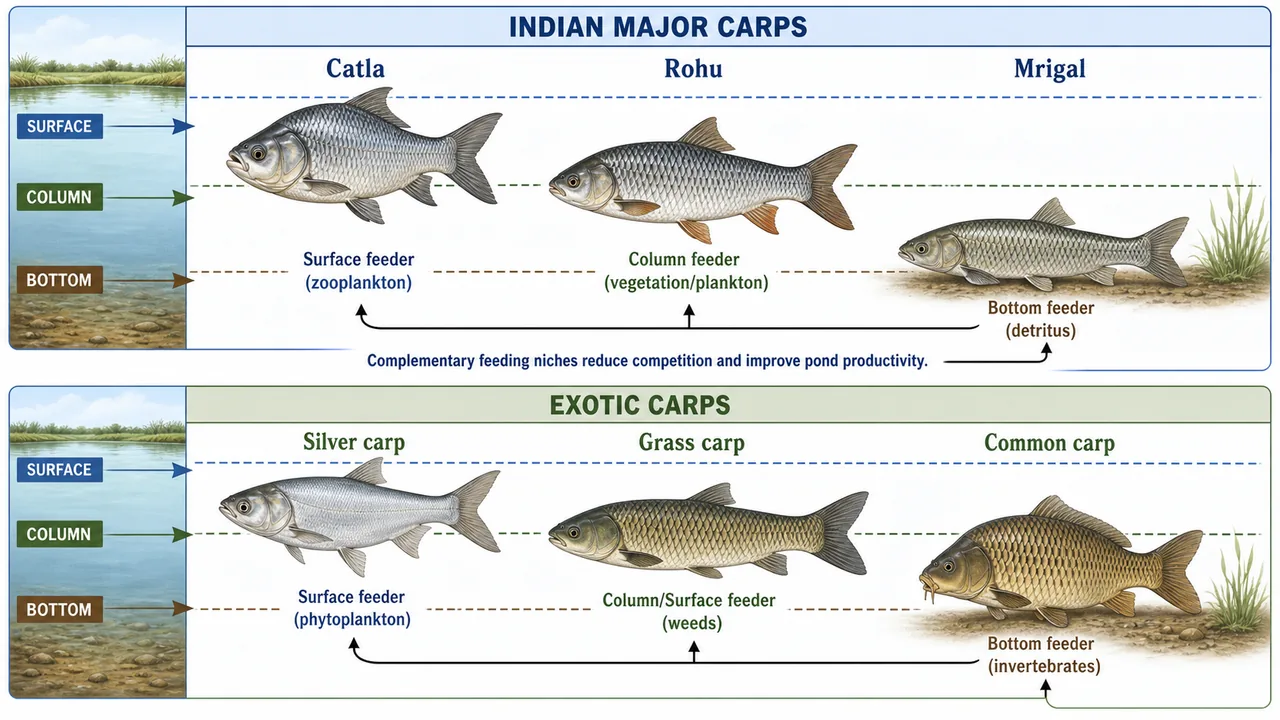
- Catla (Catla catla) -- Surface feeder, feeds on zooplankton
- Rohu (Labeo rohita) -- Column feeder, feeds on decaying vegetation and plankton
- Mrigal (Cirrhinus mrigal) -- Bottom feeder, feeds on detritus and algae
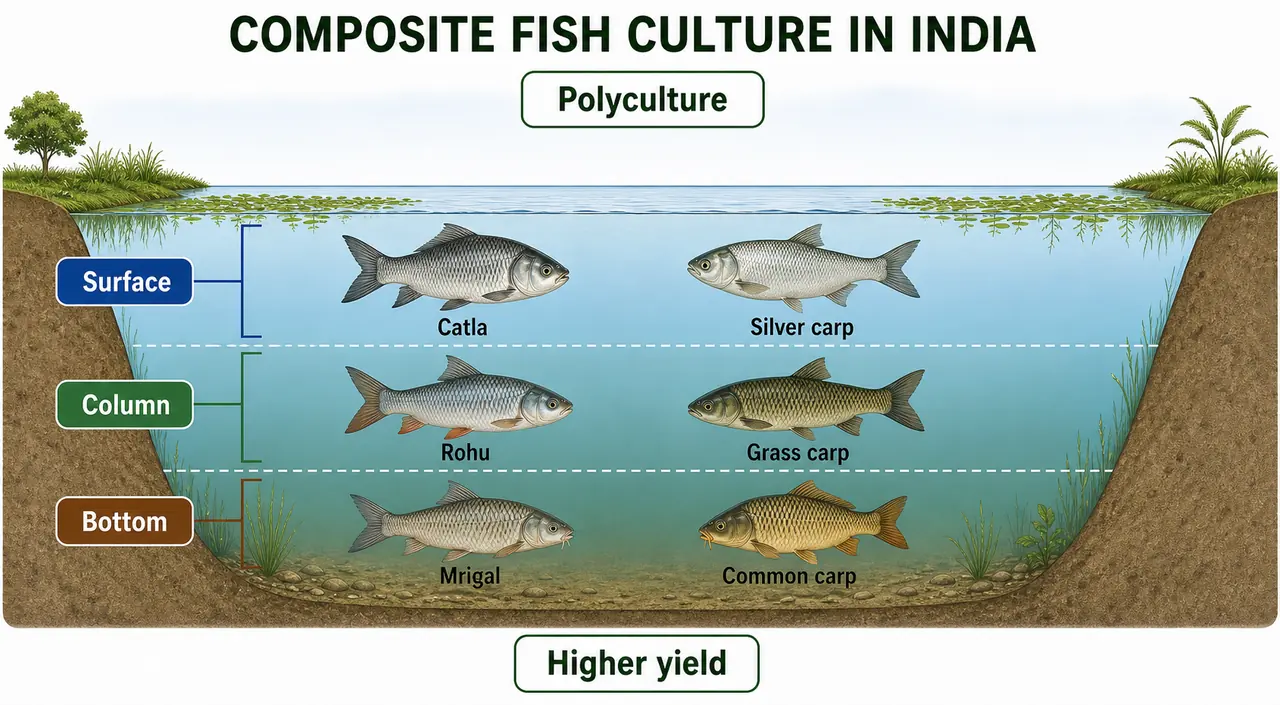
Think of them as occupying three floors of an apartment building -- each living and eating at its own level, so there is no conflict.
The Three Exotic Carps
To complement the Indian carps and fill remaining food niches, three exotic species are added:
- Silver Carp (Hypothalmichthys molitrix) -- Surface feeder, feeds on phytoplankton
- Grass Carp (Ctenopharyngodon idella) -- Column/surface feeder, feeds on aquatic weeds
- Common Carp (Cyprinus carpio) -- Bottom feeder, feeds on mud-dwelling invertebrates
Together, the six-species combination (3 IMC + 3 Exotic) is the gold standard for polyculture in Indian aquaculture.
Species Feeding Zones at a Glance
| Species | Origin | Feeding Zone | Primary Food | Key Trait |
|---|---|---|---|---|
| Catla | Indian | Surface | Zooplankton | Fastest grower among IMC |
| Silver Carp | Exotic | Surface | Phytoplankton | Filters microscopic algae |
| Rohu | Indian | Column (mid-water) | Decaying vegetation, plankton | Most popular table fish |
| Grass Carp | Exotic | Column/surface | Aquatic weeds, macrophytes | Biological weed control |
| Mrigal | Indian | Bottom | Detritus, algae | Hardy and disease-resistant |
| Common Carp | Exotic | Bottom | Bottom organisms, invertebrates | Tolerates low oxygen |
TIP
Mnemonic to remember feeding zones:
- Indian Carps = C-R-M (Catla-Rohu-Mrigal) at Surface-Column-Bottom
- Exotic Carps = S-G-C (Silver-Grass-Common) mirror the same three zones
- Think: "CRM sells fish, SGC helps them grow"
Why Polyculture Works Better Than Monoculture
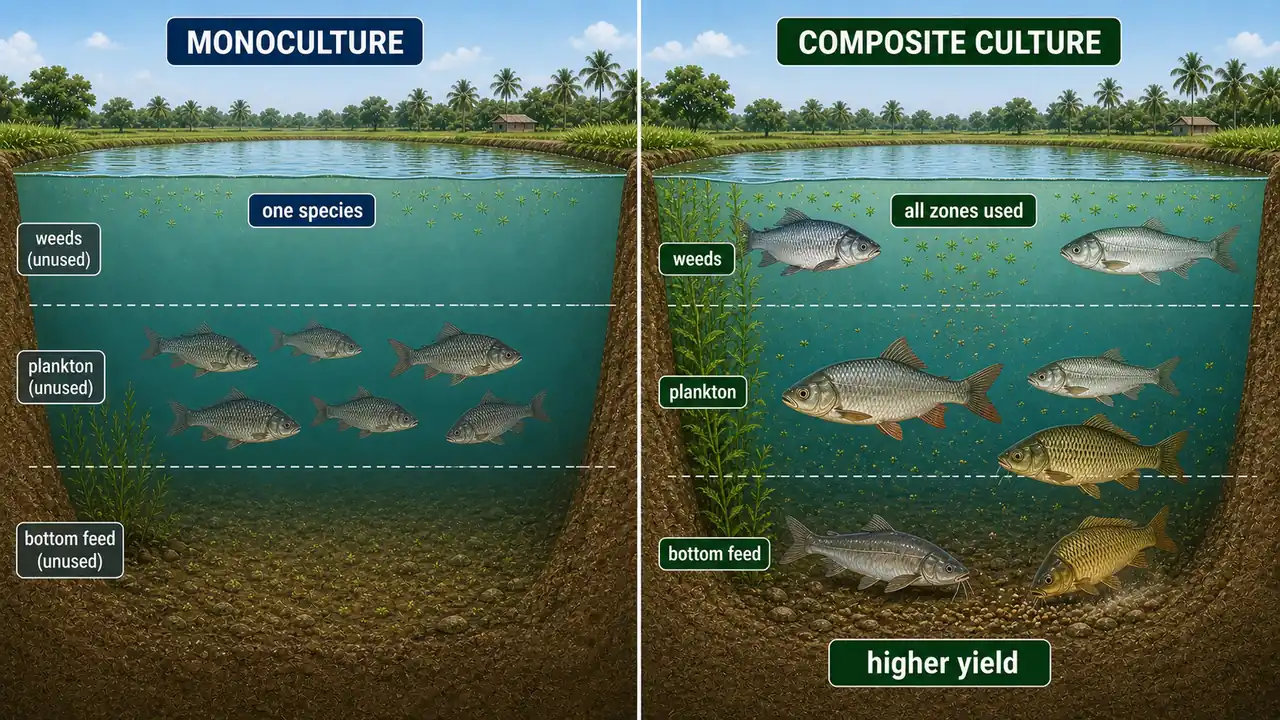
The principle is simple: no single species can utilize all food resources in a pond. By stocking species with complementary feeding habits, every ecological niche is occupied.
| Parameter | Monoculture | Polyculture (6 species) |
|---|---|---|
| Food utilization | Only one zone used | All zones exploited |
| Typical yield | 2-3 tonnes/ha/year | 6-8 tonnes/ha/year |
| Weed control | Manual required | Grass carp controls weeds |
| Risk | High (single species failure) | Spread across species |
| Economic returns | Moderate | Significantly higher |
Why Six Species and Not More?
The six-species model works because each species occupies a distinct feeding niche without significant overlap. Adding more species would increase competition for the same food resources, negating the advantage of polyculture. The system is carefully balanced so that surface, mid-water, and bottom zones are each shared by one Indian and one exotic carp with complementary diets.
Recommended Stocking Ratios
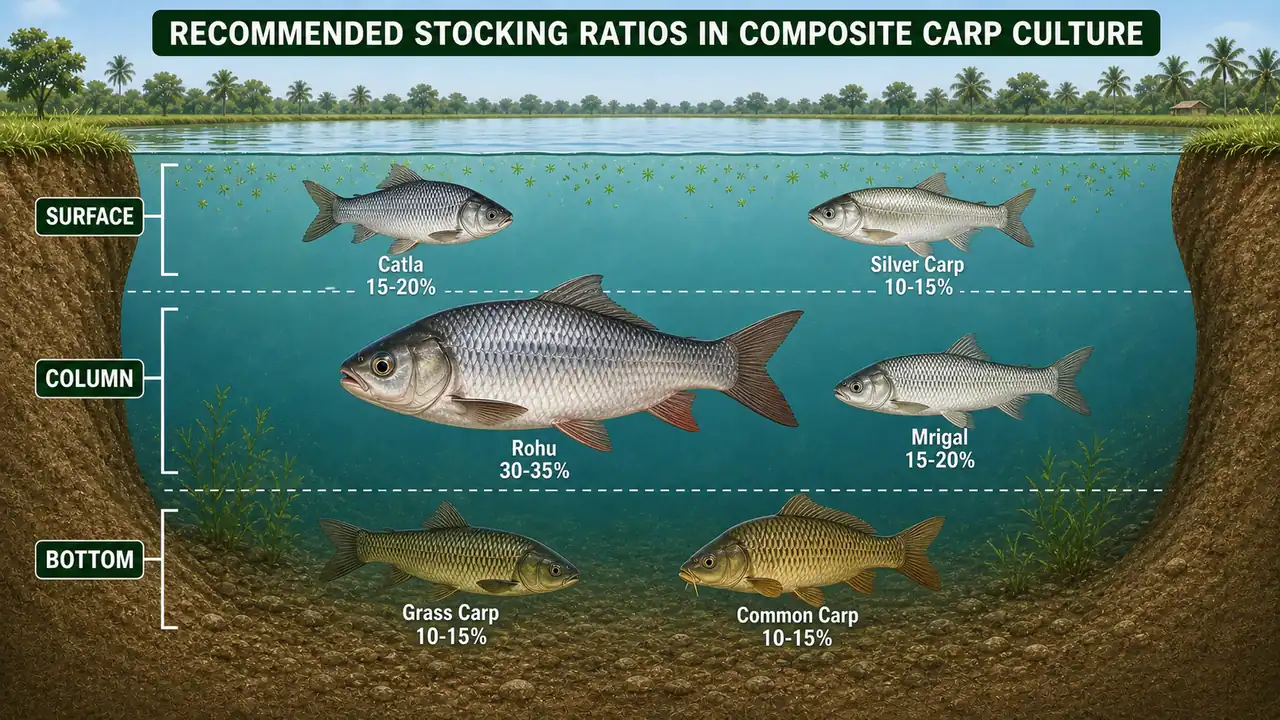
The standard stocking ratio for composite fish culture in India is:
| Species | Percentage of Total Stock |
|---|---|
| Catla | 15-20% |
| Rohu | 30-35% |
| Mrigal | 15-20% |
| Silver Carp | 10-15% |
| Grass Carp | 10-15% |
| Common Carp | 10-15% |
- Rohu gets the highest share because it is the most popular table fish with the highest market demand.
- Total stocking density is typically 8,000-10,000 fingerlings/ha for semi-intensive culture.
NOTE
Stocking ratios can be adjusted based on local market demand. In regions where Catla fetches a premium price, its proportion can be increased.
Species Feeding Habit and Feeding Zone
The diagram above illustrates how different carp species feed at different levels of the pond. This niche separation is the fundamental principle behind the success of composite fish culture (polyculture), where multiple species are stocked together to maximize the utilization of the pond's food resources without significant competition.
Agricultural Connection: Carp in Integrated Farming
Carp culture integrates beautifully with agriculture:
- Rice-fish culture -- Carps are raised in flooded paddy fields, eating pests and fertilizing the soil
- Duck-fish integration -- Duck droppings fertilize pond water, promoting plankton growth for carps
- Horticulture-fish system -- Pond dykes are used for growing vegetables and fruits, with fish waste enriching the soil
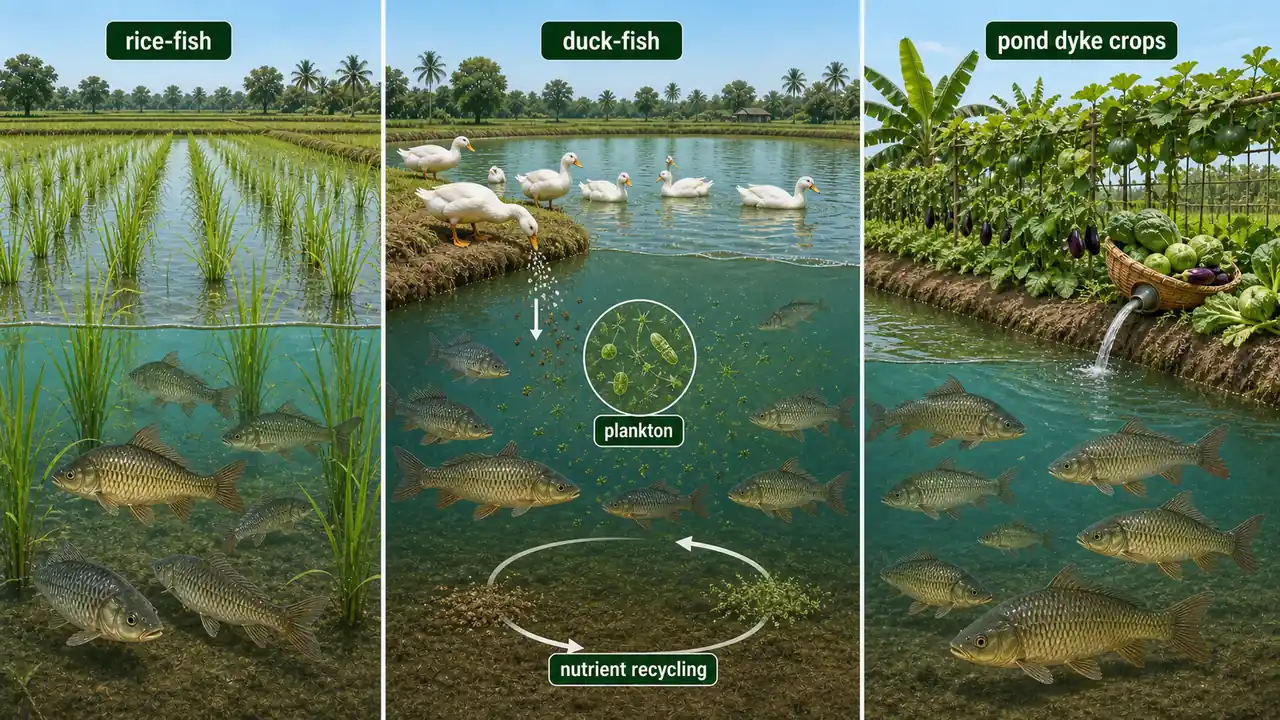
This integration increases total farm income by 40-60% compared to standalone crop farming.
Exam Tips and Quick Recall
TIP
Frequently asked in exams, NABARD, and FCI exams:
- Name the 3 Indian Major Carps -- Catla, Rohu, Mrigal
- Which carp is the fastest grower? -- Catla
- Which exotic carp controls aquatic weeds? -- Grass Carp
- Family of all carps -- Cyprinidae
- What is the principle behind polyculture? -- Different feeding niches, no competition
Summary Table
| Topic | Key Fact |
|---|---|
| Family | Cyprinidae (3,000+ species) |
| Indian Major Carps | Catla, Rohu, Mrigal (C-R-M) |
| Exotic Carps | Silver Carp, Grass Carp, Common Carp (S-G-C) |
| Feeding zones | Surface, Column, Bottom |
| Polyculture yield | 6-8 tonnes/ha/year |
| Stocking density | 8,000-10,000 fingerlings/ha |
| Most popular table fish | Rohu |
| Weed controller | Grass Carp |
| Best integrated system | Rice-fish, Duck-fish |
Explore More
Summary Cheat Sheet
| Concept / Topic | Key Details |
|---|---|
| Carp family | Cyprinidae; largest freshwater fish family; 3000+ species |
| Carp contribution | Over 80% of India's freshwater fish harvest |
| Indian Major Carps (IMC) | Catla, Rohu, Mrigal (mnemonic: C-R-M) |
| Exotic Carps | Silver Carp, Grass Carp, Common Carp (mnemonic: S-G-C) |
| Catla (Catla catla) | Surface feeder; eats zooplankton; fastest grower among IMC |
| Rohu (Labeo rohita) | Column (mid-water) feeder; decaying vegetation; most popular table fish |
| Mrigal (Cirrhinus mrigal) | Bottom feeder; eats detritus & algae; hardy, disease-resistant |
| Silver Carp | Surface feeder; eats phytoplankton; filters microscopic algae |
| Grass Carp | Column/surface feeder; eats aquatic weeds; biological weed control |
| Common Carp (Cyprinus carpio) | Bottom feeder; eats invertebrates; tolerates low oxygen |
| Polyculture advantage | Monoculture: 2–3 t/ha; Polyculture: 6–8 t/ha |
| 6-species combination | 3 IMC + 3 Exotic = gold standard for Indian polyculture |
| Principle | No single species can utilise all food in a pond |
| Stocking ratio | Surface:Column:Bottom balanced for maximum production |