🎏 Composite Fish Culture (Polyculture)
Principles, species selection, stocking ratios, advantages, and yield comparison of composite fish culture in Indian aquaculture
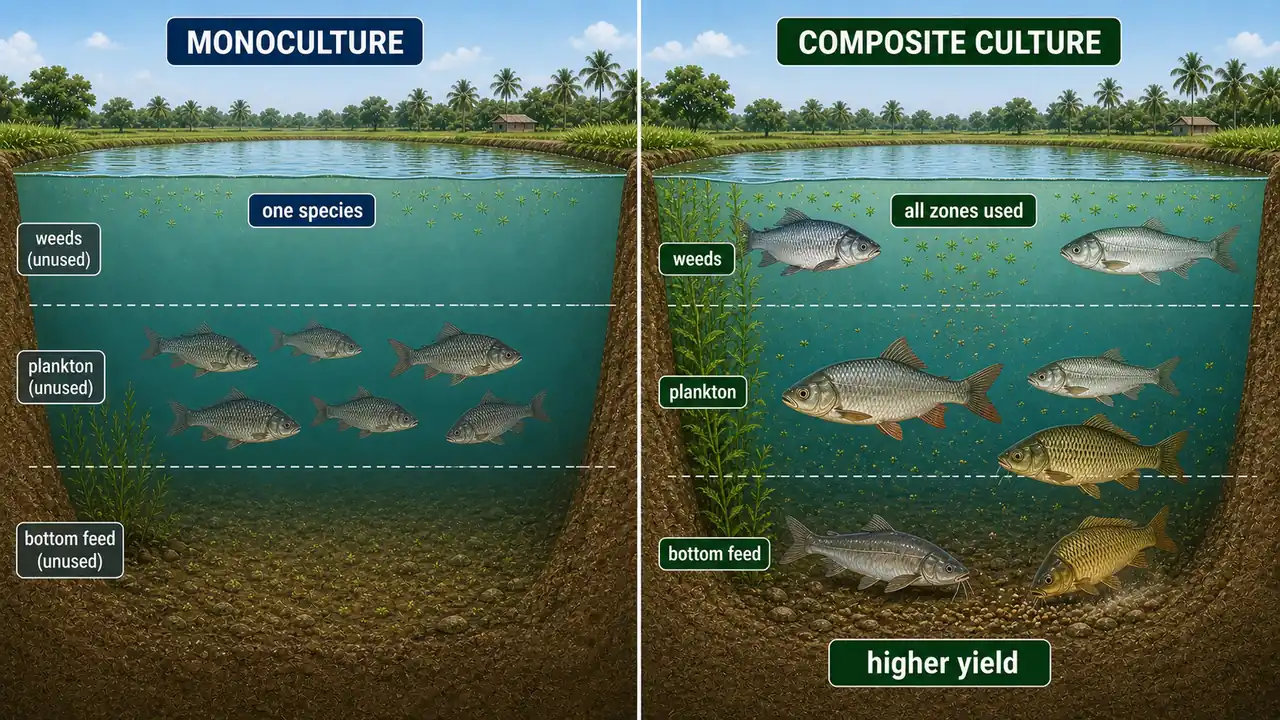
From Paddy Field to Fish Pond
In the wetlands of West Bengal, a farmer noticed that fish naturally thrived in his flooded rice fields -- but only one or two species survived. When he learned to stock six different species, each feeding at a different depth, his fish yield tripled without increasing the pond area. This is the essence of composite fish culture -- nature's own efficiency, guided by science.
What is Composite Fish Culture?
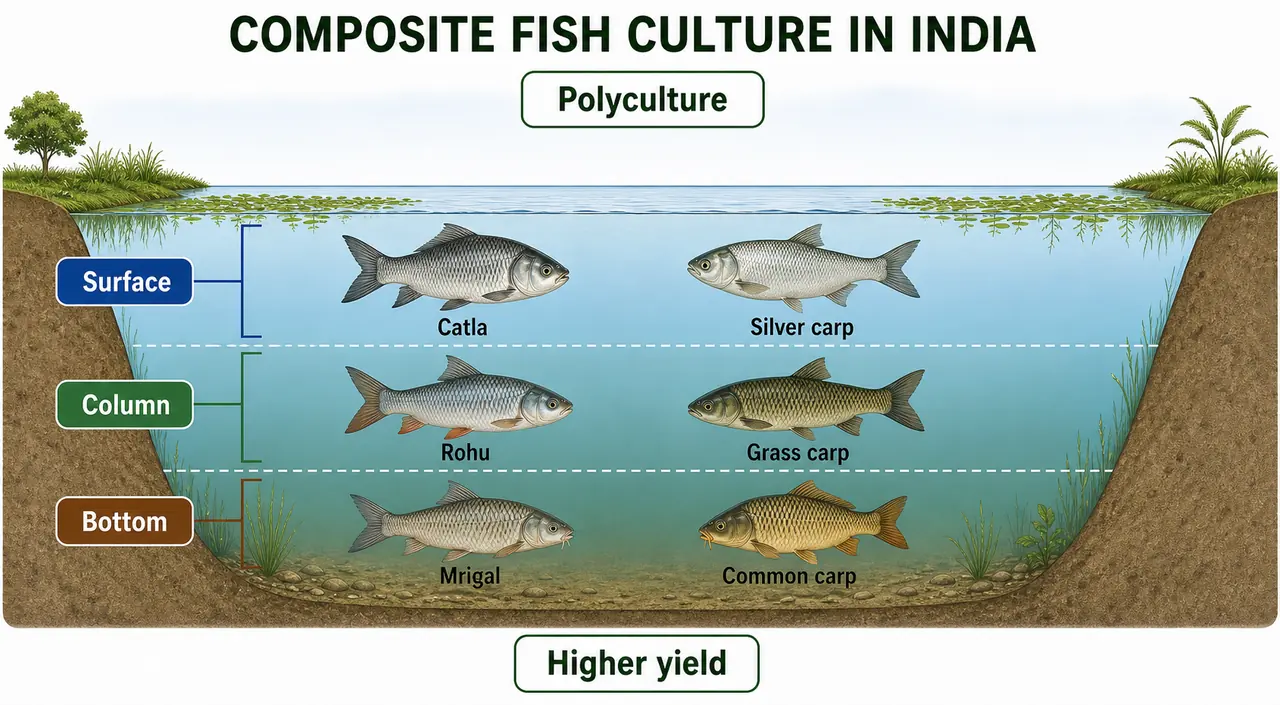
Composite fish culture (also called polyculture) is the practice of stocking fish of different feeding habits in the same pond to maximize total fish production.
Pro Content Locked
Upgrade to Pro to access this lesson and all other premium content.
₹99 charged monthly · Cancel anytime
- All Agriculture & Banking Courses
- AI Lesson Questions (100/day)
- AI Doubt Solver (50/day)
- Glows & Grows Feedback (30/day)
- AI Section Quiz (20/day)
- 22-Language Translation (100/day)
- Recall Questions (20/day)
- AI Quiz (15/day)
- AI Quiz Paper Analysis (100/day)
- AI Step-by-Step Explanations (100/day)
- Spaced Repetition Recall (FSRS)
- AI Tutor
- Immersive Text Questions
- Audio Lessons — Hindi & English
- Mock Tests & Previous Year Papers
- Summary & Mind Maps
- XP, Levels, Leaderboard & Badges
- Generate New Classrooms
- Voice AI Teacher (AgriDots Live)
- AI Revision Assistant
- Knowledge Gap Analysis
- Interactive Revision (LangGraph)
🔒 Secure via Razorpay · Cancel anytime · No hidden fees
From Paddy Field to Fish Pond
In the wetlands of West Bengal, a farmer noticed that fish naturally thrived in his flooded rice fields -- but only one or two species survived. When he learned to stock six different species, each feeding at a different depth, his fish yield tripled without increasing the pond area. This is the essence of composite fish culture -- nature's own efficiency, guided by science.
What is Composite Fish Culture?
Composite fish culture (also called polyculture) is the practice of stocking fish of different feeding habits in the same pond to maximize total fish production.
- The term "different habits" refers to differences in feeding behaviour and habitat preference (surface, column, or bottom of the pond).
- The core principle: no single fish species can utilize all the food resources present in a pond. By combining surface feeders, column feeders, and bottom feeders, the total biological productivity of the pond is harvested more completely.
IMPORTANT
In India, composite fish culture typically involves 3 Indian Major Carps -- Catla (surface), Rohu (column), and Mrigal (bottom) -- along with 3 Exotic Carps -- Silver Carp (surface), Grass Carp (weed feeder), and Common Carp (bottom). This six-species combination is the gold standard.
The Logic Behind Species Selection
Think of a pond as a three-storey building with a restaurant on each floor:
| Floor (Zone) | Indian Carp | Exotic Carp | Food Available |
|---|---|---|---|
| Surface (top) | Catla -- eats zooplankton | Silver Carp -- eats phytoplankton | Plankton floating at the surface |
| Column (middle) | Rohu -- eats decaying vegetation | Grass Carp -- eats aquatic weeds | Submerged plants and organic matter |
| Bottom (floor) | Mrigal -- eats detritus and algae | Common Carp -- eats invertebrates | Mud-dwelling organisms and debris |
Each floor has two diners with different menus, so they do not compete with each other.
TIP
Mnemonic: "CRM on the Indian side, SGC on the exotic side" -- Catla-Rohu-Mrigal vs Silver-Grass-Common, each pair sharing a zone but eating different food.
Advantages of Composite Fish Culture
| Advantage | Explanation |
|---|---|
| Maximum food utilization | All natural food in the pond is consumed across zones |
| Higher yield per hectare | 6-8 tonnes/ha vs 2-3 tonnes/ha in monoculture |
| Reduced competition | Different feeding habits prevent overlap |
| Biological weed control | Grass Carp eats aquatic weeds, reducing manual labour |
| Better economic returns | Diverse harvest fetches higher total income |
| Efficient pond space use | Surface, middle, and bottom layers all productive |
| Risk diversification | If one species underperforms, others compensate |
Composite Fish Culture vs Monoculture
| Parameter | Monoculture | Composite Fish Culture |
|---|---|---|
| Species stocked | 1 | 5-6 |
| Food zones utilized | 1 | All 3 (surface, column, bottom) |
| Typical yield | 2-3 tonnes/ha/year | 6-8 tonnes/ha/year |
| Weed management | Manual | Grass Carp handles it |
| Disease risk | High (entire stock is same species) | Lower (species diversity) |
| Market flexibility | Limited | Multiple fish types for sale |
Recommended Stocking Density and Ratio
For a standard semi-intensive composite fish culture pond:
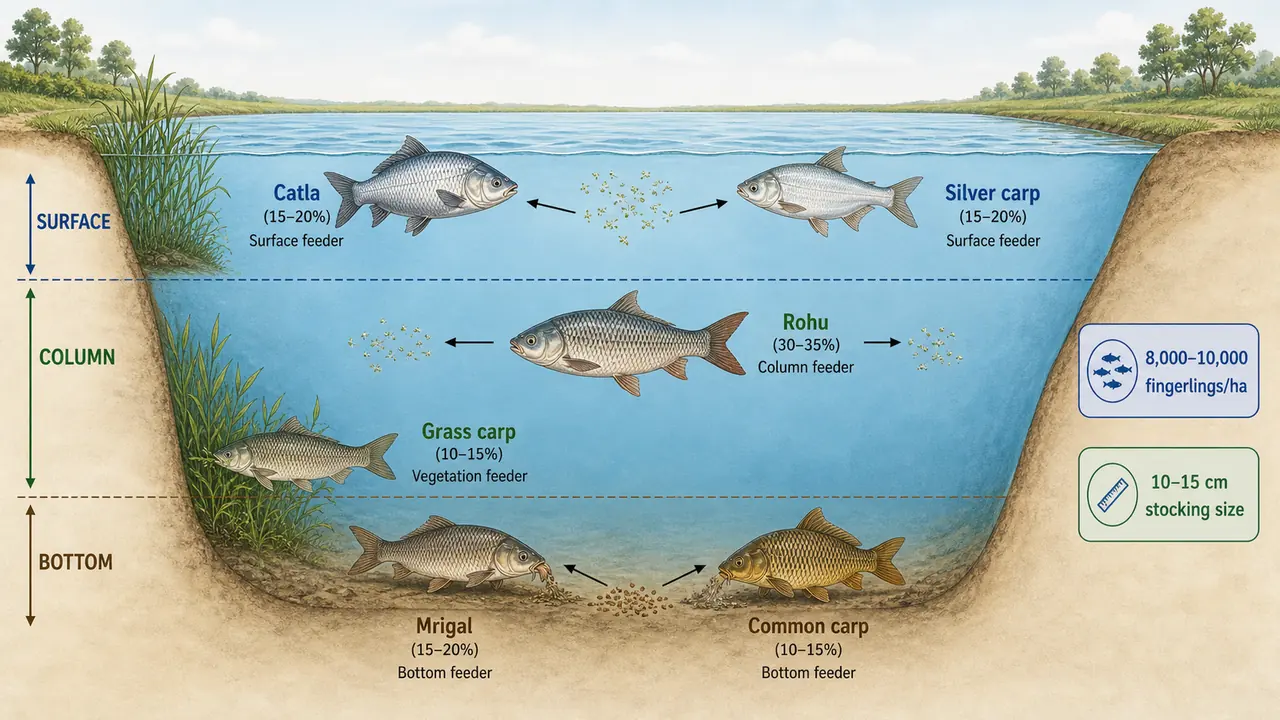
- Total stocking density: 8,000-10,000 fingerlings/ha
- Fingerling size at stocking: 10-15 cm
| Species | Recommended % | Reason |
|---|---|---|
| Catla | 15-20% | Fast grower, high market value |
| Rohu | 30-35% | Most popular table fish |
| Mrigal | 15-20% | Hardy bottom feeder |
| Silver Carp | 10-15% | Phytoplankton control |
| Grass Carp | 10-15% | Weed control |
| Common Carp | 10-15% | Scavenges bottom waste |
NOTE
Ratios are adjusted based on local food availability and market demand. In areas with heavy weed growth, Grass Carp proportion is increased.
Agricultural Example: Pond on a Mixed Farm
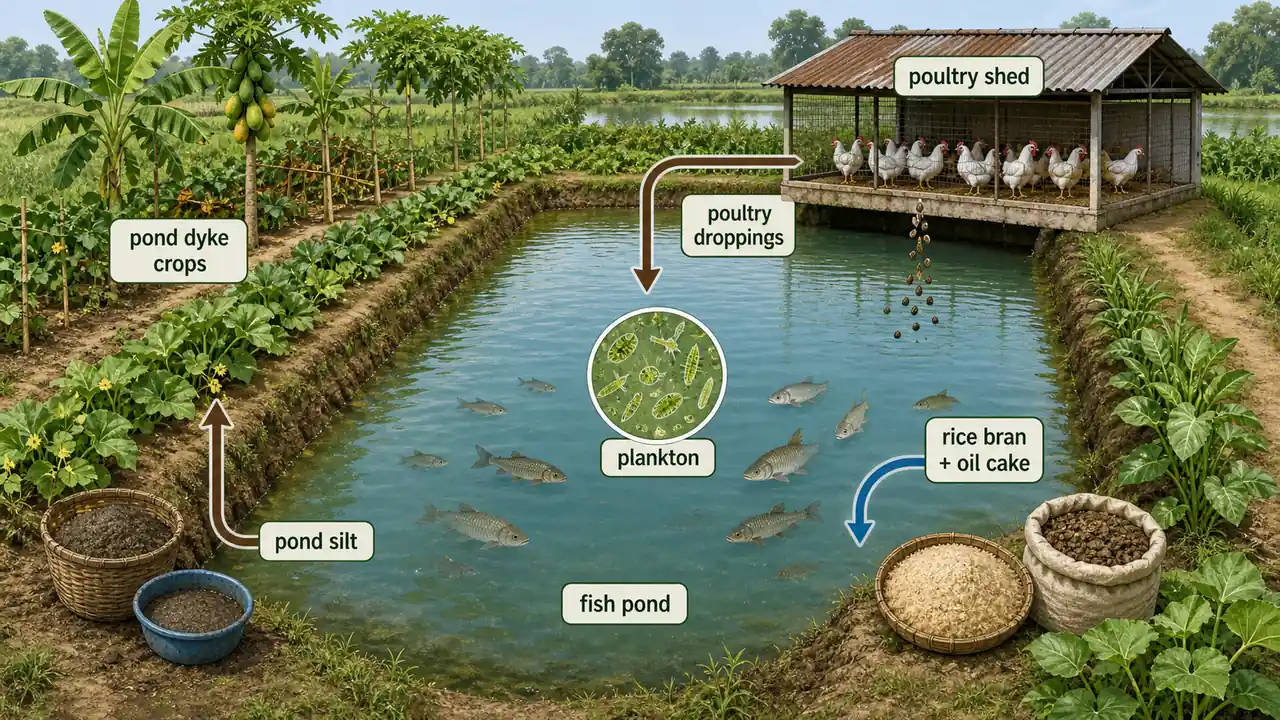
A farmer in Andhra Pradesh with a 1-hectare pond and surrounding agricultural land can integrate composite fish culture with farming:
- Pond dykes -- grow vegetables (brinjal, okra) and fruit trees (banana, papaya)
- Poultry shed over pond -- droppings fall directly into water, promoting plankton for Catla and Silver Carp
- Rice bran and mustard oil cake -- used as supplementary feed at a ratio of 1:1
- Harvested pond silt -- rich in nutrients, used as fertilizer for crops
This integrated approach can increase total farm income by 40-60% compared to standalone agriculture.
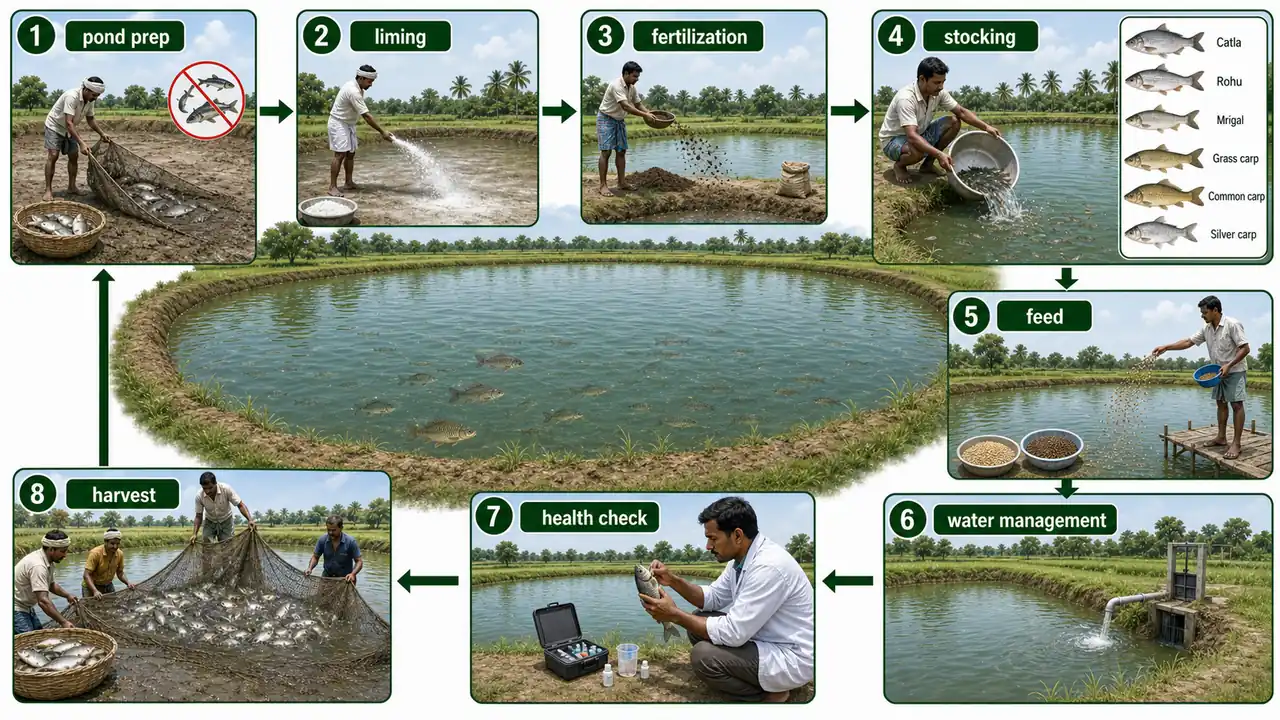
Key Culture Practices
- Pond preparation -- Remove predatory and weed fish using Mahua oil cake (250 ppm) or bleaching powder
- Liming -- Apply lime at 200-300 kg/ha to maintain pH between 7.5 and 8.5
- Fertilization -- Apply cow dung at 5,000 kg/ha/year + NPK fertilizers to promote plankton
- Stocking -- Stock healthy fingerlings (10-15 cm) in the recommended ratio
- Feeding -- Provide supplementary feed (rice bran + oil cake, 1:1) at 2-5% of fish body weight
- Water management -- Maintain water depth at 1.5-2 m, replenish evaporation losses
- Health monitoring -- Watch for disease signs; treat with KMnO4 (2-5 ppm) if needed
- Harvesting -- After 10-12 months, drain-harvest or net-harvest fish above 750 g
Exam Tips
TIP
High-frequency exam questions on composite fish culture:
- How many species in standard polyculture? -- 6 (3 IMC + 3 Exotic)
- Which species controls weeds? -- Grass Carp
- Surface feeders in composite culture? -- Catla (zooplankton) and Silver Carp (phytoplankton)
- Why is polyculture better than monoculture? -- Utilizes all food niches, higher yield
- Recommended stocking density? -- 8,000-10,000 fingerlings/ha
Why Six Species and Not More?
The six-species model works because each species occupies a distinct feeding niche without significant overlap. Adding more species would increase competition for the same food resources, negating the advantage of polyculture. The system is carefully balanced so that surface, mid-water, and bottom zones are each shared by one Indian and one exotic carp with complementary diets.
Summary Table
| Topic | Key Fact |
|---|---|
| Definition | Stocking fish of different feeding habits in the same pond |
| Core principle | No single species utilizes all food resources |
| Standard combination | 3 IMC (Catla, Rohu, Mrigal) + 3 Exotic (Silver, Grass, Common) |
| Feeding zones | Surface, Column, Bottom |
| Stocking density | 8,000-10,000 fingerlings/ha |
| Yield (polyculture) | 6-8 tonnes/ha/year |
| Yield (monoculture) | 2-3 tonnes/ha/year |
| Culture period | 10-12 months |
| Weed control species | Grass Carp |
| Most popular table fish | Rohu |
Summary Cheat Sheet
| Concept / Topic | Key Details |
|---|---|
| Composite fish culture | AKA polyculture; stocking fish of different feeding habits in same pond |
| Core principle | No single species can utilise all food resources in a pond |
| Species count | Typically 5–6 species (3 IMC + 3 Exotic) |
| Surface feeders | Catla (zooplankton) + Silver Carp (phytoplankton) |
| Column feeders | Rohu (decaying vegetation) + Grass Carp (aquatic weeds) |
| Bottom feeders | Mrigal (detritus) + Common Carp (invertebrates) |
| Yield — monoculture | 2–3 tonnes/ha/year |
| Yield — composite culture | 6–8 tonnes/ha/year |
| Weed control species | Grass Carp (biological weed control) |
| Most popular table fish | Rohu |
| Culture period | 10–12 months |
| Disease risk advantage | Lower (species diversity reduces single-species epidemics) |
| Stocking density | 5,000–10,000 fingerlings/ha (semi-intensive) |
| Key advantage | Maximum food utilisation across all zones |
| Risk diversification | If one species underperforms, others compensate |
| Mnemonic (Indian) | CRM = Catla-Rohu-Mrigal (Surface-Column-Bottom) |
| Mnemonic (Exotic) | SGC = Silver-Grass-Common |