🦐 Shrimp Culture -- Species, Parameters, and Practices
Important shrimp species (P. monodon, P. vannamei), water and soil requirements, stocking guidelines, CRZ regulations, and harvesting methods
From Coastal Ponds to Export Earnings
Along the coast of Andhra Pradesh, thousands of farmers have transformed low-lying saline lands -- once considered wasteland -- into productive shrimp farms. India is now one of the world's top shrimp exporters, with shrimp contributing over 70% of seafood export earnings. Understanding shrimp culture is essential for fisheries, banking, and agriculture exams.
What is Shrimp Culture?
Shrimp culture is an aquaculture practice that involves farming shrimp (marine) or prawns (freshwater) in controlled or semi-controlled environments, primarily in brackish water ponds along coastal areas.
- The terms shrimp and prawn are often used interchangeably in commercial contexts, though technically "shrimp" refers to marine species and "prawn" to freshwater species.
- India is among the leading shrimp-producing nations globally, driven largely by the culture of Penaeus vannamei (White Leg Shrimp).
NOTE
Pro Content Locked
Upgrade to Pro to access this lesson and all other premium content.
₹99 charged monthly · Cancel anytime
- All Agriculture & Banking Courses
- AI Lesson Questions (100/day)
- AI Doubt Solver (50/day)
- Glows & Grows Feedback (30/day)
- AI Section Quiz (20/day)
- 22-Language Translation (100/day)
- Recall Questions (20/day)
- AI Quiz (15/day)
- AI Quiz Paper Analysis (100/day)
- AI Step-by-Step Explanations (100/day)
- Spaced Repetition Recall (FSRS)
- AI Tutor
- Immersive Text Questions
- Audio Lessons — Hindi & English
- Mock Tests & Previous Year Papers
- Summary & Mind Maps
- XP, Levels, Leaderboard & Badges
- Generate New Classrooms
- Voice AI Teacher (AgriDots Live)
- AI Revision Assistant
- Knowledge Gap Analysis
- Interactive Revision (LangGraph)
🔒 Secure via Razorpay · Cancel anytime · No hidden fees
From Coastal Ponds to Export Earnings
Along the coast of Andhra Pradesh, thousands of farmers have transformed low-lying saline lands -- once considered wasteland -- into productive shrimp farms. India is now one of the world's top shrimp exporters, with shrimp contributing over 70% of seafood export earnings. Understanding shrimp culture is essential for fisheries, banking, and agriculture exams.
What is Shrimp Culture?
Shrimp culture is an aquaculture practice that involves farming shrimp (marine) or prawns (freshwater) in controlled or semi-controlled environments, primarily in brackish water ponds along coastal areas.
- The terms shrimp and prawn are often used interchangeably in commercial contexts, though technically "shrimp" refers to marine species and "prawn" to freshwater species.
- India is among the leading shrimp-producing nations globally, driven largely by the culture of Penaeus vannamei (White Leg Shrimp).
NOTE
In exam contexts, "shrimp" and "prawn" are often used interchangeably. Focus on the scientific names of key species rather than the common-name distinction.
Important Shrimp Species
Selecting the right species is a critical first step in shrimp farming. The choice depends on growth rate, market price, disease resistance, and local environmental conditions.
| Species | Common Name | Key Features |
|---|---|---|
| Penaeus monodon | Tiger Prawn | Largest farmed species, rapid growth, high market price |
| Penaeus indicus | Indian White Prawn | Adaptable to wide salinity range, good market demand |
| Penaeus vannamei (Litopenaeus vannamei) | White Leg Shrimp / Pacific White Shrimp / King Prawn | Most widely farmed globally, tolerates high stocking density |
| Metapenaeus monoceros | Speckled Shrimp | Commercially important, smaller size |
| Penaeus semisulcatus | Green Tiger Prawn | Potential species for Indian culture |
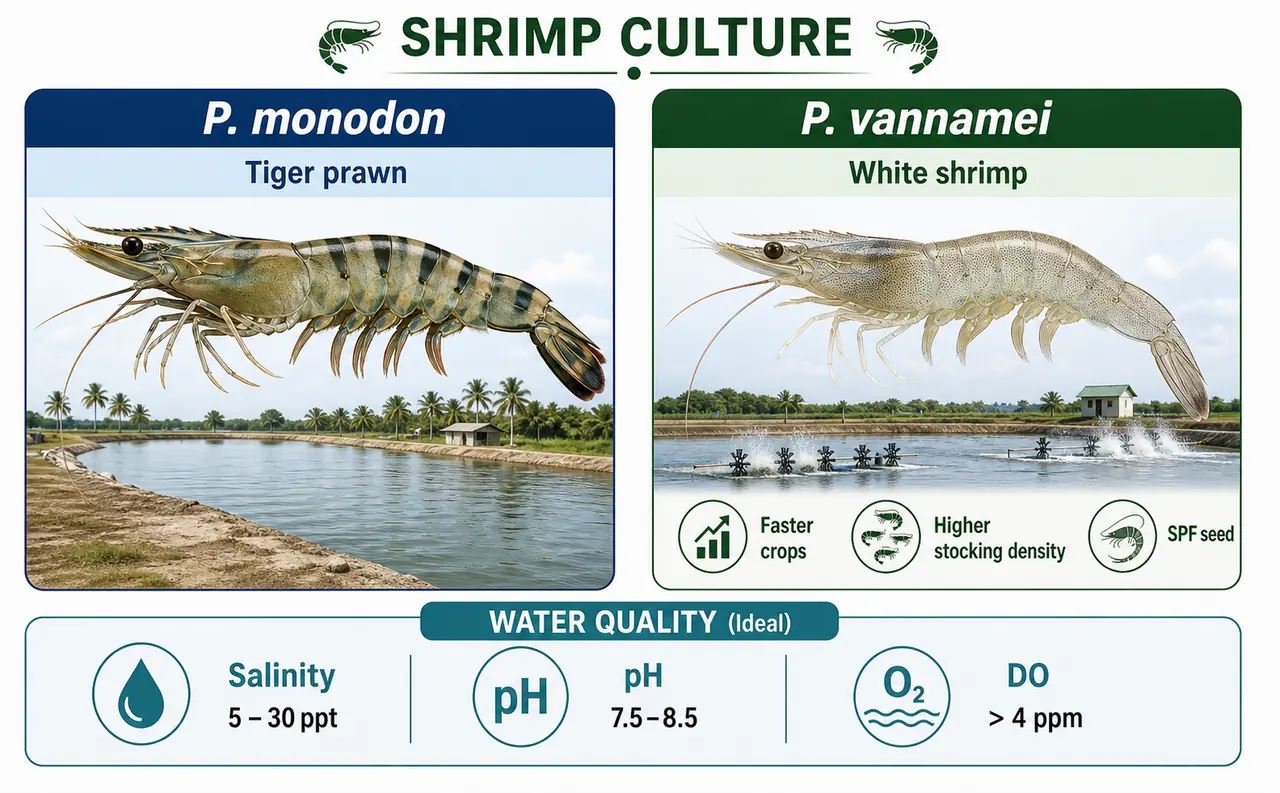
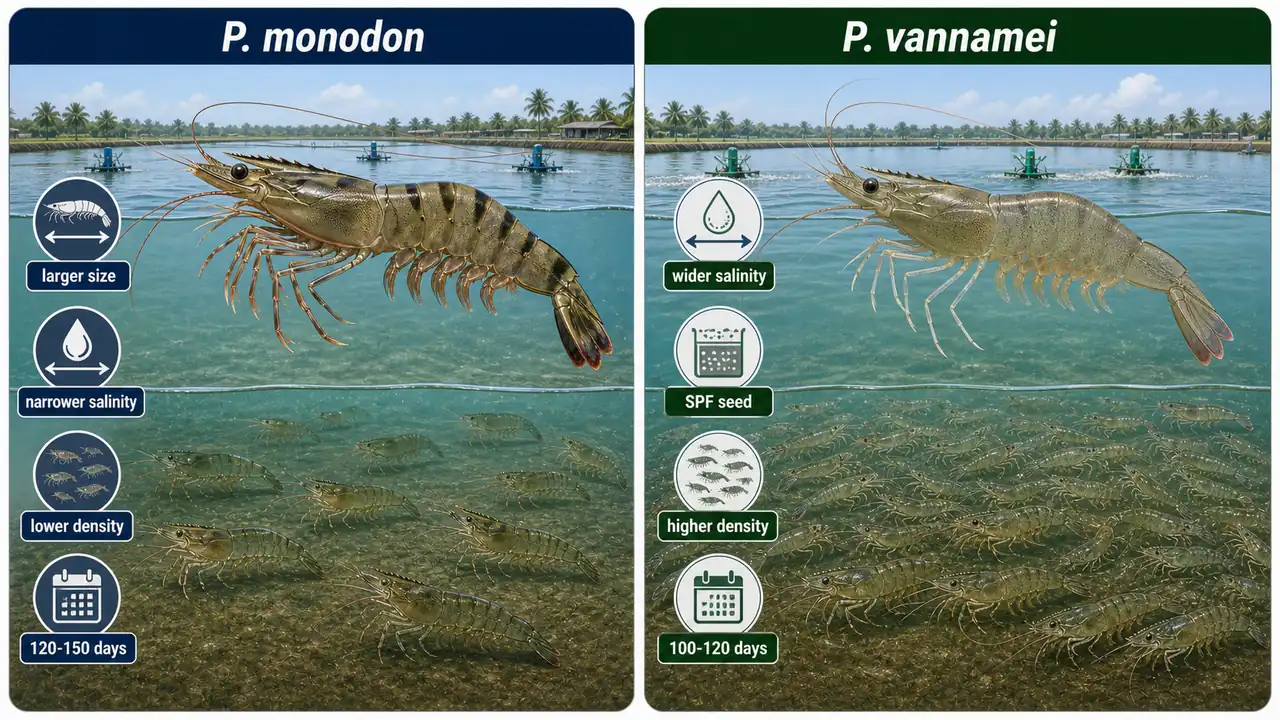
P. monodon vs P. vannamei -- A Key Comparison
| Parameter | P. monodon (Tiger Prawn) | P. vannamei (White Leg Shrimp) |
|---|---|---|
| Origin | Indo-Pacific | Eastern Pacific (Central/South America) |
| Maximum size | 30-35 cm | 20-23 cm |
| Growth rate | Fast (but variable) | Very fast and uniform |
| Culture period | 120-150 days | 100-120 days |
| Stocking density tolerance | Moderate | High (up to 60-100/m2) |
| Salinity tolerance | Narrow range | Wide range (0.5-45 ppt) |
| Disease risk | High (WSSV susceptible) | Lower (SPF seed available) |
| Market size at harvest | 25-30 g | 20 g |
| Crops per year | 1-2 | 2-3 |
| Current dominance in India | Declining | Dominant (>90% of production) |
IMPORTANT
P. vannamei has largely replaced P. monodon in Indian shrimp farming due to its tolerance of lower salinity, higher stocking densities, shorter culture period (2-3 crops/year), and availability of specific pathogen-free (SPF) seed. Vannamei now dominates Indian shrimp exports.
Water Quality Parameters
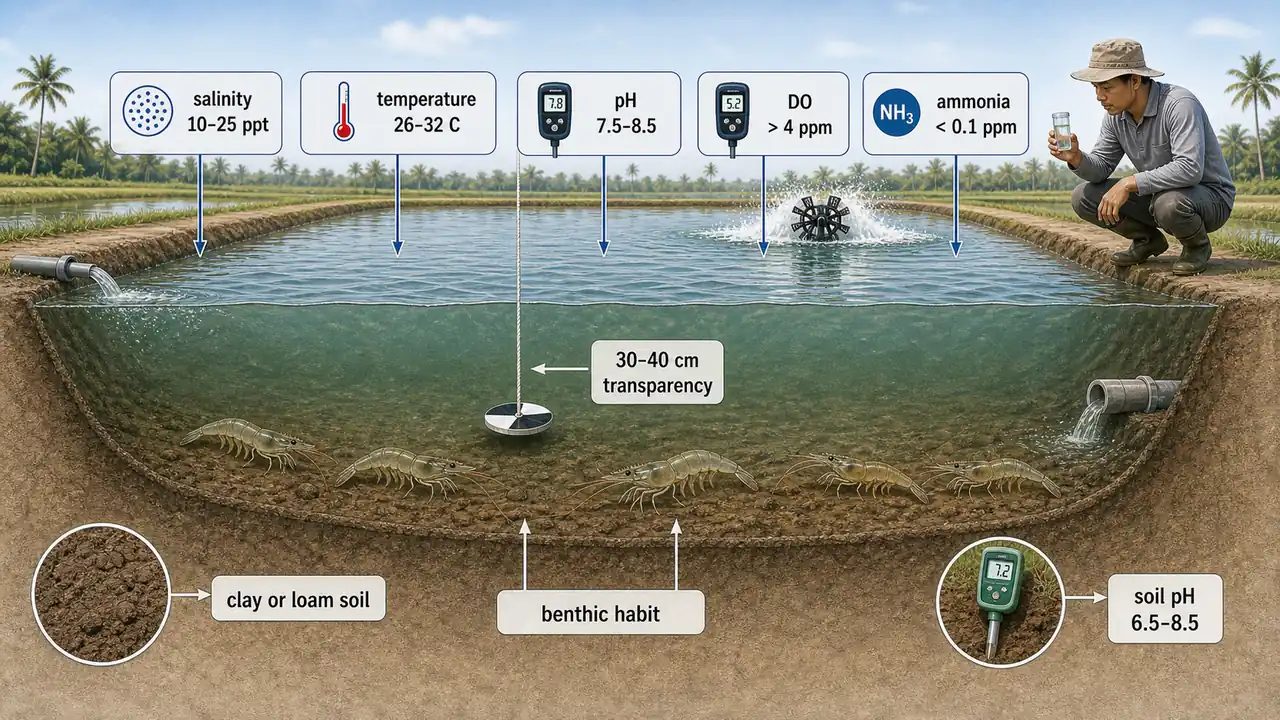
Site should have good, pollution-free supply of both freshwater and brackish water. Access to both is important because farmers need to adjust salinity levels depending on the growth stage and seasonal changes.
| Parameter | Optimal Range |
|---|---|
| Salinity | 10-25 ppt (P. monodon) |
| Temperature | 26-32 degree C |
| pH | 7.5-8.5 |
| Dissolved Oxygen | >4 ppm |
| Transparency | 30-40 cm (Secchi disc) |
| Ammonia | <0.1 ppm |
TIP
Memory aid for shrimp water quality: "STPDA" -- Salinity (10-25), Temperature (26-32), pH (7.5-8.5), DO (>4), Ammonia (<0.1).
Soil Conditions
- Shrimp are benthic organisms (bottom dwellers), so pond bottom quality directly affects their health, feeding, and growth.
- Preferred soil: Clay or loam-based containing more than 90% clay
- Soil pH: 6.5-8.5
- Why clay soil? Excellent water retention capacity, preventing seepage and maintaining adequate water levels throughout the culture period.
Stocking Guidelines and CRZ Regulations
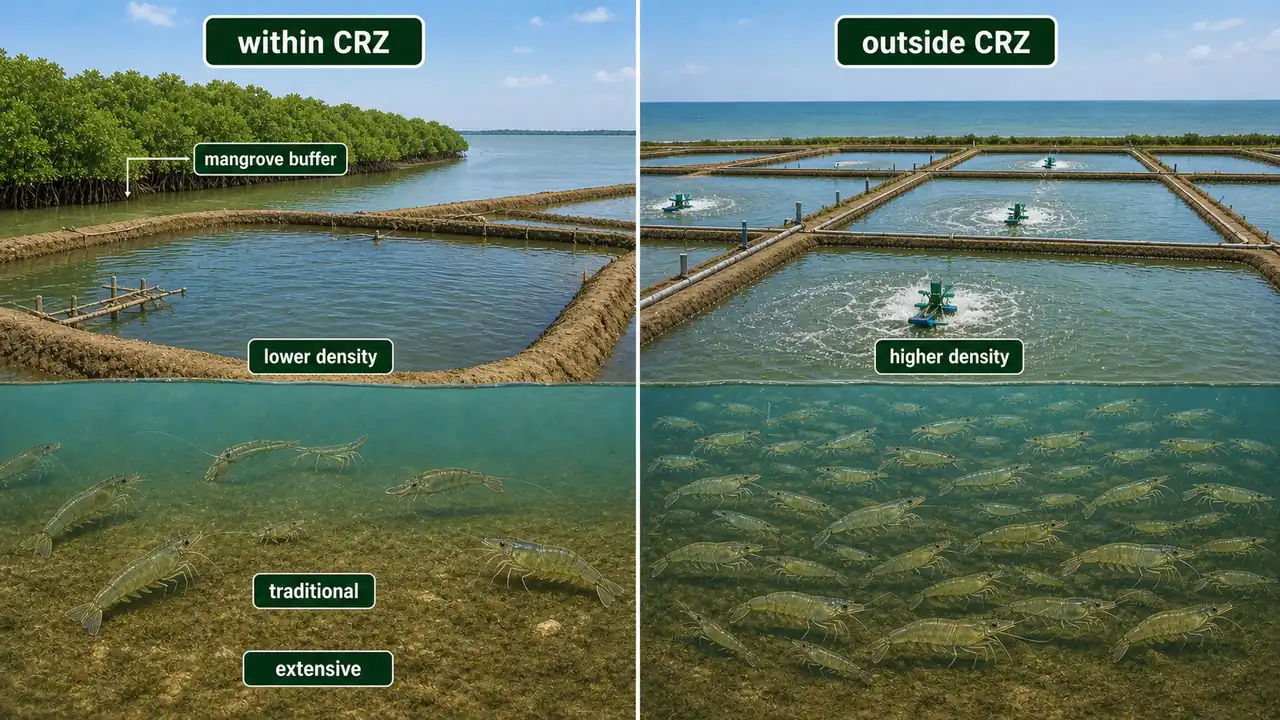
Stocking density directly affects shrimp growth, survival, and farm economics. In India, the Supreme Court has issued directives to prevent environmental damage from unregulated shrimp farming.
| Zone | Production Range | Stocking Density | Farming Type |
|---|---|---|---|
| Within CRZ | 1-1.5 t/ha/crop | 40,000-60,000/ha/crop | Traditional and improved traditional only |
| Outside CRZ | 2.5-3 t/ha/crop | 1,00,000/ha/crop | Extensive farming allowed |
IMPORTANT
The Coastal Regulation Zone (CRZ) is a protected area along India's coastline. Supreme Court directives restrict shrimp farming within CRZ to address concerns about mangrove destruction and coastal water pollution. This is frequently asked in exams.
Methods of Harvesting
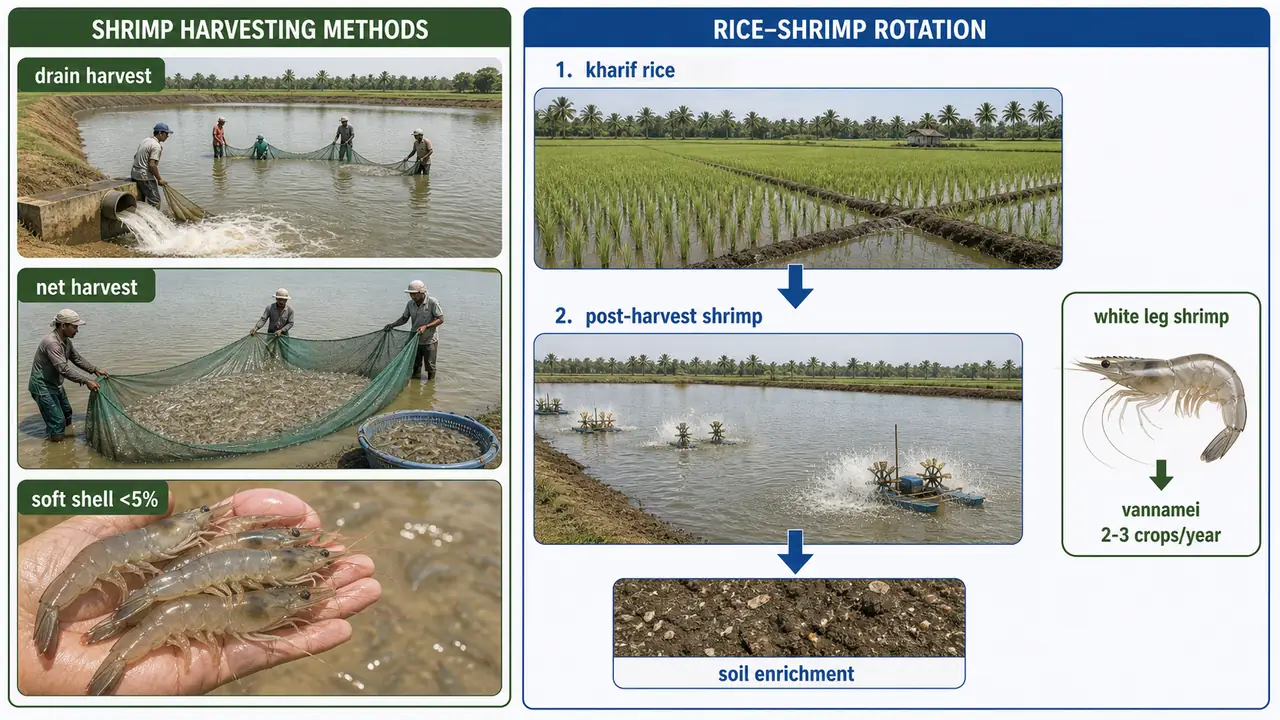
Two methods are generally practiced:
| Method | Description | When Used |
|---|---|---|
| Drain harvesting | Gradually lower water level; collect shrimp at sluice gate using bag net | Final/complete harvest |
| Net harvesting | Use cast nets or drag nets within the pond | Partial harvests |
- The proportion of soft shell shrimp should not exceed 5% at harvest time.
- Soft shell shrimp are those that recently moulted (shed old shell) and have not developed a hard new shell -- they are fragile, have shorter shelf life, and fetch lower market prices.
- Farmers should time harvests to avoid moulting periods.
TIP
Exam tip: Soft shell shrimp percentage at harvest should be less than 5%. This is a common fact tested in exams.
Agricultural Connection: Shrimp and Rice Integration
In coastal areas of Kerala and West Bengal, farmers practice rice-shrimp rotation:
- Kharif season -- Rice cultivation in the field
- Post-harvest -- Allow saline water to enter; stock shrimp in the same field
- Benefit -- Shrimp waste enriches soil for the next rice crop; dual income from the same land
This integration is an excellent example of how aquaculture and agriculture complement each other in coastal farming systems.
White Leg Shrimp -- The Game Changer
| Feature | Detail |
|---|---|
| Scientific name | Litopenaeus vannamei (formerly Penaeus vannamei) |
| Other names | King Prawn, Pacific White Shrimp |
| Origin | Pacific coast of Central and South America |
| Marketable size | 20 g after 100-120 days |
| Crops per year | 2-3 |
| Key advantages | Fast uniform growth, high density tolerance, SPF seed, wide salinity range |
| Current status | Dominates Indian shrimp production and exports |
Exam Tips and Mnemonics
TIP
Frequently tested facts:
- Tiger Prawn scientific name -- Penaeus monodon
- White Leg Shrimp -- Litopenaeus vannamei (also Penaeus vannamei)
- CRZ stocking density -- 40,000-60,000/ha/crop
- Outside CRZ density -- 1,00,000/ha/crop
- Vannamei culture period -- 100-120 days
- Soft shell limit at harvest -- less than 5%
- Preferred soil -- Clay (>90% clay), pH 6.5-8.5
- Shrimp are benthic -- bottom dwellers
Summary Table
| Topic | Key Fact |
|---|---|
| Major species in India | P. monodon, P. indicus, P. vannamei |
| Dominant species currently | P. vannamei (>90% of production) |
| Culture environment | Brackish water ponds |
| Optimal salinity | 10-25 ppt |
| Optimal temperature | 26-32 degree C |
| Soil type | Clay/loam (>90% clay), pH 6.5-8.5 |
| CRZ stocking limit | 40,000-60,000/ha/crop |
| Outside CRZ limit | 1,00,000/ha/crop |
| Vannamei harvest size | 20 g in 100-120 days |
| Crops per year (vannamei) | 2-3 |
| Harvest methods | Drain harvesting, net harvesting |
| Soft shell limit | <5% at harvest |
| Export significance | >70% of seafood export earnings |
Summary Cheat Sheet
| Concept / Topic | Key Details |
|---|---|
| Shrimp culture | Farming shrimp/prawns in brackish water ponds along coasts |
| Shrimp export share | >70% of India's seafood export earnings |
| P. monodon (Tiger Prawn) | Largest farmed species; Indo-Pacific origin; high market price; 120–150 day culture |
| P. vannamei (White Leg Shrimp) | AKA King Prawn; from eastern Pacific; dominates Indian production (>90%) |
| P. vannamei advantages | High stocking density (60–100/m²); wide salinity (0.5–45 ppt); 2–3 crops/year; SPF seed |
| P. indicus (Indian White Prawn) | Adaptable to wide salinity; good market demand |
| Culture period — vannamei | 100–120 days |
| Harvest market size — vannamei | 20 g |
| Optimal water temp | 26–32°C |
| Optimal salinity (monodon) | 10–25 ppt |
| Optimal pH | 7.5–8.5 |
| Optimal dissolved oxygen | >4 mg/L |
| Soil pH (ideal) | 6.5–8.5 |
| WSSV | White Spot Syndrome Virus; major shrimp disease; P. monodon highly susceptible |
| SPF seed | Specific Pathogen Free; available for vannamei; reduces disease risk |
| CRZ regulations | Coastal Regulation Zone; governs aquaculture pond locations |
| Soft shell limit at harvest | <5% |
| Harvest methods | Drain harvesting, net harvesting |