🧊 Fish Preservation and Diseases
Methods of fish preservation, major fish diseases - bacterial, fungal, parasitic, protozoan, and viral with symptoms and treatments
Importance of Fish
Fish is often referred to as "Rich Food for Poor People" as it provides essential nourishment with both macronutrients and micronutrients. On a fresh-weight basis, fish contains a good quantity of protein, about 18-20%, and all the eight essential amino acids including the sulphur-containing lysine, methionine, and cysteine. The fat content ranges from 0.2% to 25%. Fish generally has less fat than red meats.
Fish is also called "Brain Food" as it helps in development and function of the brain, and "Heart Food" as it contributes to lower risks of heart attacks and strokes.
NOTE
The Golden Mahseer or Himalayan Mahseer (Tor putitora, Hamilton, 1822) is a popular game fish and an angler's delight. It is known as the "Tiger in Water".
Pro Content Locked
Upgrade to Pro to access this lesson and all other premium content.
₹99 charged monthly · Cancel anytime
- All Agriculture & Banking Courses
- AI Lesson Questions (100/day)
- AI Doubt Solver (50/day)
- Glows & Grows Feedback (30/day)
- AI Section Quiz (20/day)
- 22-Language Translation (100/day)
- Recall Questions (20/day)
- AI Quiz (15/day)
- AI Quiz Paper Analysis (100/day)
- AI Step-by-Step Explanations (100/day)
- Spaced Repetition Recall (FSRS)
- AI Tutor
- Immersive Text Questions
- Audio Lessons — Hindi & English
- Mock Tests & Previous Year Papers
- Summary & Mind Maps
- XP, Levels, Leaderboard & Badges
- Generate New Classrooms
- Voice AI Teacher (AgriDots Live)
- AI Revision Assistant
- Knowledge Gap Analysis
- Interactive Revision (LangGraph)
🔒 Secure via Razorpay · Cancel anytime · No hidden fees
Importance of Fish
Fish is often referred to as "Rich Food for Poor People" as it provides essential nourishment with both macronutrients and micronutrients. On a fresh-weight basis, fish contains a good quantity of protein, about 18-20%, and all the eight essential amino acids including the sulphur-containing lysine, methionine, and cysteine. The fat content ranges from 0.2% to 25%. Fish generally has less fat than red meats.
Fish is also called "Brain Food" as it helps in development and function of the brain, and "Heart Food" as it contributes to lower risks of heart attacks and strokes.
NOTE
The Golden Mahseer or Himalayan Mahseer (Tor putitora, Hamilton, 1822) is a popular game fish and an angler's delight. It is known as the "Tiger in Water".
Part 1: Methods of Fish Preservation
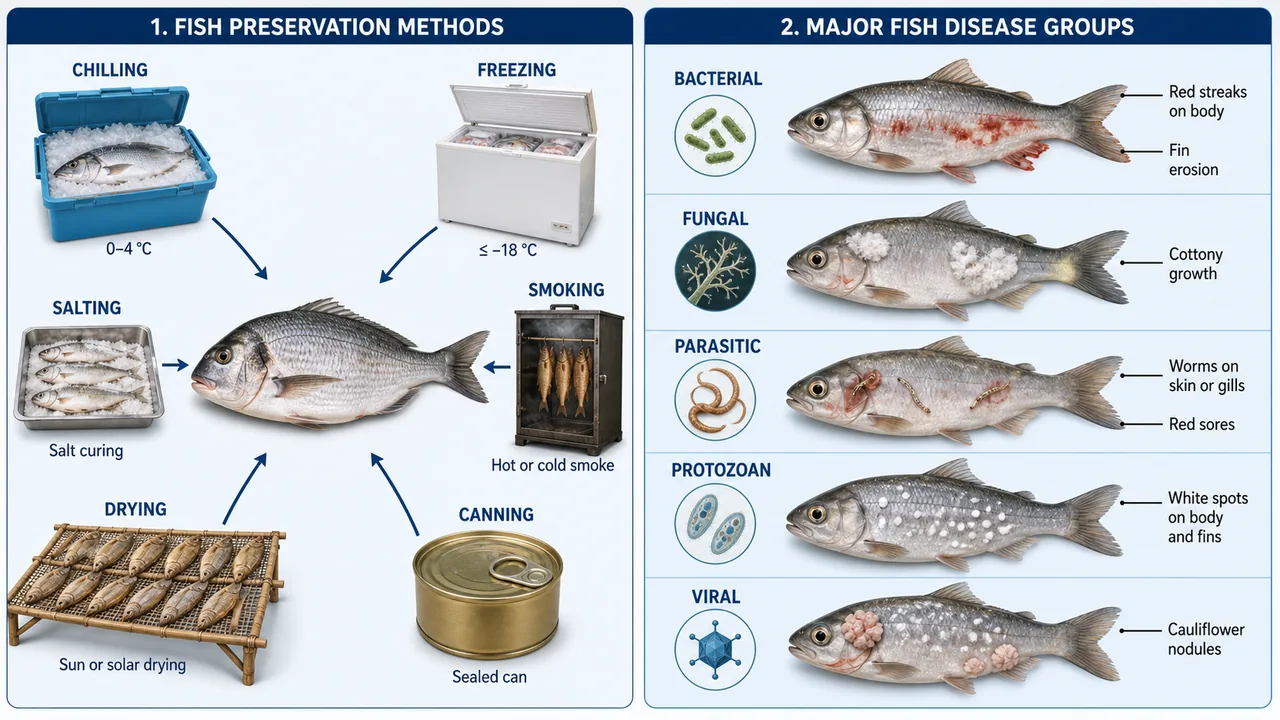
Fish is a highly perishable commodity and begins to spoil as soon as it is taken out of water. Preservation methods aim to prevent bacterial decomposition and enzymatic changes to maintain quality and extend shelf life.
A. Preservation for Short Duration
1. Chilling
- This is obtained by covering the fish with layers of ice.
- Maintains fish at temperatures close to 0 degrees C without freezing.
- Suitable for short-term storage and transportation.
- The ice should be crushed and evenly distributed around the fish.
B. Preservation for Long Duration
Before long-term preservation, fish must undergo proper preparation:
Cleaning and Gutting: Fish is washed thoroughly in cold, clean water. Large fishes are gutted (i.e., all the internal organs or viscera are removed) and the body cavity is washed.
1. Freezing
- Fish is stored under lower temperatures (typically -18 degrees C or below).
- Freezing arrests microbial growth and slows down enzymatic activity.
- Quick freezing produces smaller ice crystals, resulting in better quality upon thawing.
2. Freeze Drying
- The deep-frozen fish at -20 degrees C is dried by direct sublimation of ice to water vapour at 140 degrees C without any melting into liquid water.
- Produces a very lightweight product with excellent shelf life.
- Retains most nutritional value and can be reconstituted with water.
3. Salting / Curing
- Common salt (sodium chloride) is used as a preservative.
- Salt draws moisture from fish through osmosis, creating an environment unfavorable for bacterial growth.
- Different methods include dry salting, wet salting, and kench curing.
4. Brining
- Instead of dry salt, a brine (salt solution) is used.
- Fish is immersed in saturated or near-saturated salt solution.
- Commonly used as a pre-treatment before smoking or drying.
5. Smoking
- Fish is first treated with brine to remove moisture, and is then dried in smoking chambers.
- Smoking imparts flavor, color, and preservative effect due to chemicals in smoke (phenols, aldehydes, organic acids).
- Two types: Cold smoking (below 30 degrees C) and Hot smoking (above 60 degrees C).
IMPORTANT
Smoking was asked in NABARD Mains 2020. Remember that fish is first treated with brine before being dried in smoking chambers.
6. Sun-Drying
- Dehydration, i.e., the removal of moisture contents of fish.
- One of the oldest and most widely used methods of fish preservation.
- Fish is spread on racks, mats, or hung on lines and exposed to sun and wind.
- Moisture content is reduced to about 15-20%, inhibiting microbial growth.
7. Canning
- Spoilage is averted by killing micro-organisms through heat.
- Fish is cleaned, cut, pre-cooked, packed in cans with brine or oil, sealed, and sterilized at high temperatures (115-121 degrees C).
- Provides long shelf life (2-5 years) without refrigeration.
8. Chemical Preservation and Irradiation
- Aureomycin antibiotics @ 5 ppm or Salicylic acid or Sodium benzoate or Sodium bisulphite or Sodium nitrite or Sodium chloride can be used.
- Irradiation uses ionizing radiation (gamma rays) to destroy bacteria and parasites.
- Extends shelf life while maintaining nutritional quality.
TIP
Quick Comparison of Preservation Methods:
| Method | Principle | Shelf Life |
|---|---|---|
| Chilling | Low temperature (0 degrees C) | Short (few days) |
| Freezing | Very low temperature (-18 degrees C) | Long (months) |
| Freeze Drying | Sublimation at -20 degrees C | Very long |
| Salting | Osmotic dehydration | Long |
| Smoking | Dehydration + chemical preservation | Moderate to long |
| Sun-Drying | Moisture removal | Moderate |
| Canning | Heat sterilization | Very long (2-5 years) |
| Irradiation | Ionizing radiation | Extended |
Part 2: Major Fish Diseases
Fish diseases can be broadly classified into Bacterial, Fungal, Parasitic, Protozoan, Viral, Non-infectious, and Miscellaneous diseases.
NOTE
Bacterial diseases are usually characterized by red streaks or spots and/or swelling of the abdomen or eye.
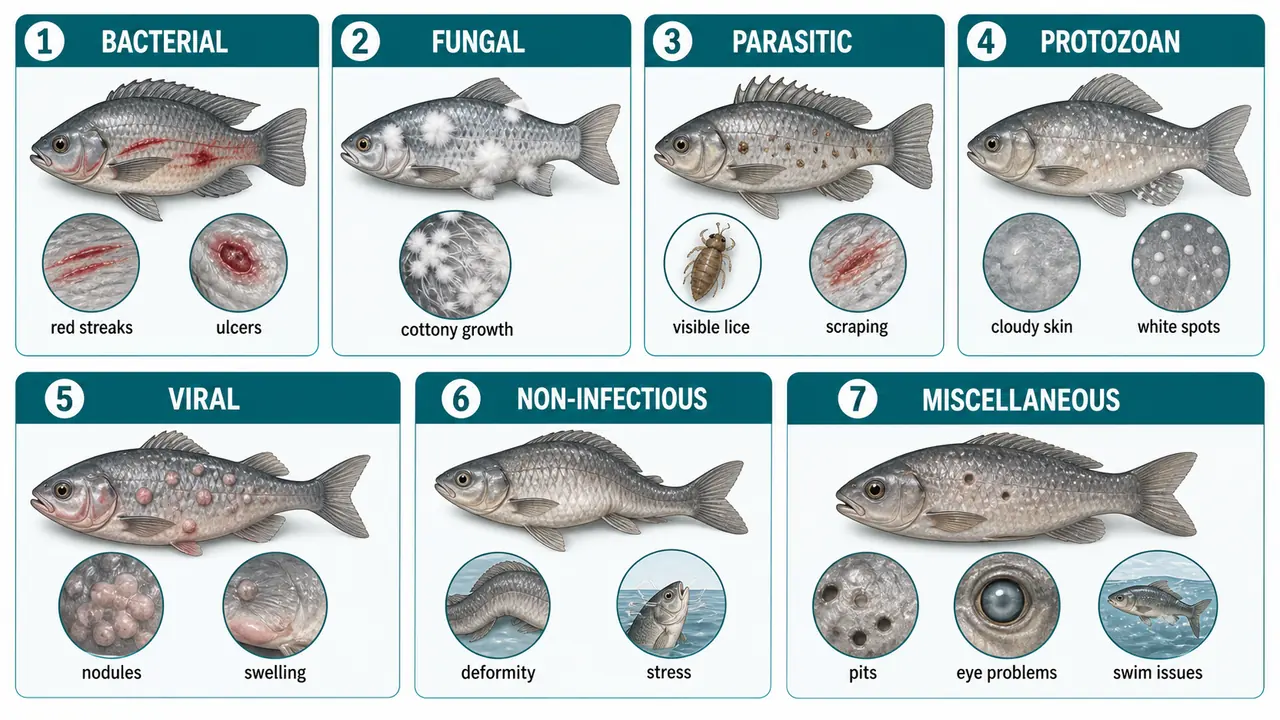
A. Bacterial Diseases of Fishes
| Disease | Causative Organism | Symptoms | Treatment |
|---|---|---|---|
| Red Pest | Bacterial infection | Bloody streaks on body, fins and/or tail; severe infection leads to ulceration, fin and tail rot with fins falling off | External treatments usually not effective as disease is internal |
| Mouth Fungus / Columnaris | Chondrococcus columnaris | White cottony patches around mouth; grey or white line appears around lips, later short tufts arise from mouth like fungus | Add 1% antibiotic (Chloromycetin/chloramphenicol or tetracycline) to food |
| Tuberculosis | Mycobacterium piscium | Emaciation, hollow belly, sores, loss of scales, loss of color, lesions on body, frayed fins, loss of appetite, skeletal deformities (curved spines), yellowish or darker nodules on body or eyes | Improve water quality, reduce overcrowding |
| Dropsy | Aeromonas (bacterial infection of kidneys) | Bloating of body, protruding scales, fluid accumulation causing renal failure; abdomen bulges, pressing on it causes water to come out through mouth | Antibiotics, improve water quality |
| Scale Protrusion | Bacterial infection of scales/body | Protruding scales without body bloat | Antibiotics, water quality management |
| Tail Rot and Fin Rot | Aeromonas | Disintegrating fins reduced to stumps, exposed fin rays, blood on edges of fins, reddened areas at base of fins, skin ulcers with grey or red margins, cloudy eyes | Chloromycetin (chloramphenicol) or tetracycline; 1% CuSO4 treatment is also effective |
| Ulcer | Haemophilus | Loss of appetite, slow body movements | Dip treatment in 1% CuSO4 for one minute for a period of 3 to 4 days |
| Fish Vibriosis | Vibrio species | Lethargy, increased respiration, loss of appetite, skin hemorrhages, and death | Antibiotics, improved water management |
WARNING
Red Pest was asked in exams Mains 2022. Remember the key symptom: bloody streaks on body, fins and tail -- hence the name "red pest." External treatments are usually not effective as the disease is internal.
Detailed Notes on Key Bacterial Diseases
Mouth Fungus / Columnaris -- Despite its name suggesting a fungal origin, this disease is actually caused by the bacterium Chondrococcus columnaris. In the beginning, a grey or white line appears around the lips and later short tufts arise from the mouth like fungus. This disease may be fatal due to production of toxins and the inability to eat. Hence, treatment at an early stage is essential.
Tuberculosis -- The main cause for this disease appears to be over-crowding in un-kept conditions with poor water quality. Fish infected with tuberculosis may become hollow bellied, pale, show skin ulcers and frayed fins, and lose appetite. The main symptoms are loss of scales, loss of color, lesions on the body, wasting, and skeletal deformities such as curved spines.
Dropsy -- Caused by a bacterial infection (Aeromonas) of the kidneys, causing fluid accumulation or renal failure. The fluids in the body build up and cause the fish to bloat up and the scales to protrude. Accumulation of body fluid/water in the body cavity or in scale pockets makes scales become loose, abdomen bulges largely, and pressing on it causes water to come out through the mouth.
Tail Rot and Fin Rot -- Caused by the bacteria Aeromonas. If fish tank conditions are not good, an infection can be caused from a simple injury to the fins/tail. Tuberculosis can also lead to tail and fin rot. Basically, the tail and/or fins become frayed or lose colour.
B. Fungal Diseases of Fishes
| Disease | Causative Organism | Symptoms | Treatment |
|---|---|---|---|
| Argulosis | Argulus (Fish louse) | Fish scrapes against objects, clamped fins, visible parasites (~1/4 inch diameter) on body, inflamed areas where lice have been | Manual removal of parasites, potassium permanganate bath |
| Ichthyosporidium | Ichthyosporidium (fungus) | Sluggishness, loss of balance, hollow belly, external cysts and sores; primarily attacks liver and kidneys | No effective treatment; usually fatal by the time external symptoms appear |
| Saprolegniasis (Fungus) | Saprolegnia | Tufts of dirty, cotton-like growth on skin; can cover large areas; fish eggs turn white; grey or whitish growth on skin and/or fins | Malachite green, salt baths, improve water quality |
| Epizootic Ulcerative Syndrome (EUS) | Aphanomyces invadans (water mould) | Red spots on skin that expand to form ulcers; extensive erosions filled with necrotic tissue and mycelium; granulomas on internal organs leading to death | Lime treatment of ponds, CIFAX application |
IMPORTANT
EUS is also known as Red Spot Disease (RSD) and Mycotic Granulomatoses (MG). It is a seasonal epizootic condition of great importance in wild and farmed freshwater and estuarine fish. It infects many freshwater and brackish fish species in the Asia-Pacific region and Australia. The disease is most commonly seen when there are low temperature and heavy rainfall in tropical and sub-tropical waters.
Detailed Notes on EUS
When EUS spreads into a fish culture pond, high morbidity (>50%) and high mortality (>50%) might be observed in those years that have a long cold season, with water temperatures between 18 and 22 degrees C. Some infected fish may recover when the cold period is over.
At first, fish develop red spots on the skin. These lesions expand to form ulcers and extensive erosions filled with necrotic tissue and mycelium. This is followed by the development of granulomas on the internal organs and death.
C. Parasitic Diseases of Fishes
| Disease | Causative Organism | Symptoms | Treatment |
|---|---|---|---|
| Velvet or Rust | Oodinium (dinoflagellate parasite) | Yellow to light brown "dust" on body, clamped fins, respiratory distress, golden or brownish dust over fins and body | Copper-based medications, salt baths |
| Anchor Worm | Lernaea (crustacean parasite) | Fish scrapes against objects, whitish-green threads hang out of skin, inflamed area at point of attachment | Manual removal with forceps, potassium permanganate |
| Ergasilus | Ergasilus (gill parasite) | Fish scrapes against objects, whitish threads hang out of gills; similar to anchor worm but smaller and attacks gills instead of skin | Organophosphate treatments |
| Flukes (Trematodes) | Various trematode species (flatworms ~1 mm long) | Fish scrapes against objects, rapid gill movement, mucus covering gills or body, reddened skin; gill flukes cause pale fish with drooping fins, rapid respiration, hollow bellies | Praziquantel, formalin baths |
| Nematoda | Nematodes (threadworms) | Worms hanging from the anus; heavy infestation causes hollow bellies; infect just about anywhere in the body | Anthelmintic medications |
| Leeches | Leeches (external parasites) | Visible on fish skin; heart-shaped worms (curled up) attached to body, fins, or gills; sucking and borrowing into surface of fish | Manual removal (careful -- forceps can cause damage), salt baths |
WARNING
Anchor Worm (Lernaea) -- The anchor worm is too deeply imbedded to safely remove in many cases. The youngs are free swimming and burrow into the skin, go into the muscles and develop for several months before showing. They release eggs and die. The holes left behind are ugly and may become infected.
Detailed Notes on Velvet Disease and Flukes
Velvet or Rust -- The gills are usually the first thing affected. Velvet affects different species in different ways. Danios seem to be the most susceptible, but often show no discomfort. The disease is highly contagious and fatal. The fish may show signs of irritation, like glancing off aquarium decor, shortage of breath, and clamping of the fins.
Flukes -- There are many species of flukes, which are flatworms about 1 mm long. They infest gills and skin much like Ich, but the difference can be seen with a hand lens. You should be able to see movement and possibly eyespots, which is not found in Ich. Gill flukes will eventually destroy the gills thus killing the fish. Symptoms of heavy infestations are pale fish with drooping fins, rapid respiration, glancing off aquarium decor, and/or hollow bellies.
D. Protozoan Diseases of Fishes
| Disease | Causative Organism | Symptoms | Treatment |
|---|---|---|---|
| Costia | Costia (flagellate protozoan) | Milky cloudiness on skin (major symptom) | Salt baths, formalin treatment |
| Hexamita | Hexamita (intestinal flagellated protozoa) | Loss of appetite; attacks the lower intestine; disease of the digestive tract | Metronidazole treatment |
| Ich / White Spot Disease | Ichthyophthirius multifiliis (protozoan) | Salt-like white specks on body and fins, excessive slime, breathing problems, clamped fins, loss of appetite | Raise temperature, malachite green, formalin |
| Neon Tetra Disease | Plistophora hyphessobryconis (sporozoan) | Whitened areas deep into flesh, muscle degeneration, abnormal swimming movements, whitish patches just below skin | No effective treatment; isolate infected fish |
| Glugea and Henneguya | Glugea / Henneguya (microsporidian) | Nodular white swellings on fins or body, similar to Lymphocystis | No effective treatment |
| Chilodonella | Chilodonella (ciliate protozoan) | Dulling of colours due to excessive slime, frying of fins, weakness, gill damage, blue-white cloudiness on skin | Formalin baths, salt treatment |
| Whirling Disease | Myxosoma cerebralis (myxosporean protozoan) | Blackening of tail, caudal band, deformity of anal region | No effective treatment; prevent introduction |
IMPORTANT
Ich (White Spot Disease) is the most common malady experienced in fish aquariums. It is caused by the protozoan Ichthyophthirius multifiliis. There are three phases to the life cycle of this protozoan. Since Ich is susceptible to treatment at only one stage of the life cycle, an awareness of the life cycle is important for effective treatment.
Detailed Notes on Protozoan Diseases
Costia -- The major symptom is milky cloudiness on the skin. It is caused by a flagellate protozoan that is difficult to diagnose without microscopy.
Hexamita -- This is caused by intestinal flagellated protozoa that attack the lower intestine. As it is a disease of the digestive tract, it is characterized by the loss of appetite. It primarily affects cichlids and other freshwater species.
Neon Tetra Disease -- Named after the fish it was first recognized on, but it can appear on other fish. It is caused by the sporozoan Plistophora hyphessobryconis. Whitish patches appear as if just below the skin, and muscle degeneration leads to abnormal swimming movements.
Chilodonella -- This disease causes a blue-white cloudiness on the skin and attacks the gills. Later the skin may be broken down and the gills destroyed. The fish may behave as if they have irritations.
Whirling Disease -- It is a protozoan disease caused by Myxosoma cerebralis. Blackening of tail, caudal band, and deformity of anal region are common symptoms. It primarily affects salmonid species.
E. Viral Diseases of Fishes
| Disease | Causative Organism | Symptoms | Treatment |
|---|---|---|---|
| Lymphocystis | Lymphocystis virus (iridovirus) | Nodular white swellings (cauliflower-like) on fins or body; abnormally large white lumps on fins or other parts of body | No cure available; disease is usually not fatal; rare disease |
NOTE
Lymphocystis is a virus that affects the cells of the fish. It usually manifests itself as abnormally large white lumps (cauliflower-like) on the fins or other parts of the body. It can be infectious but is usually not fatal. Unfortunately, there is no cure. Fortunately, this is a rare disease.
F. Non-Infectious Diseases
| Disease | Cause | Symptoms |
|---|---|---|
| Tumor | Genetic or environmental factors | Abnormal tissue growths on body |
| Congenital Abnormalities | Genetic defects | Deformities present from birth |
| Injuries | Physical damage | Wounds, torn fins, scale loss |
| Constipation | Dietary issues | Swollen abdomen, lack of feces |
G. Miscellaneous Diseases of Fishes
1. Head and Lateral Line Disease (HLLE)
Also known as "Hole-in-the-Head disease".
- Begins as small pits on the head and face, usually just above the eye.
- If untreated, these turn into large cavities and then the disease progresses along the lateral line.
- Attributed to a nutritional deficiency of one or more of: Vitamin C, Vitamin D, Calcium, and Phosphorous.
- It is thought to be caused by a poor diet or lack of variety, lack of partial water changes, or over-filtration with chemical media such as activated carbon.
- It is a common syndrome of marine species that are reared in captivity.
- It is nonfatal but can result in permanent scarring of the skin surface.
2. Eye Problems
- Symptoms: Cloudy cornea, opaque lens, poor eye, swelling, blindness.
- Can be caused by bacterial infections, parasites, nutritional deficiencies, or poor water quality.
3. Swim-Bladder Disease
- Symptoms: Abnormal swimming pattern, difficulty in maintaining equilibrium.
- Fish may float upside down or sink to the bottom.
- Can be caused by bacterial infection, physical injury, or dietary issues.
Summary Table: Classification of Fish Diseases
| Category | Diseases |
|---|---|
| Bacterial | Red Pest, Mouth Fungus/Columnaris, Tuberculosis, Dropsy, Scale Protrusion, Tail Rot and Fin Rot, Ulcer, Fish Vibriosis |
| Fungal | Argulosis, Ichthyosporidium, Saprolegniasis, EUS (Epizootic Ulcerative Syndrome) |
| Parasitic | Velvet/Rust, Anchor Worm (Lernaea), Ergasilus, Flukes, Nematoda, Leeches |
| Protozoan | Costia, Hexamita, Ich (White Spot), Neon Tetra Disease, Glugea and Henneguya, Chilodonella, Whirling Disease |
| Viral | Lymphocystis |
| Non-infectious | Tumor, Congenital Abnormalities, Injuries, Constipation |
| Miscellaneous | Head and Lateral Line Disease (HLLE), Eye Disease, Swim-Bladder Disease |
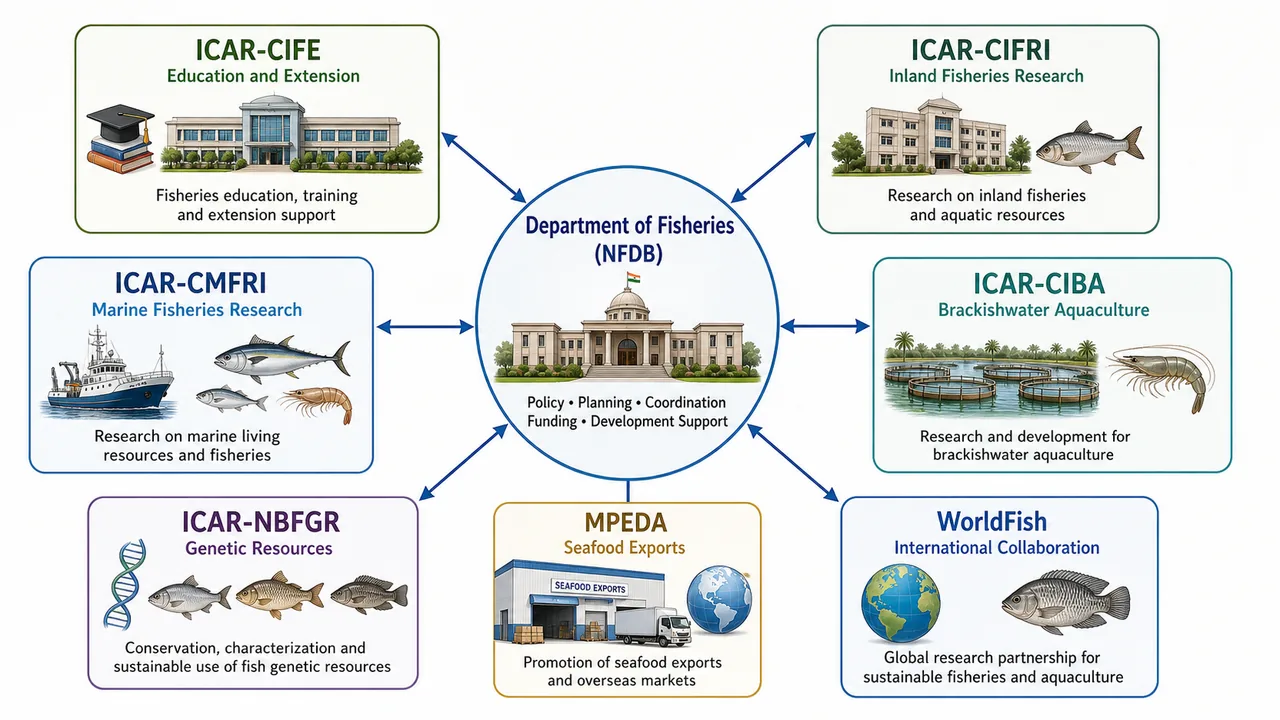
MPEDA (Marine Products Export Development Authority)
- Constituted on 24 August 1972.
- Head Quarter: Kochi, Kerala.
- Functions under: Dept. of Commerce, Govt. of India.
- Acts as coordinating agency with different central and state government establishments engaged in fishery production and allied activities.
Major Activities of MPEDA:
- Market Promotion
- Capture Fisheries
- Culture Fisheries
- Processing Infrastructure and Value Addition
- Quality Control
Societies of MPEDA:
- RGCA (Rajiv Gandhi Centre for Aquaculture)
- NETFISH (est. 2006)
TIP
For exam purposes, remember: MPEDA was established in 1972, headquartered in Kochi, and functions under the Department of Commerce. Its three societies are RGCA, NETFISH, and NaCSA.
Summary Cheat Sheet
| Concept / Topic | Key Details |
|---|---|
| Fish AKA | Rich Food for Poor People; Brain Food; Heart Food |
| Fish protein | 18–20% with all 8 essential amino acids |
| Fish fat range | 0.2–25% (less than red meats) |
| Golden Mahseer | AKA Tiger in Water; Tor putitora; game fish |
| Chilling | Covering with ice layers; short-term preservation |
| Freezing | Storage at -18°C or below; arrests microbial growth |
| Freeze drying | Frozen at -20°C, dried by sublimation at 140°C |
| Salting/Curing | NaCl draws moisture via osmosis |
| Smoking | Brine-treated then dried in smoking chambers (NABARD 2020) |
| Sun-drying | Oldest method; dehydration of moisture |
| Canning | Fish sealed in airtight containers; heat-sterilised |
| EUS (Epizootic Ulcerative Syndrome) | Fungal; red spots/ulcers on body; caused by Aphanomyces invadans |
| Columnaris | Bacterial; white patches on body/fins |
| Dropsy | Bacterial; swollen belly; scales raised (pine cone appearance) |
| White spot (Ichthyophthirius) | Protozoan; white spots on skin/gills |
| Argulosis (Fish louse) | Parasitic; Argulus attaches to skin; causes irritation |
| MPEDA | Est. 1972; HQ: Kochi; under Dept. of Commerce |
| MPEDA societies | RGCA, NETFISH, NaCSA |