🚣 Fishing Crafts, Gears and Seaweed
Fishing crafts and gears used in India, trophic classification of water bodies, seaweed cultivation, and important fisheries organizations
Fishing Crafts and Gears in Lakes of India
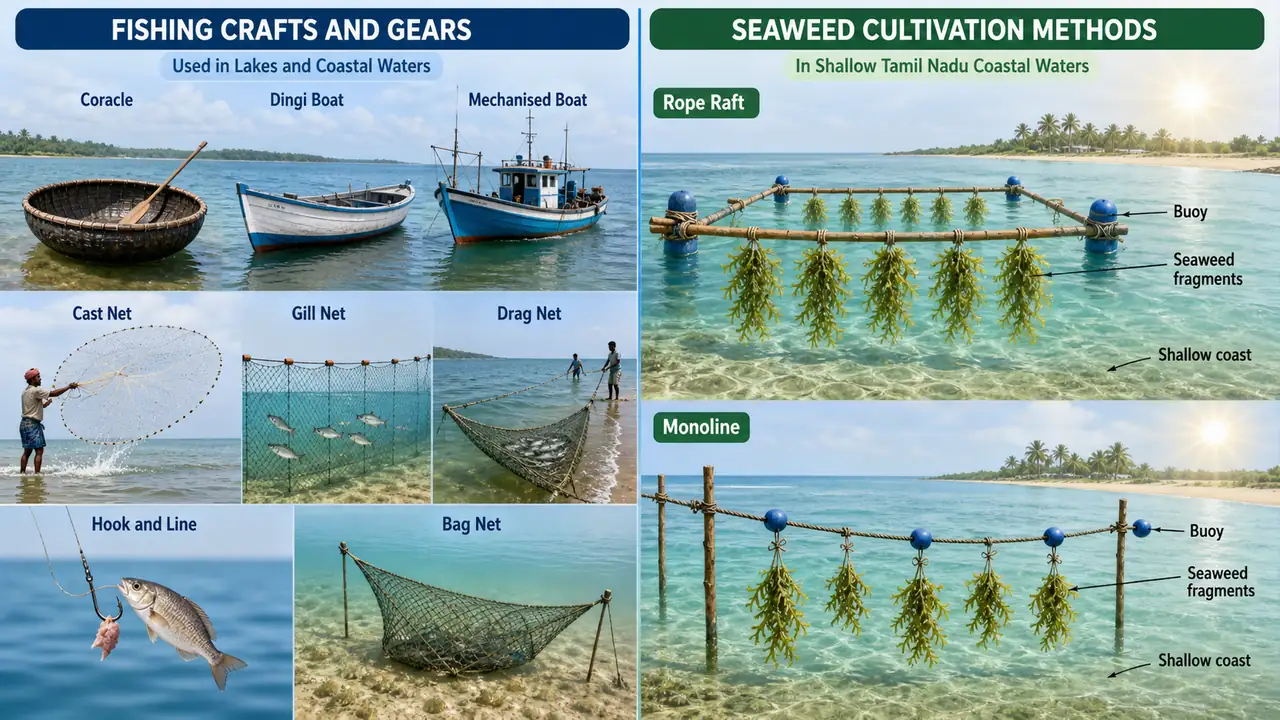
Fishing crafts and gears are fundamental tools used by fishermen to harvest aquatic resources from lakes, rivers, reservoirs, and marine waters. India has a rich diversity of traditional and modern fishing crafts and gears adapted to different water bodies and target species.
Fishing Crafts Used in Lakes
The following crafts are commonly used for fishing in Indian lakes:
| S. No. | Craft Type | Description |
|---|---|---|
| 1 | Dingi | Small flat-bottomed boat used in shallow waters |
| 2 | Coracle | Circular bowl-shaped craft made of bamboo and hide |
| 3 | Dhoni | Traditional wooden sailing vessel |
| 4 | Plank Built Boats | Boats constructed from wooden planks |
| 5 | Thermocol Raft | Lightweight raft made from thermocol sheets |
Fishing Gears Used in Lakes
| S. No. | Gear Type | Description |
|---|---|---|
| 1 | Hook and Line | Simple gear with a hook attached to a line, used for selective fishing |
| 2 | Box Trap | Rectangular trap made of bamboo or wire mesh to catch fish |
| 3 | Tubular Trap | Cylindrical trap used for catching fish and prawns |
| 4 | Bag Net | Cone-shaped net fixed in tidal waters to catch fish carried by currents |
| 5 | Hand Lift Net | Small net operated by hand, lifted from the water to catch fish |
| 6 | Cast Net | Circular weighted net thrown by hand over water surface |
| 7 | Drag Net | Net dragged through water to collect fish in its path |
| 8 | Gill Net | Net that catches fish by their gills as they try to swim through |
TIP
Pro Content Locked
Upgrade to Pro to access this lesson and all other premium content.
₹99 charged monthly · Cancel anytime
- All Agriculture & Banking Courses
- AI Lesson Questions (100/day)
- AI Doubt Solver (50/day)
- Glows & Grows Feedback (30/day)
- AI Section Quiz (20/day)
- 22-Language Translation (100/day)
- Recall Questions (20/day)
- AI Quiz (15/day)
- AI Quiz Paper Analysis (100/day)
- AI Step-by-Step Explanations (100/day)
- Spaced Repetition Recall (FSRS)
- AI Tutor
- Immersive Text Questions
- Audio Lessons — Hindi & English
- Mock Tests & Previous Year Papers
- Summary & Mind Maps
- XP, Levels, Leaderboard & Badges
- Generate New Classrooms
- Voice AI Teacher (AgriDots Live)
- AI Revision Assistant
- Knowledge Gap Analysis
- Interactive Revision (LangGraph)
🔒 Secure via Razorpay · Cancel anytime · No hidden fees
Fishing Crafts and Gears in Lakes of India
Fishing crafts and gears are fundamental tools used by fishermen to harvest aquatic resources from lakes, rivers, reservoirs, and marine waters. India has a rich diversity of traditional and modern fishing crafts and gears adapted to different water bodies and target species.
Fishing Crafts Used in Lakes
The following crafts are commonly used for fishing in Indian lakes:
| S. No. | Craft Type | Description |
|---|---|---|
| 1 | Dingi | Small flat-bottomed boat used in shallow waters |
| 2 | Coracle | Circular bowl-shaped craft made of bamboo and hide |
| 3 | Dhoni | Traditional wooden sailing vessel |
| 4 | Plank Built Boats | Boats constructed from wooden planks |
| 5 | Thermocol Raft | Lightweight raft made from thermocol sheets |
Fishing Gears Used in Lakes
| S. No. | Gear Type | Description |
|---|---|---|
| 1 | Hook and Line | Simple gear with a hook attached to a line, used for selective fishing |
| 2 | Box Trap | Rectangular trap made of bamboo or wire mesh to catch fish |
| 3 | Tubular Trap | Cylindrical trap used for catching fish and prawns |
| 4 | Bag Net | Cone-shaped net fixed in tidal waters to catch fish carried by currents |
| 5 | Hand Lift Net | Small net operated by hand, lifted from the water to catch fish |
| 6 | Cast Net | Circular weighted net thrown by hand over water surface |
| 7 | Drag Net | Net dragged through water to collect fish in its path |
| 8 | Gill Net | Net that catches fish by their gills as they try to swim through |
TIP
For competitive exams, remember the classification: Crafts = vessels used for transport, Gears = tools used for catching fish. Both are essential components of the fishing operation.
Trophic State of Water Bodies
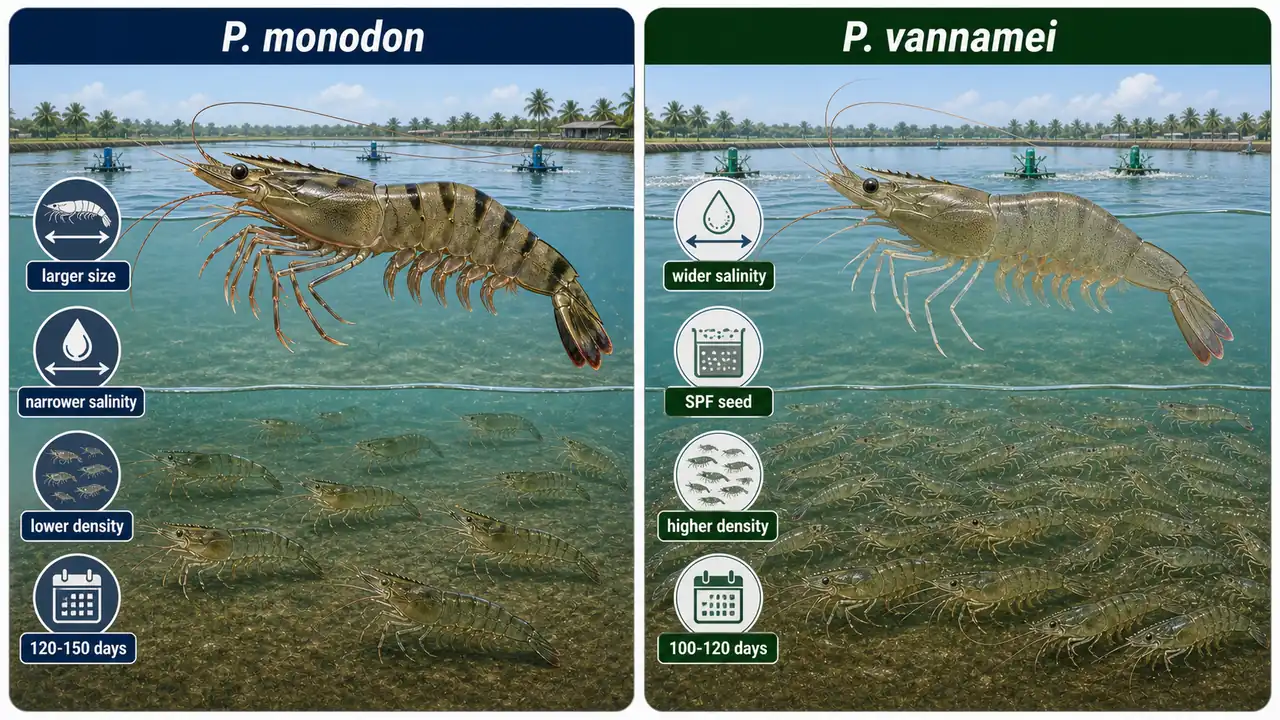
Trophic state is defined as the total weight of the biomass in a water body at a specific location and time. It represents the biological response to nutrient additions in water bodies. The amount of nitrogen, phosphorus, and other biologically useful nutrients dissolved in the water determines the trophic state of the lake.
The water trophic index is used to estimate the biological condition of a water body.
Classification of Lakes Based on Trophic State
| S. No. | Trophic Index | Trophic Class | Characteristics |
|---|---|---|---|
| 1 | < 30-40 | Oligotrophic | Low nutrient content, clear water, low biological productivity, high dissolved oxygen |
| 2 | 40-50 | Mesotrophic | Moderate nutrient content, intermediate biological productivity |
| 3 | 50-70 | Eutrophic | High nutrient content, turbid water, high biological productivity, low dissolved oxygen |
IMPORTANT
Eutrophication is the process by which a water body becomes enriched with nutrients (nitrogen and phosphorus), leading to excessive growth of algae and aquatic plants. This can cause oxygen depletion and fish kills. In cage culture, accumulation of unused feed and excreta can lead to eutrophication.
Types of Fishing Crafts of India
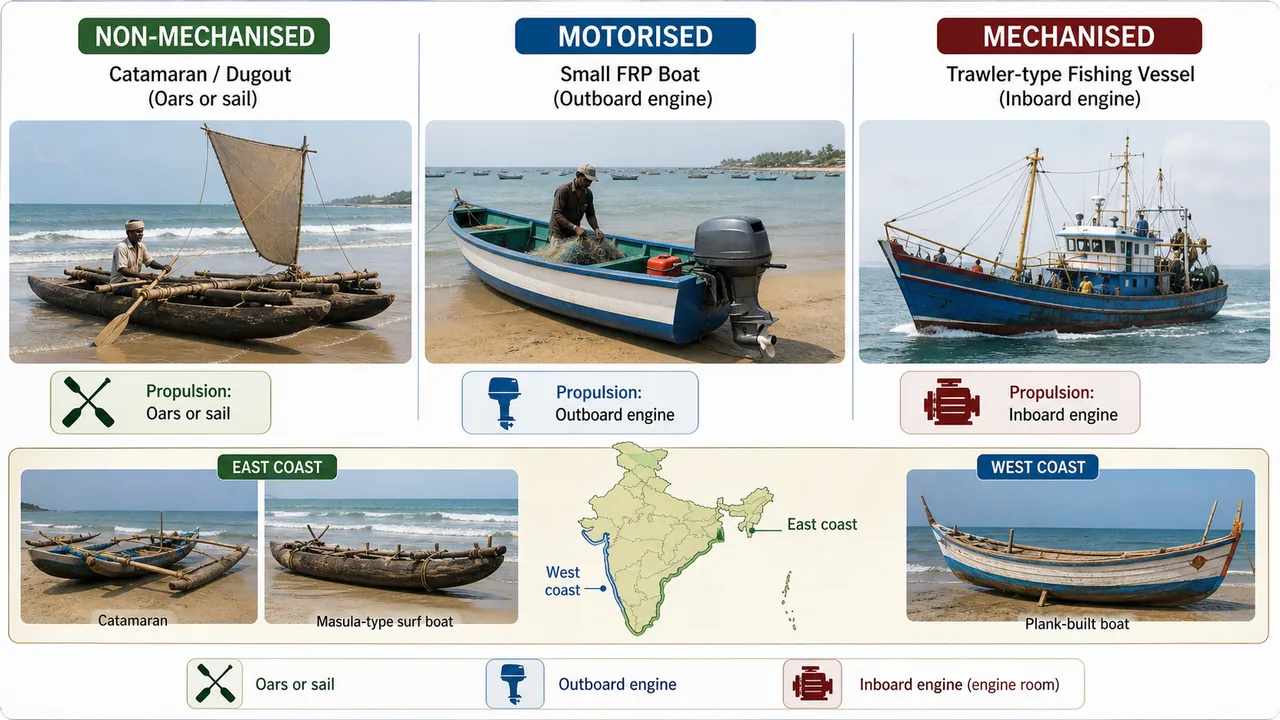
Indian fishing crafts are broadly classified into three categories based on their mode of propulsion:
1. Non-Mechanised Boats
These are traditional crafts operated manually using oars, sails, or poles. They are the most common type of fishing craft in India, especially among small-scale fishermen.
| S. No. | Craft | Details |
|---|---|---|
| 1 | Catamaran | Made of wooden logs tied together; used on East Coast |
| 2 | Dug-out Canoes | Carved from a single log of wood |
| 3 | Plank Built Canoes | Constructed by joining wooden planks |
| 4 | Masula Boats | Weakly constructed, about 8-12 metres long; used in clear weather near shore |
| 5 | Dhinghi | Traditional small boat |
| 6 | Outrigger Canoes | Canoe with lateral support float for stability |
| 7 | Built Up Boats | Boats constructed from multiple components |
2. Mechanised Boats
These are powered by engines and are capable of deep-sea fishing operations.
| S. No. | Craft | Details |
|---|---|---|
| 1 | Hand Line Boat | Used for hook and line fishing operations |
| 2 | Pole and Line Fishing Vessel | Used for tuna fishing |
| 3 | Trolling Vessel | Vessel that drags baited lines through water |
| 4 | Dol Netter | Used for dol net (bag net) operations |
| 5 | Gill Netter | Used for gill net fishing |
| 6 | Stern Trawlers | Trawl net operated from the stern of the vessel |
NOTE
In addition to non-mechanised and mechanised boats, there are also motorised boats which are traditional crafts fitted with outboard motors (OBM). They bridge the gap between non-mechanised and fully mechanised crafts.
Crafts and Boats by Coastal Region
Crafts Used on the East Coast
A. Catamaran
Catamaran is the most important non-mechanised craft used on the East Coast of India. There are four types of catamarans:
-
Orissa and Ganjam Type -- Made by five logs pegged with wood. The logs are cut in boat shape and are not tied with rope.
-
Coromandal Type -- Used in Tamil Nadu to capture flying fish of Nagapattanam. Made using 3-5 logs. A modified type of Coromandal catamaran is called Kolamaram, made by means of 7 logs (Asked in exams Mains 2022).
-
Andhra Type -- Modified form of Orissa type, larger in size (about 5-7 metres long), made by nine heavy side wood logs fitted with a median log.
-
The Boat Catamaran -- Made of three wood logs tied in boat shape. Used in Mandapam and Mukkun coastal regions.
B. Masula Boat
A weakly constructed boat of about 8-12 metres long. Used in clear weather near the shore.
C. Nauka and Dinghi
These boats have carvings and are operated in the West Bengal and Orissa regions. They are well-designed large boats measuring about 11-13 metre x 2-3 metre x 2 metre in size.
D. Tuticorin Boats or Fishing Luggers
Operated in inshore waters and used as cargo boats. They are carved boats of about 11 metre x 2 metre x 1 metre in size, used in Tamil Nadu state.
Crafts Used on the West Coast
| S. No. | Craft Type |
|---|---|
| 1 | Dugout Canoes |
| 2 | Plank Built Canoes |
| 3 | Outrigger Canoes |
| 4 | Built Up Boats |
| 5 | Coracle |
| 6 | Shoe Dhonie |
Seaweed Cultivation
What are Seaweeds?
Seaweeds are macrophytic algae, a primitive type of plants lacking true roots, stems, and leaves. They are wonder plants of the sea and are highly useful. Seaweeds grow in shallow waters. Root system and conducting tissues like land plants are absent in seaweeds.
Classification of Seaweeds
Four groups of seaweeds are recognized according to their pigments that absorb light of particular wavelengths and give them their colours of green, blue, brown, and red.
Most seaweeds belong to one of three divisions:
| Division | Common Name | Approximate Species |
|---|---|---|
| Chlorophyta | Green Algae | ~900 species |
| Phaeophyta | Brown Algae | ~1,500 species |
| Rhodophyta | Red Algae | ~4,000 species |
TIP
Remember: Red algae have the most species (4,000), followed by brown (1,500) and green (900).
Uses of Seaweeds
Seaweeds are used for production of Agar, Alginates, and Carrageenan.
Detailed Products from Seaweeds
From Brown Seaweeds:
- Alginic acid
- Mannitol
- Laminarin
- Fucoidin
- Iodine
Alginates can absorb many times their own weight of water, have a wide range of viscosity, can readily form gels, and are non-toxic. They have countless uses in manufacturing:
- Pharmaceuticals
- Cosmetic creams
- Paper and cardboard
- Processed foods
From Red Seaweeds:
- Agar-agar
- Agarose
- Carrageenan
These are commercially valuable substances that find extensive use in many industries.
Important Seaweed Species for Cultivation
| Species | Type | Product |
|---|---|---|
| Gracilaria | Red algae | Agar |
| Gelidiella | Red algae | Agar |
| Kappaphycus | Red algae | Carrageenan |
Methods of Seaweed Cultivation
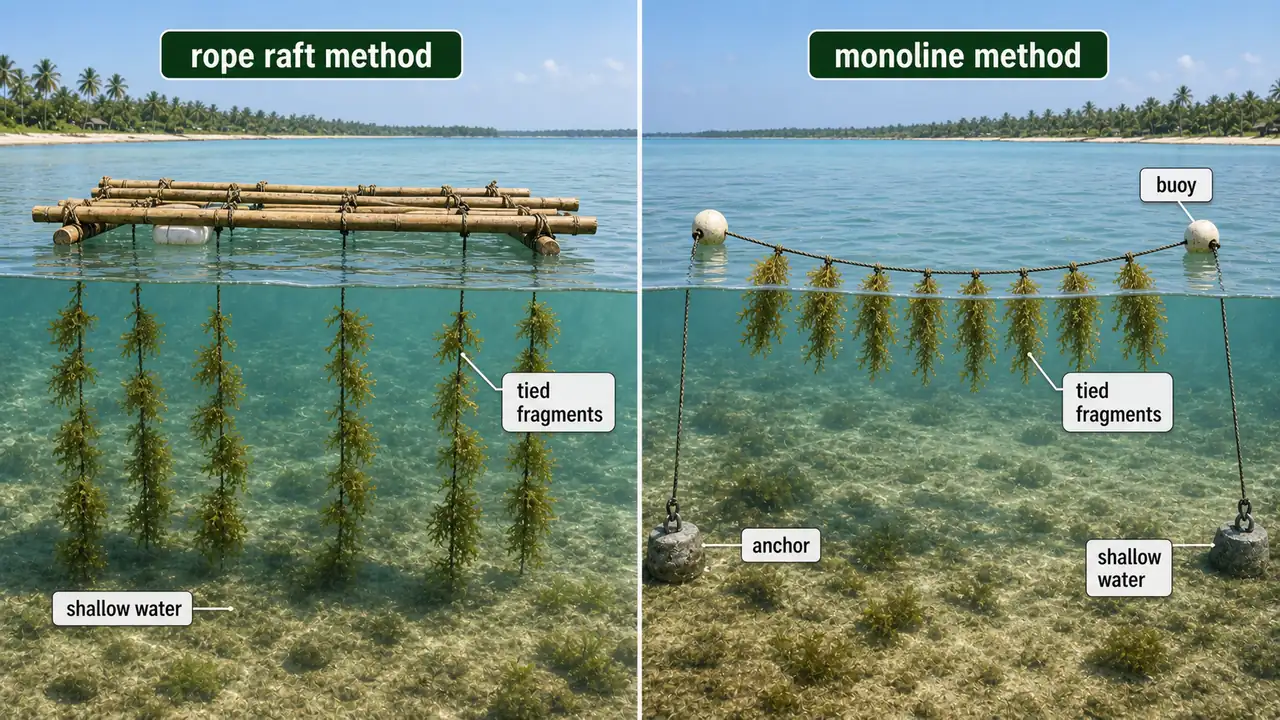
The main methods used for commercial seaweed cultivation include:
-
Rope/Raft Method -- Seaweed fragments are tied to ropes which are suspended from floating bamboo rafts in shallow coastal waters. This is the most common method used in India.
-
Monoline Method -- A single long rope with seaweed fragments is anchored at both ends and kept afloat using buoys. Suitable for areas with moderate wave action.
IMPORTANT
India's seaweed cultivation is mainly concentrated along the coast of Tamil Nadu, particularly around Ramanathapuram district and the Gulf of Mannar region.
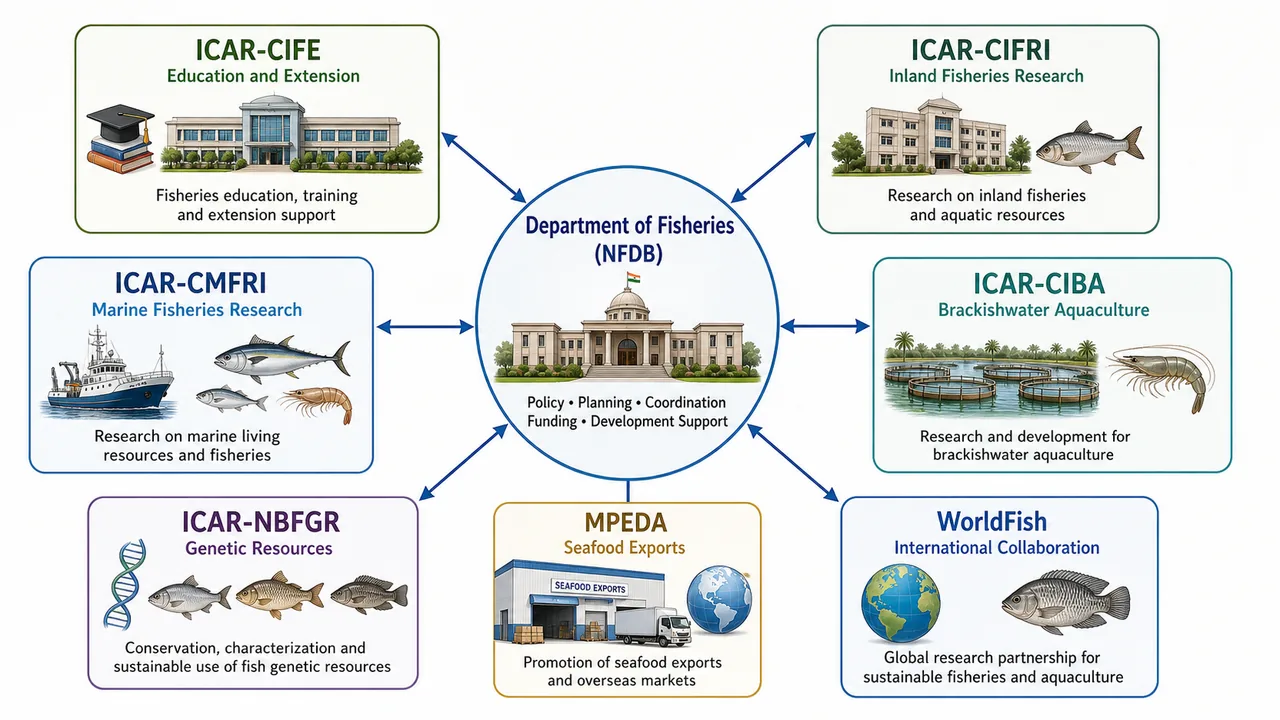
MPEDA -- Marine Products Export Development Authority
MPEDA was constituted on 24 August 1972.
| Parameter | Details |
|---|---|
| Constituted | 24 August 1972 |
| Headquarters | Kochi, Kerala |
| Functions under | Department of Commerce, Government of India |
| Role | Acts as coordinating agency with different central and state government establishments engaged in fishery production and allied activities |
Major Activities of MPEDA
- Market Promotion -- Promoting export of marine products
- Capture Fisheries -- Supporting marine and inland capture fisheries
- Culture Fisheries -- Promoting aquaculture and mariculture
- Processing Infrastructure and Value Addition -- Developing processing facilities
- Quality Control -- Ensuring quality standards for export products
Societies under MPEDA
| S. No. | Society | Details |
|---|---|---|
| 1 | RGCA | Rajiv Gandhi Centre for Aquaculture |
| 2 | NETFISH | Network for Fish Quality Management and Sustainable Fishing (est. 2006) |
| 3 | NaCSA | National Centre for Sustainable Aquaculture |
Miscellaneous Fisheries Facts
Fish as Food
- Fish is often referred to as "Rich Food for Poor People" as it provides essential nourishment with both macronutrients and micronutrients.
- On a fresh-weight basis, fish contains a good quantity of protein, about 18-20%, and all eight essential amino acids including the sulphur-containing lysine, methionine, and cysteine.
- Fish have less fat than red meats; the fat content ranges from 0.2% to 25%.
- Fish is also called "Brain Food" (helps in brain development and function) and "Heart Food" (contributes to lower risks of heart attacks and strokes).
- The Golden Mahseer or Himalayan Mahseer (Tor putitora, Hamilton, 1822) is a popular game fish and angler's delight. It is known as the "Tiger in Water".
Methods of Fish Preservation
A. Preservation for Short Duration
- Chilling -- Covering the fish with layers of ice
B. Preservation for Long Duration
| Method | Description |
|---|---|
| Cleaning and Gutting | Fish washed in cold, clean water; large fishes are gutted (internal organs removed) |
| Freezing | Stored under lower temperatures |
| Freeze Drying | Deep-frozen fish at -20 degree C dried by direct sublimation of ice to water vapour (140 degree C) |
| Salting | Common salt (sodium chloride) used as preservative |
| Smoking | First treated with brine to remove moisture, then dried in smoking chambers (Asked in NABARD Mains 2020) |
| Canning | Spoilage averted by killing micro-organisms through heat |
| Sun-Drying | Dehydration -- removal of moisture contents of fish |
| Brining | Instead of dry salt, brine (salt solution) is used |
C. Chemicals and Radiation
Aureomycin antibiotics @ 5 ppm or Salicylic acid or sodium benzoate or sodium bisulphite or sodium nitrite or sodium chloride can be used for fish preservation.
Major Fish Diseases
Bacterial Diseases
- Red pest
- Mouth fungus / Columnaris / Cotton wool disease / Cotton mouth disease
- Tuberculosis
- Dropsy
- Scale protrusion
- Tail Rot and Fin rot
- Ulcer
- Fish vibriosis
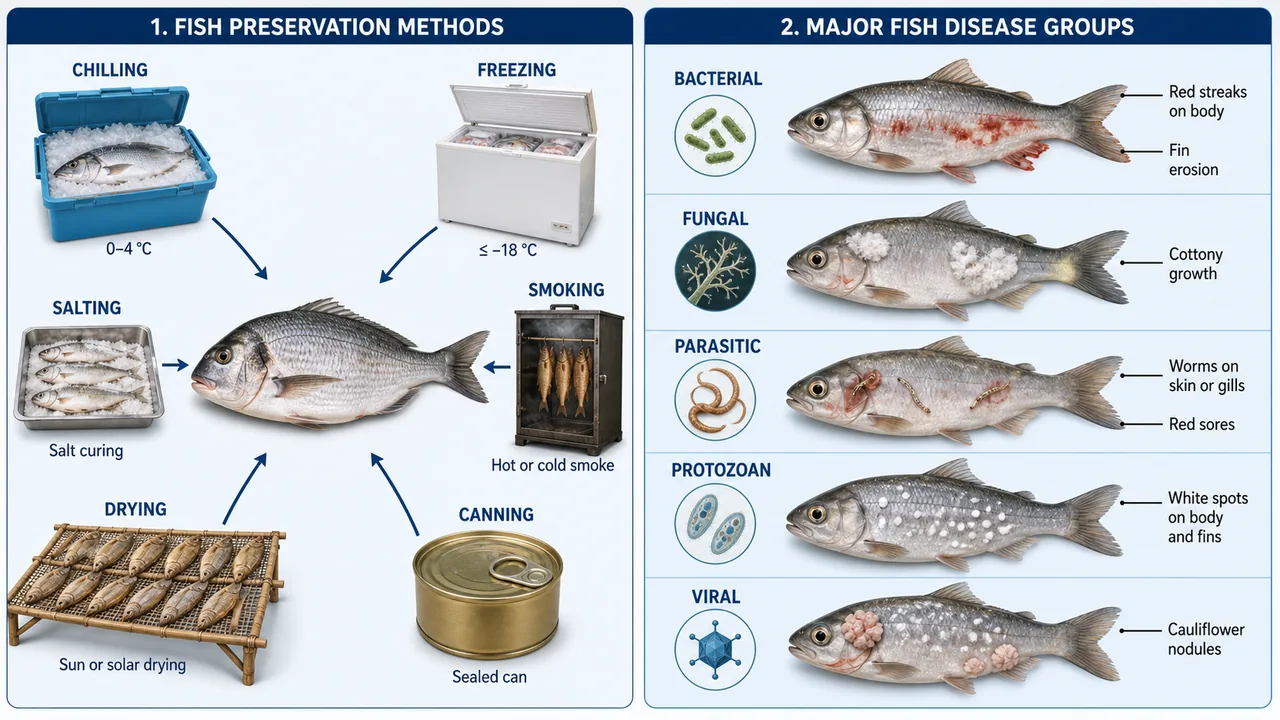
Fungal Diseases
- Argulus
- Ichthyoporidium
Parasitic Diseases
- Velvet or rust
- Anchor worm
- Ergasilus
- Flukes
- Nematodes
- Leeches
Protozoan Diseases
- Costia
- Hexamita
- Ich
- Neon Tetra disease
- Glugea and Henne guya
- Chiodonella
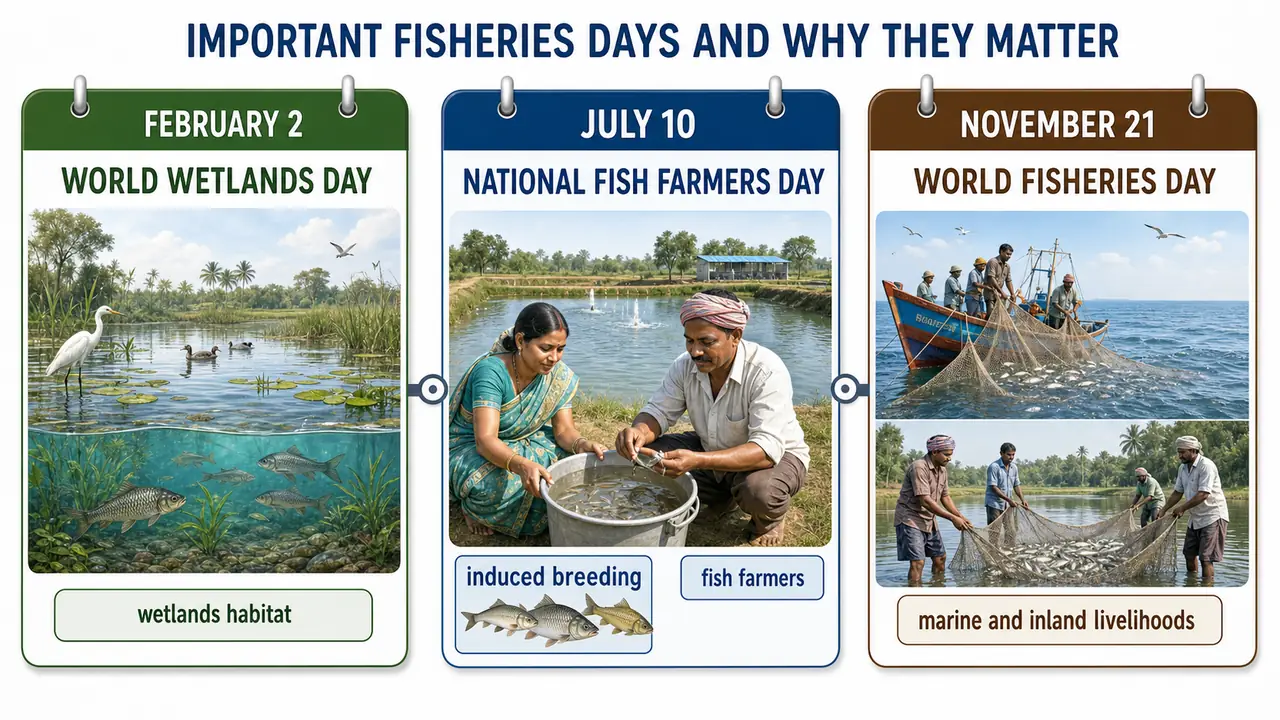
Important Days Related to Fisheries
| Date | Day |
|---|---|
| February 02 | World Wetlands Day |
| March 22 | World Water Day |
| March 23 | World Meteorology Day |
| May 02 | World Tuna Day |
| June 05 | World Environment Day |
| June 08 | World Oceans Day |
| July 10 | National Fish Farmers Day / NFDB Foundation Day |
| September 26 | World Hunting and Fishing Day |
| October 16 | World Food Day |
| November 21 | World Fisheries Day |
| December 03 | World Conservation Day |
| December 05 | World Soil Day |
| 3-9 September | Shark Week |
IMPORTANT
July 10 is celebrated as both National Fish Farmers Day and NFDB Foundation Day. November 21 is World Fisheries Day.
Institutes Related to Fisheries
| Name of Institute | Location | Established |
|---|---|---|
| ICAR - Central Marine Fisheries Research Institute (CMFRI) | Kochi, Kerala | 1947 |
| ICAR - Central Inland Fisheries Research Institute | Barrackpore, West Bengal | 1947 |
| ICAR - Central Institute of Fisheries Technology | Kochi, Kerala | 1957 |
| ICAR - Central Institute of Fisheries Education | Mumbai, Maharashtra | 1961 |
| ICAR - National Bureau of Fish Genetic Resources | Lucknow, Uttar Pradesh | 1983 |
| ICAR - Central Institute of Freshwater Aquaculture | Bhubaneshwar, Odisha | 1987 |
| ICAR - Central Institute of Brackishwater Aquaculture | Chennai, Tamil Nadu | 1987 |
| ICAR - Directorate of Coldwater Fisheries Research | Bhimtal, Uttarakhand | 1987 |
| National Fisheries Development Board (NFDB) | Hyderabad, Telangana | 2006 |
NOTE
CMFRI (Kochi) and CIFRI (Barrackpore) are the oldest fisheries research institutes in India, both established in 1947. NFDB (Hyderabad) is the newest, established in 2006.
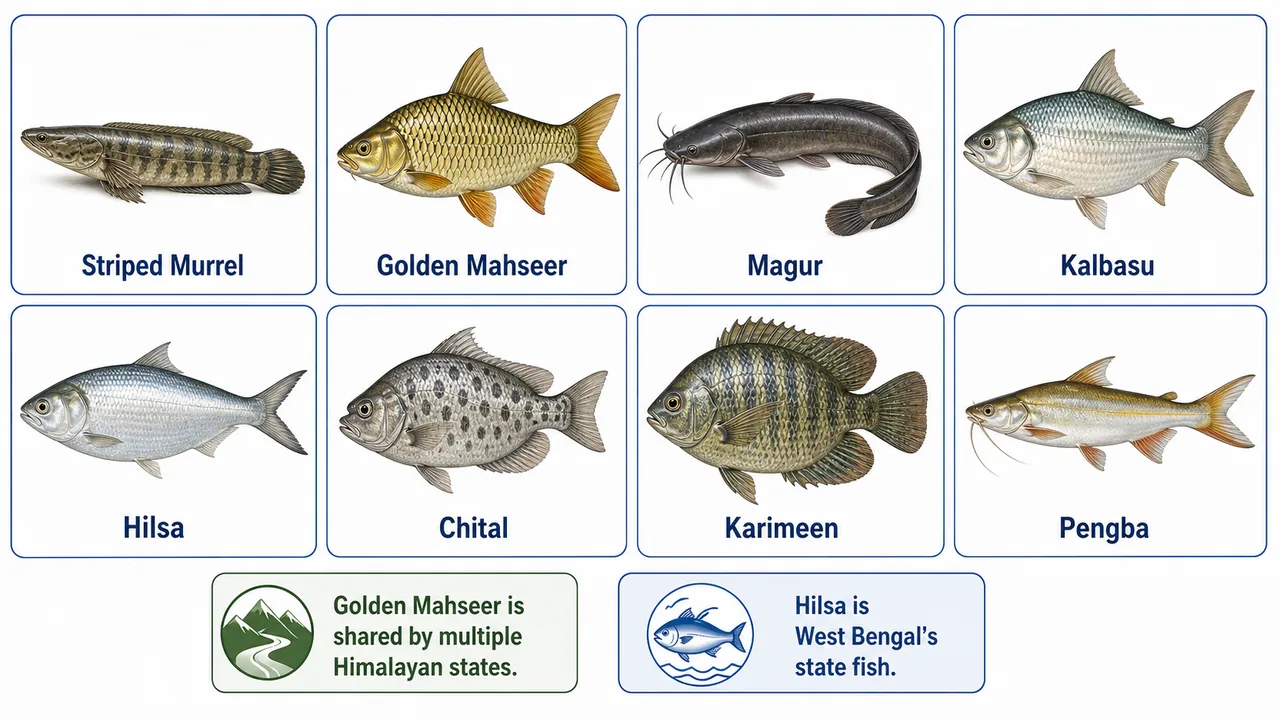
State Fishes of India
| S. No. | State / UT | Common Name | Scientific Name |
|---|---|---|---|
| 1 | Andhra Pradesh, Telangana | Striped Murrel | Channa straitus |
| 2 | Arunachal Pradesh, Himachal Pradesh, Jammu and Kashmir, Uttarakhand | Golden Mahseer | Tor putitora |
| 3 | Bihar | Magur | Clarias batrachus |
| 4 | Haryana | Kalbasu / Calabasu | Labeo calbasu |
| 5 | West Bengal | Hilsa | Tenualosa ilisha |
| 6 | Uttar Pradesh | Chital | Chitala chitala |
| 7 | Kerala | Karimeen / Pearlspot | Etroplus suratensis |
| 8 | Manipur | Pengba | Osteobrama belangeri |
TIP
For exams, remember: Golden Mahseer (Tor putitora) is the state fish of four states/UTs -- Arunachal Pradesh, Himachal Pradesh, J&K, and Uttarakhand. Hilsa (Tenualosa ilisha) is the state fish of West Bengal and also the national fish of Bangladesh.
Summary Cheat Sheet
| Concept / Topic | Key Details |
|---|---|
| Fishing crafts | Vessels for transport; gears = tools for catching fish |
| Non-mechanised crafts | Catamaran, Dug-out canoe, Masula boat, Dhinghi |
| Mechanised crafts | Trawlers, Gill-netters, Purse seiners |
| Gill net | Catches fish by their gills as they swim through |
| Cast net | Circular weighted net thrown by hand |
| Trawl net | Large net dragged along bottom; used by trawlers |
| Oligotrophic lake | Low nutrients, clear water, high dissolved oxygen |
| Mesotrophic lake | Moderate nutrients and productivity |
| Eutrophic lake | High nutrients, turbid water, low dissolved oxygen, algal blooms |
| Eutrophication | Enrichment with N & P → excessive algae → oxygen depletion → fish kills |
| Seaweed cultivation | Grows in shallow coastal waters; used for agar, carrageenan, algin |
| Seaweed uses | Food, fertiliser, pharmaceuticals, cosmetics, phycocolloids |
| Golden Mahseer | State fish of 4 states/UTs (AP, HP, J&K, Uttarakhand) |
| Hilsa | State fish of West Bengal; national fish of Bangladesh |
| National fish of India | Not Hilsa — India does not have an officially designated national fish |
| Catamaran | Made of wooden logs tied together; used on East Coast |