⛲️ Garden Styles, Landscaping and Garden Features
Complete guide to formal, informal, and freestyle garden styles, Mughal garden symbolism, Japanese Zen gardens, English gardens, lawn management, bonsai, topiary, edges, and hedges for competitive exams.
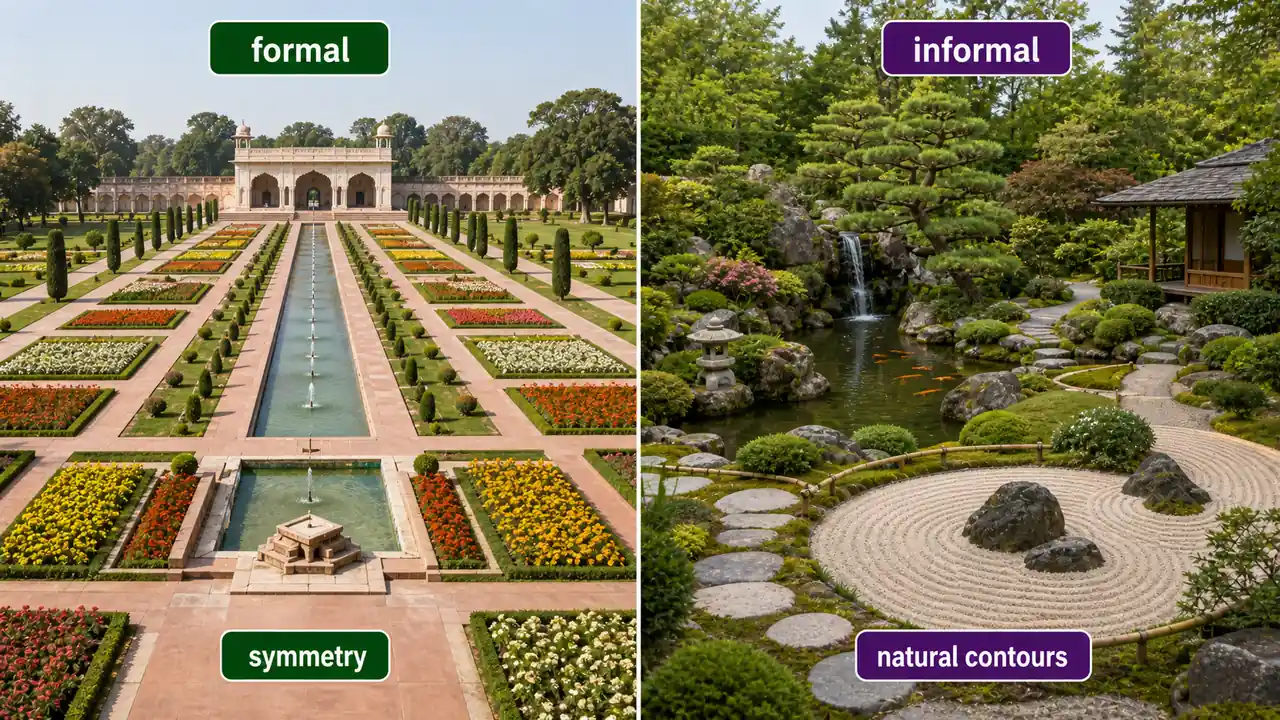
Stand at the lowest terrace of the Shalimar Bagh in Kashmir, and water channels stretch symmetrically toward a grand terminal building at the summit — every tree, fountain, and pathway following a precise geometric plan. Now step into the Buddha Jayanti Park in New Delhi, and the scene is entirely different: winding paths, natural rock arrangements, and sand patterns that mimic flowing water without a drop being used. These two gardens represent the two fundamental approaches to garden design — formal and informal — and understanding their differences is a cornerstone of landscape horticulture exams.
IMPORTANT
The three garden styles — Formal, Informal, and Freestyle — are frequently tested. Focus on their distinguishing features: symmetry type, land treatment, and hedge maintenance. Also remember: Mughal gardens have 7, 8, or 12 terraces with deep symbolic meaning.
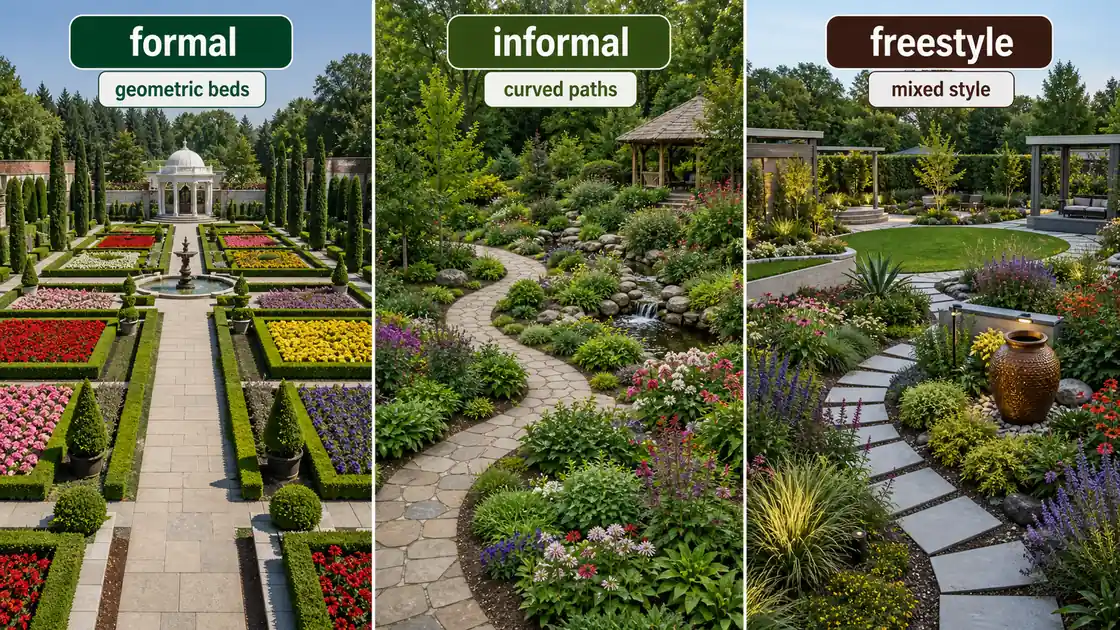
Three Styles of Garden Design
Comparison Table
| Feature | Formal | Informal | Freestyle |
|---|---|---|---|
| Design approach | Plan first, then select land | Land first, adapt plan | Combination of both |
| Symmetry | Symmetrical (mirror-balanced) | Asymmetrical | Mixed |
| Land | Leveled | Natural contours preserved | Varies |
| Beds and borders | Geometric (square, rectangular, circular) | Non-geometric, free-flowing | Mixed |
| Paths | Right angles (90 degrees) | Curved, irregular | Mixed |
| Hedges and topiary | Trimmed | Untrimmed, natural growth | Varies |
| Individual trees | Used as focal points | Not highlighted (whole landscape) | Varies |
| Examples | Mughal, Persian, Pinjore, Italian, French, American | Japanese, Chinese, English | Rose Garden of Chandigarh |
TIP
Pro Content Locked
Upgrade to Pro to access this lesson and all other premium content.
₹99 charged monthly · Cancel anytime
- All Agriculture & Banking Courses
- AI Lesson Questions (100/day)
- AI Doubt Solver (50/day)
- Glows & Grows Feedback (30/day)
- AI Section Quiz (20/day)
- 22-Language Translation (100/day)
- Recall Questions (20/day)
- AI Quiz (15/day)
- AI Quiz Paper Analysis (100/day)
- AI Step-by-Step Explanations (100/day)
- Spaced Repetition Recall (FSRS)
- AI Tutor
- Immersive Text Questions
- Audio Lessons — Hindi & English
- Mock Tests & Previous Year Papers
- Summary & Mind Maps
- XP, Levels, Leaderboard & Badges
- Generate New Classrooms
- Voice AI Teacher (AgriDots Live)
- AI Revision Assistant
- Knowledge Gap Analysis
- Interactive Revision (LangGraph)
🔒 Secure via Razorpay · Cancel anytime · No hidden fees
Stand at the lowest terrace of the Shalimar Bagh in Kashmir, and water channels stretch symmetrically toward a grand terminal building at the summit — every tree, fountain, and pathway following a precise geometric plan. Now step into the Buddha Jayanti Park in New Delhi, and the scene is entirely different: winding paths, natural rock arrangements, and sand patterns that mimic flowing water without a drop being used. These two gardens represent the two fundamental approaches to garden design — formal and informal — and understanding their differences is a cornerstone of landscape horticulture exams.
IMPORTANT
The three garden styles — Formal, Informal, and Freestyle — are frequently tested. Focus on their distinguishing features: symmetry type, land treatment, and hedge maintenance. Also remember: Mughal gardens have 7, 8, or 12 terraces with deep symbolic meaning.
Three Styles of Garden Design
Comparison Table
| Feature | Formal | Informal | Freestyle |
|---|---|---|---|
| Design approach | Plan first, then select land | Land first, adapt plan | Combination of both |
| Symmetry | Symmetrical (mirror-balanced) | Asymmetrical | Mixed |
| Land | Leveled | Natural contours preserved | Varies |
| Beds and borders | Geometric (square, rectangular, circular) | Non-geometric, free-flowing | Mixed |
| Paths | Right angles (90 degrees) | Curved, irregular | Mixed |
| Hedges and topiary | Trimmed | Untrimmed, natural growth | Varies |
| Individual trees | Used as focal points | Not highlighted (whole landscape) | Varies |
| Examples | Mughal, Persian, Pinjore, Italian, French, American | Japanese, Chinese, English | Rose Garden of Chandigarh |
TIP
Quick contrast: Formal = symmetrical, leveled, geometric, trimmed, plan-first. Informal = asymmetrical, natural terrain, free-flowing, untrimmed, land-first.
Formal Style

The formal style is defined by precision, order, and geometric symmetry. Every element is deliberately planned before execution — the design comes first, and the site is chosen to fit the plan.
Key characteristics:
- Mirror-balanced layout along a central axis
- Strict geometric shapes for planting beds
- Paths cut at right angles (90 degrees)
- Hedges, edges, and topiary are regularly trimmed
- Specimen trees placed as focal points
Informal Style
The informal style works with the existing natural landscape rather than imposing a rigid design.
Key characteristics:
- Plan adapts to the natural terrain
- Land not leveled — contours and slopes preserved
- Asymmetrical layout mimicking natural randomness
- Free-flowing, curved borders
- Plants allowed to grow naturally without strict pruning
Freestyle
A modern, flexible approach that blends the best of both traditions. The Rose Garden of Chandigarh beautifully combines structured rose beds with naturalistic landscaping.
Famous Garden Types — Detailed Features
Mughal Gardens (Formal)

Among the most iconic examples of formal garden design in India, inspired by Persian garden traditions and built during the Mughal era.
| Feature | Detail |
|---|---|
| Terraces | 7, 8, or 12 terraces symbolizing 7 planets, 8 paradise, and 12 zodiacal signs. Entrance at the lowest terrace. |
| Running water | Life and soul of Mughal garden. Channels, fountains, cascades (Chahar Bagh = four-part layout). |
| Baradari | Canopied building with 12 open doors (3 in each direction). Literally means "twelve doors." |
| High protecting wall | Privacy, security, and sense of enclosed paradise. ("Paradise" = from Persian pairidaeza = "walled garden".) |
| Terminal building | Grand structure at the highest point — visual culmination of the design. |
| Scented flowers | Roses, jasmine, narcissus — selected for multisensory experience. |
Symbolism in Mughal Gardens
| Element | Symbolism |
|---|---|
| Water | Source of life |
| Cross of water channels | Meeting of humanity with God |
| Eight divisions | Eight divisions of the Quran (spiritual completeness) |
| Cypress + flowering trees | Immortality (cypress = eternity) and renewal of life (flowering trees = life cycle) |
| Bauhinia alba | Youth and life |
Japanese Gardens (Informal)

Celebrated for serene beauty and philosophical depth. Embody principles of harmony (wa), simplicity (kanso), and contemplation.
| Feature | Detail |
|---|---|
| Also called | Zen garden (influence of Zen Buddhism) |
| Garden lanterns (toro) | Stone lanterns — originally lit paths to tea ceremonies |
| Garden pagoda | Buddhist symbolism — five elements of nature |
| Dry landscape (karesansui) | Sand, gravel, and rocks represent water and mountains without actual water |
| Wells | Symbolize depth and purity |
| Indian example | Buddha Jayanti Park, New Delhi |
English Gardens (Informal)

Known for a romantic, naturalistic approach blending structure with wild beauty.
| Feature | Detail |
|---|---|
| Herbaceous border | Long mixed plantings of perennials arranged by height, colour, and bloom time |
| Rockery | Rock garden with alpine plants — miniature mountain landscape |
| Lawn | Well-maintained green grass — central open space |
| Cottage garden | Dense, informal mix of flowers, herbs, and vegetables |
| Indian example | Rashtrapati Garden |
Garden Features
Lawn
- Regarded as the heart of the garden
- No garden is complete without a lawn
- Best planting method: Turf method (quickest — pre-grown grass mats laid on prepared soil)

Bonsai
| Parameter | Detail |
|---|---|
| Origin | Japanese art of extreme dwarfing |
| Meaning | "Planted in a container" |
| Optimum size | 30-60 cm |
| Best wire | Aluminium wire (soft, flexible, easy to apply) |
| Techniques | Pruning, wiring, root restriction |

Topiary

- Art of training plants into shapes — animals, birds, geometric forms
- Key feature of formal gardens
- Plants must be evergreen (foliage year-round)
- Examples: Duranta, Murraya paniculata
Edge

| Parameter | Detail |
|---|---|
| Definition | Low-growing plants on the border of plots |
| Height | 30 cm |
| Examples | Alternanthera, Sunrose |
Hedges

| Parameter | Detail |
|---|---|
| Definition | Shrubs planted on boundaries for fencing (living fences) |
| Types | Ornamental (beauty) or Protective (thorny, deters intruders) |
| Height | 1-2 metres |
| Examples | Karonda, Bougainvillea, Mehndi, Hibiscus, Clerodendron, Lantana |
| Group of shrubs | Called a shrubbery |
Famous Gardens of India


Summary Cheat Sheet
| Concept / Topic | Key Details / Explanation |
|---|---|
| Three garden styles at a glance | The lesson centers on Formal, Informal, and Freestyle gardens, and the key exam contrast is symmetry, land treatment, path pattern, and pruning discipline. |
| Formal style | Formal gardens are plan-first, use leveled land, maintain mirror symmetry, and prefer geometric beds, right-angled paths, and trimmed hedges/topiary. |
| Informal style | Informal gardens are land-first, preserve natural contours, use asymmetrical, free-flowing layouts, and allow plants to keep a more natural growth habit. |
| Freestyle | Freestyle gardens combine formal and informal features, and the lesson gives the Rose Garden of Chandigarh as the example. |
| Formal vs informal examples | The main formal examples are Mughal, Persian, Pinjore, Italian, French, and American gardens, while Japanese, Chinese, and English gardens are treated as informal. |
| Mughal garden identity | Mughal gardens are classic formal gardens inspired by Persian traditions, with the entrance at the lowest terrace and the design culminating in a grand terminal structure. |
| Mughal terraces and symbols | Mughal gardens commonly have 7, 8, or 12 terraces, symbolizing the 7 planets, 8 paradise, and 12 zodiacal signs. |
| Water in Mughal gardens | Running water is the life and soul of the Mughal garden, expressed through channels, fountains, cascades, and the Chahar Bagh four-part layout. |
| Mughal structures and symbolism | Baradari means a canopied structure with 12 open doors; the high protecting wall creates an enclosed paradise; water symbolizes life; the cross of channels symbolizes the meeting of humanity with God; cypress stands for immortality; flowering trees stand for renewal; and Bauhinia alba symbolizes youth and life. |
| Japanese garden identity | Japanese gardens are also called Zen gardens and emphasize harmony, simplicity, contemplation, and natural-looking design. |
Summary Continued
| Concept / Topic | Key Details / Explanation |
|---|---|
| Japanese garden features | Their major features include stone lanterns, pagodas, dry landscape (karesansui) using sand, gravel, and rocks instead of water, and wells symbolizing depth and purity. |
| Indian example of Japanese garden | The lesson names Buddha Jayanti Park, New Delhi as the Indian example of a Japanese garden. |
| English garden identity | English gardens are described as romantic and naturalistic, using herbaceous borders, rockery, lawns, and cottage-garden planting, with Rashtrapati Garden as the Indian example. |
| Lawn | The lawn is the heart of the garden, and the best method for establishing it is the turf method. |
| Bonsai | Bonsai is the Japanese art of extreme dwarfing in containers; its meaning is “planted in a container”, the usual size is 30-60 cm, and aluminium wire is preferred for training. |
| Topiary | Topiary is the art of shaping plants into decorative forms, is strongly associated with formal gardens, and works best with evergreen plants such as Duranta and Murraya paniculata. |
| Edge | An edge is a low border planting around plots, usually about 30 cm high, and common examples are Alternanthera and Sunrose. |
| Hedge | A hedge is a line of shrubs used as a living fence, may be ornamental or protective, usually stands 1-2 metres high, and common examples include Karonda, Bougainvillea, Mehndi, Hibiscus, Clerodendron, and Lantana. |
| Group term for shrubs | A grouped planting of shrubs is called a shrubbery. |