🥗 Okra, Pea, Cowpea, Cluster Bean and Palak
Complete guide to okra (YVMV resistance, interspecific hybrids), pea (tenderometer, protein content), cowpea, cluster bean (guar gum), and palak cultivation for competitive exams.
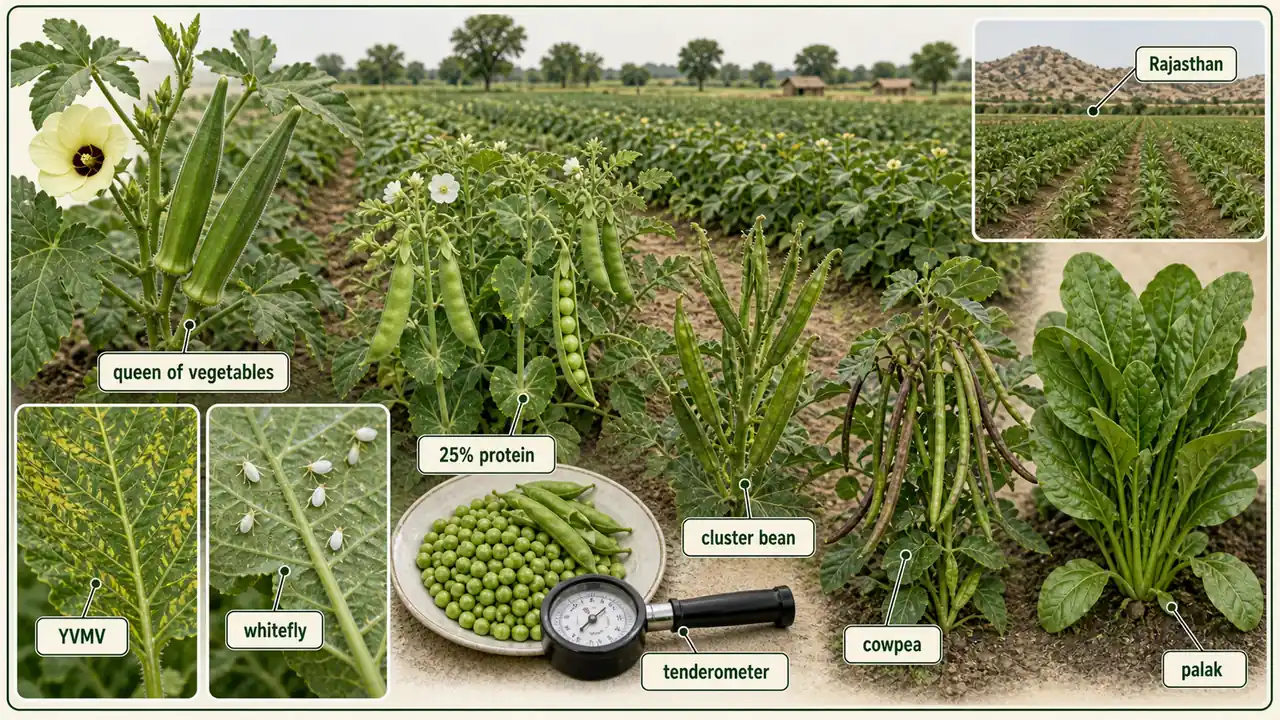
In the jaggery-making villages of Uttar Pradesh, farmers add okra roots and stems to boiling sugarcane juice — the mucilaginous substances act as natural clarifying agents that help remove impurities from the juice. Meanwhile in Rajasthan, cluster bean thrives in the scorching desert heat, producing seeds from which guar gum is extracted — a product so commercially valuable that it is used in everything from food processing to oil drilling and even explosives. These examples illustrate how Indian vegetable crops serve purposes far beyond the dinner plate.
IMPORTANT
Key exam facts: YVMV (Yellow Vein Mosaic Virus) resistance is the major breeding objective in okra — transmitted by whitefly. Pea has ~25% protein and maturity is measured by tenderometer. Cluster bean is led by Rajasthan. Okra is the queen of vegetables.
Okra (Bhindi / Lady's Finger)
Botanical Identity
| Parameter | Detail |
|---|---|
| Botanical Name | Abelmoschus esculentus |
| Family | Malvaceae |
| Origin | Africa |
| Also known as | Queen of vegetables |
| Leading state | West Bengal (followed by Bihar) |
| Optimal temperature | 24-28 degrees C |
| Flower bud drop above | 42 degrees C |
| Spacing | 45 cm x 30 cm |
| Export standard | 6-8 cm long fruits |
| Pioneer researcher | Dr. Harbhajan Singh |

Key Facts
- Higher iodine content — helps in controlling goitre (thyroid deficiency disease).
- Accounts for 70% of the remaining 30% of vegetable export earnings after onion.
- Roots and stems are used for clearing cane juice in jaggery (gur) preparation.
- Gives 300-500% crop land use efficiency as an intercrop in cassava and cucurbits.
- Longer fruits for domestic fresh market; 6-8 cm for export.
Seed Rate
| Season | Seed Rate |
|---|---|
| Kharif | 8-10 kg/ha |
| Hybrid | 2.5 kg/ha |
| Spring-summer | 20 kg/ha (higher due to hard seed coat, lower germination) |
YVMV — The Most Important Disease
Yellow Vein Mosaic Virus (YVMV) is the most devastating disease of okra. It is caused by a Begomovirus transmitted by whitefly (Bemisia tabaci) in a persistent manner. Infected plants show characteristic yellow netting of leaf veins, stunting, and severely reduced yield.
Pro Content Locked
Upgrade to Pro to access this lesson and all other premium content.
Charged once for one year · ₹1188 total
Save ₹100/month vs ₹2388/year launch price
- All Agriculture & Banking Courses
- AI Lesson Questions (100/day)
- AI Doubt Solver (50/day)
- Glows & Grows Feedback (30/day)
- AI Section Quiz (20/day)
- 22-Language Translation (100/day)
- Recall Questions (20/day)
- AI Quiz (15/day)
- AI Quiz Paper Analysis (100/day)
- AI Step-by-Step Explanations (100/day)
- Spaced Repetition Recall (FSRS)
- AI Tutor
- Immersive Text Questions
- Audio Lessons — Hindi & English
- Mock Tests & Previous Year Papers
- Summary & Mind Maps
- XP, Levels, Leaderboard & Badges
- Generate New Classrooms
- Voice AI Teacher (AgriDots Live)
- AI Revision Assistant
- Knowledge Gap Analysis
- Interactive Revision (LangGraph)
🔒 Secure one-time yearly payment via Razorpay · No hidden fees
In the jaggery-making villages of Uttar Pradesh, farmers add okra roots and stems to boiling sugarcane juice — the mucilaginous substances act as natural clarifying agents that help remove impurities from the juice. Meanwhile in Rajasthan, cluster bean thrives in the scorching desert heat, producing seeds from which guar gum is extracted — a product so commercially valuable that it is used in everything from food processing to oil drilling and even explosives. These examples illustrate how Indian vegetable crops serve purposes far beyond the dinner plate.
IMPORTANT
Key exam facts: YVMV (Yellow Vein Mosaic Virus) resistance is the major breeding objective in okra — transmitted by whitefly. Pea has ~25% protein and maturity is measured by tenderometer. Cluster bean is led by Rajasthan. Okra is the queen of vegetables.
Okra (Bhindi / Lady's Finger)
Botanical Identity
| Parameter | Detail |
|---|---|
| Botanical Name | Abelmoschus esculentus |
| Family | Malvaceae |
| Origin | Africa |
| Also known as | Queen of vegetables |
| Leading state | West Bengal (followed by Bihar) |
| Optimal temperature | 24-28 degrees C |
| Flower bud drop above | 42 degrees C |
| Spacing | 45 cm x 30 cm |
| Export standard | 6-8 cm long fruits |
| Pioneer researcher | Dr. Harbhajan Singh |
Key Facts
- Higher iodine content — helps in controlling goitre (thyroid deficiency disease).
- Accounts for 70% of the remaining 30% of vegetable export earnings after onion.
- Roots and stems are used for clearing cane juice in jaggery (gur) preparation.
- Gives 300-500% crop land use efficiency as an intercrop in cassava and cucurbits.
- Longer fruits for domestic fresh market; 6-8 cm for export.
Seed Rate
| Season | Seed Rate |
|---|---|
| Kharif | 8-10 kg/ha |
| Hybrid | 2.5 kg/ha |
| Spring-summer | 20 kg/ha (higher due to hard seed coat, lower germination) |
YVMV — The Most Important Disease
Yellow Vein Mosaic Virus (YVMV) is the most devastating disease of okra. It is caused by a Begomovirus transmitted by whitefly (Bemisia tabaci) in a persistent manner. Infected plants show characteristic yellow netting of leaf veins, stunting, and severely reduced yield.

Management: Spray systemic insecticides (Methyl demeton or Dimethoate @ 2 ml/litre) to control the whitefly vector + grow resistant varieties.
Important Varieties
| Variety | Development Method | Special Feature |
|---|---|---|
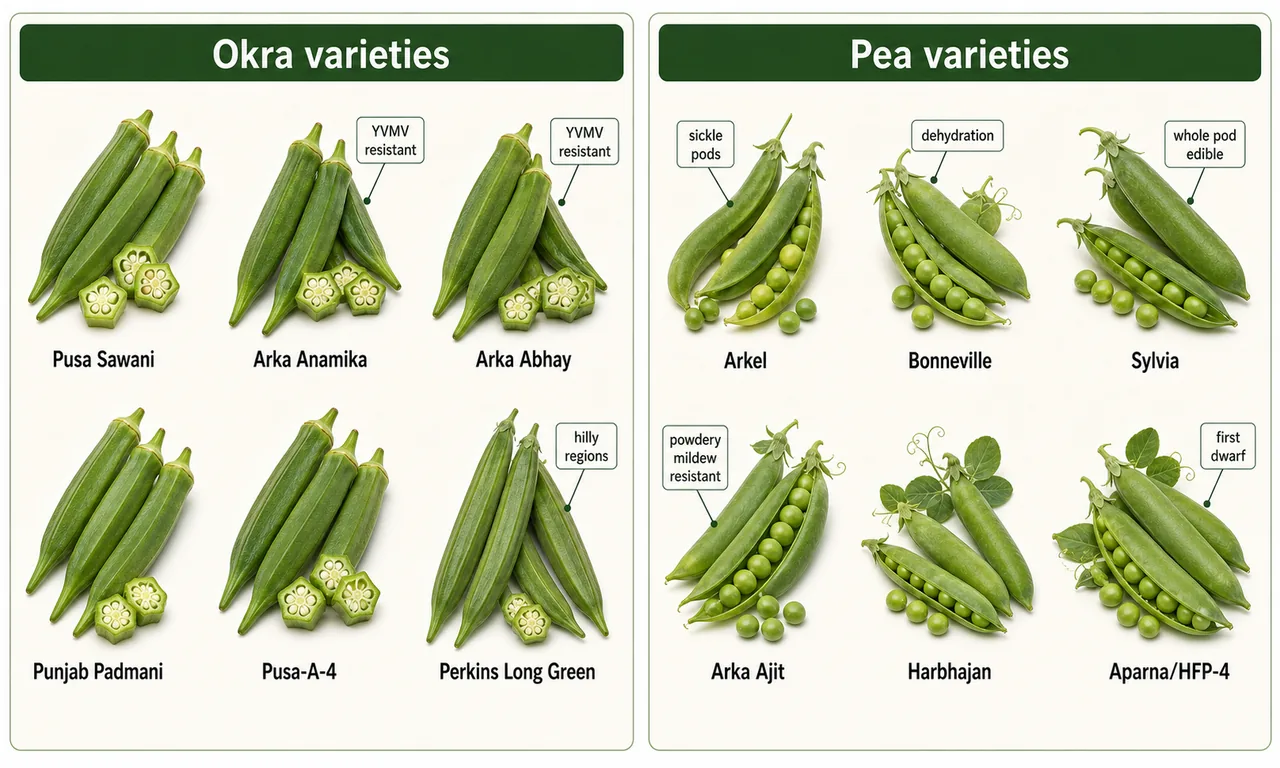
| Pusa Sawani | Pusa Mokhmali x IC-1542 | Day neutral, spineless, salinity tolerant, wide pH range |
| Arka Anamika | A. esculentus x A. manihot ssp. tetraphyllus | YVMV resistant (interspecific hybrid) |
| Arka Abhay | A. esculentus x A. manihot ssp. manihot | YVMV resistant; quick branching after pruning |
| Parbhani Kranti | A. esculentus x A. manihot ssp. manihot | YVMV resistant |
| Punjab Padmani | A. esculentus x A. manihot ssp. manihot | Field resistant to YVMV + tolerant to jassids and bollworm |
| Pusa-A-4 | — | YVMV resistant + tolerant to jassids and fruit/shoot borer |
| Varsha Upkar | — | Suitable for YVMV-prone areas |
| Perkins Long Green | Introduction | Suitable for hilly regions of North India |
| EMS-8 | Mutant (EMS chemical mutagen) | Mutation breeding variety |
NOTE
Most YVMV-resistant okra varieties are interspecific hybrids — crosses between cultivated A. esculentus and wild A. manihot species. The wild species provides the resistance genes.
Pests
| Pest | Scientific Name | Damage |
|---|---|---|
| Jassid (most serious) | — | Yellowing, curling of leaf margins (hopper burn) |
| Fruit borer | Earias vittella | Bores into shoots and fruits |
| Blister beetle | Mylabris pustulata | Feeds on flowers; secretes cantharidin (causes skin blisters) |


Pea (Matar)
Botanical Identity
| Parameter | Detail |
|---|---|
| Botanical Name | Pisum sativum |
| Garden pea | P. sativum var. hortense |
| Family | Leguminosae (Fabaceae) |
| Protein content | ~25% (one of the most protein-rich vegetables) |
| Leading state | Uttar Pradesh (area + production) |
| Seed rate | 75-80 kg/ha (directly sown, large seed) |
| Maturity measured by | Tenderometer |
| Most popular canned vegetable | Pea (in India) |
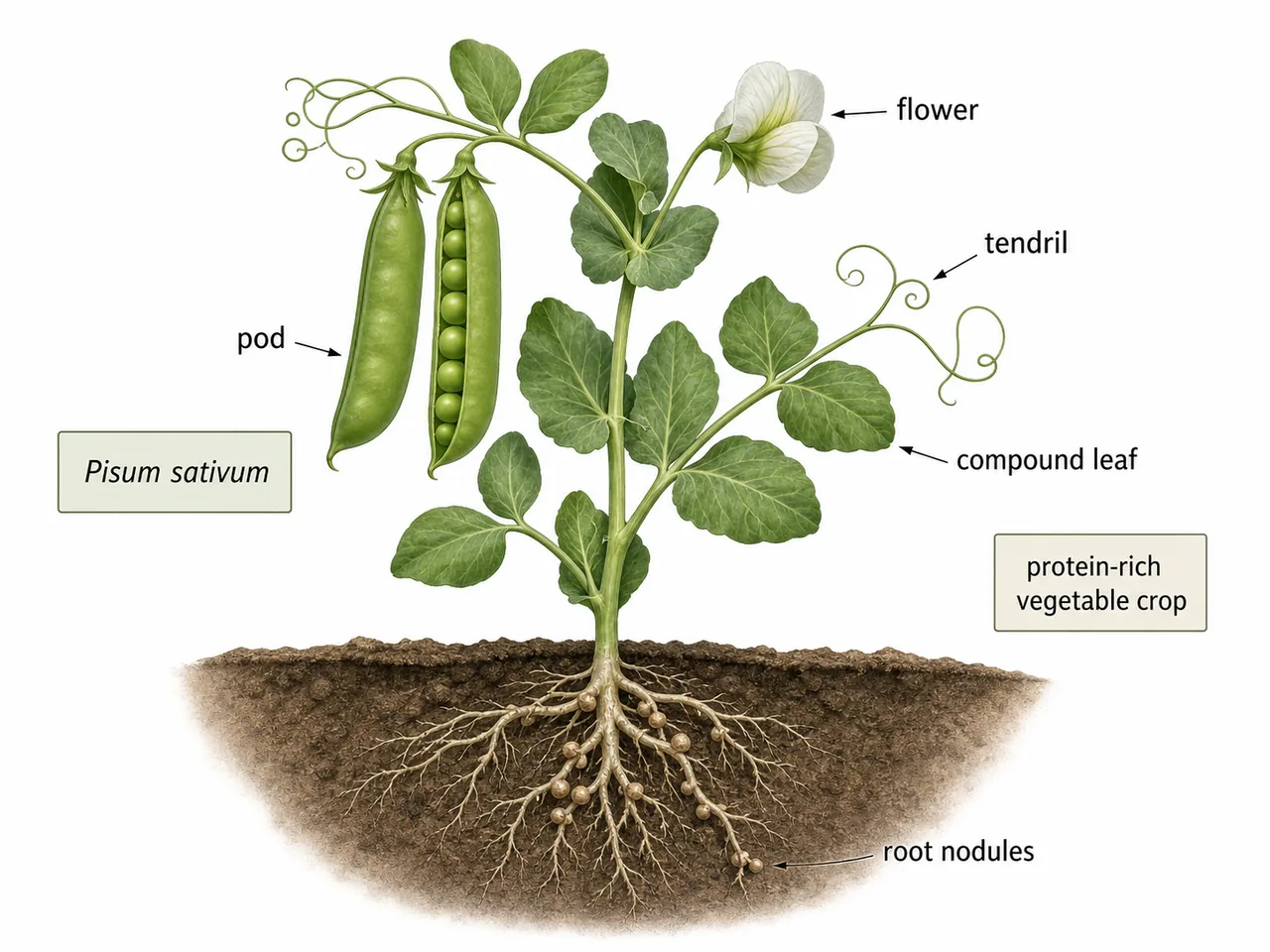
A tenderometer measures the tenderness (or toughness) of peas by measuring the force required to shear a sample. Lower readings = more tender peas. This is critical for the processing industry.
Important Varieties
| Variety | Special Feature |
|---|---|
| Arkel | Sickle-shaped pods |
| Bonneville | Suitable for dehydration (high dry matter) |
| Sylvia | Whole pod edible (snow pea / sugar pea) |
| Arka Ajit | Powdery mildew resistant |
| Rachna | Powdery mildew resistant |
| Harbhajan | Extra early variety |
| Aparna / HFP-4 | First dwarf variety (less lodging, easier harvest) |
| Jawahar Matar-1 | Susceptible to powdery mildew |
Pest and Disease
| Problem | Cause |
|---|---|
| Stem borer | Etiella zinckenella |
| Powdery mildew | Erysiphe polygoni |
Cowpea (Lobia)
| Parameter | Detail |
|---|---|
| Family | Leguminosae (Fabaceae) |
| Origin | Africa |
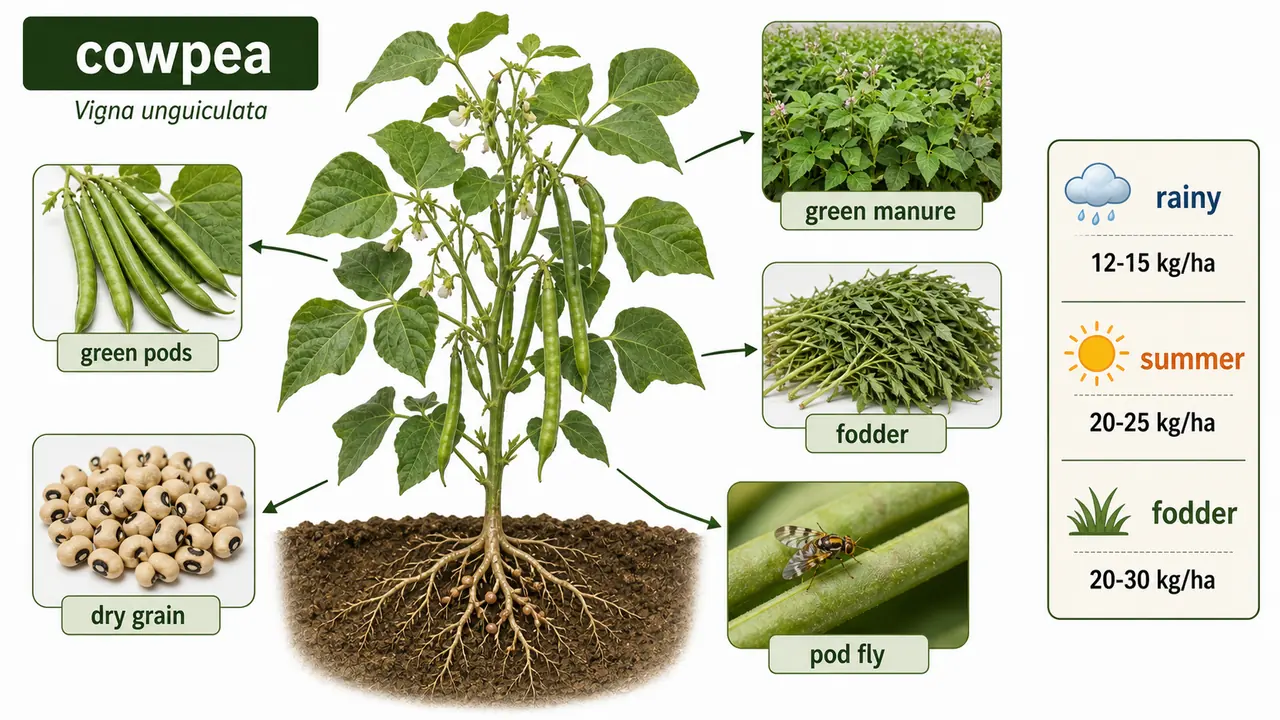
| Uses | Green pods (vegetable), dry grain (pulse), green manure, fodder |
| Major pest | Pod fly (Ophiomyia phaseoli) |
Seed Rate by Purpose
| Purpose | Seed Rate |
|---|---|
| Rainy season vegetable | 12-15 kg/ha |
| Summer vegetable | 20-25 kg/ha |
| Fodder | 20-30 kg/ha |
Varieties
- Pusa Barsati, Pusa Dofasali, Pusa Rituraj, Pusa Komal, Kansi Gouri
- Pusa Phalguni — dwarf variety (compact growth, suitable for intercropping)
Cluster Bean (Guar)
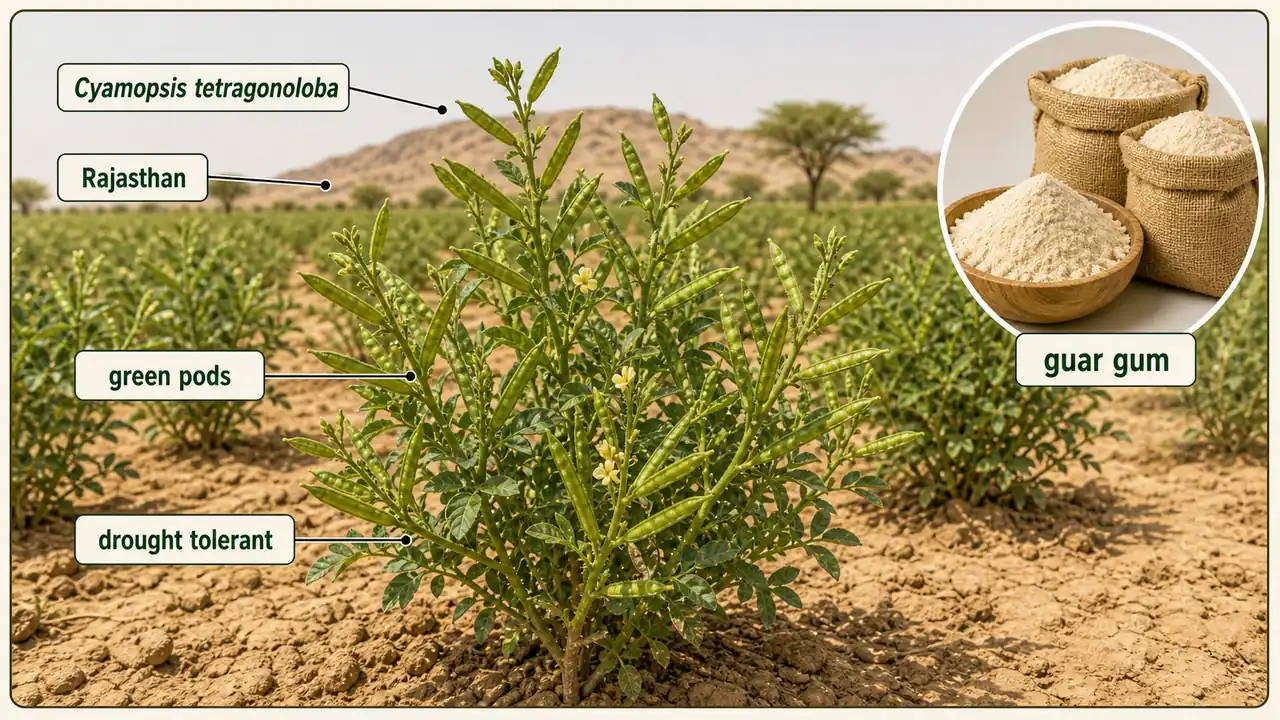
| Parameter | Detail |
|---|---|
| Botanical Name | Cyamopsis tetragonoloba |
| Leading state | Rajasthan (1st in area + production) |
| Industrial uses | Guar gum — used in food processing, textiles, paper, oil drilling, explosives |
| Vegetable use | Immature pods eaten as green vegetable (gawar phali) |
| Climate | Drought-tolerant; suited to hot, arid conditions |
Varieties (for Green Vegetable)
- Pusa Sadabahar, Pusa Mosami, Durgapura Safed, Pusa Navbahar
Palak (Indian Spinach)
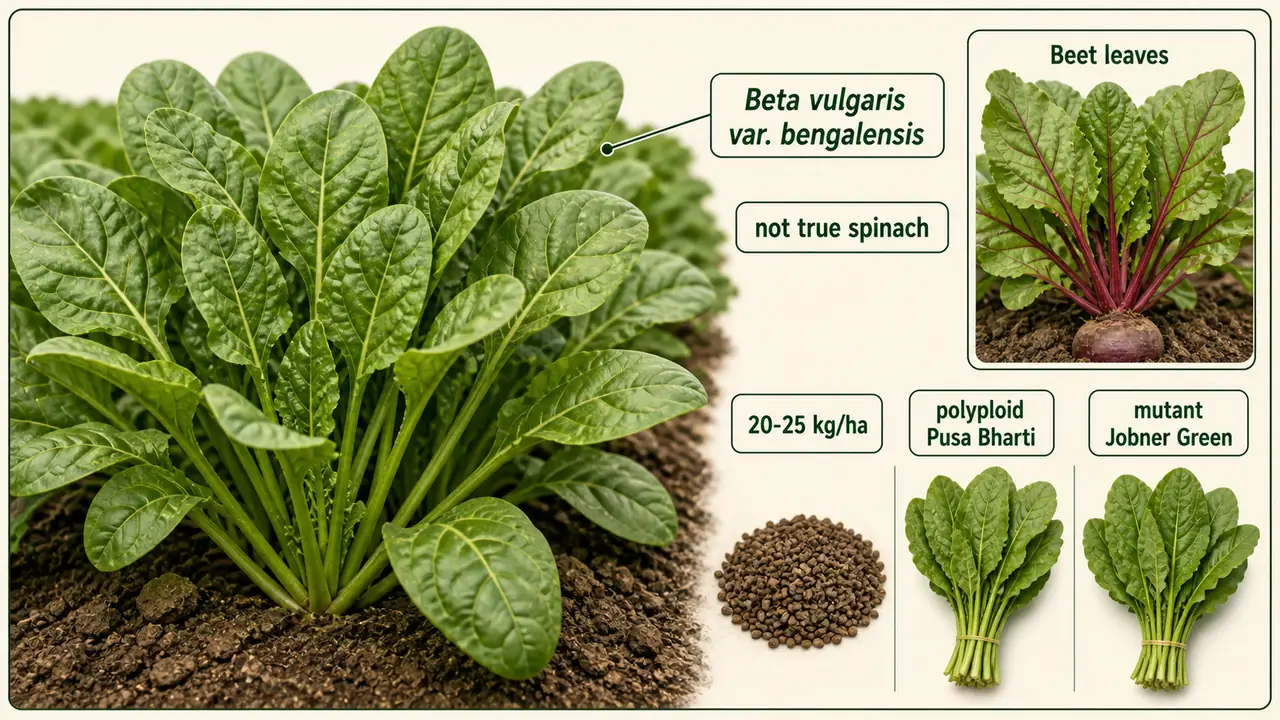
| Parameter | Detail |
|---|---|
| Botanical Name | Beta vulgaris var. bengalensis |
| Family | Chenopodiaceae |
| Seed rate | 20-25 kg/ha |
NOTE
Palak (Beta vulgaris) is botanically a leafy variety of beet (Chenopodiaceae family), NOT the same as true spinach (Spinacia oleracea). This is a commonly confused point.
Varieties
| Variety | Special Feature |
|---|---|
| Pusa Bharti | Polyploid — chromosome doubling gives larger, thicker leaves and higher yields |
| Jobner Green | Mutant variety (mutation breeding) |
| Punjab Green, All Green, Pusa Harit, Pusa Jyoti | Standard varieties |
Seed Rate Quick Reference — All Vegetables
Seed Rate Quick Reference - All Vegetables
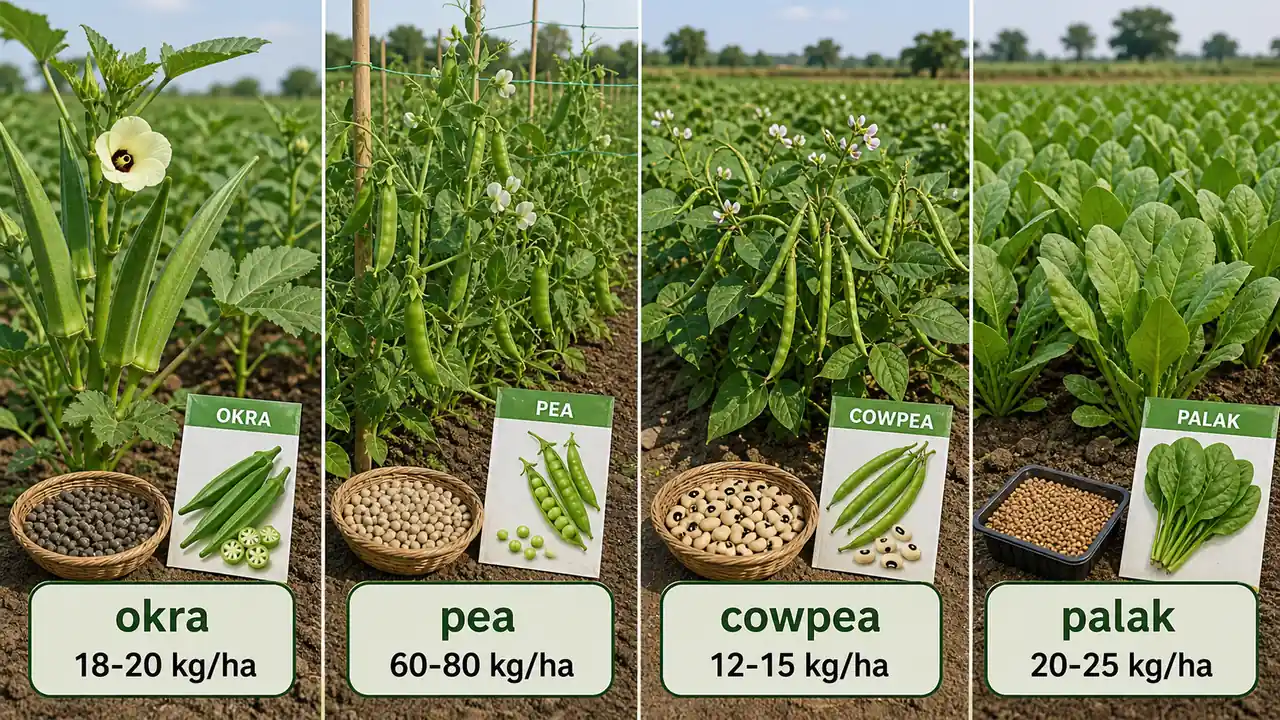
| Crop | Seed Rate |
|---|---|
| Tomato (normal) | 350-400 g/ha |
| Tomato (hybrid) | 100-150 g/ha |
| Brinjal | 200 g/ha |
| Chilli | 1.0-1.5 kg/ha |
| Onion | 8-10 kg/ha |
| Cabbage | 500-750 g/ha |
| Cauliflower | 450-700 g/ha |
| Cucumber | 2.5 kg/ha |
| Musk Melon | 1.5-2.0 kg/ha |
| Water Melon | 4-4.5 kg/ha |
| Carrot | 5-6 kg/ha |
| Radish | 5.5-11 kg/ha |
| Pea | 75-80 kg/ha |
| Okra (Kharif) | 8-10 kg/ha |
| Palak | 20-25 kg/ha |
Summary Cheat Sheet
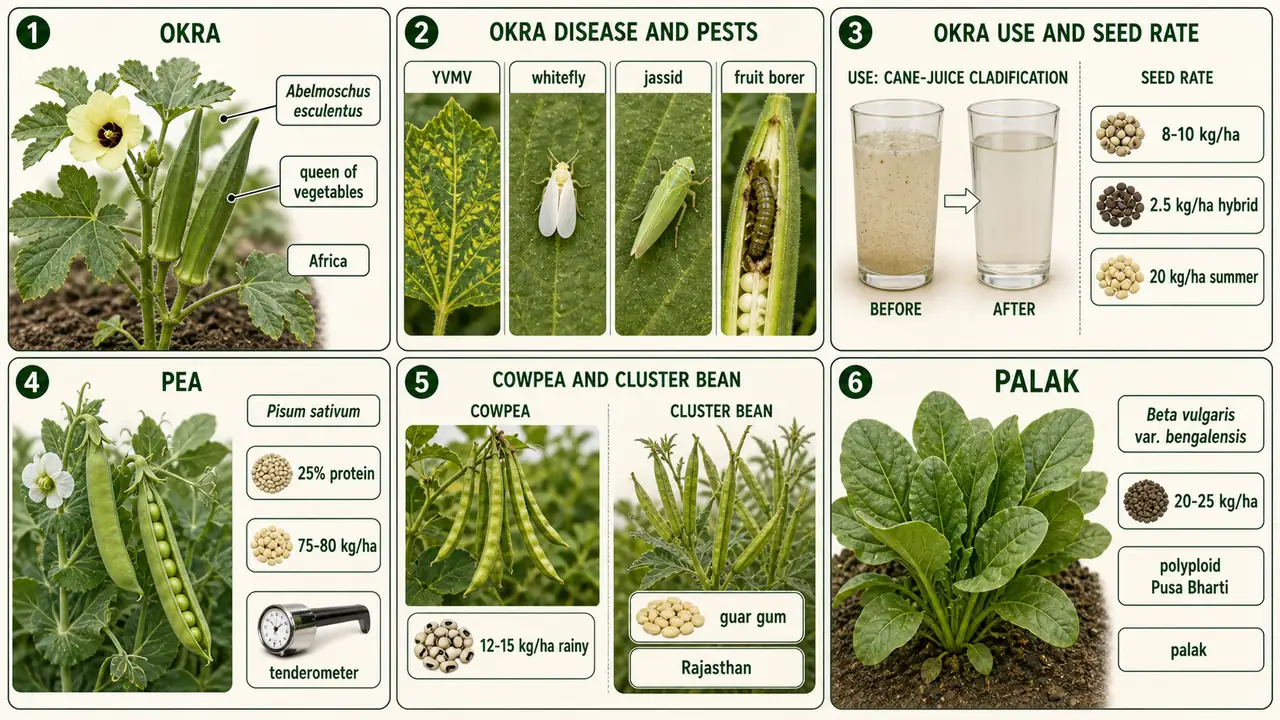
| Concept / Topic | Key Details / Explanation |
|---|---|
| Okra identity | Okra is Abelmoschus esculentus of the Malvaceae family, originated in Africa, is called the queen of vegetables, and West Bengal is the leading state. |
| Okra crop facts | Optimum temperature is 24-28 degrees C, flower bud drop occurs above 42 degrees C, spacing is 45 x 30 cm, export fruits are 6-8 cm long, and Dr. Harbhajan Singh is the pioneer researcher. |
| Okra uses and importance | Okra has higher iodine content, roots and stems are used for clarifying cane juice during jaggery making, and it can give 300-500% land-use efficiency as an intercrop. |
| Okra seed rate | Seed rate is 8-10 kg/ha in kharif, about 2.5 kg/ha for hybrids, and 20 kg/ha in spring-summer because of the hard seed coat and lower germination. |
| Most important disease of okra | Yellow Vein Mosaic Virus (YVMV) is the major disease and the main breeding target; it is caused by a Begomovirus and transmitted by whitefly (Bemisia tabaci). |
Summary Continued
| Concept / Topic | Key Details / Explanation |
|---|---|
| YVMV management and resistant breeding | YVMV is managed through vector control with Methyl demeton or Dimethoate @ 2 ml/litre plus resistant varieties; many resistant okra varieties are interspecific hybrids involving wild A. manihot. |
| Important okra varieties | Pusa Sawani is day-neutral and spineless; Arka Anamika, Arka Abhay, Parbhani Kranti, Punjab Padmani, and Pusa-A-4 are important YVMV-resistant lines; Varsha Upkar suits YVMV-prone areas, Perkins Long Green suits hills, and EMS-8 is a mutant. |
| Major okra pests | Jassid is the most serious pest, Earias vittella is the fruit borer, and Mylabris pustulata is the blister beetle that feeds on flowers and secretes cantharidin. |
| Pea identity | Pea is Pisum sativum and garden pea is P. sativum var. hortense; it belongs to Fabaceae, contains about 25% protein, and Uttar Pradesh leads in area and production. |
| Pea management facts | Pea is directly sown with a seed rate of 75-80 kg/ha; maturity for processing is judged by a tenderometer, and pea is the most popular canned vegetable in India. |
Summary Continued
| Concept / Topic | Key Details / Explanation |
|---|---|
| Important pea varieties | Arkel has sickle-shaped pods, Bonneville is suitable for dehydration, Sylvia is a whole-pod edible type, Arka Ajit and Rachna resist powdery mildew, Harbhajan is extra early, and Aparna/HFP-4 is the first dwarf variety. |
| Pea pest and disease | Etiella zinckenella causes stem borer, while Erysiphe polygoni causes powdery mildew. |
| Cowpea | Cowpea belongs to Fabaceae, originated in Africa, is used as vegetable, pulse, green manure, and fodder, and its major pest is pod fly (Ophiomyia phaseoli). |
| Cowpea seed rate and variety | Seed rate is 12-15 kg/ha for rainy-season vegetable, 20-25 kg/ha for summer vegetable, and 20-30 kg/ha for fodder; important varieties include Pusa Barsati, Pusa Dofasali, Pusa Rituraj, Pusa Komal, Kansi Gouri, and dwarf Pusa Phalguni. |
| Cluster bean | Cluster bean is Cyamopsis tetragonoloba; Rajasthan leads in area and production, and the crop is important for guar gum used in food, textiles, paper, oil drilling, and explosives. |
| Cluster bean varieties | Important vegetable varieties are Pusa Sadabahar, Pusa Mosami, Durgapura Safed, and Pusa Navbahar. |
| Palak | Palak is Beta vulgaris var. bengalensis of the Chenopodiaceae family with seed rate 20-25 kg/ha; it is botanically a leafy beet and not the same as true spinach. |
| Palak varieties | Pusa Bharti is a polyploid variety, Jobner Green is a mutant, and Punjab Green, All Green, Pusa Harit, and Pusa Jyoti are standard varieties. |
| Cross-lesson seed-rate recall | The quick reference in the lesson reinforces seed rates such as chilli 1.0-1.5 kg/ha, onion 8-10 kg/ha, cabbage 500-750 g/ha, cauliflower 450-700 g/ha, cucumber 2.5 kg/ha, pea 75-80 kg/ha, okra 8-10 kg/ha, and palak 20-25 kg/ha. |