🧅 Onion — India's Most Important Foreign Exchange Earning Vegetable
Complete guide to onion cultivation covering bulb formation, photoperiod response, pungency compounds, varieties, Maleic Hydrazide for storage, thrips management, and purple blotch disease for competitive exams.
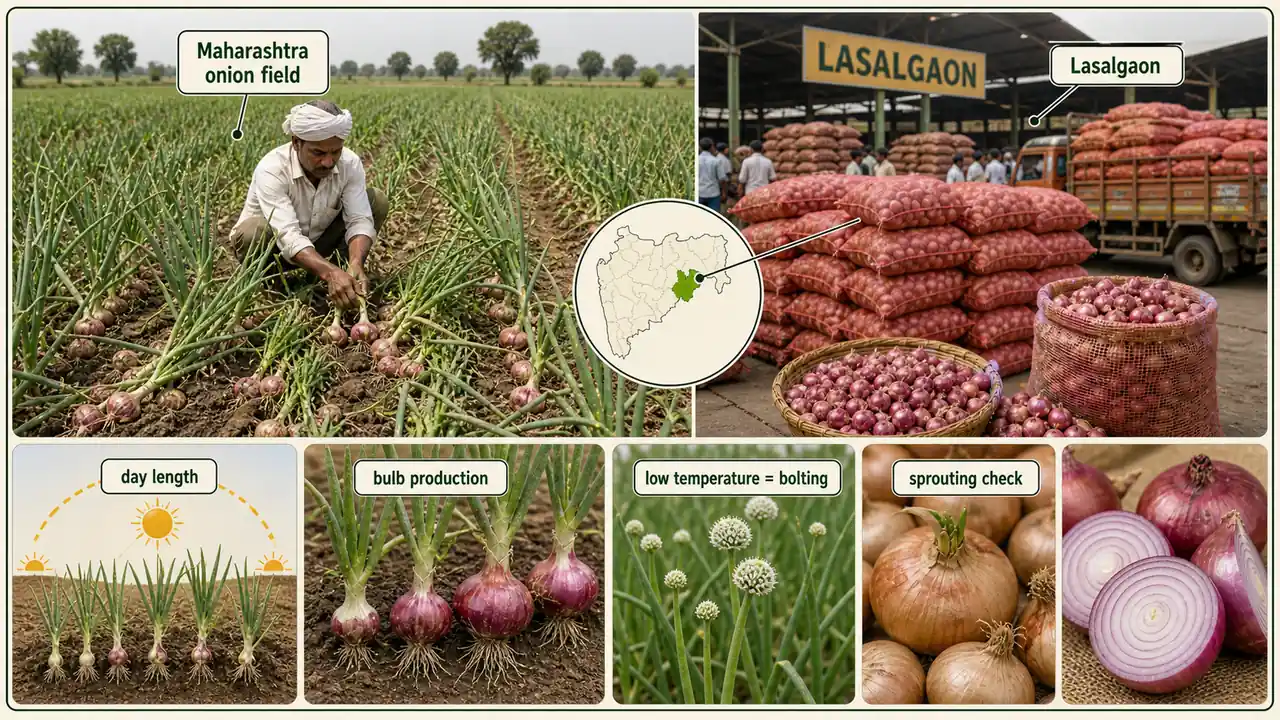
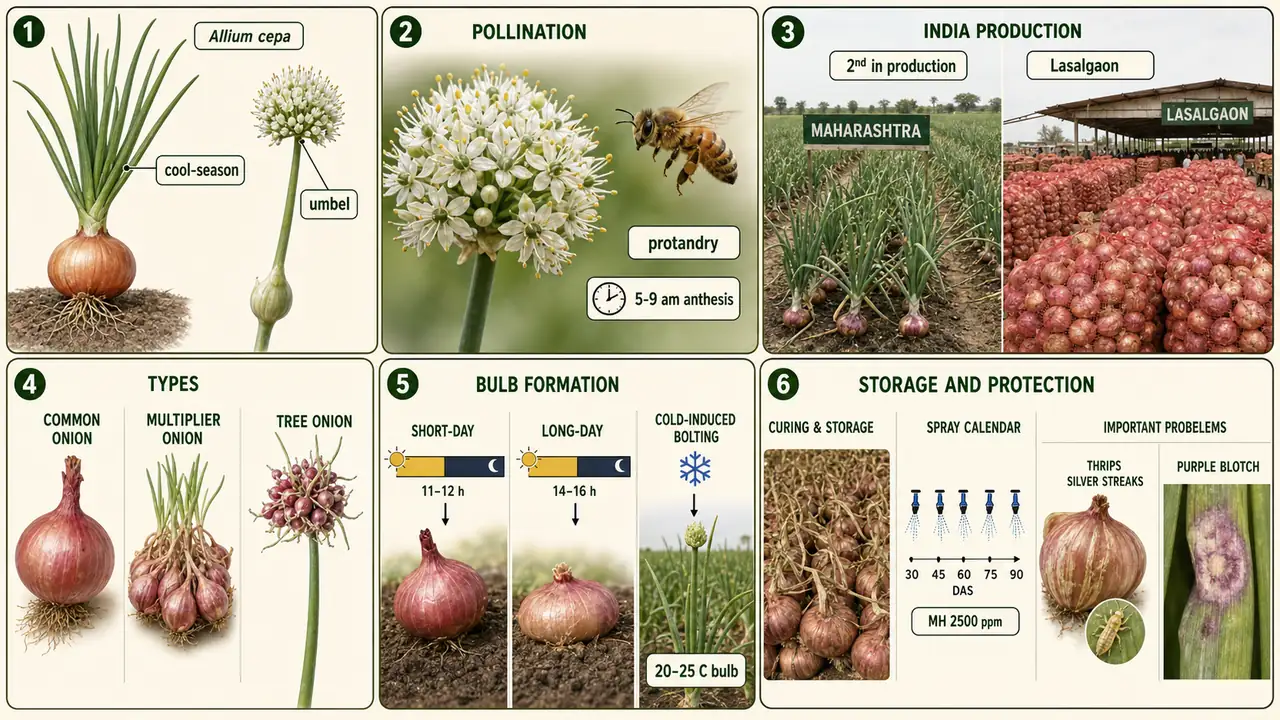
At Lasalgaon in Maharashtra's Nashik district — India's biggest onion market — prices fluctuate daily, influencing the cost of this essential kitchen staple across the entire country. Onion is not just a vegetable; it is a politically sensitive commodity. Maharashtra alone accounts for 23.4% of India's onion area and 27.5% of production, and onion contributes a remarkable 77% of India's total foreign exchange earnings among fresh vegetables. Understanding its cultivation science is critical for both farming and competitive exams.
IMPORTANT
Key exam facts: Day length is more important than temperature for bulb production. Temperature is more important for seed production. Pungency is due to Allyl propyl disulphide. Bolting is caused by low temperature. Spray Maleic Hydrazide @ 2500 ppm to check sprouting in storage.
Botanical Identity
| Parameter | Detail |
|---|---|
| Botanical Name | Allium cepa |
| Family | Alliaceae (previously Liliaceae) |
| Origin | Central Asia |
| Rich source of | Vitamin B Complex |
| Pollination | Highly cross-pollinated (due to protandry) |
| Pollinator | Honey bees |
| Inflorescence | Umbellate (umbrella-shaped cluster) |
| Flower colour | White or bluish |
| Anthesis time | 5-9 am |
| Season | Cool season crop |

India's Position in Onion Production
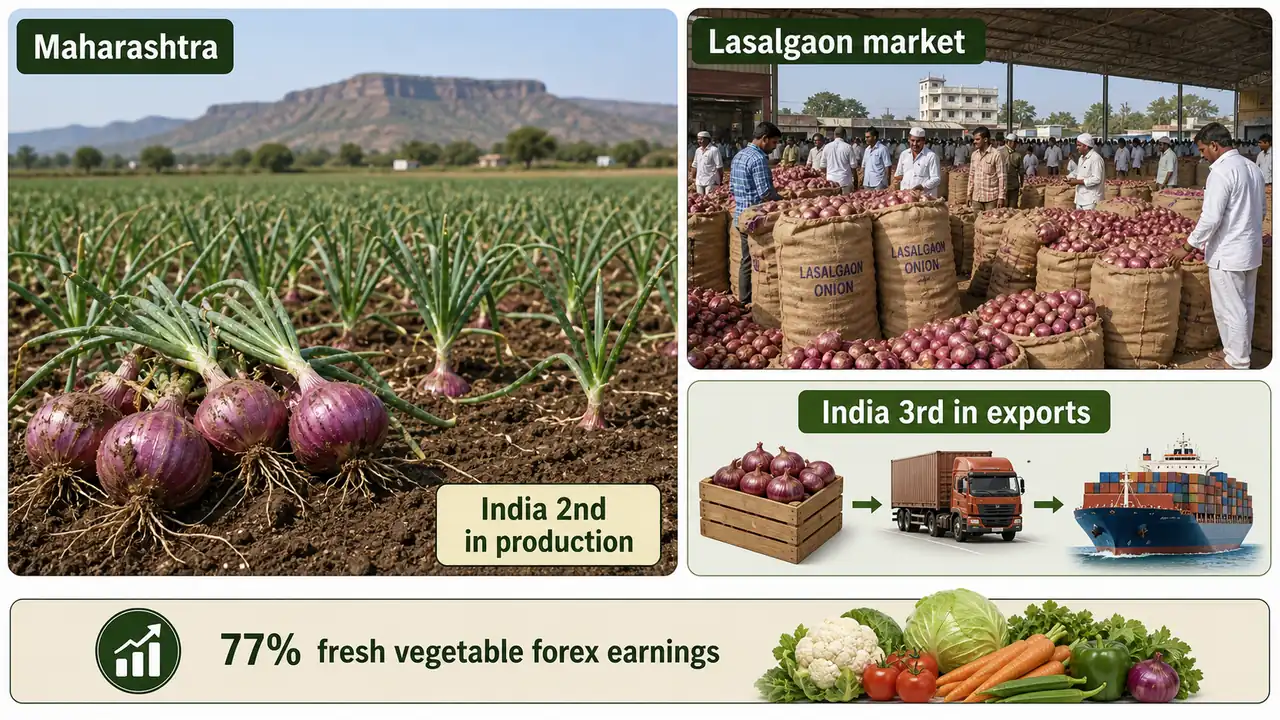
| Parameter | Fact |
|---|---|
| India's global rank (area and production) | 2nd (after China) |
| India's rank in exports | 3rd (12% of world exports) |
| World's leading onion exporter | Netherlands (21%), followed by Spain |
| Leading Indian state (area + production) | Maharashtra (23.4% area, 27.5% production) |
| Biggest onion market in India | Lasalgaon, Nashik, Maharashtra |
| Share in fresh vegetable forex earnings | 77% |
Types of Onion
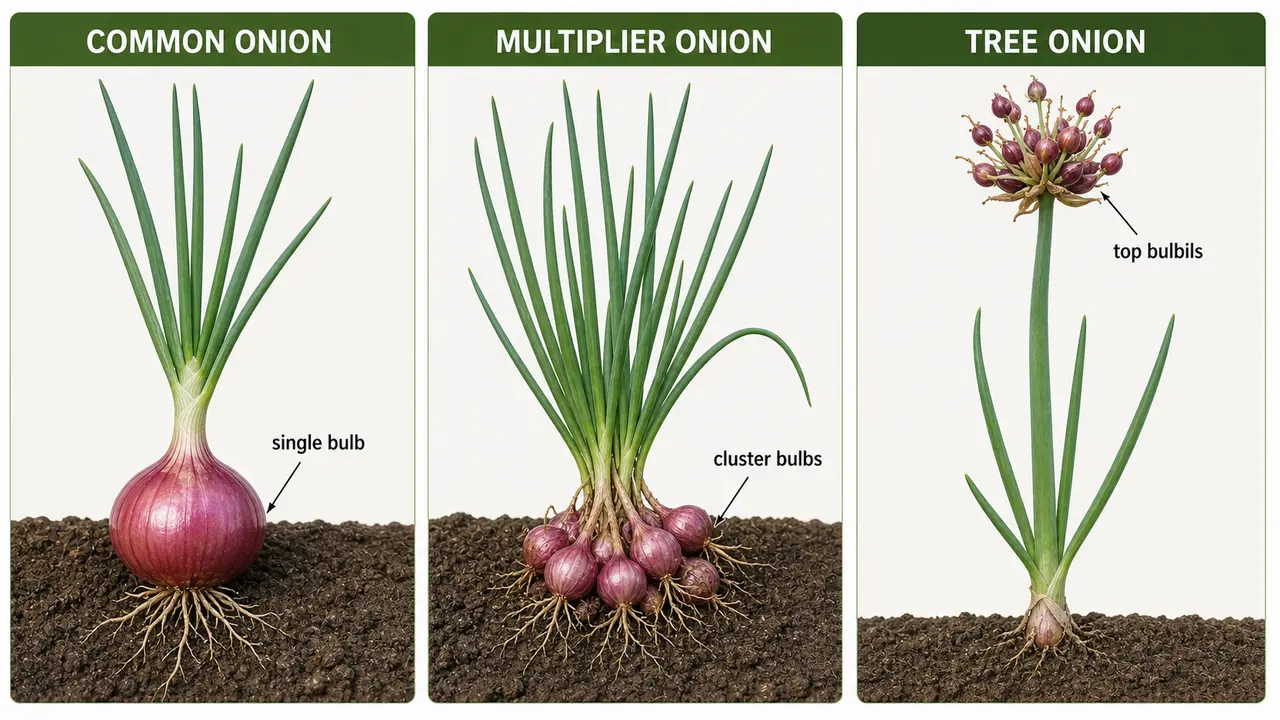
| Type | Botanical Name | Key Feature |
|---|---|---|
| Common onion | Allium cepa | Single large bulb |
| Potato/Multiplier onion | A. cepa var. aggregatum | Clusters of small bulbs underground |
| Tree onion | A. cepa var. viviparum | Produces small bulbils on top of flower stalk |
Bulb Formation and Photoperiod
Understanding the interplay between day length and temperature is essential:
Pro Content Locked
Upgrade to Pro to access this lesson and all other premium content.
Charged once for one year · ₹1188 total
Save ₹100/month vs ₹2388/year launch price
- All Agriculture & Banking Courses
- AI Lesson Questions (100/day)
- AI Doubt Solver (50/day)
- Glows & Grows Feedback (30/day)
- AI Section Quiz (20/day)
- 22-Language Translation (100/day)
- Recall Questions (20/day)
- AI Quiz (15/day)
- AI Quiz Paper Analysis (100/day)
- AI Step-by-Step Explanations (100/day)
- Spaced Repetition Recall (FSRS)
- AI Tutor
- Immersive Text Questions
- Audio Lessons — Hindi & English
- Mock Tests & Previous Year Papers
- Summary & Mind Maps
- XP, Levels, Leaderboard & Badges
- Generate New Classrooms
- Voice AI Teacher (AgriDots Live)
- AI Revision Assistant
- Knowledge Gap Analysis
- Interactive Revision (LangGraph)
🔒 Secure one-time yearly payment via Razorpay · No hidden fees
At Lasalgaon in Maharashtra's Nashik district — India's biggest onion market — prices fluctuate daily, influencing the cost of this essential kitchen staple across the entire country. Onion is not just a vegetable; it is a politically sensitive commodity. Maharashtra alone accounts for 23.4% of India's onion area and 27.5% of production, and onion contributes a remarkable 77% of India's total foreign exchange earnings among fresh vegetables. Understanding its cultivation science is critical for both farming and competitive exams.
IMPORTANT
Key exam facts: Day length is more important than temperature for bulb production. Temperature is more important for seed production. Pungency is due to Allyl propyl disulphide. Bolting is caused by low temperature. Spray Maleic Hydrazide @ 2500 ppm to check sprouting in storage.
Botanical Identity
| Parameter | Detail |
|---|---|
| Botanical Name | Allium cepa |
| Family | Alliaceae (previously Liliaceae) |
| Origin | Central Asia |
| Rich source of | Vitamin B Complex |
| Pollination | Highly cross-pollinated (due to protandry) |
| Pollinator | Honey bees |
| Inflorescence | Umbellate (umbrella-shaped cluster) |
| Flower colour | White or bluish |
| Anthesis time | 5-9 am |
| Season | Cool season crop |
India's Position in Onion Production
| Parameter | Fact |
|---|---|
| India's global rank (area and production) | 2nd (after China) |
| India's rank in exports | 3rd (12% of world exports) |
| World's leading onion exporter | Netherlands (21%), followed by Spain |
| Leading Indian state (area + production) | Maharashtra (23.4% area, 27.5% production) |
| Biggest onion market in India | Lasalgaon, Nashik, Maharashtra |
| Share in fresh vegetable forex earnings | 77% |
Types of Onion
| Type | Botanical Name | Key Feature |
|---|---|---|
| Common onion | Allium cepa | Single large bulb |
| Potato/Multiplier onion | A. cepa var. aggregatum | Clusters of small bulbs underground |
| Tree onion | A. cepa var. viviparum | Produces small bulbils on top of flower stalk |
Bulb Formation and Photoperiod
Understanding the interplay between day length and temperature is essential:
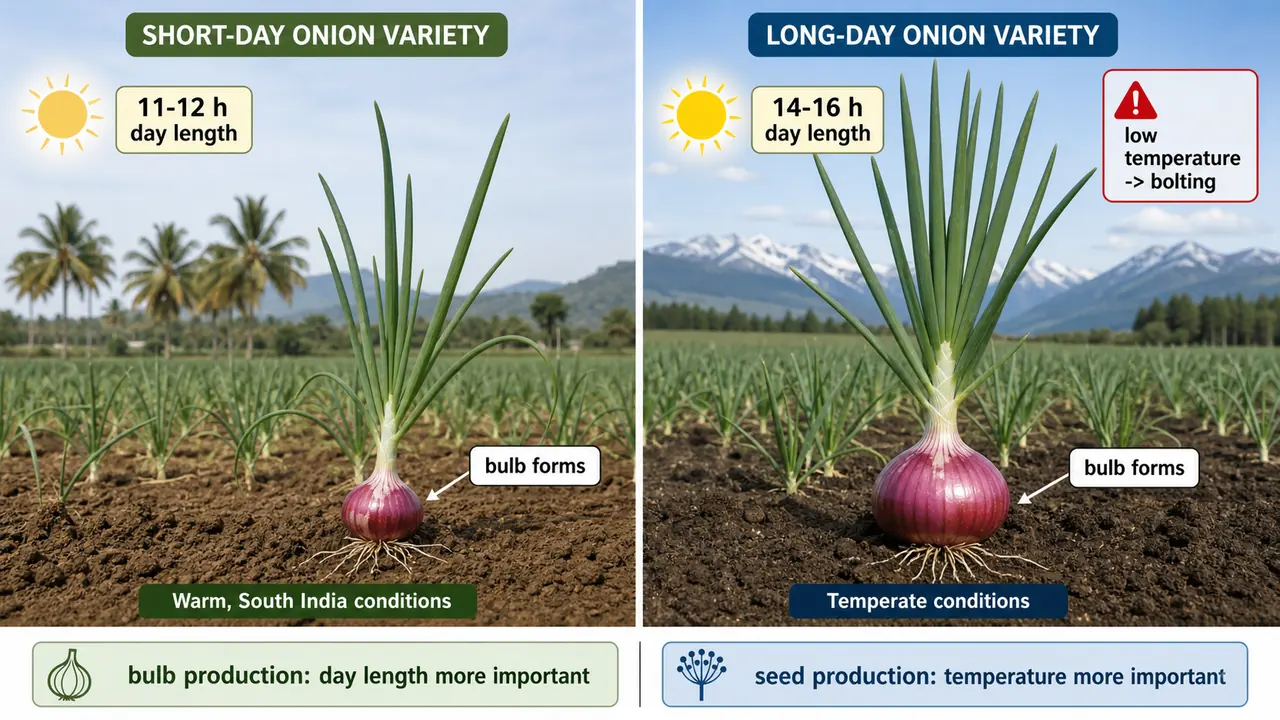
| Factor | Importance |
|---|---|
| Day length | More important than temperature for bulb production |
| Temperature | More important than day length for seed production |
| Optimum temperature for bulb development | 20-25 degrees C |
- Short-day varieties form bulbs at 11-12 hours of daylight (suitable for South India).
- Long-day varieties require 14-16 hours of daylight for bulbing (suited for temperate regions).
- Bolting (premature flowering / stem elongation) is triggered by low temperature (vernalization) — an undesirable response that reduces bulb quality.
Pungency and Chemical Compounds
| Compound | Role |
|---|---|
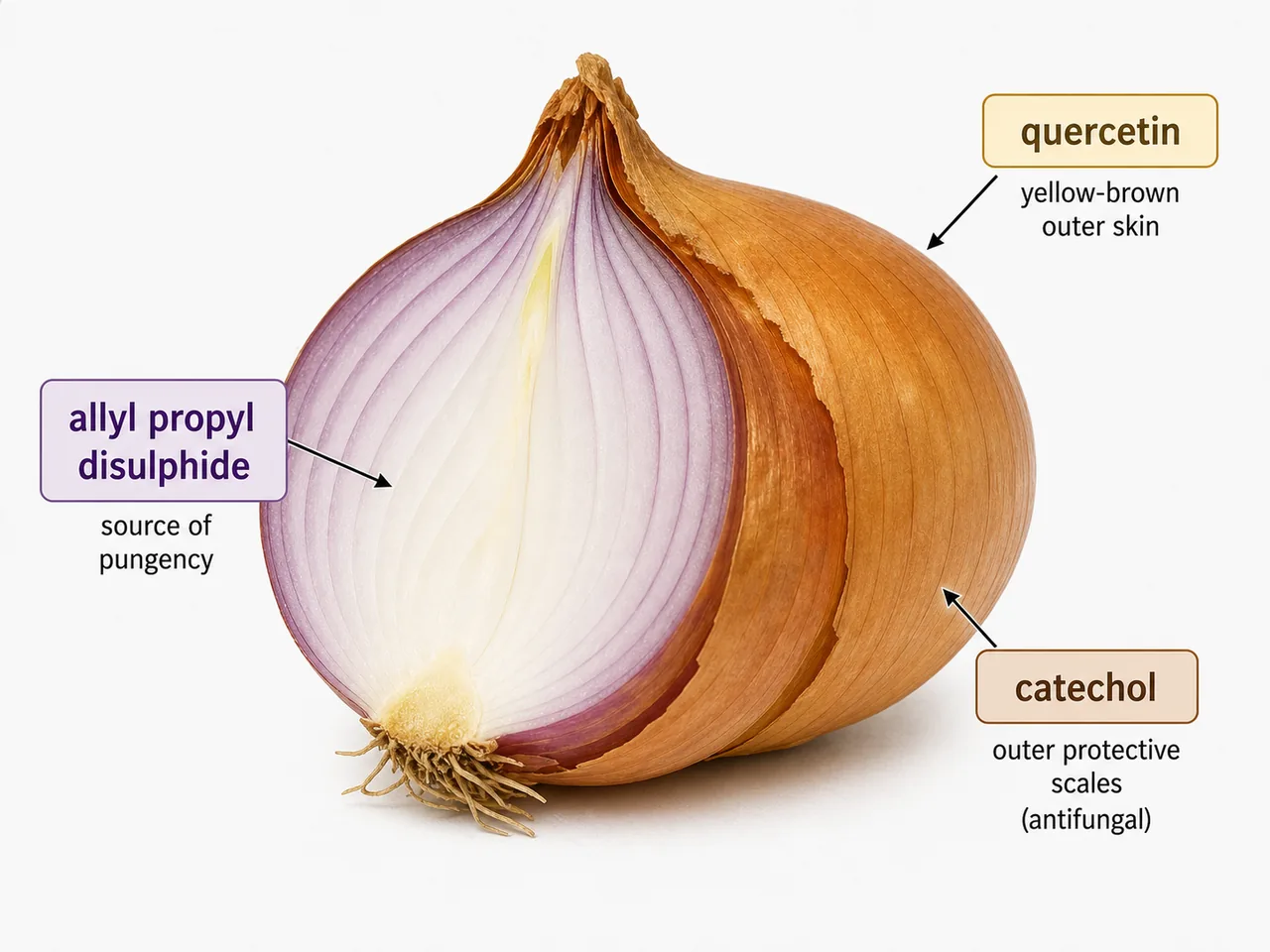
| Allyl propyl disulphide | Pungency (volatile sulphur compound causing tears) |
| Quercetin | Colour of outer skin (yellow-brown flavonoid); antioxidant, anti-cancer |
| Catechol | Phenolic compound with antifungal property; protects outer scales |
IMPORTANT
Key pungency compounds to remember: Onion = Allyl propyl disulphide. Garlic = Diallyl disulphide. Chilli = Capsaicin.
Post-Harvest and Storage
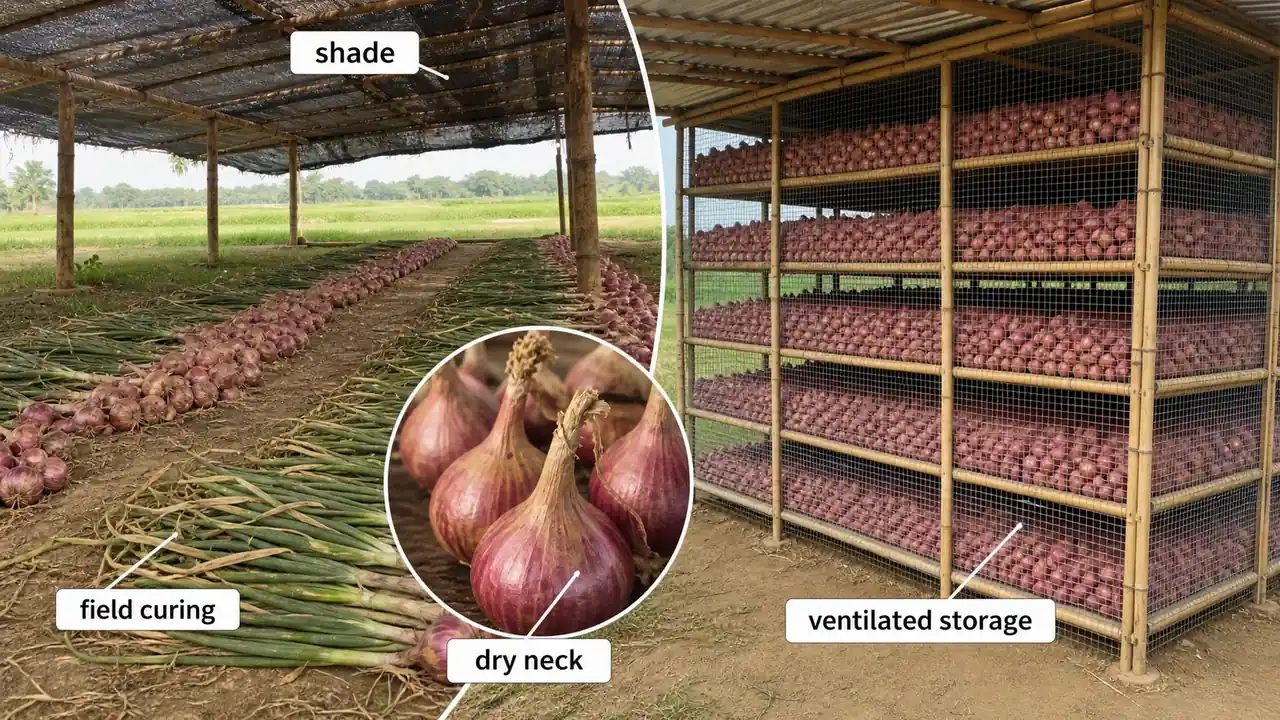
- To check sprouting during storage: spray Maleic Hydrazide (MH) @ 2500 ppm, applied 15-20 days before harvest.
- MH is a plant growth inhibitor that suppresses cell division in the onion meristem, extending storage life by several months.
- Zinc application (1-3 ppm) increases yield and improves storage quality.
- Onion is traditionally used in sun stroke treatment due to its cooling properties.
Seed Rate
| Method | Rate |
|---|---|
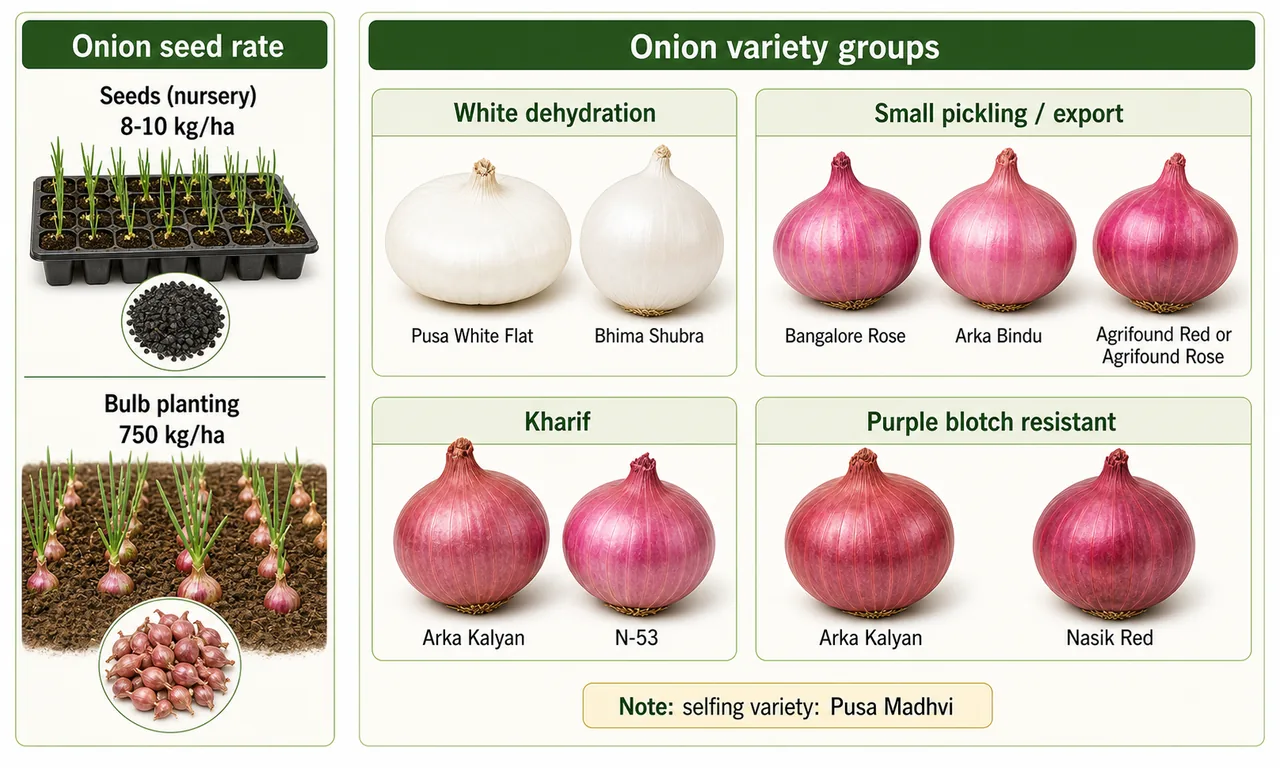
| Seeds (nursery raised) | 8-10 kg/ha |
| Bulb planting | 750 kg/ha (medium-sized bulbs) |
Important Varieties
By Colour and Use
| Category | Varieties |
|---|---|
| Largest cultivated type | Orange and Yellow |
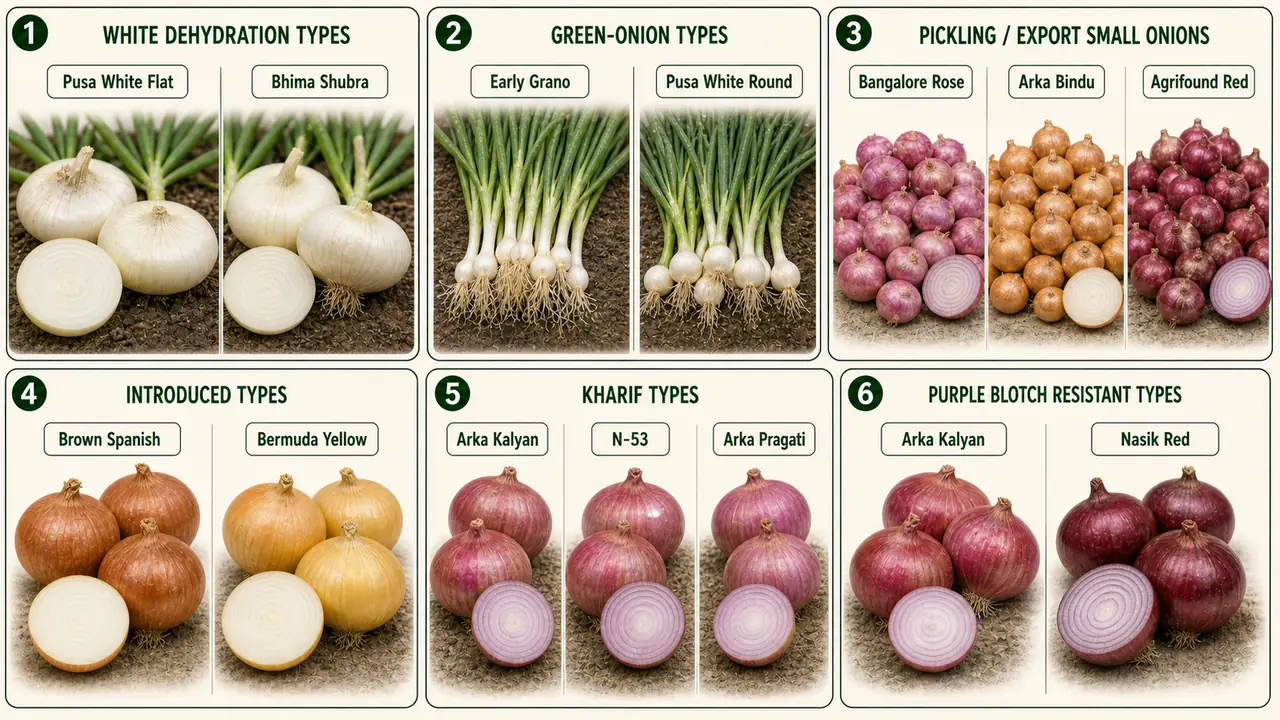
| White (dehydration) | Pusa White Flat, Bhima Shubra |
| Green onion | Early Grano, Pusa White Flat, Pusa White Round |
| Small onion (pickling) | Bangalore Rose, Arka Bindu, Agrifound Red |
| Export quality | Arka Bindu, Agrifound Rose |
| Selfing variety | Pusa Madhvi (unusual for cross-pollinated onion) |
By Development Method
| Method | Varieties |
|---|---|
| Introduced | Brown Spanish, Early Grano, Bermuda Yellow |
| Selection | Pusa Ratnar, Pusa Red, N-53, Arka Niketan, Arka Kalyan, Arka Pragati, Arka Bindu, Nasik Red, Agrifound Dark Red, Patna Red, Bangalore Rose |
| Hybrid | Arka Pitambar (White x Red), Arka Kirtiman, Arka Lalima |
| Male sterile lines isolated in | Pusa Red |
By Season
| Season | Varieties |
|---|---|
| Kharif | Arka Kalyan, Agrifound, N-53, N-241, Arka Pragati (both seasons) |
| Long day | Brown Spanish, Early Grano (yellow, good for salad) |
Disease-Resistant Varieties
| Resistance | Varieties |
|---|---|
| Purple blotch resistant | Arka Kalyan, Nasik Red |
Multiplier Onion Varieties
- Agrifound Red, CO-3, CO-4
Pests and Diseases
Thrips — Most Important Pest
- Scientific Name: Thrips tabaci
- Damage: Tiny sucking insects causing silvery streaks on leaves; severe infestations reduce bulb size
- Management: Acephate 1 ml/litre of water

Purple Blotch — Major Foliar Disease
- Cause: Alternaria porri
- Symptoms: Purple, elongated lesions on leaves and seed stalks; severe cases cause complete defoliation
- Resistant varieties: Arka Kalyan, Nasik Red

Summary Cheat Sheet
| Concept / Topic | Key Details / Explanation |
|---|---|
| Botanical identity | Onion is Allium cepa of the Alliaceae family, originated in Central Asia, is a cool-season crop, and is rich in Vitamin B complex. |
| Flowering and pollination facts | Onion is highly cross-pollinated because of protandry, honey bees are the main pollinators, the inflorescence is umbellate, flowers are white or bluish, and anthesis occurs at 5-9 am. |
| India's position | India ranks second in area and production after China, third in exports, and onion contributes about 77% of foreign exchange earnings among fresh vegetables; Maharashtra is the leading state and Lasalgaon is the biggest onion market. |
| Types of onion | Common onion is Allium cepa, potato or multiplier onion is A. cepa var. aggregatum, and tree onion is A. cepa var. viviparum. |
| Bulb formation vs seed production | Day length is more important than temperature for bulb production, while temperature is more important for seed production; optimum temperature for bulb development is 20-25 degrees C. |
| Photoperiod classes and bolting | Short-day varieties bulb at 11-12 hours of daylight, long-day varieties need 14-16 hours, and bolting is induced by low temperature. |
| Pungency and protective compounds | Onion pungency is due to allyl propyl disulphide; quercetin gives outer-skin colour and antioxidant value, while catechol protects outer scales through antifungal action. |
| Storage and post-harvest management | Sprouting in storage is checked by spraying Maleic Hydrazide @ 2500 ppm about 15-20 days before harvest; zinc improves yield and storage quality, and onion is also associated with relief from sun stroke. |
Summary Continued
| Concept / Topic | Key Details / Explanation |
|---|---|
| Seed rate | Seed rate is 8-10 kg/ha for nursery-raised crop and about 750 kg bulbs/ha for bulb planting. |
| Varieties by use and colour | Orange and yellow onions are the largest cultivated group; Pusa White Flat and Bhima Shubra are important white dehydration types; Early Grano, Pusa White Flat, and Pusa White Round are used as green onion types. |
| Pickling, export, and selfing types | Bangalore Rose, Arka Bindu, and Agrifound Red are used for small pickling onions; Arka Bindu and Agrifound Rose are export-quality, while Pusa Madhvi is notable as a selfing variety. |
| Varieties by development method | Introduced varieties include Brown Spanish, Early Grano, and Bermuda Yellow; major selections include Pusa Ratnar, Pusa Red, N-53, Arka Niketan, Arka Kalyan, Arka Pragati, Arka Bindu, Nasik Red, Agrifound Dark Red, Patna Red, and Bangalore Rose; important hybrids are Arka Pitambar, Arka Kirtiman, and Arka Lalima. |
| Seasonal and resistant varieties | Arka Kalyan, Agrifound, N-53, N-241, and Arka Pragati are kharif types; Brown Spanish and Early Grano are long-day types; Arka Kalyan and Nasik Red resist purple blotch. |
| Multiplier onion varieties | Important multiplier onion varieties are Agrifound Red, CO-3, and CO-4. |
| Major pest | Thrips tabaci is the most important pest, producing silvery streaks on leaves and reducing bulb size; it is managed with Acephate 1 ml/litre. |
| Major disease | Purple blotch, caused by Alternaria porri, produces purple elongated lesions on leaves and seed stalks; Arka Kalyan and Nasik Red are resistant varieties. |