💡 Light Reactions — Photophosphorylation, Photosystems, and Emerson's Effect
Cyclic and non-cyclic photophosphorylation, PS I and PS II, electron transport chain, Emerson's enhancement effect, and products of light reactions with comparison tables
From Field to Lab — Where Sunlight Becomes Chemical Energy
In the previous lesson, we identified the photosynthetic pigments that capture light energy and established that photosynthesis has two phases — light and dark. Now we dive deep into the light reaction, the phase where captured light energy is converted into the chemical currency (ATP and NADPH₂) that powers sugar synthesis.
When sunlight strikes a rice leaf in a flooded paddy, the light energy does not simply warm the leaf. Inside each chloroplast, a remarkable chain of molecular events begins: water molecules are split, electrons are energised and passed down a transport chain, and the energy is captured as ATP and NADPH₂ — the "chemical currency" that will later be used to build sugars from CO₂. This is the light reaction — the first half of photosynthesis, and the step that generates all the oxygen we breathe.
Understanding the light reaction helps explain why light intensity, light quality (red vs blue), and duration directly affect crop yield — questions frequently asked in agriculture exams.
Pro Content Locked
Upgrade to Pro to access this lesson and all other premium content.
Charged once for one year · ₹1188 total
Save ₹100/month vs ₹2388/year launch price
- All Agriculture & Banking Courses
- AI Lesson Questions (100/day)
- AI Doubt Solver (50/day)
- Glows & Grows Feedback (30/day)
- AI Section Quiz (20/day)
- 22-Language Translation (100/day)
- Recall Questions (20/day)
- AI Quiz (15/day)
- AI Quiz Paper Analysis (100/day)
- AI Step-by-Step Explanations (100/day)
- Spaced Repetition Recall (FSRS)
- AI Tutor
- Immersive Text Questions
- Audio Lessons — Hindi & English
- Mock Tests & Previous Year Papers
- Summary & Mind Maps
- XP, Levels, Leaderboard & Badges
- Generate New Classrooms
- Voice AI Teacher (AgriDots Live)
- AI Revision Assistant
- Knowledge Gap Analysis
- Interactive Revision (LangGraph)
🔒 Secure one-time yearly payment via Razorpay · No hidden fees
From Field to Lab — Where Sunlight Becomes Chemical Energy
In the previous lesson, we identified the photosynthetic pigments that capture light energy and established that photosynthesis has two phases — light and dark. Now we dive deep into the light reaction, the phase where captured light energy is converted into the chemical currency (ATP and NADPH₂) that powers sugar synthesis.
When sunlight strikes a rice leaf in a flooded paddy, the light energy does not simply warm the leaf. Inside each chloroplast, a remarkable chain of molecular events begins: water molecules are split, electrons are energised and passed down a transport chain, and the energy is captured as ATP and NADPH₂ — the "chemical currency" that will later be used to build sugars from CO₂. This is the light reaction — the first half of photosynthesis, and the step that generates all the oxygen we breathe.
Understanding the light reaction helps explain why light intensity, light quality (red vs blue), and duration directly affect crop yield — questions frequently asked in agriculture exams.
This lesson covers:
- Overview of Light Reactions — location, products, and photosystem concept
- Four Steps — photo-excitation, photolysis, electron transport, NADP reduction
- Products of Light Reaction — ATP, NADPH₂, and O₂
- Two Pathways — cyclic vs non-cyclic photophosphorylation
- Emerson's Enhancement Effect — evidence for two photosystems
All topics are high-yield for exams, NABARD, and FCI exams.
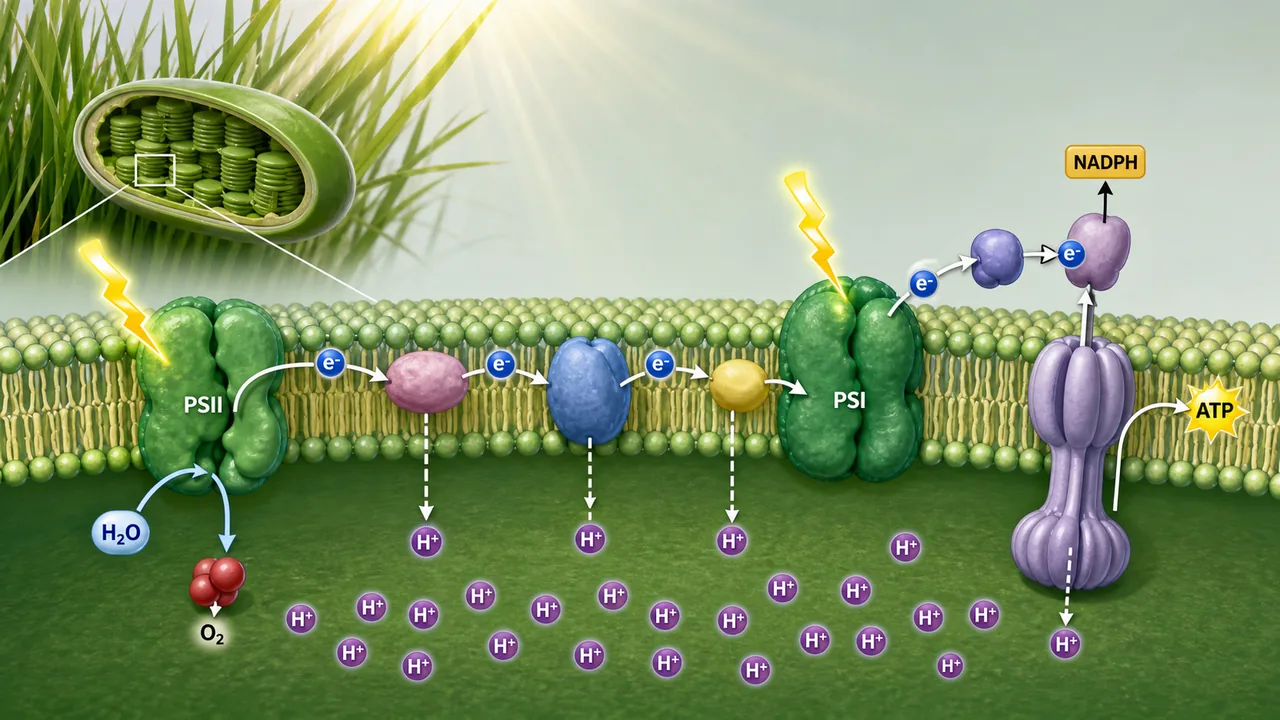
Overview of Light Reactions
Before examining the individual steps, here is a summary of where the light reaction fits within the photosynthesis machinery. The light reaction occurs in the grana (thylakoid membranes) and produces the assimilatory power — ATP and NADPH₂ — that the dark reaction will consume in the stroma.
The light reaction is also called the Primary Photochemical Reaction, Hill's Reaction, or Arnon's Cycle.
- Older exam books also refer to the photosynthetic unit or quantasome. This is the functional cluster of pigment molecules that works together to trap light energy and transfer it to the reaction centre.
- Older MCQ books may give the quantasome as containing about 230-250 chlorophyll molecules. Treat this as a textbook variation/range, because different older sources use slightly different counts.
| Feature | Detail |
|---|---|
| Location | Grana (thylakoid membranes) of chloroplast |
| Speed | Faster than the dark reaction |
| Products | ATP, NADPH₂, and O₂ |
| Purpose | Provides assimilatory power (ATP + NADPH₂) for the dark reaction to fix CO₂ |
IMPORTANT
Photosystem concept:
- Both PS I and PS II are affected by wavelengths shorter than 680 nm
- PS I alone is affected by wavelengths longer than 680 nm
- Grana contains mainly PS II; stroma contains PS I
- PS I is a strong reductant; PS II is a strong oxidant

Four Steps of Light Reaction
The light reaction proceeds through four sequential steps: pigment excitation, water splitting, electron transport, and NADP reduction. Each step feeds into the next — understanding this chain is essential for distinguishing cyclic from non-cyclic photophosphorylation later.
Step 1 — Photo-excitation of Pigment Electrons
When light strikes a pigment molecule, its electrons absorb energy and jump to a higher energy state (excited state). This photo-excitation effectively oxidises the pigment.
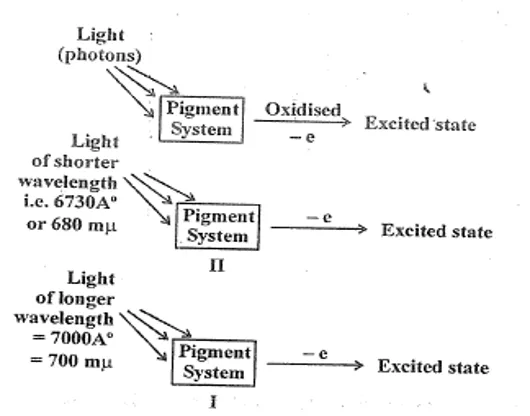
- Photosystem I (PSI) absorbs light maximally at 700 nm (far-red)
- Photosystem II (PSII) absorbs light maximally at 680 nm (red)
- In this classical naming, the letter P stands for the pigment reaction centre, while the number indicates the wavelength (in nm) at which that reaction centre absorbs maximally.
- Pigment systems work on the quality of light — primarily blue and red wavelengths
Emerson's work discovered the two pigment systems and the enhancement effect — when both red (680 nm) and far-red (700 nm) light are given together, photosynthesis rate exceeds the sum of individual rates.
| Unit | Equivalent |
|---|---|
| 1 nm (nanometre) | 10⁻⁹ m |
| 1 mμ (millimicron) | 10⁻⁹ m (same as nm) |
| 1 A° (Angstrom) | 10⁻¹⁰ m |
Step 2 — Photolysis of Water
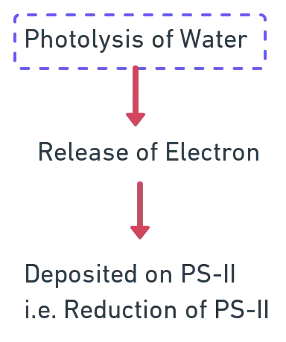
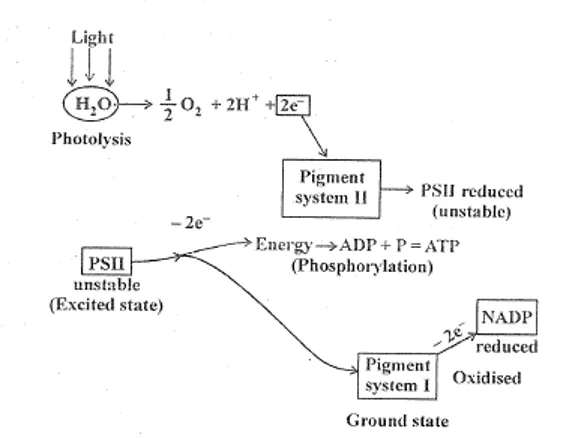
At PSII, water molecules are split into hydrogen ions (H⁺), electrons, and oxygen. The electrons replace those lost by excited chlorophyll in PSII. The oxygen is released as a by-product — this is the source of all atmospheric O₂.
- Older exam-oriented plant physiology also highlights that the oxygen-evolving system of photolysis depends especially on Mn, Cl, and Ca.
- Classical Hill-reaction recall often names ferricyanide and benzoquinone as common Hill reagents used as artificial electron acceptors.
Step 3 — Electron Transport from PS II to PS I
As excited electrons travel from PSII to PSI through the electron transport chain, they release energy at each step.

| Effect | Result |
|---|---|
| Direct | Reduction of PS I (electrons restore PSI to ground state) |
| Indirect | Photophosphorylation — ATP produced using energy from electron transport |
The released energy pumps H⁺ ions across the thylakoid membrane, creating a proton gradient. This gradient drives ATP synthase to produce ATP — a process called chemiosmosis.
- The experimental demonstration of photophosphorylation is classically credited to Arnon.
- The chemiosmotic theory explaining ATP synthesis through the proton gradient was proposed by Peter Mitchell (1961).
Step 4 — Electron Transfer from PS I to NADP

Excited electrons from PSI are passed to NADP⁺, which picks up H⁺ ions to form NADPH₂ — a powerful reducing agent used in the dark reactions to reduce CO₂ into carbohydrates.
- NADP = Nicotinamide Adenine Dinucleotide Phosphate
Products of Light Reaction
The four steps above produce three distinct products. Two of them (ATP and NADPH₂) are consumed by the dark reaction; the third (O₂) is released to the atmosphere. Together, ATP and NADPH₂ are called assimilatory power.
| Product | Formed in Step | Role |
|---|---|---|
| ATP | Step 3 (electron transport) | Energy currency for dark reaction |
| NADPH₂ | Step 4 (NADP reduction) | Reducing agent for CO₂ fixation |
| ½ O₂ | Step 2 (photolysis) | Released to atmosphere |
ATP and NADPH₂ together are called assimilatory power — they provide the energy and reducing power needed to assimilate CO₂ into organic molecules.
- For quick structural recall, ATP is built from adenine + ribose (adenosine) + three phosphate groups, which is why it can act as the cell's immediate transferable energy currency.
Two Pathways of Electron Transfer
Electrons can follow two different routes through the photosystems. The non-cyclic pathway is the main route producing all three products, while the cyclic pathway is a supplementary route that generates extra ATP when needed. Distinguishing these two pathways is one of the most commonly tested topics in photosynthesis.
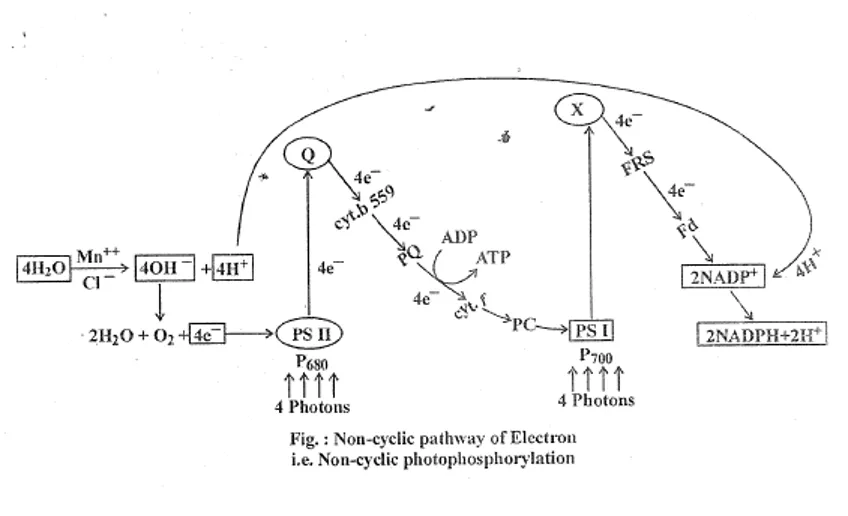
Non-cyclic Photophosphorylation
- Involves both PSI and PSII
- Occurs in all green plants
- This is the primary pathway of light reactions
| Feature | Detail |
|---|---|
| Photosystems | Both PS I and PS II |
| Products | ½ O₂ + ATP + NADPH₂ |
| Electron source | Water (H₂O → H⁺ + e⁻ + O₂) |
| Electron destination | NADP⁺ → NADPH₂ |
| Electron flow | Linear: H₂O → PSII → ETC → PSI → NADP⁺ |
IMPORTANT
In non-cyclic photophosphorylation, electrons flow in a linear (non-cyclic) path from water to NADP⁺. Both ATP and NADPH₂ are produced.
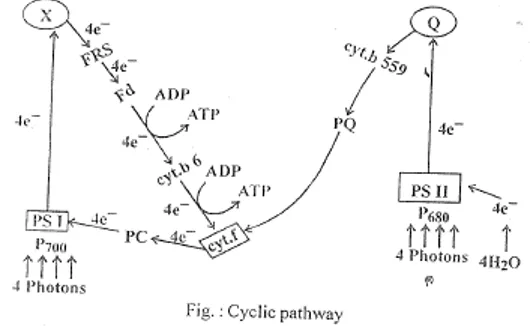
Cyclic Photophosphorylation
- Involves only PSI (PSII is not involved)
- Electrons from PSI return to PSI after passing through the electron transport chain
| Feature | Detail |
|---|---|
| Photosystems | Only PS I |
| Products | ATP only (no NADPH₂, no O₂) |
| Electron source | PSI itself |
| Electron destination | Returns to PSI |
| Electron flow | Cyclic: PSI → ETC → PSI |
| When active | When NADP⁺ is unavailable or dark reaction needs extra ATP |
Comparison — Cyclic vs Non-cyclic Photophosphorylation
This comparison table consolidates the key differences — memorise it thoroughly as MCQs frequently test individual rows from this table.
| Feature | Non-cyclic | Cyclic |
|---|---|---|
| Photosystems involved | PS I + PS II | PS I only |
| Electron flow | Linear (H₂O → NADP⁺) | Circular (PSI → PSI) |
| Photolysis of water | Yes | No |
| O₂ evolved | Yes | No |
| NADPH₂ produced | Yes | No |
| ATP produced | Yes | Yes |
| Significance | Main pathway; produces both ATP and NADPH₂ | Supplementary; only produces ATP when needed |
TIP
Mnemonic — "Non-cyclic = Everything, Cyclic = ATP only":
- Non-cyclic produces NADPH₂ + ATP + O₂ (all products)
- Cyclic produces only ATP (Currency alone)
Emerson's Enhancement Effect
The existence of two separate photosystems was not obvious until Emerson's elegant experiment demonstrated that they must work cooperatively. This finding is the experimental foundation for the entire non-cyclic pathway described above.
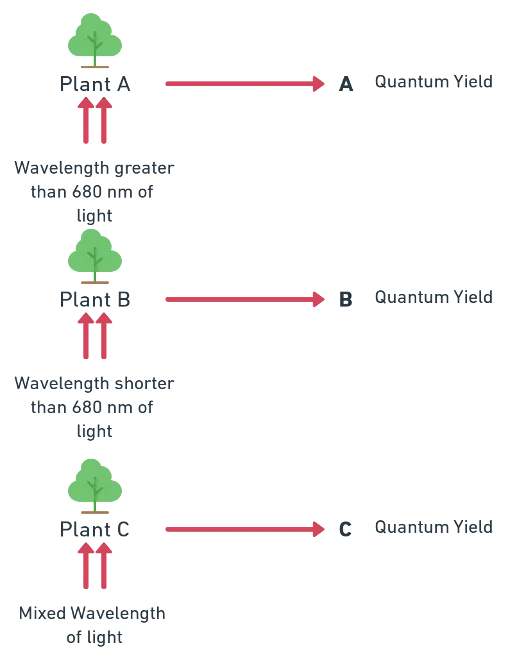
Robert Emerson discovered that when both red light (680 nm, activating PSII) and far-red light (700 nm, activating PSI) are given simultaneously, the rate of photosynthesis is greater than the sum of the rates when each wavelength is given alone. This proved that two photosystems work cooperatively — neither alone can drive non-cyclic photophosphorylation at full efficiency.
- A closely related older recall point is the red drop effect: when the wavelength rises beyond about 680 nm, the quantum yield of photosynthesis falls sharply if far-red light acts alone. This decline helped show that one photosystem by itself cannot maintain maximum photosynthetic efficiency.
- In older objective-style plant physiology, the idealized quantum yield is often summarized as roughly 1/8, meaning about one O2 molecule is evolved for eight quanta of light absorbed under standard textbook assumptions.
TIP
Exam favourite: The Emerson Enhancement Effect is the key evidence for the existence of two photosystems (PSI and PSII) working together in non-cyclic photophosphorylation.
Summary Cheat Sheet
| Fact | Answer |
|---|---|
| Light reactions occur in | Grana (thylakoid membranes) |
| PSI absorbs maximally at | 700 nm (far-red) |
| PSII absorbs maximally at | 680 nm (red) |
| Products of light reaction | ATP + NADPH₂ + O₂ |
| Assimilatory power = | ATP + NADPH₂ |
| Source of O₂ | Photolysis of water at PSII |
| Non-cyclic involves | Both PSI and PSII |
| Cyclic involves | Only PSI |
| Cyclic produces | ATP only (no NADPH₂, no O₂) |
| Chemiosmosis driven by | Proton gradient across thylakoid membrane |
| Enhancement effect by | Emerson |
| PSI is a | Strong reductant |
| PSII is a | Strong oxidant |
| Light reaction speed | Faster than dark reaction |
| Non-cyclic electron flow | Linear: H₂O → PSII → ETC → PSI → NADP⁺ |
| Cyclic electron flow | Circular: PSI → ETC → PSI |
| Chemiosmosis | Proton gradient drives ATP synthase |
| NADP full form | Nicotinamide Adenine Dinucleotide Phosphate |
| Photosynthetic unit / quantasome | Functional pigment cluster for light harvesting |
TIP
Next: The next lesson covers the Dark Reactions — the Calvin cycle (C3 pathway), Hatch-Slack pathway (C4), and CAM pathway — where the ATP and NADPH₂ produced here are used to fix CO₂ into sugars.