🌞 Mechanism of Respiration — Glycolysis, Link Reaction, Krebs Cycle, and ETS
EMP pathway (glycolysis), pyruvate fate, fermentation, link reaction, Krebs cycle, electron transport system, and ATP accounting with step-by-step tables and exam tips
From Field to Lab — Breaking Down a Grain of Sugar
In the previous lesson, we established that aerobic respiration yields 38 ATP per glucose while anaerobic respiration yields only 2. Now we trace the exact biochemical steps — from glycolysis in the cytoplasm through the Krebs cycle and electron transport in the mitochondria — that account for every one of those ATP molecules.
When a germinating wheat seed splits open its coat and sends out a radicle, the energy for that first push comes from glycolysis — the breakdown of stored glucose in the cytoplasm. As the seedling grows and oxygen becomes available, the partially oxidised pyruvate enters the mitochondria for the Krebs cycle and electron transport chain, extracting 18 times more energy from the same glucose molecule. Understanding these biochemical pathways explains why aeration (oxygen supply) is critical for healthy root growth, and why waterlogged soils stunt plants.
Pro Content Locked
Upgrade to Pro to access this lesson and all other premium content.
Charged once for one year · ₹1188 total
Save ₹100/month vs ₹2388/year launch price
- All Agriculture & Banking Courses
- AI Lesson Questions (100/day)
- AI Doubt Solver (50/day)
- Glows & Grows Feedback (30/day)
- AI Section Quiz (20/day)
- 22-Language Translation (100/day)
- Recall Questions (20/day)
- AI Quiz (15/day)
- AI Quiz Paper Analysis (100/day)
- AI Step-by-Step Explanations (100/day)
- Spaced Repetition Recall (FSRS)
- AI Tutor
- Immersive Text Questions
- Audio Lessons — Hindi & English
- Mock Tests & Previous Year Papers
- Summary & Mind Maps
- XP, Levels, Leaderboard & Badges
- Generate New Classrooms
- Voice AI Teacher (AgriDots Live)
- AI Revision Assistant
- Knowledge Gap Analysis
- Interactive Revision (LangGraph)
🔒 Secure one-time yearly payment via Razorpay · No hidden fees
From Field to Lab — Breaking Down a Grain of Sugar
In the previous lesson, we established that aerobic respiration yields 38 ATP per glucose while anaerobic respiration yields only 2. Now we trace the exact biochemical steps — from glycolysis in the cytoplasm through the Krebs cycle and electron transport in the mitochondria — that account for every one of those ATP molecules.
When a germinating wheat seed splits open its coat and sends out a radicle, the energy for that first push comes from glycolysis — the breakdown of stored glucose in the cytoplasm. As the seedling grows and oxygen becomes available, the partially oxidised pyruvate enters the mitochondria for the Krebs cycle and electron transport chain, extracting 18 times more energy from the same glucose molecule. Understanding these biochemical pathways explains why aeration (oxygen supply) is critical for healthy root growth, and why waterlogged soils stunt plants.
This lesson covers:
- Glycolysis (EMP pathway) — the universal anaerobic first step
- Fate of pyruvic acid — fermentation vs aerobic continuation
- Link reaction — connecting glycolysis to the Krebs cycle
- Krebs cycle (TCA cycle) — the central oxidation hub
- Electron Transport System (ETS) — where most ATP is generated
- Complete ATP accounting — the 38 ATP balance sheet
- Metabolic connections — how fats and proteins feed into respiration
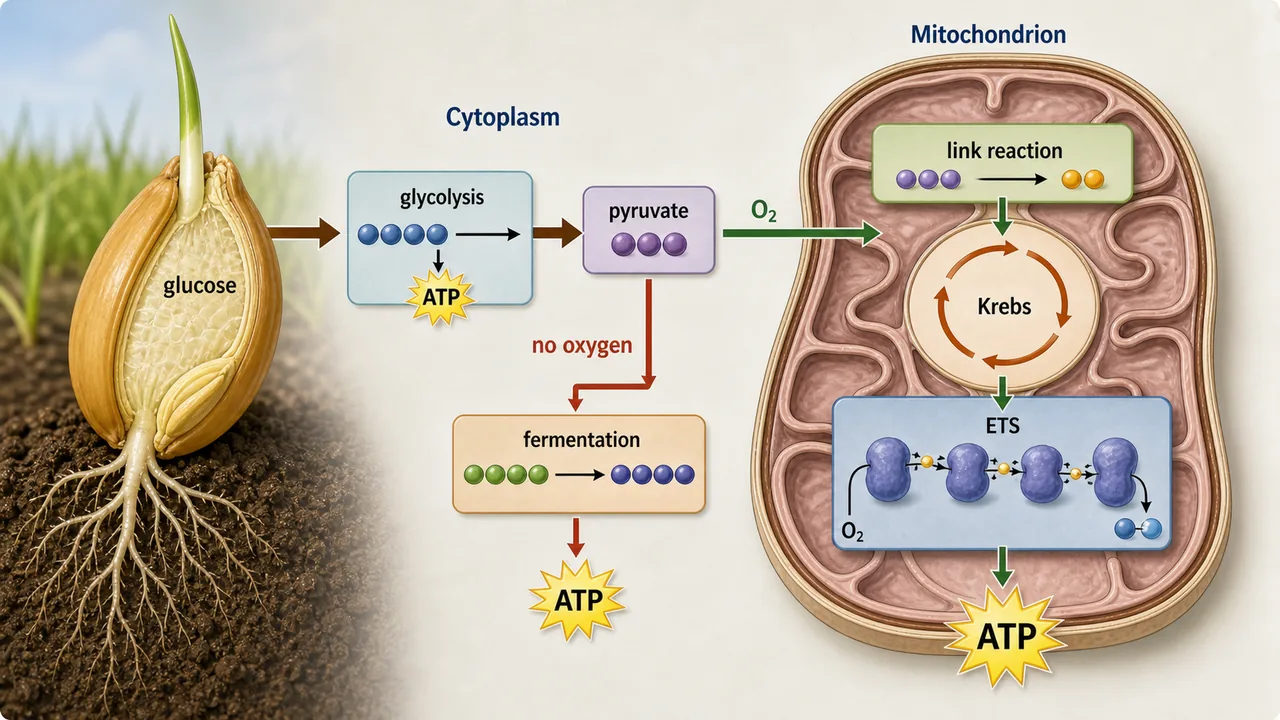
Overview — Stages of Respiration
Respiration proceeds through four sequential stages, each in a specific cellular location. The overview table below serves as a roadmap for the detailed sections that follow.
| Stage | Location | Oxygen Needed? | Products |
|---|---|---|---|
| Glycolysis (EMP) | Cytoplasm | No (anaerobic) | 2 Pyruvic acid + 2 NADH₂ + 2 ATP (net) |
| Link Reaction | Mitochondrial matrix | Yes | 2 Acetyl CoA + 2 CO₂ + 2 NADH₂ |
| Krebs Cycle | Mitochondrial matrix | Yes | 4 CO₂ + 6 NADH₂ + 2 FADH₂ + 2 ATP (GTP) |
| ETS | Inner mitochondrial membrane | Yes | 34 ATP + H₂O |
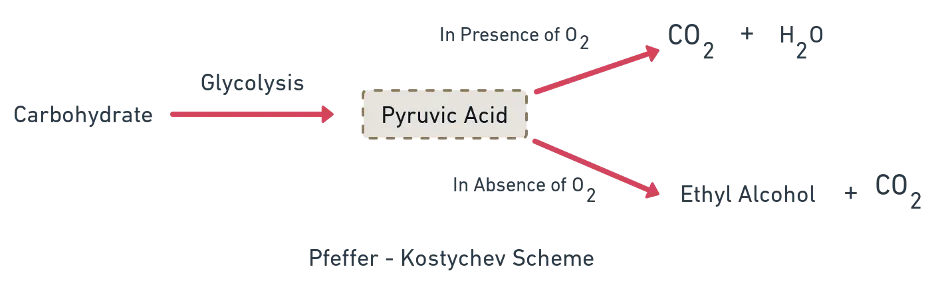
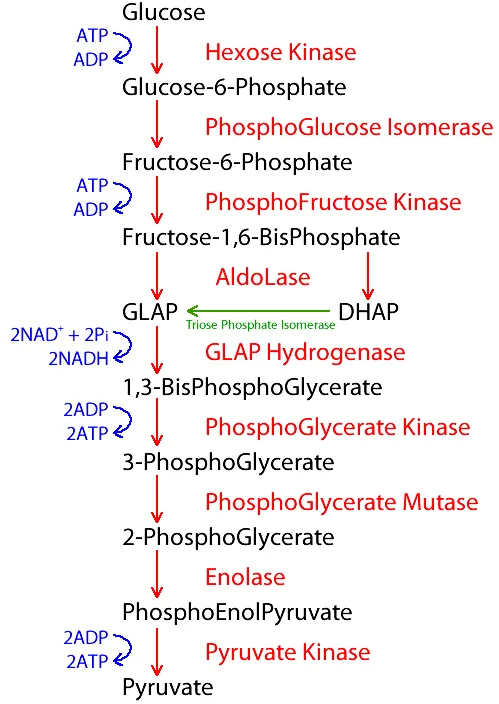
I. Glycolysis (EMP Pathway)
Named after German scientists Embden, Meyerhof, and Parnas who traced its steps. Glycolysis is universal — it occurs in virtually all living organisms.
| Feature | Detail |
|---|---|
| Location | Cytoplasm (cytosol) |
| Oxygen requirement | Not required (anaerobic) |
| Starting substrate | 1 molecule of glucose (6-carbon) |
| End product | 2 molecules of Pyruvic acid (3-carbon each) |
| Step count | 10 enzyme-catalysed reactions |
| All reactions | Reversible |
Two Phases of Glycolysis
| Phase | What Happens | ATP | Net Energy |
|---|---|---|---|
| 1st Phase (Preparatory) | Phosphorylation of glucose (2 ATP consumed) | −2 ATP | Endothermic (energy investment) |
| 2nd Phase (Payoff) | Oxidation produces 4 ATP + 2 NADH₂ | +4 ATP | Exothermic (energy harvest) |
- In compact enzyme-order recall, the first key control points are commonly listed as hexokinase, phosphoglucose isomerase, and phosphofructokinase, with hexokinase usually keyed as the first regulatory enzyme.
- A traditional exam bridge between the two halves of glycolysis is that the preparatory phase yields two molecules of 3-PGAL / glyceraldehyde-3-phosphate (G3P), which then enter the payoff phase.
Products of Glycolysis (per glucose)
| Product | Quantity | Fate |
|---|---|---|
| Pyruvic acid | 2 molecules | Further oxidised via Link + Krebs (aerobic) OR fermented (anaerobic) |
| NADH₂ | 2 molecules | → 6 ATP via ETS (3 ATP each) |
| ATP (net) | 2 ATP | Direct substrate-level phosphorylation |
TIP
Glycolysis ATP total: Net direct = 2 ATP. With O₂ (NADH₂ → ETS): 2 + 6 = 8 ATP total from glycolysis.
Fate of Pyruvic Acid — Two Paths
The pyruvic acid produced by glycolysis stands at a metabolic crossroads. What happens next depends entirely on whether oxygen is available — this single decision determines whether the cell extracts 2 ATP or 38 ATP from glucose.
| Condition | Pathway | End Products |
|---|---|---|
| No oxygen (anaerobic) | Fermentation | Ethanol + CO₂ or Lactic acid |
| Oxygen present (aerobic) | Link reaction → Krebs cycle → ETS | CO₂ + H₂O + 38 ATP |
Anaerobic Respiration (Fermentation)
When oxygen is absent, cells cannot run the Krebs cycle or ETS. Instead, pyruvate is converted to either ethanol or lactic acid through fermentation — a process that regenerates NAD⁺ so glycolysis can continue producing at least 2 ATP.
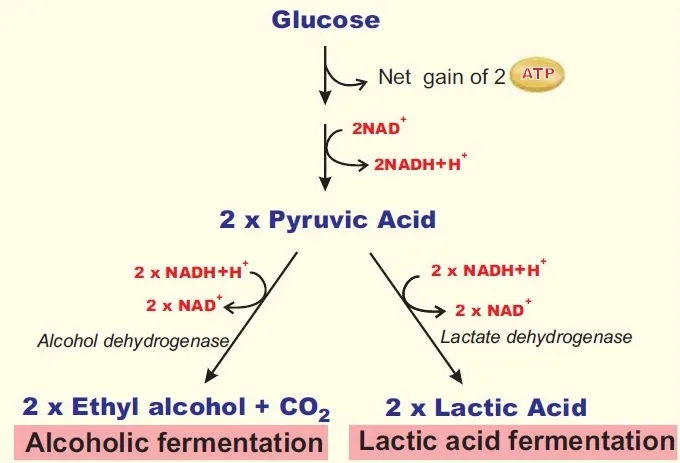
Fermentation occurs in some fungi and bacteria when O₂ is absent. The purpose is to regenerate NAD⁺ so glycolysis can continue.
Two Types of Fermentation
| Type | Organism | Product | Agricultural Use |
|---|---|---|---|
| Alcoholic fermentation | Yeast (Saccharomyces) | Ethanol + CO₂ | Brewing, wine-making, bread |
| Lactic acid fermentation | Lactobacillus | Lactic acid | Curd, silage making |
- Yeast uses the enzyme zymase for alcoholic fermentation
- Only 2 ATP per glucose are produced (compared to 38 in aerobic)
IMPORTANT
Why fermentation matters in agriculture:
- Waterlogged roots undergo anaerobic respiration → insufficient energy → root death
- Silage making relies on lactic acid fermentation to preserve fodder
- Ethanol production from sugarcane molasses uses yeast fermentation
Link Reaction (Oxidative Decarboxylation)
If oxygen is available, pyruvate does not ferment — instead, it undergoes oxidative decarboxylation in the mitochondrial matrix. This irreversible step connects glycolysis to the Krebs cycle and is catalysed by a large multi-enzyme complex.
Pyruvic acid + CoA + NAD⁺ → Acetyl CoA + CO₂ + NADH₂
| Feature | Detail |
|---|---|
| Enzyme | Pyruvate dehydrogenase complex |
| Location | Mitochondrial matrix |
| Products (per glucose) | 2 Acetyl CoA + 2 CO₂ + 2 NADH₂ (→ 6 ATP via ETS) |
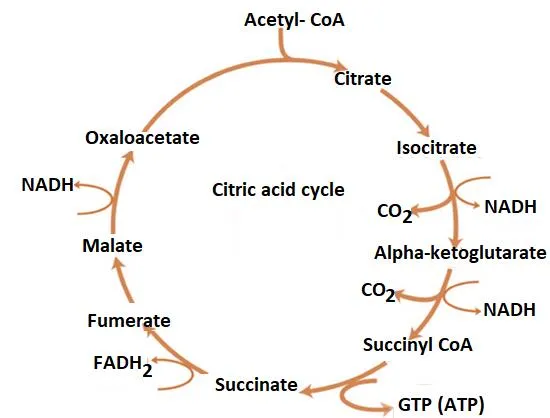
Krebs Cycle (TCA Cycle / Citric Acid Cycle)
Named after Sir Hans Krebs (Nobel Prize). Also called the Tricarboxylic Acid (TCA) Cycle because the first product, citric acid, has three carboxyl groups.
| Feature | Detail |
|---|---|
| Location | Mitochondrial matrix |
| Starting molecule | Acetyl CoA (2-carbon) combines with OAA (4-carbon) |
| First product | Citric acid (6-carbon) |
| Products per Acetyl CoA | 2 CO₂ + 3 NADH₂ + 1 FADH₂ + 1 GTP (= 1 ATP) |
| Products per glucose | 4 CO₂ + 6 NADH₂ + 2 FADH₂ + 2 GTP |
- A high-yield exception worth remembering: among Krebs-cycle enzymes, succinate dehydrogenase is the classical one associated with the inner mitochondrial membrane rather than the soluble matrix fraction.
TIP
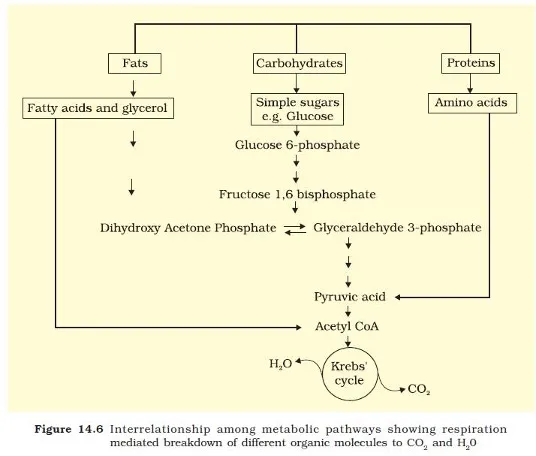
Exam fact: Acetyl CoA is the common intermediate connecting carbohydrate, fat, and protein metabolism. All three macronutrients converge at Acetyl CoA before entering the Krebs cycle.
Electron Transport System (ETS) / Oxidative Phosphorylation
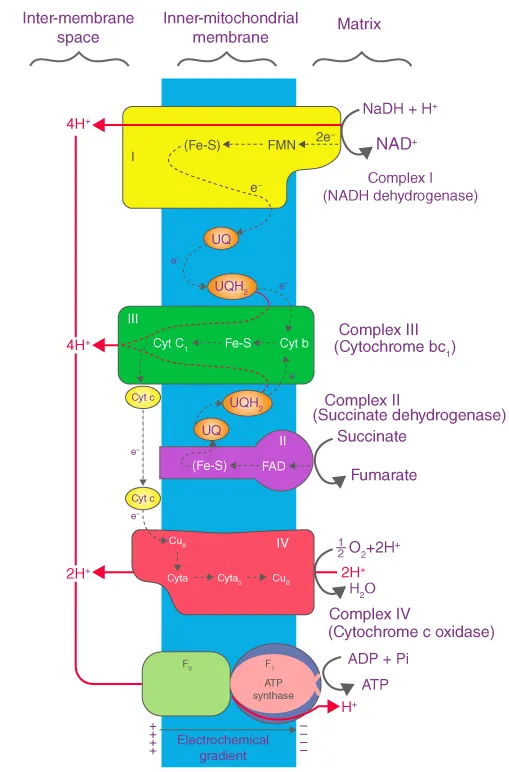
The ETS is the final stage of aerobic respiration and the primary ATP generator. All the NADH₂ and FADH₂ produced in glycolysis, the link reaction, and the Krebs cycle donate their electrons to a chain of carriers embedded in the inner mitochondrial membrane. As electrons flow down the chain, protons are pumped across the membrane, creating a gradient that drives ATP synthase — this is called chemiosmotic phosphorylation (proposed by Peter Mitchell, Nobel Prize 1978).
- In older competitive-exam wording, the electron carriers of the chain are often summarized simply as cytochromes, while the final electron acceptor is oxygen.
| Electron Donor | ATP per molecule |
|---|---|
| 1 NADH₂ | 3 ATP |
| 1 FADH₂ | 2 ATP |
Complete ATP Accounting (per glucose)
| Stage | Direct ATP | NADH₂ | FADH₂ | ATP via ETS | Total ATP |
|---|---|---|---|---|---|
| Glycolysis | 2 | 2 (→ 6 ATP) | 0 | 6 | 8 |
| Link reaction | 0 | 2 (→ 6 ATP) | 0 | 6 | 6 |
| Krebs cycle (×2) | 2 (GTP) | 6 (→ 18 ATP) | 2 (→ 4 ATP) | 22 | 24 |
| Grand Total | 4 | 10 | 2 | 34 | 38 ATP |
IMPORTANT
Total ATP per glucose = 38 ATP (aerobic). The bulk (34 out of 38) comes from the Electron Transport System, not from glycolysis or Krebs directly.
Metabolic Connections — The Central Hub
Respiration is not just a glucose-burning machine — it is the central metabolic crossroads of the cell. Its intermediates connect carbohydrate, fat, and protein metabolism, which is why respiration is described as amphibolic (both catabolic and anabolic).
Pentose Phosphate Pathway (Hexose Monophosphate Shunt)
- The pentose phosphate pathway (PPP) runs parallel to glycolysis and is important for generating NADPH and ribose-5-phosphate for nucleotide synthesis.
- Its main site is the cytoplasm (cytosol).
- In older plant-physiology exam books, PPP is also linked with the recall phrase cyanide-resistant respiration.
- It is also classically called the hexose monophosphate (HMP) shunt, and older summaries may cite spinach as a representative plant example in this context.
TIP
PPP / HMP shunt is not the main ATP-yielding pathway of respiration. Its exam value is remembering: cytosol, NADPH, ribose-5-phosphate, and the older cyanide-resistant association.
- PGAL (glycolysis intermediate) → glycerol → fats
- PGA → amino acids (serine, glycine, cysteine)
- Pyruvate → alanine (amino acid)
- Acetyl CoA = connecting link between fat, carbohydrate, and protein metabolism
- Sequential oxidation of fatty acids to Acetyl CoA = Beta-oxidation
- In plants, the shikimate pathway operates mainly in the plastids and diverts carbohydrate-derived intermediates into aromatic amino acids and other aromatic compounds.
- For location-oriented recall, beta-oxidation is linked mainly with mitochondria and also peroxisomes, alpha-oxidation with peroxisomes, and omega-oxidation with the endoplasmic reticulum.
TIP
This is why respiration is amphibolic — its intermediates feed into both catabolic (breakdown) and anabolic (synthesis) pathways.
Summary Table — Key Facts at a Glance
| Fact | Answer |
|---|---|
| Glycolysis location | Cytoplasm |
| Glycolysis oxygen need | Not required |
| Glycolysis end product | 2 Pyruvic acid |
| Net ATP from glycolysis | 2 ATP (8 with ETS) |
| Krebs cycle location | Mitochondrial matrix |
| Krebs cycle first product | Citric acid |
| Common intermediate | Acetyl CoA |
| 1 NADH₂ = | 3 ATP |
| 1 FADH₂ = | 2 ATP |
| Total ATP per glucose (aerobic) | 38 ATP |
| Total ATP per glucose (anaerobic) | 2 ATP |
| Fermentation enzyme in yeast | Zymase |
| Alcoholic fermentation products | Ethanol + CO₂ |
| Beta-oxidation = | Fatty acid → Acetyl CoA |
| EMP named after | Embden, Meyerhof, Parnas |
| Krebs cycle Nobel Prize | Sir Hans Krebs |
| Chemiosmotic theory | Peter Mitchell (Nobel 1978) |
Summary Cheat Sheet
| Fact | Answer |
|---|---|
| Glycolysis is also called | EMP pathway (Embden, Meyerhof, Parnas) |
| Glycolysis location | Cytoplasm (cytosol) |
| Glycolysis oxygen requirement | Not required (anaerobic) |
| Glycolysis end product | 2 Pyruvic acid (3C each) |
| Net ATP from glycolysis (direct) | 2 ATP |
| Total ATP from glycolysis (with ETS) | 8 ATP |
| All glycolysis reactions are | Reversible |
| ATP consumed in preparatory phase | 2 ATP |
| Alcoholic fermentation organism | Yeast (Saccharomyces) |
| Enzyme for alcoholic fermentation | Zymase |
| Lactic acid fermentation organism | Lactobacillus |
| ATP yield in anaerobic respiration | 2 ATP per glucose |
| Link reaction enzyme | Pyruvate dehydrogenase complex |
| Link reaction location | Mitochondrial matrix |
| Krebs cycle discovered by | Sir Hans Krebs (Nobel Prize) |
| Krebs cycle alternate names | TCA cycle / Citric Acid Cycle |
| First product of Krebs cycle | Citric acid (6C) |
| Krebs cycle starting molecule | Acetyl CoA (2C) + OAA (4C) |
| 1 NADH₂ yields via ETS | 3 ATP |
| 1 FADH₂ yields via ETS | 2 ATP |
| ETS location | Inner mitochondrial membrane |
| Chemiosmotic theory proposed by | Peter Mitchell (Nobel Prize 1978) |
| Total ATP per glucose (aerobic) | 38 ATP |
| ATP from ETS alone | 34 ATP (out of 38) |
| Common intermediate for fats, carbs, proteins | Acetyl CoA |
| Fatty acid → Acetyl CoA process | Beta-oxidation |
| Respiration is called amphibolic because | It serves both catabolic and anabolic pathways |
| Waterlogged roots die because | Anaerobic respiration yields only 2 ATP (insufficient energy) |
TIP
Next: Lesson 03-03 covers Respiratory Quotient (RQ) — the ratio that reveals which substrate a plant is burning, respiration efficiency calculations, and the factors that affect respiration rate.