📈 Plant Growth — Definition, Measurement, Phases, and Growth Rates
Definition of growth, primary vs secondary growth, methods of measurement, crescograph, phases of growth, arithmetic vs geometric growth curves, and development with exam tables
From Field to Lab — Growth You Can See and Growth You Cannot
In the previous chapter, we studied enzymes — the catalytic machinery that drives every metabolic reaction in plants. Now we zoom out from individual biochemical reactions to the whole-plant outcome of that metabolism: growth. Enzymes break down starch, synthesise proteins, and build cell walls — the cumulative result is measurable increases in size, weight, and cell number.
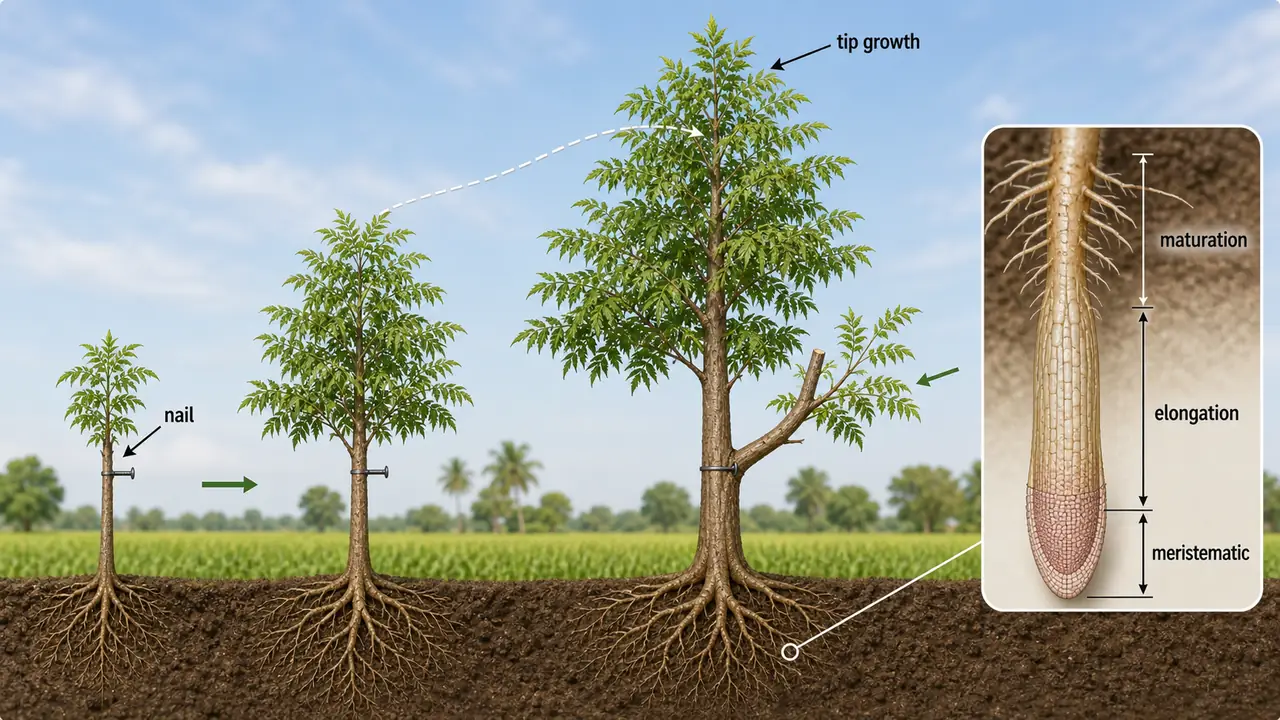
A farmer hammers a nail into the trunk of a young neem tree at chest height. Twenty years later, the tree has grown to 15 metres tall — but the nail is still at the same height. Why? Because trees grow only at their tips (apical meristems) and in girth (lateral meristems), not in the middle of the trunk. This localised pattern of plant growth is fundamentally different from animal growth and has enormous practical implications — from pruning strategies in orchards to understanding why intercropping works.
Pro Content Locked
Upgrade to Pro to access this lesson and all other premium content.
Charged once for one year · ₹1188 total
Save ₹100/month vs ₹2388/year launch price
- All Agriculture & Banking Courses
- AI Lesson Questions (100/day)
- AI Doubt Solver (50/day)
- Glows & Grows Feedback (30/day)
- AI Section Quiz (20/day)
- 22-Language Translation (100/day)
- Recall Questions (20/day)
- AI Quiz (15/day)
- AI Quiz Paper Analysis (100/day)
- AI Step-by-Step Explanations (100/day)
- Spaced Repetition Recall (FSRS)
- AI Tutor
- Immersive Text Questions
- Audio Lessons — Hindi & English
- Mock Tests & Previous Year Papers
- Summary & Mind Maps
- XP, Levels, Leaderboard & Badges
- Generate New Classrooms
- Voice AI Teacher (AgriDots Live)
- AI Revision Assistant
- Knowledge Gap Analysis
- Interactive Revision (LangGraph)
🔒 Secure one-time yearly payment via Razorpay · No hidden fees
From Field to Lab — Growth You Can See and Growth You Cannot
In the previous chapter, we studied enzymes — the catalytic machinery that drives every metabolic reaction in plants. Now we zoom out from individual biochemical reactions to the whole-plant outcome of that metabolism: growth. Enzymes break down starch, synthesise proteins, and build cell walls — the cumulative result is measurable increases in size, weight, and cell number.
A farmer hammers a nail into the trunk of a young neem tree at chest height. Twenty years later, the tree has grown to 15 metres tall — but the nail is still at the same height. Why? Because trees grow only at their tips (apical meristems) and in girth (lateral meristems), not in the middle of the trunk. This localised pattern of plant growth is fundamentally different from animal growth and has enormous practical implications — from pruning strategies in orchards to understanding why intercropping works.
This lesson covers:
- Definition of growth — permanent, irreversible change; positive vs negative growth
- Plant vs animal growth — localised vs diffused, indefinite vs definite
- Types of growth — primary (apical) and secondary (lateral)
- Growth measurement — parameters, crescograph, auxanometer
- Phases of growth — meristematic, elongation, maturation
- Growth rates — arithmetic vs geometric (sigmoid curve)
These concepts are frequently tested in exams and ICAR examinations.
What is Growth?
Growth is a dynamic vital process that brings about a permanent and irreversible change in any plant or its parts with respect to size, form, weight, and volume.
- The keywords are permanent and irreversible — temporary changes (like seed swelling upon water absorption) are not true growth unless they lead to lasting structural changes
- Growth can be positive (increase in size) or negative (dry weight of sprouting potato tubers decreases as stored starch fuels the emerging sprout)
- In classical physiology language, growth is treated mainly as a quantitative change, whereas development is a qualitative change involving differentiation and organisation.
- So when cells not only enlarge but also become xylem, phloem, guard cells, or floral organs, the plant is undergoing development — the combined outcome of growth plus differentiation.
- In life-history terms, a plant that flowers, sets seed, and then dies is described as monocarpic, whereas plants that can flower and fruit repeatedly over more than one reproductive cycle are described as polycarpic.
- Plant phenology is the study of recurring seasonal plant events such as emergence, flowering, fruiting, leaf fall, and leaf renewal in relation to environmental conditions.
Plant Growth vs Animal Growth
| Feature | Plant Growth | Animal Growth |
|---|---|---|
| Distribution | Localised (only at meristems) | Diffused (throughout the body) |
| Duration | Indefinite (plants grow throughout life) | Definite (stops at maturity) |
| Example | Nail in tree trunk stays at same height | Growth occurs everywhere simultaneously |
- Growth is primarily affected by two climatic factors: light and temperature
Types of Growth
| Type | Meristem Responsible | Result |
|---|---|---|
| Primary growth | Apical meristems + intercalary meristems | Increase in length (root and shoot elongation) |
| Secondary growth | Lateral meristems (vascular cambium + cork cambium) | Increase in girth (diameter / thickness) |
TIP
Agricultural application: When you prune a hedge, you remove the apical meristem, triggering lateral bud growth (due to release of apical dominance). Secondary growth is what makes tree trunks thicker each year.
Growth is Measurable
Knowing that growth occurs is not enough — agronomists need to quantify it. Since protoplasm increase is hard to measure directly, growth is measured through proportional parameters that reflect the underlying cellular changes:
| Parameter | Best For | Accuracy |
|---|---|---|
| Fresh weight | Quick field assessment | Variable (includes water) |
| Dry weight | Most accurate measure | Excludes variable water content |
| Length | Pollen tube, root elongation | Easy to measure |
| Area | Dorsiventral leaf growth | Surface expansion |
| Volume | Fruit growth | 3D expansion |
| Cell number | Meristematic tissues | Measures cell division |
Astonishing growth facts:
- One maize root apical meristem produces >17,500 new cells per hour
- Watermelon cells can increase in size by up to 350,000 times
- Pollen tube growth is measured by length
Methods of Growth Measurement
| Method | Principle | Invented By |
|---|---|---|
| Direct observation | Visual / ruler measurement | — |
| Horizontal microscope | Magnified viewing | — |
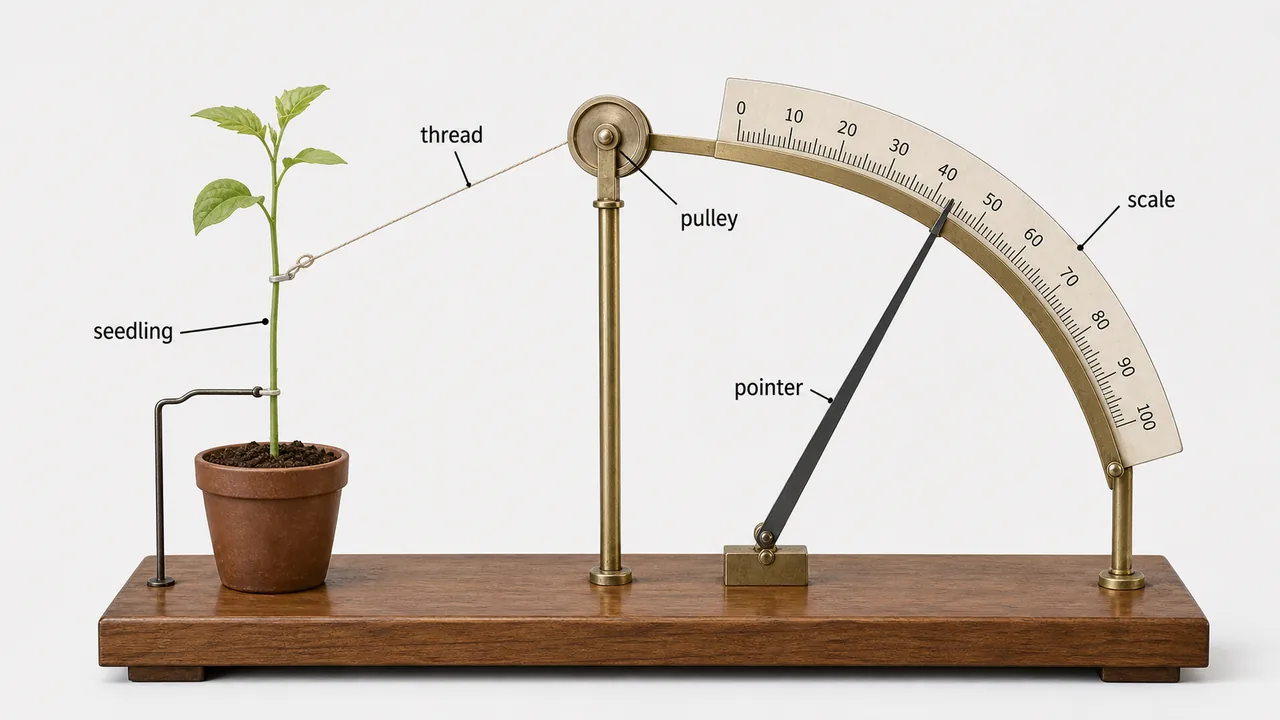
| Crescograph | Magnifies growth 10,000 times | J.C. Bose (Indian scientist) |
| Auxanometer | Records elongation using lever and pulley | — |
| Photometer | Measures light intensity available for photosynthesis | — |
TIP
Exam favourite: The crescograph was invented by Indian scientist Sir Jagadish Chandra Bose. It detects extremely minute growth movements invisible to the naked eye.
Phases of Growth
Once a cell is produced at the meristem, it does not immediately become a functional tissue. It passes through three distinct developmental phases, each with different cellular activities. Understanding these phases explains why root tips and shoot tips look different under a microscope at different distances from the apex.
| Phase | Location | Characteristics | Agricultural Relevance |
|---|---|---|---|
| Meristematic | At root/shoot apex | Small cells, thin walls, large nuclei, rich in protoplasm, continuous division | Where new cells are born |
| Elongation | Just behind meristem | Vacuolation, cell enlargement, new cell wall deposition, water uptake | Where most visible length increase occurs |
| Maturation | Further from apex | Cells reach max size, wall thickening, differentiation into xylem/phloem/epidermis | Where functional tissues form |
TIP
Mnemonic — "MEM": Meristematic → Elongation → Maturation. Cells are born (M), stretch (E), and specialise (M).
Growth Rate
Growth rate describes how fast a plant or organ increases in size over time. Two fundamentally different patterns exist, depending on whether one or both daughter cells continue dividing after mitosis. These patterns produce very different graphs — a distinction that appears frequently in exams.
A. Arithmetic Growth

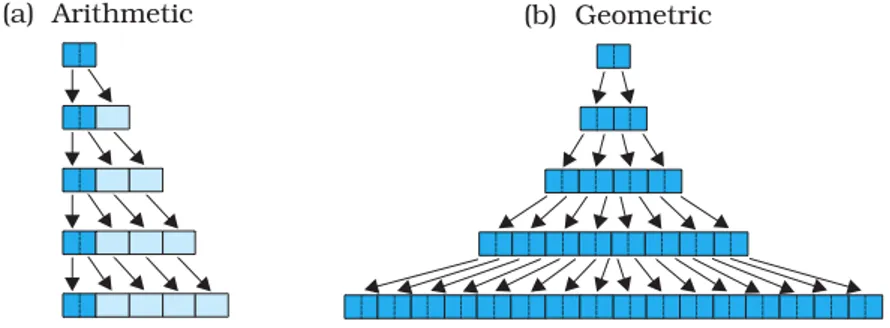
In arithmetic growth, only one daughter cell continues to divide after each mitosis while the other differentiates. This results in a constant, linear increase — the graph is a straight line.
- Example: Root elongation at a constant rate
B. Geometric (Exponential) Growth
In geometric growth, both daughter cells continue to divide. This produces exponential increase — the graph is a J-shaped curve initially. However, resources eventually become limiting, and growth slows to produce an S-shaped (sigmoid) curve.
| Growth Type | Graph Shape | Cell Division Pattern | Example |
|---|---|---|---|
| Arithmetic | Straight line | One daughter divides, one matures | Root elongation |
| Geometric | S-curve (sigmoid) | Both daughters divide | Population growth, tissue culture |
The Sigmoid Growth Curve
The S-shaped curve has three phases:
- Lag phase — slow initial growth (cells adjusting)
- Log/Exponential phase — rapid growth (abundant resources)
- Stationary/Plateau phase — growth slows and stops (resources limiting)
- In broader population-style descriptions, this same sigmoid pattern is often expanded into five phases: lag, log/exponential, deceleration, stationary/plateau, and decline/senescence, followed conceptually by death if the whole population is being tracked.
IMPORTANT
The sigmoid (S-shaped) growth curve is the most common growth pattern in nature. Understanding its three phases helps explain crop growth stages and optimum harvest timing.
Determinate vs Indeterminate Growth
| Type | Pattern | Examples |
|---|---|---|
| Determinate growth | Growth stops after a definite size or after the reproductive switch | Many annual field crops after flowering |
| Indeterminate growth | Vegetative and reproductive growth overlap for a prolonged period | Cotton, Pigeon pea, Soybean, Mungbean |
- In indeterminate crops, new vegetative growth may continue even while flowering, pod formation, or fruit development are already in progress.
Light and Temperature Effects on Growth
- Growth can occur across a broad temperature span, while older agronomy-style recall keys often place the cardinal growth range around 28-33°C under active field growth conditions.
- Cooler nights reduce respiratory loss, while warm days favour photosynthesis and assimilate accumulation; this is the classical explanation for the larger potato tubers under hill conditions compared with warmer plains.
- In older light-quality summaries, blue-violet light is linked with internode elongation, green light with poorer leaf expansion, white light with maximum leaf expansion, and red light with strong overall growth support.
Tropic Growth Responses
Directional growth responses to external stimuli are grouped under tropisms.
| Tropism | Stimulus | Classical example / note |
|---|---|---|
| Phototropism | Light | Shoots usually show positive phototropism |
| Geotropism | Gravity | Roots are generally positively geotropic; shoots are negatively geotropic |
| Chemotropism | Chemical stimulus | Pollen tube grows toward the ovule |
| Thigmotropism | Touch | Tendril coiling response |
- Heliotropism is the directional orientation or movement of plant parts toward the sun; sunflower is the standard recall example.
- Groundnut is a classic crop recall for positive geotropic growth during peg penetration into the soil.
- Additional orientation terms often used in exams:
- Plagiotropism: growth at an oblique angle to gravity, as in many lateral branches.
- Diageotropism: growth at right angles to gravity, classically linked with structures such as rhizomes and stolons.
- Apogeotropism: growth away from gravity, a recall often paired with coralloid roots of Cycas.
- Etiolation is the abnormal elongation and pale appearance of seedlings grown in the absence of light.
Summary Table — Key Facts at a Glance
| Fact | Answer |
|---|---|
| Growth is | Permanent, irreversible change in size/form/weight |
| Plant growth is | Localised (at meristems) |
| Primary growth by | Apical meristems (increases length) |
| Secondary growth by | Lateral meristems (increases girth) |
| Most accurate growth measure | Dry weight |
| Crescograph invented by | J.C. Bose (magnifies 10,000×) |
| Auxanometer measures | Elongation rate |
| Leaf Area Index (LAI) | Ratio of total leaf area to ground area; concept by Watson |
| Three growth phases | Meristematic → Elongation → Maturation |
| Arithmetic growth graph | Straight line |
| Geometric growth graph | S-shaped (sigmoid) curve |
| Sigmoid curve phases | Lag → Log (exponential) → Stationary |
| Climatic factors for growth | Light and Temperature |
| Nail in tree stays same height because | Growth is localised at meristems, not in trunk |
Summary Cheat Sheet
| Fact | Answer |
|---|---|
| Definition of growth | Permanent and irreversible change in size, form, weight, volume |
| Growth can be | Positive (increase) or Negative (e.g., sprouting potato tuber loses dry weight) |
| Plant growth distribution | Localised (only at meristems) |
| Animal growth distribution | Diffused (throughout the body) |
| Plant growth duration | Indefinite (grows throughout life) |
| Animal growth duration | Definite (stops at maturity) |
| Primary growth — meristem responsible | Apical meristems + intercalary meristems |
| Primary growth results in | Increase in length |
| Secondary growth — meristem responsible | Lateral meristems (vascular cambium + cork cambium) |
| Secondary growth results in | Increase in girth (diameter) |
| Most accurate growth parameter | Dry weight |
| Pollen tube growth measured by | Length |
| Maize root apical meristem cell production | >17,500 new cells per hour |
| Watermelon cell size increase | Up to 350,000 times |
| Crescograph invented by | J.C. Bose (Sir Jagadish Chandra Bose) |
| Crescograph magnification | 10,000 times |
| Auxanometer measures | Elongation using lever and pulley |
| Leaf Area Index (LAI) concept by | Watson |
| Three phases of growth (in order) | Meristematic → Elongation → Maturation |
| Arithmetic growth — graph shape | Straight line (one daughter cell divides) |
| Geometric growth — graph shape | S-shaped (sigmoid) curve (both daughter cells divide) |
| Sigmoid curve phases | Lag → Log (Exponential) → Stationary |
| Two climatic factors affecting growth | Light and Temperature |
| Nail in tree stays at same height because | Growth occurs only at apical meristems, not in the trunk |
TIP
Next: Lesson 05-02 explores Plant Growth Hormones — the chemical signals (auxins, gibberellins, cytokinins, ABA, ethylene) that coordinate and control the growth processes covered here.