🧚🏼♂️ Phosphorus in Soil: Forms, Fixation, Cycle, Functions & Deficiency
Complete guide to phosphorus — soil forms, fixation in acid and alkaline soils, P cycle, functions as 'Key to Life', deficiency and toxicity symptoms for competitive exams
Why Phosphorus Matters: A Farmer's Perspective
A maize farmer in Madhya Pradesh notices his crop has dark bluish-green leaves with purplish discolouration on the lower foliage. Growth is slow and maturity is delayed. Soil testing reveals very low available P (8 kg/ha — well below the critical limit of 12.5 kg/ha). The red laterite soil has been fixing most of the applied DAP. Without adequate phosphorus, the plant cannot complete its life cycle — this is why P is called the "Key to Life."
Phosphorus in Soil: Basic Facts
| Property | Value |
|---|---|
| Average plant concentration | 0.1% (dry weight basis); range 0.1-0.4% |
| Uptake forms | H2PO4-, HPO42-, PO43- |
| Uptake mechanism | Diffusion (94%), mass flow (4%), root interception (2%) |
| Mobility in plant | Highly mobile — translocated from old to new tissues |
| Mobility in soil | Immobile — stays near the point of application |
| Ideal pH for availability | 6.5-7.5 |
| P2O5 efficiency | Only 15-35% available to crop (rest gets fixed) |
TIP
Pro Content Locked
Upgrade to Pro to access this lesson and all other premium content.
₹99 charged monthly · Cancel anytime
- All Agriculture & Banking Courses
- AI Lesson Questions (100/day)
- AI Doubt Solver (50/day)
- Glows & Grows Feedback (30/day)
- AI Section Quiz (20/day)
- 22-Language Translation (100/day)
- Recall Questions (20/day)
- AI Quiz (15/day)
- AI Quiz Paper Analysis (100/day)
- AI Step-by-Step Explanations (100/day)
- Spaced Repetition Recall (FSRS)
- AI Tutor
- Immersive Text Questions
- Audio Lessons — Hindi & English
- Mock Tests & Previous Year Papers
- Summary & Mind Maps
- XP, Levels, Leaderboard & Badges
- Generate New Classrooms
- Voice AI Teacher (AgriDots Live)
- AI Revision Assistant
- Knowledge Gap Analysis
- Interactive Revision (LangGraph)
🔒 Secure via Razorpay · Cancel anytime · No hidden fees
Why Phosphorus Matters: A Farmer's Perspective
A maize farmer in Madhya Pradesh notices his crop has dark bluish-green leaves with purplish discolouration on the lower foliage. Growth is slow and maturity is delayed. Soil testing reveals very low available P (8 kg/ha — well below the critical limit of 12.5 kg/ha). The red laterite soil has been fixing most of the applied DAP. Without adequate phosphorus, the plant cannot complete its life cycle — this is why P is called the "Key to Life."
Phosphorus in Soil: Basic Facts
| Property | Value |
|---|---|
| Average plant concentration | 0.1% (dry weight basis); range 0.1-0.4% |
| Uptake forms | H2PO4-, HPO42-, PO43- |
| Uptake mechanism | Diffusion (94%), mass flow (4%), root interception (2%) |
| Mobility in plant | Highly mobile — translocated from old to new tissues |
| Mobility in soil | Immobile — stays near the point of application |
| Ideal pH for availability | 6.5-7.5 |
| P2O5 efficiency | Only 15-35% available to crop (rest gets fixed) |
TIP
Key contrast: P is highly mobile in plants but immobile in soil. Once P enters the plant, it moves freely. But in soil, it gets fixed and barely moves. This is why placement near roots is critical.
Forms of Phosphorus in Soil
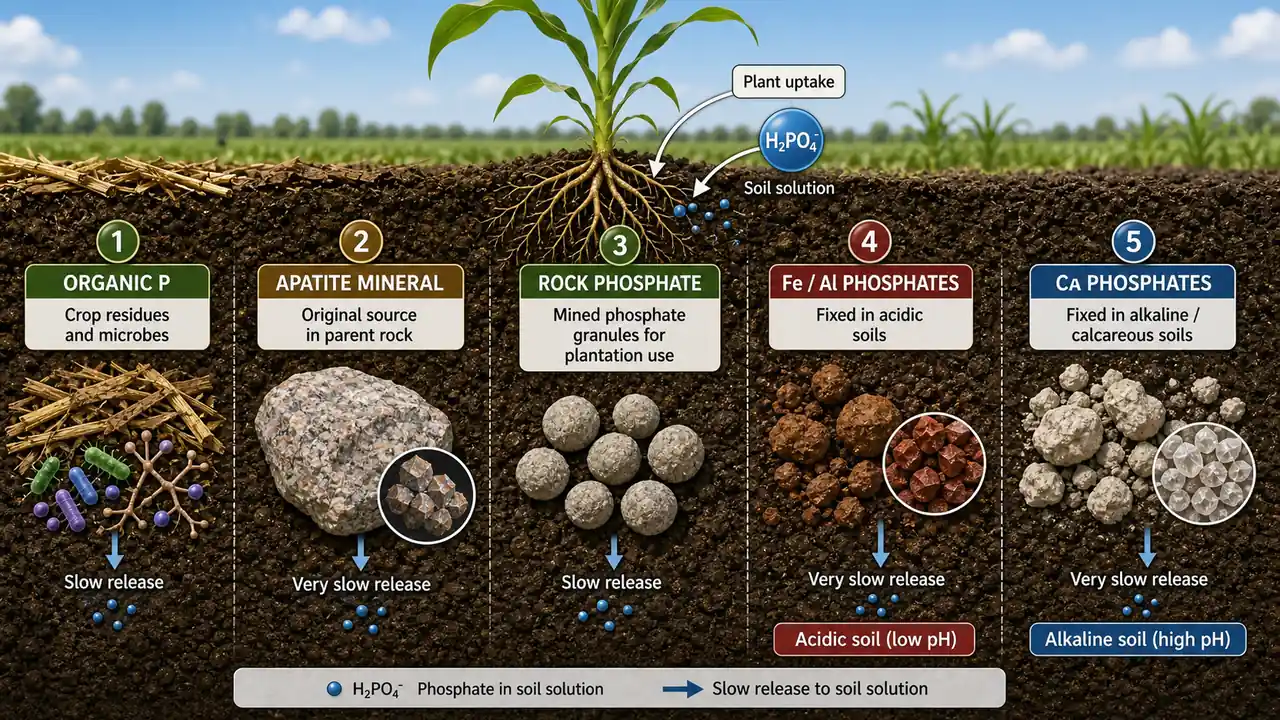
| Form | Details |
|---|---|
| Organic P | Nucleic acids and phospholipids; must be mineralised by microorganisms before plant use |
| Apatite minerals | Original source of soil P; constitute 55% of soil P; weather very slowly |
| Rock phosphate | Acid-soluble; black in colour; suited for plantation crops with extensive root systems |
| Iron/Aluminium phosphates | AlPO4, FePO4 — insoluble; formed in acid soils |
| Calcium phosphates | CaPO4 — formed in alkaline/calcareous soils |
Phosphorus Mineralization
- C:N:P ratio = 100:10:1
- If C:P ratio > 100:1 → immobilization of P occurs (microbes scavenge available P)
- If C:P ratio < 100:1 → net mineralization (P is released)
Agricultural example: Adding fresh crop residues with high C:P ratio can temporarily reduce P availability. Composting the residues first solves this problem.
Phosphorus Fixation
Fixation is the biggest challenge in P management — a large portion of applied fertilizer P becomes unavailable to plants.
pH and P Availability
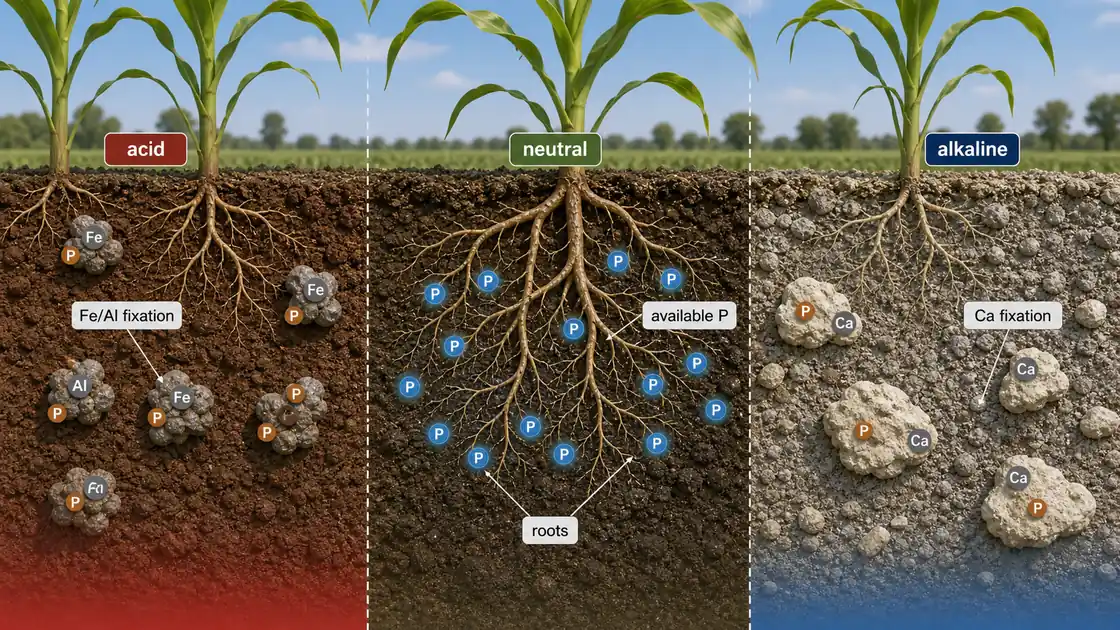
P availability follows a bell-shaped curve with respect to soil pH:
| pH Range | What Happens | Agricultural Example |
|---|---|---|
| < 6.5 (Acid) | Fe, Al, Mn react with P → AlPO4, FePO4 (insoluble) | Laterite soils of Kerala, northeast India |
| 6.5-7.5 (Optimum) | Maximum P availability — fixation by both mechanisms is minimised | Alluvial soils at neutral pH |
| > 8.5 (Alkaline) | Ca reacts with P → Ca3(PO4)2 (insoluble) | Calcareous soils of Rajasthan, Gujarat |
Forms of P Absorbed at Different pH
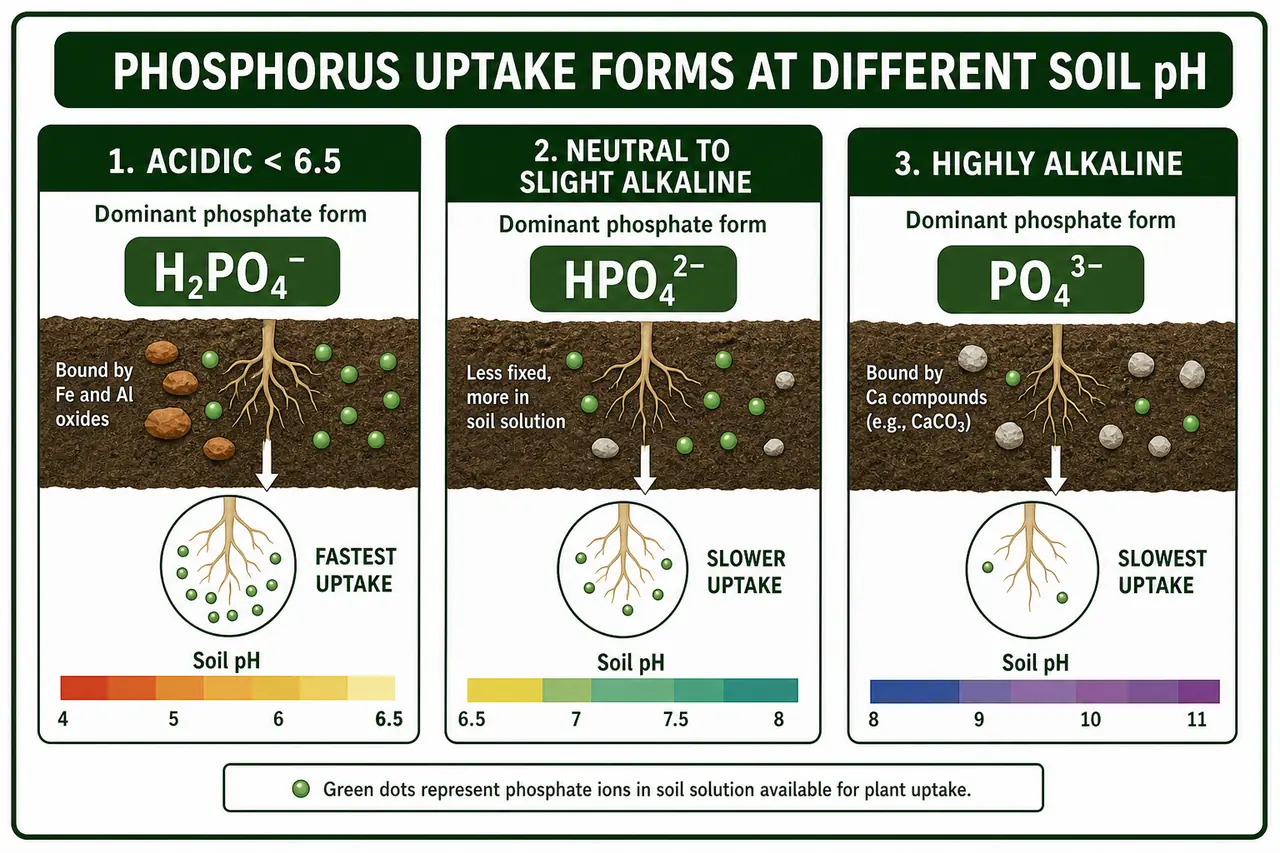
| Soil pH | Primary Form Absorbed | Absorption Speed |
|---|---|---|
| Acidic (< 6.5) | H2PO4- | Fastest |
| Neutral to slightly alkaline | HPO42- | Slower |
| Highly alkaline | PO43- | Slowest |
Factors Affecting P Fixation
| Factor | How It Affects Fixation |
|---|---|
| Clay minerals | Higher clay content → more P fixation. PO4 reacts with soluble Al from clay to form insoluble AlPO4 |
| Iron and Aluminium (acid soils) | 2Al + 3H2PO4 → Al2(PO4)3 — dominant fixation mechanism in tropical/subtropical soils |
| Calcium carbonate (alkaline soils) | Ca(H2PO4)2 + 2CaCO3 → Ca3(PO4)2 — dominant in calcareous soils |
| Organic matter | Dual effect: acids from OM can increase fixation by solubilising Fe/Al; but humic/fulvic acids can coat oxide surfaces and reduce fixation |
Agricultural example: In a laterite soil of Meghalaya (pH 4.5), applying SSP without liming wastes most of the P through Fe/Al fixation. Raising pH to 6.5 with lime before P application dramatically improves P availability.
The Phosphorus Cycle
NOTE
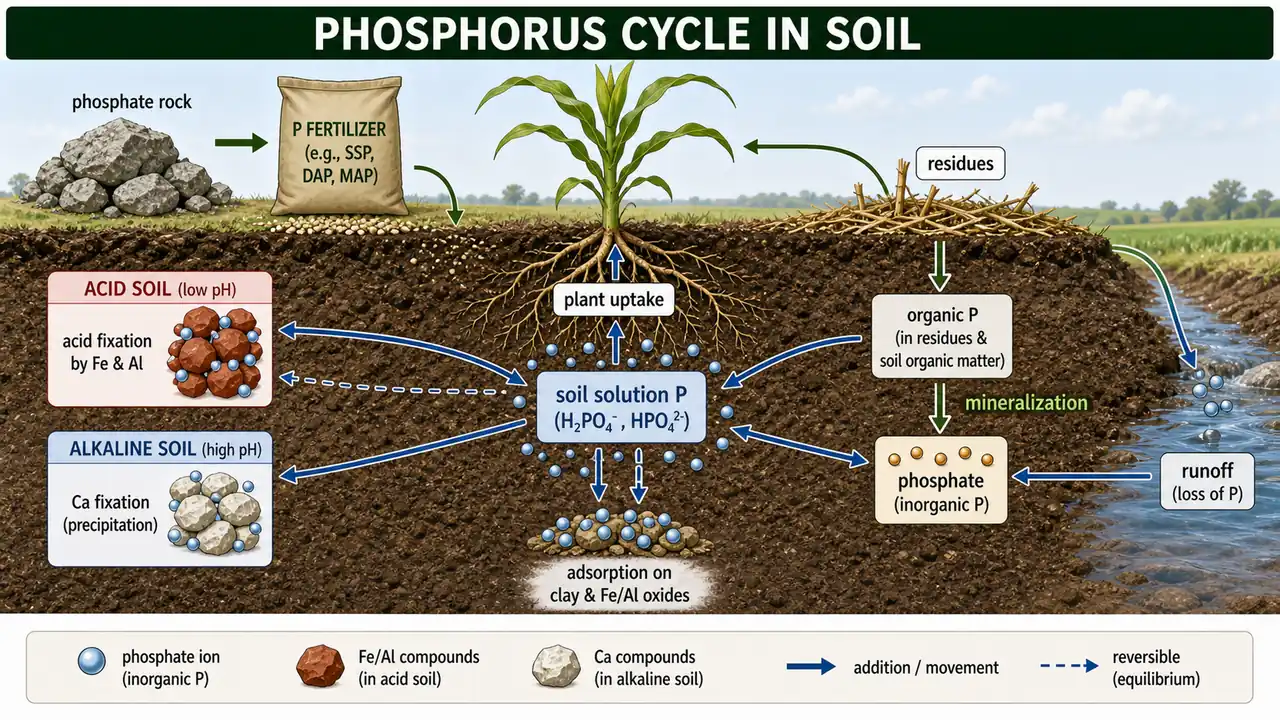
The P cycle is simpler than the N cycle because phosphorus has no significant gaseous phase. P cycles between organic and inorganic forms in soil.
| Process | Description |
|---|---|
| Weathering | Primary P minerals (apatite) release P into soil solution |
| Plant uptake | H2PO4- and HPO42- absorbed from soil solution |
| Return | Organic P returned through plant residues and animal wastes |
| Mineralization | Organic P converted to inorganic forms by soil microorganisms |
| Immobilization | Inorganic P incorporated into microbial biomass (when C:P > 100:1) |
| Fixation | P rendered unavailable by Fe/Al (acid soils) or Ca (alkaline soils) |
| Desorption/dissolution | Fixed P slowly released back to soil solution |
Unlike nitrogen, P is not lost through volatilization or denitrification. Primary P losses occur through crop removal, erosion, and limited leaching in sandy or organic soils.
Functions of Phosphorus
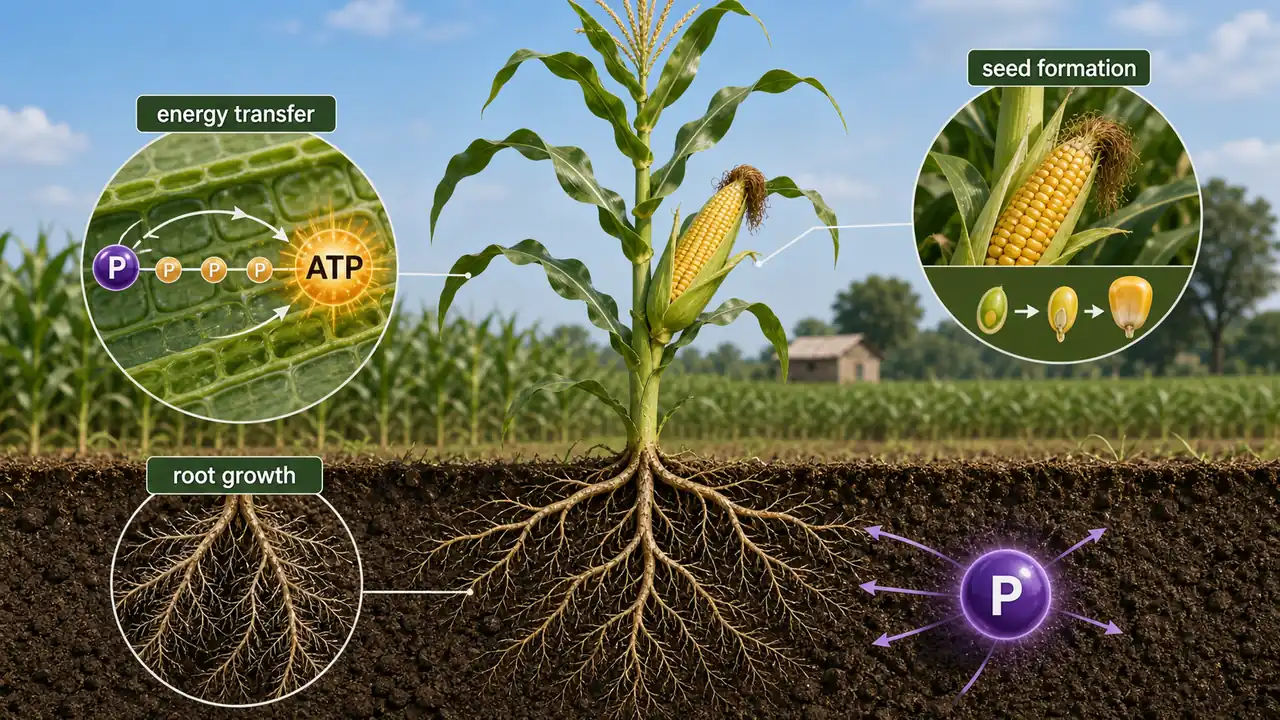
Phosphorus is called "Key to Life" because without it, plants cannot complete their life cycle.
| Function | Agricultural Significance |
|---|---|
| Energy storage and transfer (ATP, ADP) | Every energy-requiring process depends on P. Phosphorylation = transfer of PO4 from ATP to substances |
| Constituent of nucleic acids (DNA, RNA), phytin, phospholipids | Essential for genetic code and cell membrane structure |
| Component of cell membrane, chloroplasts, mitochondria, meristematic tissue | Structural role in cell organisation |
| Essential for cell division (meristem region) | Rapidly dividing cells have high P demand |
| Governs root growth (N governs shoot growth) | Strong early root development is critical for water and nutrient access |
| Stimulates early root development and quick seedling establishment | P placement near seed at planting is very effective |
| Gives rapid, vigorous start to plants | Strengthens straw, decreases lodging |
| Essential for seed formation — phytic acid is the main P storage in seeds | Seeds are concentrated P stores for next generation |
| Counteracts excess N — increases grain-to-straw ratio | Better balance between harvested product and residue |
| Increases Rhizobia activity and root nodule formation | Enhances biological N fixation in legumes |
| Promotes flowering, fruit ripening, seed germination, early maturity | Accelerates reproductive development |
| Constituent of NAD, NADP, ATP and other high-energy compounds | Co-enzymes essential for metabolic reactions |
TIP
Exam Tip: N = shoot growth (above ground). P = root growth (below ground). P is called "Key to Life" because life cycle cannot be completed without it.
Deficiency of Phosphorus
NOTE
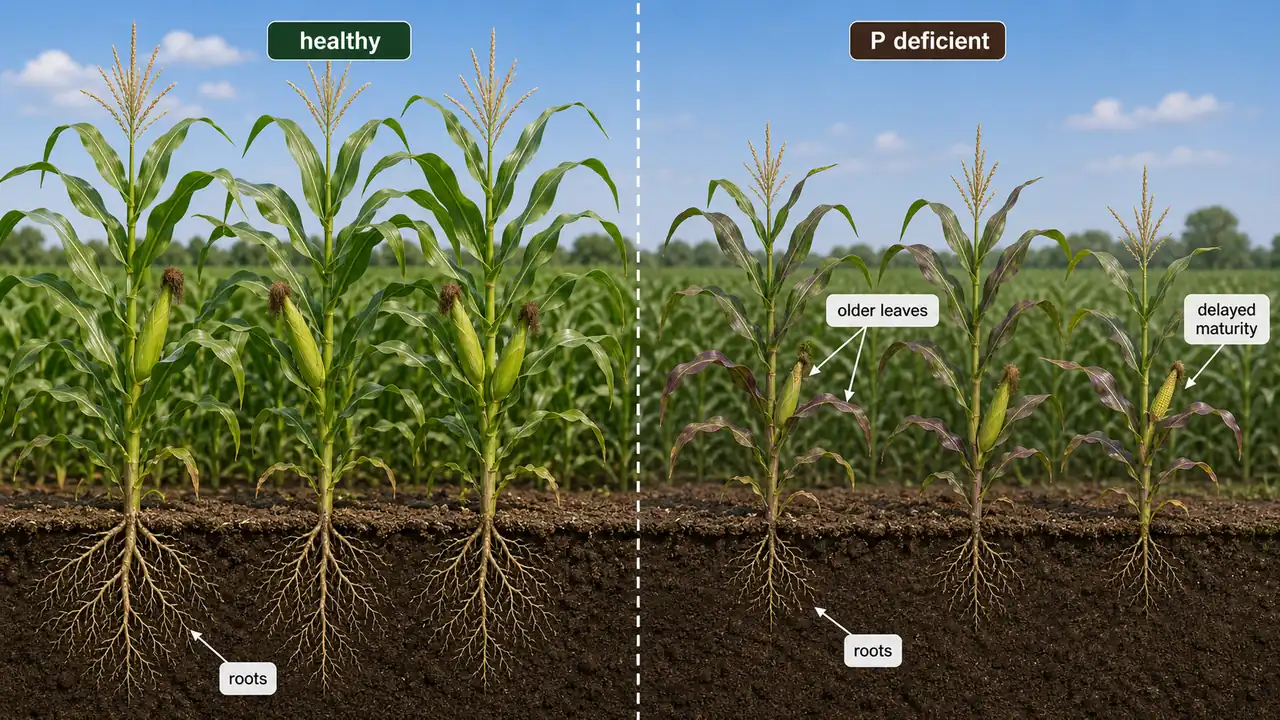
P is mobile in plants — deficiency symptoms appear on older plant parts first. Two hallmarks: bluish-green leaves and late maturity.
| Symptom | Details |
|---|---|
| Retarded overall growth — Late Maturity | Plants visibly smaller, take longer to mature |
| Bluish-green leaves | Due to accumulation of anthocyanin pigments |
| Purplish discolouration of foliage | Dead necrotic areas on leaves, petioles, or fruits |
| Reduced sugar content | Poor seed and fruit development |
| Premature leaf fall | Restricted root growth |
| Sickle leaf disease | Characteristic P deficiency disorder |
| Delayed flowering and ripening | Inferior quality, blossom shedding, premature fruit fall |
| Inhibited sugar synthesis | Or abnormally high sugar accumulation |
| Life cycle cannot be completed | Hence P = "Key of Life" |

Agricultural example: In a tomato nursery, if seedlings show purplish stems and stunted root systems, suspect P deficiency. Apply SSP or DAP at transplanting, placed near the root zone for maximum benefit.
Toxicity of Phosphorus
| Effect | Details |
|---|---|
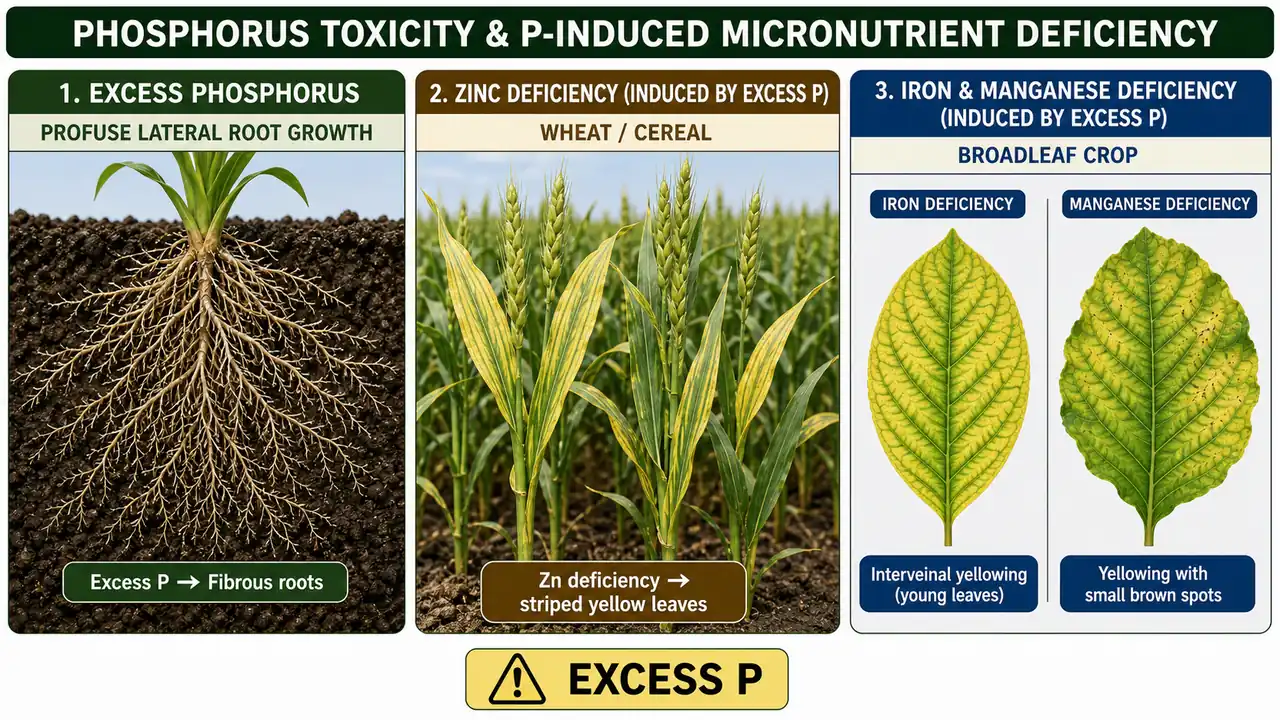
| Profuse lateral/fibrous root growth | Early maturity but less overall growth |
| Micronutrient deficiency | Excess P induces deficiency of Zinc, Iron, and Mn |
| P-induced Zn deficiency | Most common interaction — very relevant in Indian soils UPPSC 2021 |
Agricultural example: In wheat fields of the Indo-Gangetic plains where heavy DAP has been applied for years, Zn deficiency becomes widespread due to P-Zn antagonism. Co-application of zinc sulphate is essential.
Nutrient Mobility Summary
| Property | Phosphorus |
|---|---|
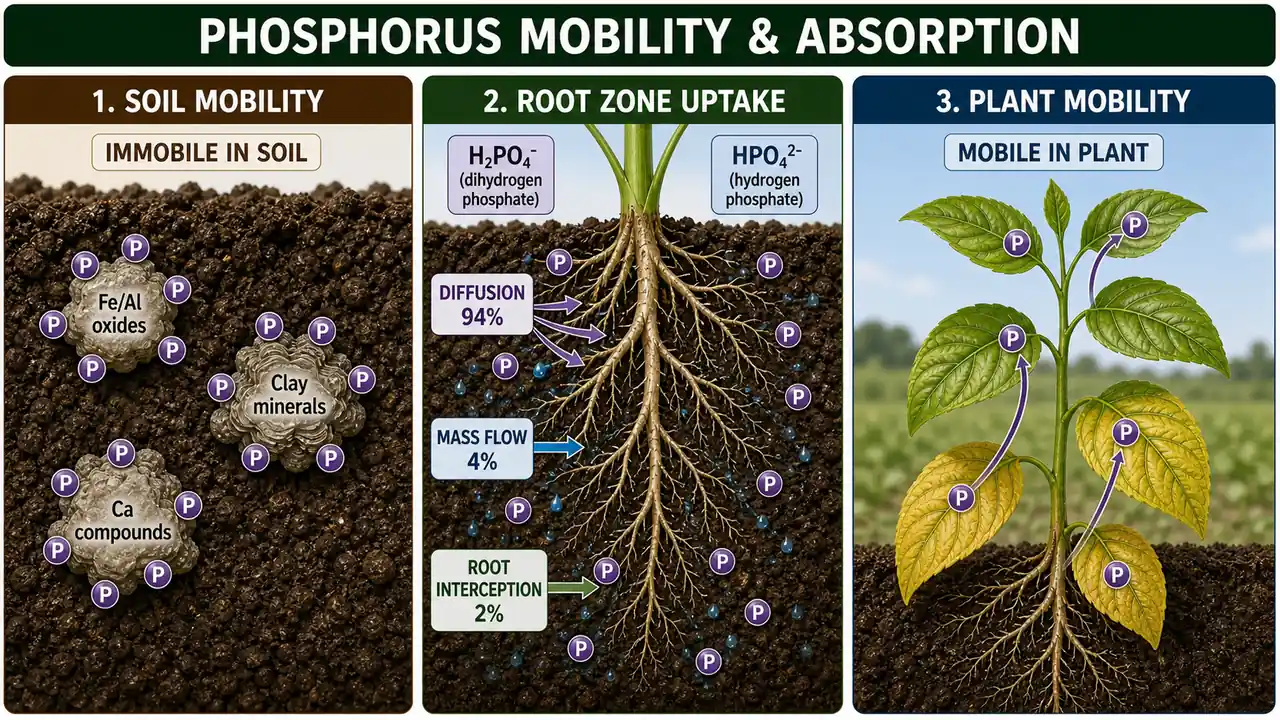
| Mobility in soil | Immobile — stays near point of application |
| Mobility in plant | Highly mobile — translocated from old to new tissues |
| Deficiency appears on | Older leaves first |
| Uptake form | H2PO4- (acid pH), HPO42- (alkaline pH) |
| Primary uptake mechanism | Diffusion (94%), Mass flow (4%), Root interception (2%) |
| Foliar absorption | Immobile (slow) |
| Average plant concentration | 0.1% |
TIP
Mnemonic: "P is for Planting roots deep, Powering energy (ATP), and Producing seeds — the Key to Life."
References
- Tisdale, S.L., Nelson, W.L., Beaton, J.D., Havlin, J.L. 1997. Soil Fertility and Fertilizers. 5th ed. Prentice Hall of India, New Delhi.
- Singh, S.S. 1995. Soil Fertility and Nutrient Management. Kalyani Publishers, Ludhiana.
- Maliwal, G.L. and Somani, L.L. 2011. Soil Technology. Agrotech.
- IARI Toppers Soil Science Part-9 (6th Edition 2025).
Summary Cheat Sheet
| Concept / Topic | Key Details |
|---|---|
| P called | "Key to Life" — life cycle cannot be completed without P |
| Plant P concentration | 0.1% dry weight (range 0.1–0.4%) |
| P uptake mechanism | Diffusion (94%), mass flow (4%), root interception (2%) |
| P uptake forms | H₂PO₄⁻ (acid pH — fastest), HPO₄²⁻, PO₄³⁻ |
| P mobility in plant | Highly mobile — deficiency on older leaves first |
| P mobility in soil | Immobile — stays near point of application |
| Optimum pH for P | 6.5–7.5 (maximum availability) |
| P₂O₅ fertilizer efficiency | Only 15–35% available to crop (rest fixed) |
| Apatite | Primary P mineral; constitutes 55% of soil P |
| P fixation in acid soils | By Fe and Al → AlPO₄, FePO₄ |
| P fixation in alkaline soils | By Ca → Ca₃(PO₄)₂ |
| C:N:P ratio | 100:10:1 |
| C:P > 100:1 | Net immobilization of P |
| P functions — energy | Component of ATP, ADP, NAD, NADP; phosphorylation |
| P functions — growth | Governs root growth (N governs shoot growth) |
| P functions — reproduction | Essential for seed formation (phytic acid), flowering, fruit ripening |
| P and N balance | Counteracts excess N; increases grain-to-straw ratio |
| P and Rhizobia | Increases nodule formation and BNF activity |
| P deficiency signs | Bluish-green leaves, purplish discolouration, late maturity |
| Sickle leaf disease | Characteristic P deficiency disorder |
| P toxicity | Induces deficiency of Zn, Fe, Mn (P-induced Zn deficiency most common) |
| Critical soil test (Olsen) | < 12.5 kg/ha = Low |
| No gaseous loss | Unlike N, P has no significant gaseous phase |
| P application method | Single basal dose, placed near roots |
| Rock phosphate | Black; acid-soluble; suited for plantation crops with extensive roots |
| Primary mineral source | Apatite (55% of soil P) |
| Main uptake mechanism | Diffusion (94%) |
| Toxicity concern | Induces Zn and Fe deficiency |
| Critical soil test value | < 12.5 kg/ha = Low (Olsen's method) |