🎃 Potassium in Soil: Forms, Fixation, Functions & Deficiency
Complete guide to potassium — soil forms, fixation, luxury consumption, functions as 'Quality Element', deficiency and toxicity symptoms for competitive exams
Why Potassium Matters: A Farmer's Perspective
A banana grower in Tamil Nadu notices that the margins of older leaves are turning brown and scorched, fruits are shrivelled, and plants are lodging in the wind. Soil testing reveals critically low exchangeable K (100 kg/ha — well below the critical limit of 135 kg/ha). Potassium is the "Quality Element" of crops — it controls stomata, strengthens stems, improves disease resistance, and enhances the size, taste, and shelf life of fruits. Without adequate K, even high N and P cannot deliver quality produce.
Potassium in Soil: Basic Facts
| Property | Value |
|---|---|
| Average plant concentration | 1.0% (dry weight); range 0.1-4% in vegetative tissue |
| Uptake form | K+ (simple cation) |
| Uptake mechanism | Diffusion (78%), Mass flow (20%), Root interception (2%) |
| Mobility in plant | Highly mobile — translocated from old to new tissues |
| Mobility in soil | Moderately mobile — less prone to leaching than NO3- |
| Called | "Quality Element" Exams and "Traffic Policeman of the Plant" |
IMPORTANT
Pro Content Locked
Upgrade to Pro to access this lesson and all other premium content.
₹99 charged monthly · Cancel anytime
- All Agriculture & Banking Courses
- AI Lesson Questions (100/day)
- AI Doubt Solver (50/day)
- Glows & Grows Feedback (30/day)
- AI Section Quiz (20/day)
- 22-Language Translation (100/day)
- Recall Questions (20/day)
- AI Quiz (15/day)
- AI Quiz Paper Analysis (100/day)
- AI Step-by-Step Explanations (100/day)
- Spaced Repetition Recall (FSRS)
- AI Tutor
- Immersive Text Questions
- Audio Lessons — Hindi & English
- Mock Tests & Previous Year Papers
- Summary & Mind Maps
- XP, Levels, Leaderboard & Badges
- Generate New Classrooms
- Voice AI Teacher (AgriDots Live)
- AI Revision Assistant
- Knowledge Gap Analysis
- Interactive Revision (LangGraph)
🔒 Secure via Razorpay · Cancel anytime · No hidden fees
Why Potassium Matters: A Farmer's Perspective
A banana grower in Tamil Nadu notices that the margins of older leaves are turning brown and scorched, fruits are shrivelled, and plants are lodging in the wind. Soil testing reveals critically low exchangeable K (100 kg/ha — well below the critical limit of 135 kg/ha). Potassium is the "Quality Element" of crops — it controls stomata, strengthens stems, improves disease resistance, and enhances the size, taste, and shelf life of fruits. Without adequate K, even high N and P cannot deliver quality produce.
Potassium in Soil: Basic Facts
| Property | Value |
|---|---|
| Average plant concentration | 1.0% (dry weight); range 0.1-4% in vegetative tissue |
| Uptake form | K+ (simple cation) |
| Uptake mechanism | Diffusion (78%), Mass flow (20%), Root interception (2%) |
| Mobility in plant | Highly mobile — translocated from old to new tissues |
| Mobility in soil | Moderately mobile — less prone to leaching than NO3- |
| Called | "Quality Element" Exams and "Traffic Policeman of the Plant" |
IMPORTANT
Unlike N and P, potassium does not become part of any organic compound in the plant. It remains in ionic form throughout, functioning as a regulator and catalyst rather than a structural component.
Sources of Potassium
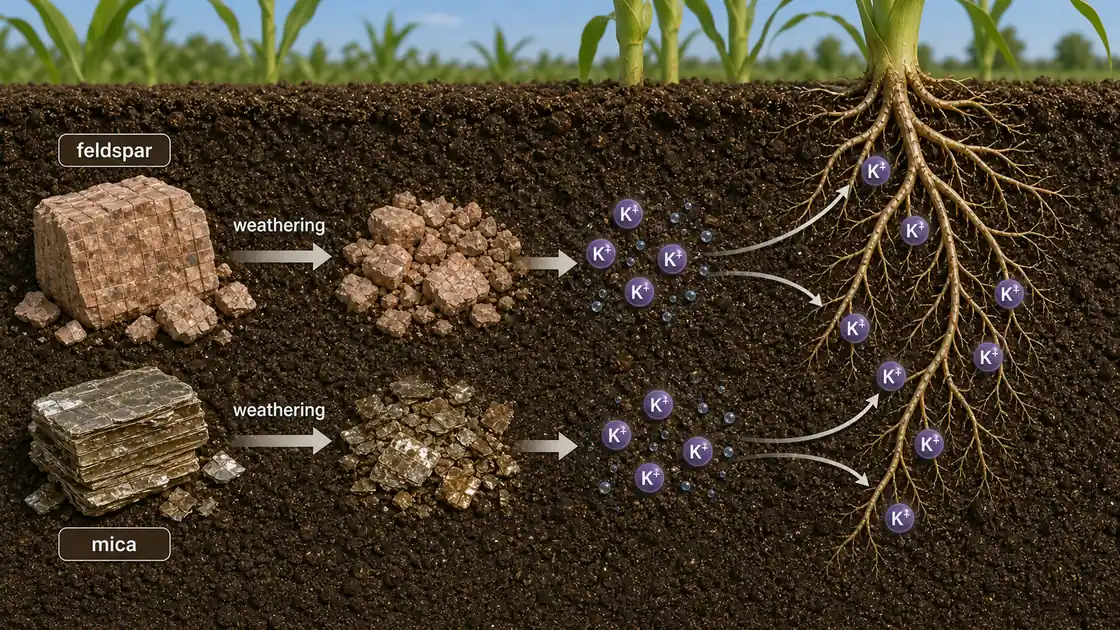
- The micas and feldspars are the major K-bearing minerals
- K-Feldspar: KAlSi3O10
Agricultural example: Soils developed from mica-rich parent material (e.g., Indo-Gangetic alluvial soils) generally have good K reserves in non-exchangeable form. But intensive rice-wheat cropping depletes exchangeable K faster than it is replenished.
Four Forms of Potassium in Soil
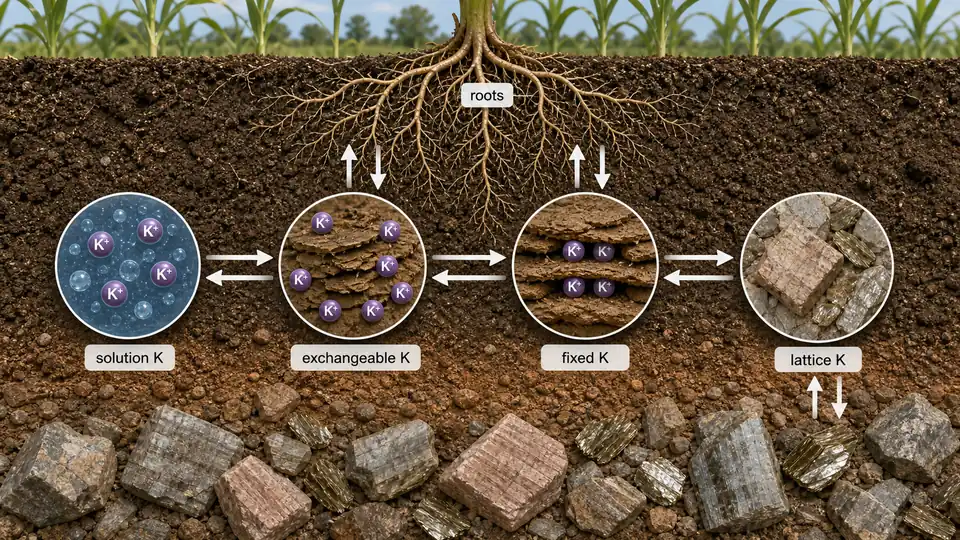
K exists in four forms with different levels of plant availability. These are in dynamic equilibrium — as plants remove one form, the next form replenishes it.
| Form | Availability | % of Total K | Details |
|---|---|---|---|
| Water-soluble K | Immediately available | <1% | Directly taken up by roots |
| Exchangeable K | Readily available | 1-2% | Held on clay surfaces; released into solution as plants draw down soluble K |
| Fixed (Non-exchangeable) K | Slowly available | 1-10% | Trapped between layers of 2:1 clay minerals (illite, vermiculite); slow-release reserve |
| Lattice (Mineral) K | Very slowly available | 90-98% | Locked in muscovite, biotite, K-feldspar; released only through geological weathering |
Water-Soluble K
Concentration depends on:
| Factor | Effect |
|---|---|
| Type of clay | Different clays hold and release K differently |
| Soil moisture | Dilution increases soluble K; drying decreases it (K gets fixed in clay) |
| Leaching intensity | Heavy rainfall removes soluble K |
| Exchange K pool | Feeds the solution pool |
| Competing cations | Ca2+, Mg2+, Al3+, Na+ compete with K+ for uptake (cation antagonism) |
Activity Ratio
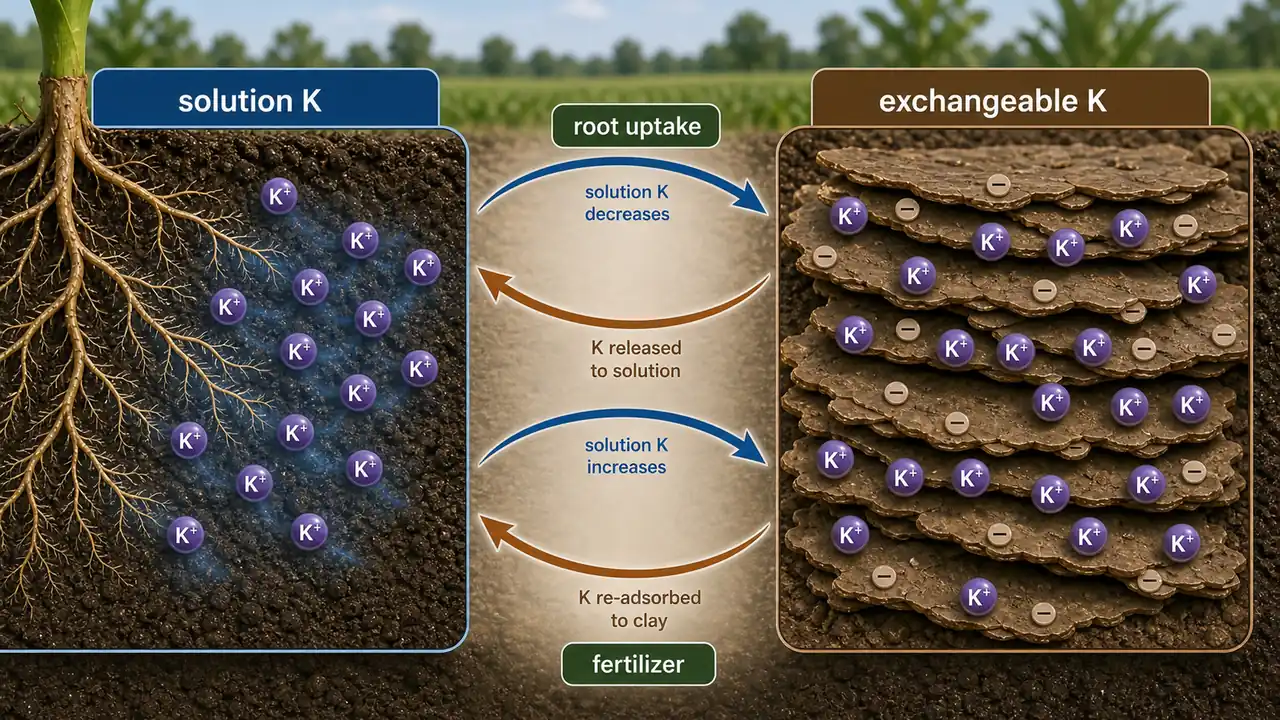
- Measures the intensity of labile K — a more meaningful indicator of K availability than total exchangeable K
- Represents K immediately available to crop roots
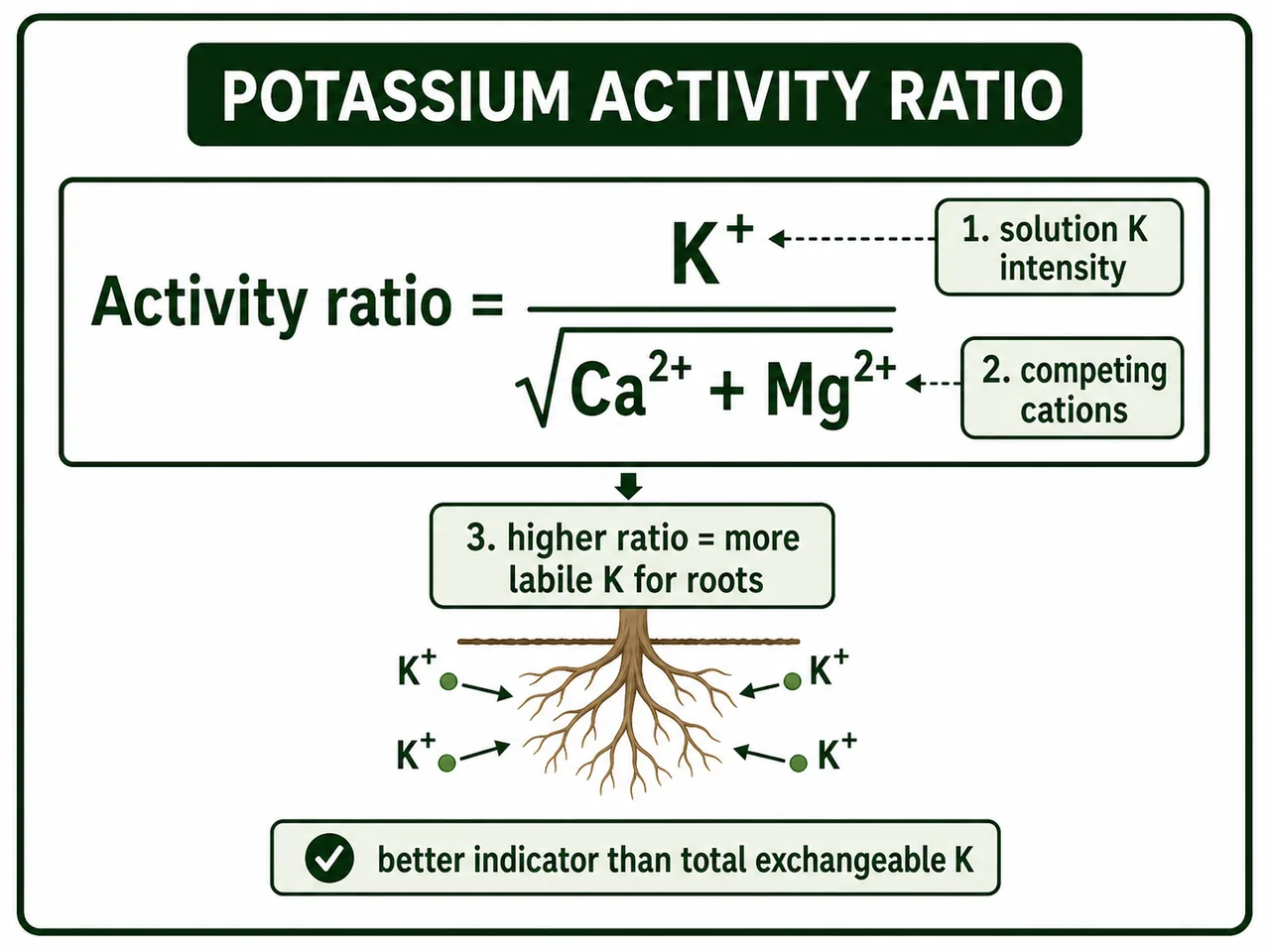
Exchangeable K
- Adsorbed on soil clay complex, replaceable with neutral salts
- Acts as the immediate reserve for plant uptake
- K is called "Decalcifier" because K fertilizers containing Cl can displace Ca from exchange sites, forming CaCl2 which leaches away
Fixed (Non-exchangeable) K
- Firmly bound in 2:1 type clay minerals (illite, vermiculite)
- Not immediately replaceable with neutral salts
- Serves as a slow-release reserve
Lattice (Mineral) K
- Present in muscovite, biotite, K-feldspar
- Constitutes the largest reservoir (90-98% of total K)
- Released too slowly to meet crop demands
Potassium Fixation
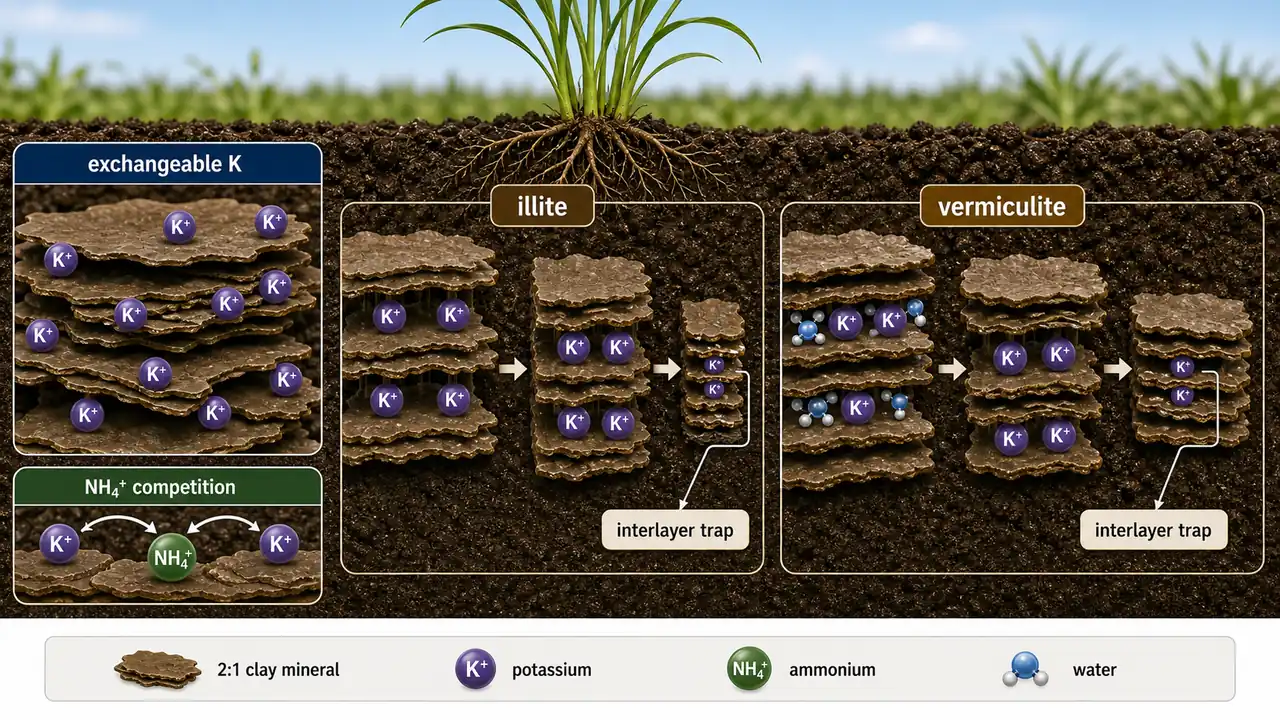
| Aspect | Details |
|---|---|
| Mechanism | K+ ions enter interlayer space of 2:1 clays; layers contract around them, trapping the ion |
| K+ and NH4+ competition | Nearly identical ionic radii → compete for same fixation sites. K+ can block release of fixed NH4+ and vice versa |
| Agricultural implication | In illite-rich soils, applied K may get fixed, reducing immediate availability |
Agricultural example: In a rice-wheat system on alluvial soil of Punjab, K depletion is a growing concern. Even with continuous K application, the soil's illite clay fixes much of the applied K, making it unavailable in the short term.
Luxury Consumption of Potassium
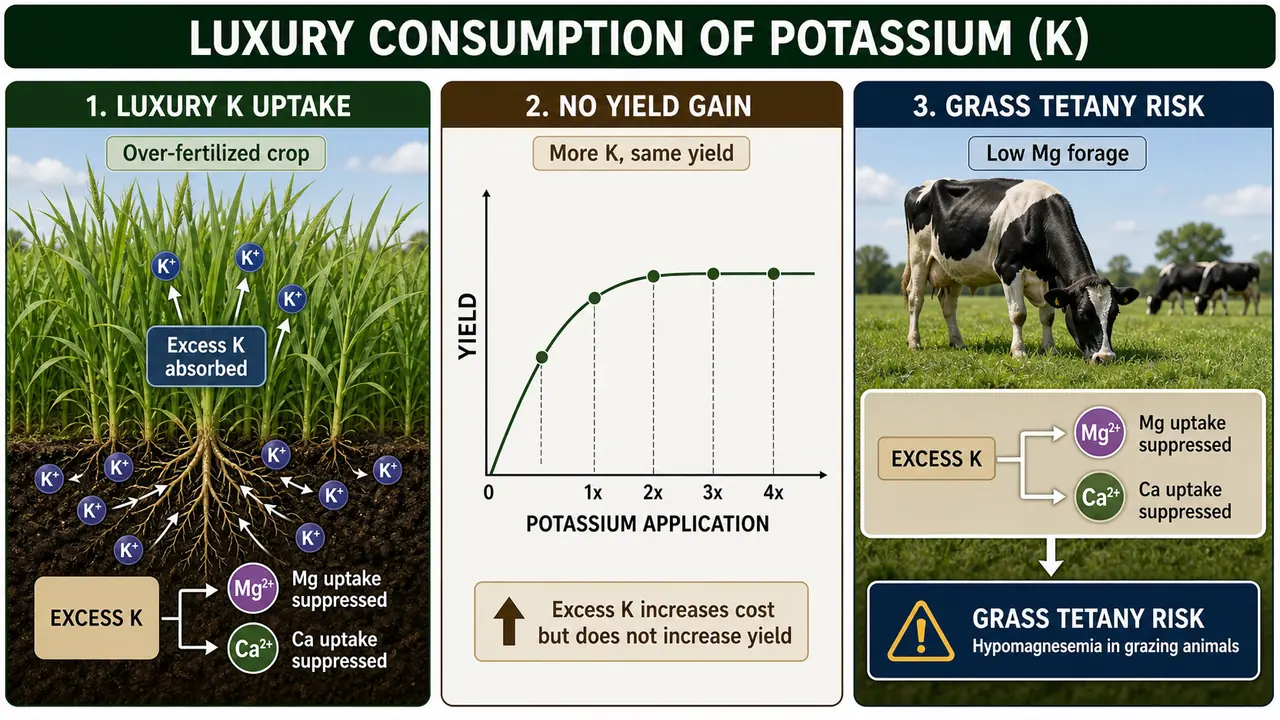
| Aspect | Details |
|---|---|
| Most common in | Grasses, forages, cereals when K is over-applied |
| Problems caused | Suppresses Mg and Ca absorption (cation competition) |
| Animal health risk | Reduces Mg in forages → Grass Tetany (hypomagnesemia) in grazing cattle |
| Solution | Base K fertilization on soil testing and crop requirement, not blanket application |
Agricultural example: Over-applying MOP (muriate of potash) to a fodder sorghum field leads to luxury K uptake. The fodder looks lush but has dangerously low Mg, risking Grass Tetany in dairy cattle.
Functions of Potassium
Potassium is unique — it functions as a regulatory and catalytic element rather than a structural component.
| Function | Agricultural Significance |
|---|---|
| Regulates opening and closing of stomata exams | Guard cells accumulate K+ to open stomata; K+ leaves to close them |
| Transport of water and nutrients in xylem | Drives movement through the plant |
| Imparts disease resistance and drought tolerance exams | Stomata close quickly during water stress, conserving moisture |
| Osmo-regulation and cell turgor pressure | Central role in water balance |
| pH stabilisation of cytoplasm (pH 7-8) | Neutralises organic anions |
| Activates > 60 enzymes | Including starch synthetase and nitrate reductase |
| Enhances crop quality | Size of grain/seed, shelf life of fruits, fibre quality of cotton, tobacco leaf quality |
| Reduces lodging | Strong, stiff straw in paddy and wheat |
| Called "Traffic Policeman of the Plant" | Regulates movement of ions within the plant |
| Essential for starch and sugar formation | Required in large quantity for potato, sweet potato, banana, tapioca |
| Improves water use efficiency | Better yield per unit of water |
| Promotes flower buds, fruiting, hardening of woody plants Exams | Reproductive development |
TIP
Exam Tip: K is the "Quality Element" — it improves everything about crop quality. But excess K in citrus fruits reduces quality (lowers acidity, making fruit bland).
Deficiency of Potassium
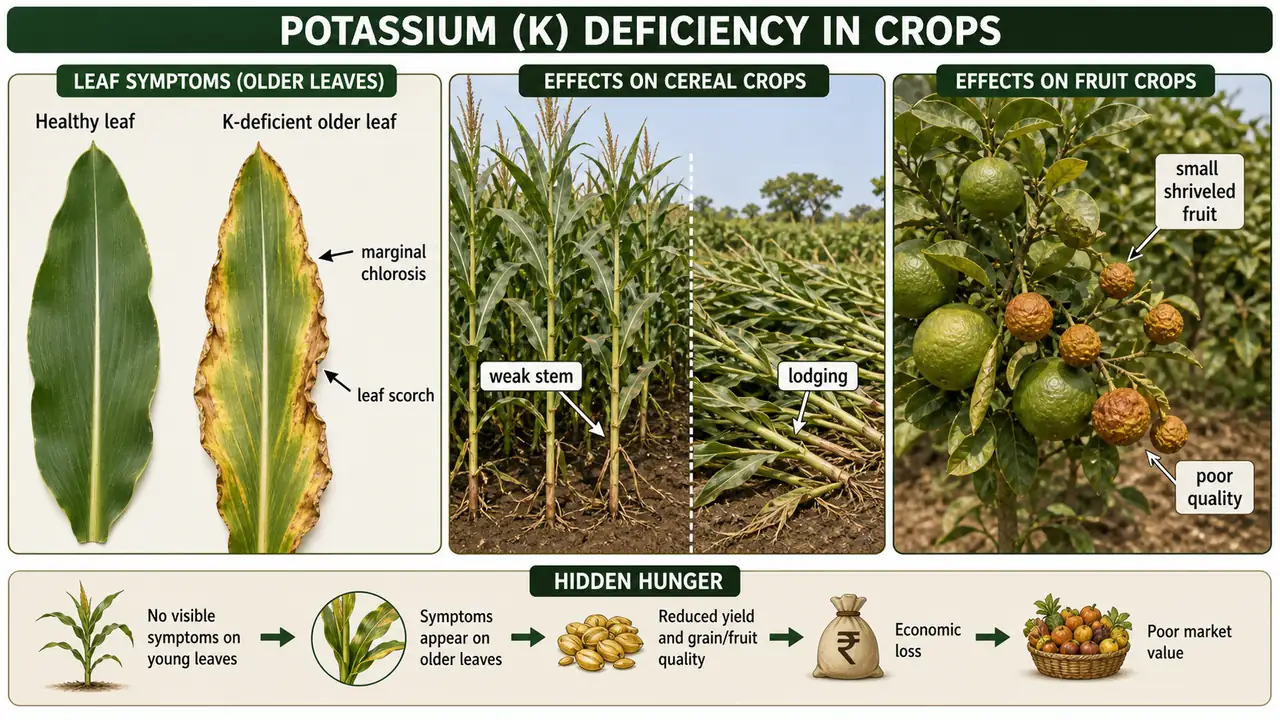
WARNING
K deficiency symptoms often appear only after yields have already been significantly reduced (hidden hunger). Watch for marginal leaf scorch on older leaves.
| Symptom | Details |
|---|---|
| Chlorosis along leaf margins → scorching and browning of tips | Progresses inward giving burning appearance — hallmark of K deficiency |
| Slow, stunted growth | Reduced growth rate precedes visible symptoms |
| Lodging | Weakened stems in cereals |
| Hidden hunger | Reduced yield without visible symptoms |
| Shrivelled fruits and seeds | Poor quality |
| Decreased disease resistance | More vulnerable to fungal and bacterial infections |
| Marginal necrosis, shortening of internodes | Stunted appearance |
| More water lost per unit dry matter | Disturbed water economy |
| Stalk breakage in corn and sorghum | Due to weak stems |
Crop-Specific K Deficiency Symptoms
| Crop | Specific Symptom |
|---|---|
| Rice | Leaf tips dark brown; blades bluish-green with chlorosis and necrosis |
| Banana | Deficiency on margins and bottom of leaves |
| Grapes | Yellow leaves with brown necrotic spots, brittle, uneven ripening; severe attack of Botrytis cinerea |
| Potato | Poor keeping quality of tubers |
| Sugarcane | Disturbed invertase and catalase enzyme activity |
Agricultural example: In a potato field, if tubers have poor storage quality and plants show marginal leaf scorch on lower leaves, K deficiency is the likely cause. Apply SOP (sulphate of potash) rather than MOP to avoid chloride toxicity in potato.
Excess of Potassium (Toxicity)
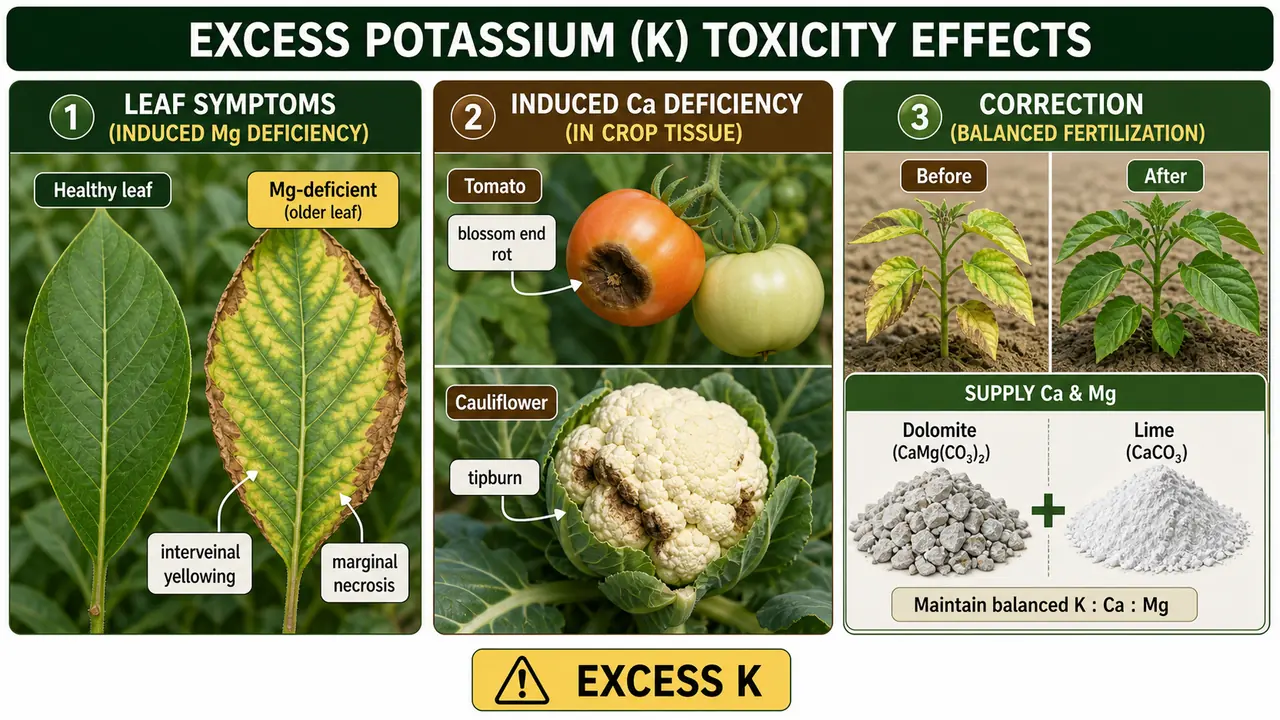
| Effect | Mechanism |
|---|---|
| Mg deficiency symptoms | K competitively inhibits Mg2+ uptake |
| Ca deficiency symptoms | K competitively inhibits Ca2+ uptake |
| Correction | Balanced fertilisation with Ca and Mg amendments (liming, dolomite application) |
Nutrient Mobility Summary
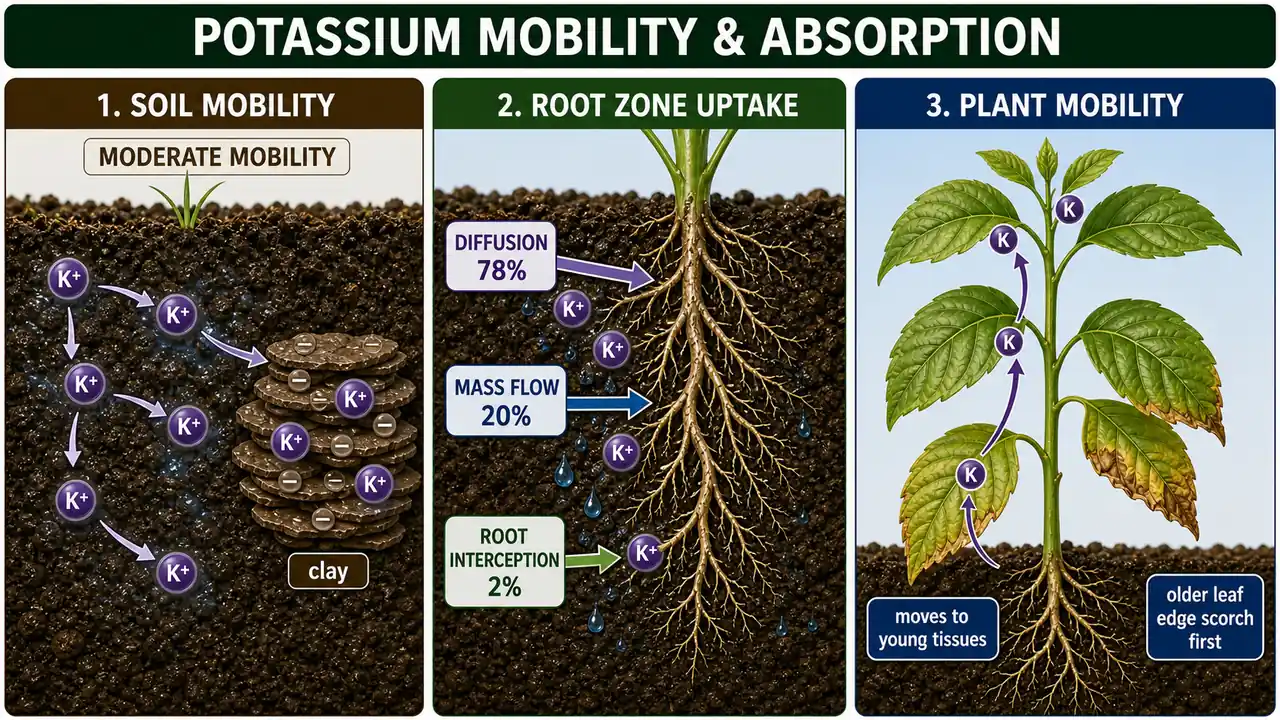
| Property | Potassium |
|---|---|
| Mobility in soil | Moderately mobile — less prone to leaching than NO3- |
| Mobility in plant | Highly mobile — translocated from old to new tissues |
| Deficiency appears on | Older/lower leaves first |
| Uptake form | K+ (simple cation) |
| Primary uptake mechanism | Diffusion (78%), Mass flow (20%), Root interception (2%) |
| Foliar absorption | Rapid |
| Average plant concentration | 1.0% |
TIP
Mnemonic: "K is for Kuality — Kontrols stomata, Keeps plants standing (no lodging), and Kicks disease away."
References
- Tisdale, S.L., Nelson, W.L., Beaton, J.D., Havlin, J.L. 1997. Soil Fertility and Fertilizers. 5th ed. Prentice Hall of India, New Delhi.
- Singh, S.S. 1995. Soil Fertility and Nutrient Management. Kalyani Publishers, Ludhiana.
- Maliwal, G.L. and Somani, L.L. 2011. Soil Technology. Agrotech.
- IARI Toppers Soil Science Part-9 (6th Edition 2025).
Summary Cheat Sheet
| Concept / Topic | Key Details |
|---|---|
| K called | "Quality Element" and "Traffic Policeman of the Plant" |
| K plant concentration | Average 1.0% dry weight (range 0.1–4%) |
| K uptake form | K⁺ (simple cation) |
| K uptake mechanism | Diffusion (78%), mass flow (20%), root interception (2%) |
| K mobility in plant | Highly mobile — deficiency on older/lower leaves |
| K not structural | Remains in ionic form; does not enter proteins, chlorophyll, or carbohydrates |
| 4 forms of soil K | Water-soluble (<1%) → Exchangeable (1–2%) → Fixed (1–10%) → Lattice (90–98%) |
| K source minerals | Micas (muscovite, biotite) and K-feldspar (KAlSi₃O₁₀) |
| K "Decalcifier" | K displaces Ca from exchange sites → CaCl₂ leaches away |
| K fixation clays | 2:1 type — illite, vermiculite; K⁺ trapped in interlayer spaces |
| K⁺ vs NH₄⁺ | Nearly identical ionic radii → compete for same fixation sites |
| Luxury consumption | Plants absorb excess K with no yield increase; unique to K |
| Grass Tetany | Excess K suppresses Mg in forages → hypomagnesemia in cattle |
| K — stomatal regulation | Guard cells use K⁺ to open/close stomata |
| K activates enzymes | >60 enzymes including starch synthetase and nitrate reductase |
| K improves quality | Grain size, shelf life, fibre quality (cotton), tobacco leaf quality |
| K reduces lodging | Strengthens straw in paddy and wheat |
| K deficiency signs | Marginal leaf scorch on older leaves; lodging; hidden hunger |
| K deficiency — grapes | Uneven ripening; severe Botrytis cinerea attack |
| K deficiency — potato | Poor keeping quality of tubers |
| K toxicity | Induces Mg and Ca deficiency (cation competition) |
| Critical soil test (K) | <135 kg/ha = Low |
| High-K crops | Potato, banana, sugarcane, cotton, sweet potato, tapioca |
| Activity ratio | Measures intensity of labile K — better indicator than total exchangeable K |
| Not a structural component | Remains in ionic form; does not enter proteins, chlorophyll, fats, or carbohydrates |
| 4 forms in soil | Water-soluble → Exchangeable → Fixed → Lattice (in dynamic equilibrium) |
| Mineral K | 90-98% of total K; locked in micas and feldspars |
| Main uptake | Diffusion (78%) |
| Key crops needing high K | Potato, banana, sugarcane, cotton, sweet potato |