💳 Soil Health Card Scheme: Objectives, Parameters & Soil Health Management
Complete guide to India's Soil Health Card Scheme — launch details, 12 parameters, sampling methods, SHM components, INM approach, and benefits for competitive exams
Why the Soil Health Card Matters: A Farmer's Perspective
A wheat farmer in Rajasthan receives his Soil Health Card and discovers his soil has adequate N and K but critically low P and Zn. Previously, he applied a blanket dose of urea and DAP every season. Now, guided by the SHC recommendation, he reduces urea by 10%, increases single super phosphate, and adds 25 kg/ha zinc sulphate. His input cost drops by 8%, and wheat yield increases by 6%. This is the transformative promise of the Soil Health Card — replacing guesswork with science-based, farm-specific advice.
Soil Health Card Scheme (SHC): Overview
IMPORTANT
Soil Health Card Scheme — launched 19-02-2015 at Suratgarh, Rajasthan. Issued every 2 years, covering 12 parameters. Motto: "Swasth Dharaa. Khet Haraa."
| Aspect | Details |
|---|---|
| Launched by | Hon'ble Prime Minister |
| Date | 19 February 2015 |
| Location | Suratgarh, Rajasthan |
| Type | Centrally Sponsored Scheme |
| Nodal Ministry | Department of Agriculture, Cooperation & Farmers Welfare (Ministry of Agriculture and Farmers Welfare) |
| Motto | "Swasth Dharaa. Khet Haraa" (Healthy Earth. Green Farm) |
| Frequency | Issued every 2 years for all land holdings |
| Target | 12 crore Soil Health Cards during 12th Plan period |
| Cards distributed | 25+ crore (updated; was 10.73 crore by Oct 2019) |
| Current status | Merged into RKVY cafeteria scheme |
| Grassroots infra | VLSTLs (Village Level Soil Testing Labs) established |
| Background | Soil testing programme started in India in 1955-56 |
What is a Soil Health Card?
A Soil Health Card is a printed report issued to each farmer for each of his land holdings. It contains the status of the soil with respect to 12 parameters and provides fertiliser recommendations and soil amendment advice.
Pro Content Locked
Upgrade to Pro to access this lesson and all other premium content.
₹99 charged monthly · Cancel anytime
- All Agriculture & Banking Courses
- AI Lesson Questions (100/day)
- AI Doubt Solver (50/day)
- Glows & Grows Feedback (30/day)
- AI Section Quiz (20/day)
- 22-Language Translation (100/day)
- Recall Questions (20/day)
- AI Quiz (15/day)
- AI Quiz Paper Analysis (100/day)
- AI Step-by-Step Explanations (100/day)
- Spaced Repetition Recall (FSRS)
- AI Tutor
- Immersive Text Questions
- Audio Lessons — Hindi & English
- Mock Tests & Previous Year Papers
- Summary & Mind Maps
- XP, Levels, Leaderboard & Badges
- Generate New Classrooms
- Voice AI Teacher (AgriDots Live)
- AI Revision Assistant
- Knowledge Gap Analysis
- Interactive Revision (LangGraph)
🔒 Secure via Razorpay · Cancel anytime · No hidden fees
Why the Soil Health Card Matters: A Farmer's Perspective
A wheat farmer in Rajasthan receives his Soil Health Card and discovers his soil has adequate N and K but critically low P and Zn. Previously, he applied a blanket dose of urea and DAP every season. Now, guided by the SHC recommendation, he reduces urea by 10%, increases single super phosphate, and adds 25 kg/ha zinc sulphate. His input cost drops by 8%, and wheat yield increases by 6%. This is the transformative promise of the Soil Health Card — replacing guesswork with science-based, farm-specific advice.
Soil Health Card Scheme (SHC): Overview
IMPORTANT
Soil Health Card Scheme — launched 19-02-2015 at Suratgarh, Rajasthan. Issued every 2 years, covering 12 parameters. Motto: "Swasth Dharaa. Khet Haraa."
| Aspect | Details |
|---|---|
| Launched by | Hon'ble Prime Minister |
| Date | 19 February 2015 |
| Location | Suratgarh, Rajasthan |
| Type | Centrally Sponsored Scheme |
| Nodal Ministry | Department of Agriculture, Cooperation & Farmers Welfare (Ministry of Agriculture and Farmers Welfare) |
| Motto | "Swasth Dharaa. Khet Haraa" (Healthy Earth. Green Farm) |
| Frequency | Issued every 2 years for all land holdings |
| Target | 12 crore Soil Health Cards during 12th Plan period |
| Cards distributed | 25+ crore (updated; was 10.73 crore by Oct 2019) |
| Current status | Merged into RKVY cafeteria scheme |
| Grassroots infra | VLSTLs (Village Level Soil Testing Labs) established |
| Background | Soil testing programme started in India in 1955-56 |
What is a Soil Health Card?
A Soil Health Card is a printed report issued to each farmer for each of his land holdings. It contains the status of the soil with respect to 12 parameters and provides fertiliser recommendations and soil amendment advice.
The 12 Parameters
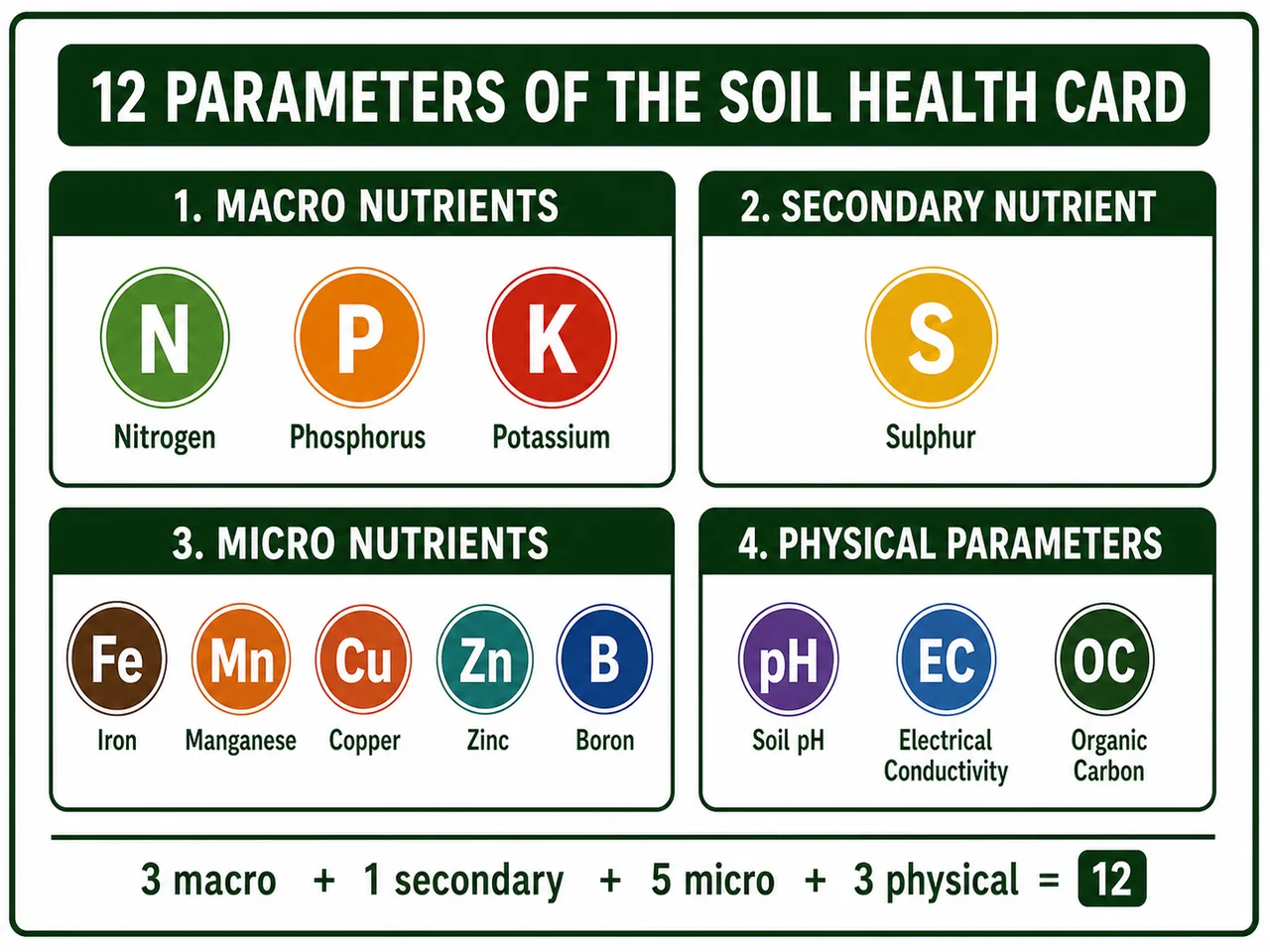
| Category | Parameters | What They Indicate |
|---|---|---|
| Macro-nutrients | N, P, K | Primary nutrients needed in largest quantities |
| Secondary nutrient | S | Essential for protein synthesis and enzyme function |
| Micro-nutrients | Fe, Mn, Cu, Zn, B | Needed in small amounts but critical for plant health |
| Physical parameters | pH, EC, OC | Soil acidity/alkalinity, salinity, and organic carbon content |
Agricultural example: A paddy farmer in Tamil Nadu receives his SHC showing: N = Low (220 kg/ha), P = Medium (18 kg/ha), K = High (380 kg/ha), Zn = Deficient. The recommendation: increase N by 25%, maintain P, reduce K, and apply ZnSO4 at 25 kg/ha.
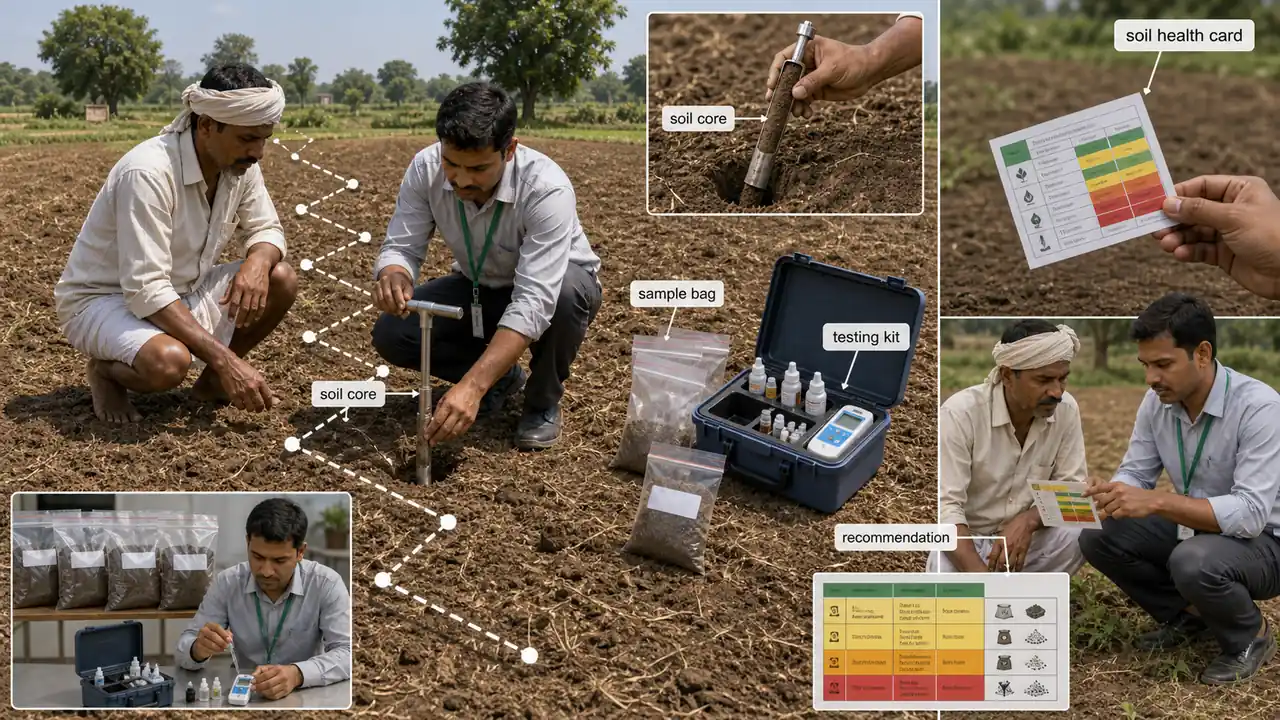
Objectives of SHC Scheme
| Objective | What It Means for Farmers |
|---|---|
| Provide information on soil nutrient status | Know exactly what your soil has and lacks |
| Recommend appropriate dosage of nutrients | How much of which fertiliser to apply |
| Provide customised crop-specific recommendations | Advice tailored to both soil type and intended crop |
| Promote balanced and integrated use of plant nutrients | Reduce wasteful over-application; correct hidden deficiencies |
Soil Sampling Under SHC
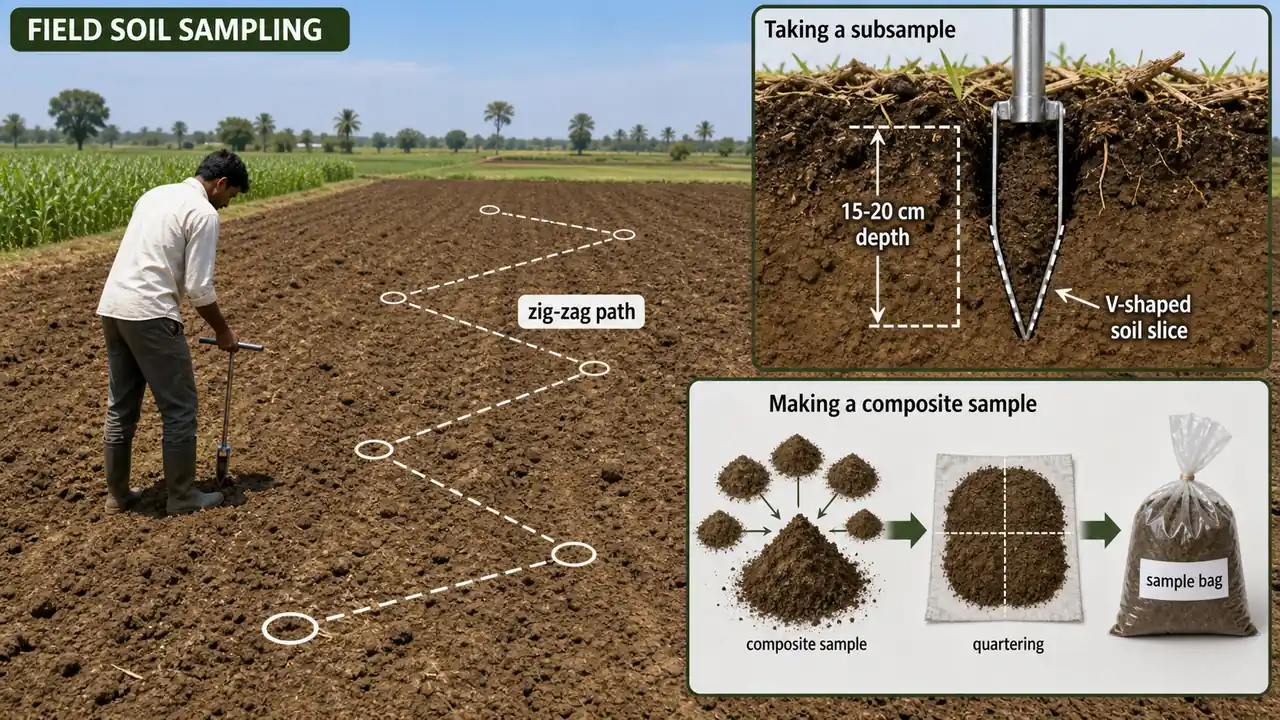
Sampling Grid
| Area Type | Grid Size | Reason |
|---|---|---|
| Irrigated area | 2.5 ha per sample | Denser grid — greater variability in intensively managed fields |
| Rain-fed area | 10 ha per sample | Wider grid — more uniform conditions |
| Tools used | GPS tools and revenue maps | Precision in sample location |
Key Sampling Details
| Question | Answer |
|---|---|
| Who collects samples? | State Government staff (Dept. of Agriculture) or outsourced agency; may also involve local agriculture/science college students |
| When to sample? | After harvesting Rabi and Kharif crops, or when there is no standing crop |
| Sampling depth | 15-20 cm |
| Sampling method | Cut soil in a "V" shape — ensures representative slice from surface to sampling depth |
Where Are Samples Tested?
| Testing Facility | Details |
|---|---|
| State STLs (Dept. of Agriculture staff) | Primary testing centres |
| State STLs (outsourced agency staff) | Capacity augmentation |
| Outsourced agency's own labs | Third-party testing |
| ICAR institutions (including KVKs and SAUs) | Research-level accuracy |
| Science College/University labs | Students under professor/scientist supervision |
Cost Per Sample
- Rs. 190 per soil sample provided to State Governments
- Covers collection, testing, card generation, and distribution
Agricultural example: A progressive farmer in Madhya Pradesh gets samples collected from his 10-acre irrigated field — 4 samples at the 2.5 ha grid. The testing reveals that his western plot is Zn-deficient while the eastern plot has adequate Zn. He applies ZnSO4 only where needed, saving cost and improving efficiency.
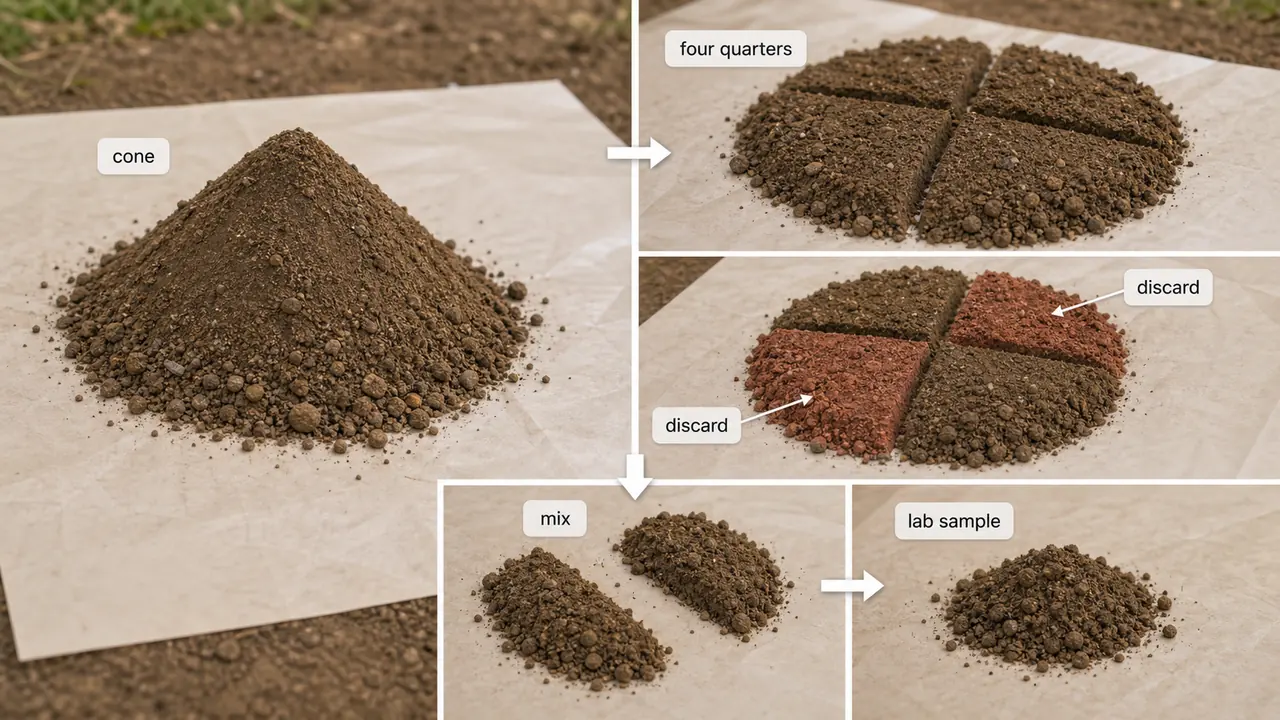
Soil Health Management (SHM)
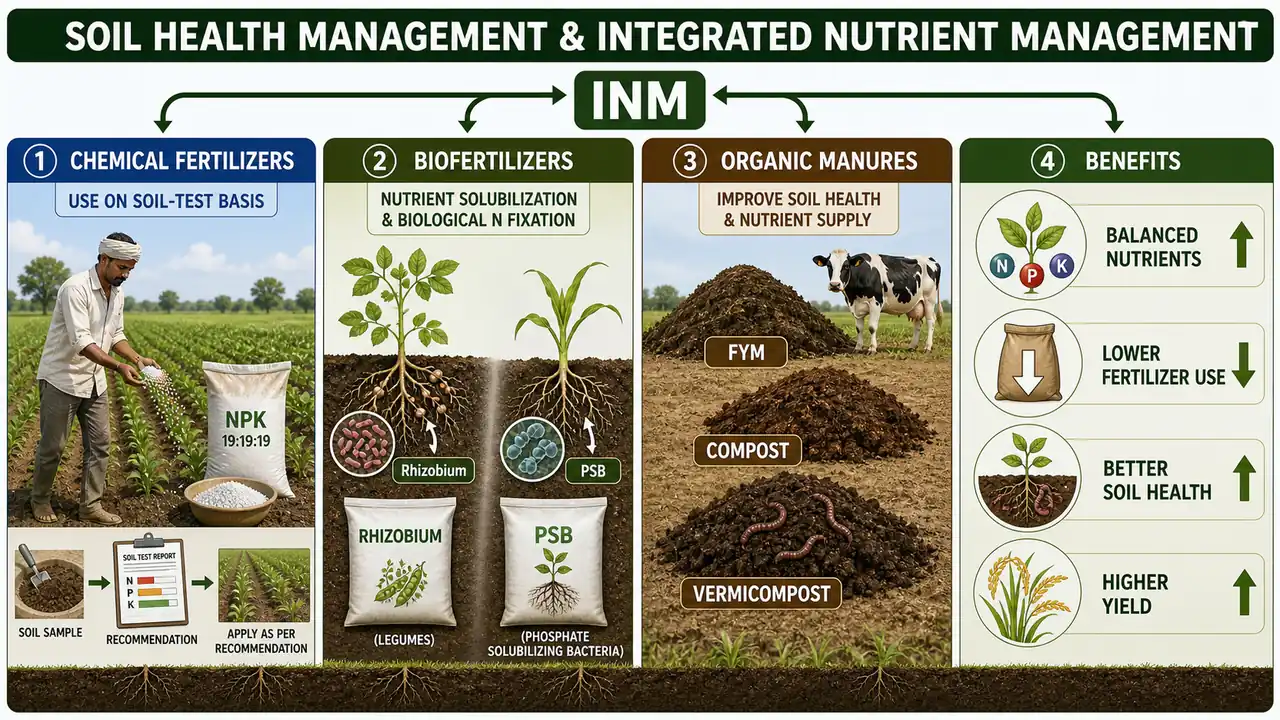
SHM promotes Integrated Nutrient Management (INM) — soil test-based balanced use of fertilisers combined with bio-fertilisers and locally available organic manures.
| INM Component | Examples |
|---|---|
| Chemical fertilisers | Soil test-based, balanced NPK + micronutrients |
| Bio-fertilisers | Rhizobium, Azotobacter, PSB, Azospirillum |
| Organic manures | Farm Yard Manure, Compost, Vermi-compost, Green Manure |
TIP
Exam Tip: INM recognises that chemical fertilisers alone cannot sustain long-term soil health. Organic and biological inputs are equally important for maintaining soil physical, chemical, and biological properties.
Components of SHM (Under National Mission for Sustainable Agriculture)
| Component | Purpose |
|---|---|
| Setting up new STLs (static/mobile/mini labs) | Expand testing infrastructure |
| Strengthening existing STLs | Enable micronutrient testing capability |
| Training of STL staff, extension officers, farmers | Build capacity for balanced fertilisation |
| Field demonstrations | Show farmers the benefits of soil test-based nutrition |
| Promotion and distribution of micronutrients | Address widespread micronutrient deficiencies |
| Setting up new Fertiliser Quality Control Labs (FQCL) | Ensure fertiliser quality standards |
Objectives of SHM
- Promote soil test-based balanced use of fertiliser with organic sources and bio-fertilisers
- Make agriculture more productive, sustainable, and climate-resilient
- Adopt comprehensive soil health management practices
Benefits of SHC and SHM
| Benefit | Impact |
|---|---|
| Promotes balanced and judicious nutrient use | Reduces over-application of some nutrients, corrects deficiency of others |
| Soil test-based application of major, secondary, and micronutrients | Precision nutrition |
| Adoption of INM | Reduces chemical fertiliser consumption |
| Decrease in chemical fertiliser use | 8-10% reduction |
| Increase in crop yield | 5-6% increase |
| Lower input cost + higher yield | Directly improves farm profitability |
Agricultural example: Across 5 districts of Karnataka, farmers following SHC recommendations reduced their urea use by 10 kg/acre (saving Rs. 60/acre) while increasing ragi yield by 1.2 q/acre (earning Rs. 2400/acre more). Net benefit: Rs. 2460/acre — a compelling economic case for soil testing.
National Project on Management of Soil Health & Fertiliser (NPMSH&F)
| Aspect | Details |
|---|---|
| Started | 2008-09 |
| Purpose | Promote balanced and judicious use of fertiliser with organic manure on soil test basis |
| Outlay | Rs. 429.85 crore during 11th Plan period |
| Significance | Laid the groundwork for the more ambitious SHC Scheme that followed in 2015 |
TIP
Mnemonic for 12 SHC parameters: "NPK-S + 5 micros (Fe, Mn, Cu, Zn, B) + 3 physicals (pH, EC, OC)" — think: "3 macro + 1 secondary + 5 micro + 3 physical = 12"
TIP
Exam shortcut for SHC benefits: "8-10% less fertiliser, 5-6% more yield" — these two numbers appear in almost every SHC-related question.
References
- Soil Health Card Portal, Government of India (soilhealth.dac.gov.in)
- Department of Agriculture, Cooperation & Farmers Welfare, Ministry of Agriculture.
- IARI Toppers Soil Science Part-9 (6th Edition 2025).
Summary Cheat Sheet
| Concept / Topic | Key Details |
|---|---|
| SHC launch date | 19 February 2015 |
| SHC launch location | Suratgarh, Rajasthan |
| SHC motto | "Swasth Dharaa. Khet Haraa" (Healthy Earth. Green Farm) |
| SHC type | Centrally Sponsored Scheme |
| SHC frequency | Issued every 2 years |
| 12 parameters | N, P, K, S, Fe, Mn, Cu, Zn, B, pH, EC, OC |
| Parameter breakdown | 3 macro + 1 secondary + 5 micro + 3 physical = 12 |
| Cards distributed | 10.73 crore (by Oct 2019); target 12 crore |
| Sampling grid — irrigated | 2.5 ha per sample |
| Sampling grid — rain-fed | 10 ha per sample |
| Sampling depth | 15–20 cm; "V" shape cut |
| Cost per sample | Rs. 190 |
| Fertiliser reduction | 8–10% decrease in chemical fertiliser use |
| Yield increase | 5–6% crop yield increase |
| Soil testing in India started | 1955–56 |
| INM components | Chemical fertilisers + bio-fertilisers + organic manures |
| NPMSH&F started | 2008–09; outlay Rs. 429.85 crore (11th Plan) |
| SHM under | National Mission for Sustainable Agriculture |
| SHM objective | Promote soil test-based balanced fertilisation with organic sources |
| Sample collectors | State Govt. staff, outsourced agencies, agriculture/science college students |
| Testing facilities | State STLs, outsourced labs, ICAR/KVKs/SAUs, university labs |
| Sampling timing | After Rabi/Kharif harvest or when no standing crop |
| Launch place | Suratgarh, Rajasthan |
| Parameters tested | 12 (N, P, K, S, Fe, Mn, Cu, Zn, B, pH, EC, OC) |
| INM approach | Chemical fertilisers + bio-fertilisers + organic manures |