🦪 Soil Formation: Factors & Pedogenic Processes
Five soil forming factors (CLiORP/Jenny's equation), passive and active factors, and 14 soil forming processes from humification to pedoturbation
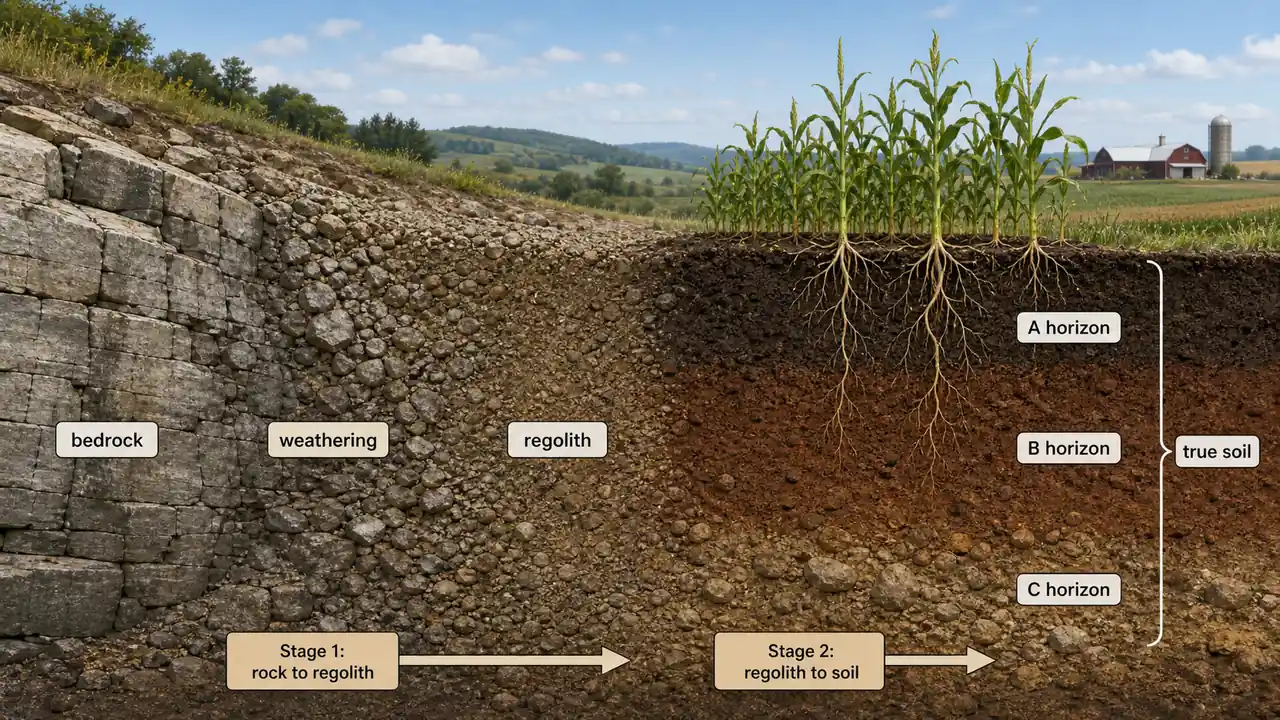
Two Stages of Soil Formation
Soil formation occurs in two consecutive stages:
| Stage | Process | Result |
|---|---|---|
| Stage 1 | Weathering of rock (R) | Formation of Regolith (loose, unconsolidated material) |
| Stage 2 | Action of soil forming factors and processes on regolith | Formation of true soil with distinct horizons |
- Formation of one inch of topsoil takes 800-1000 years
- This is why soil conservation is critical -- soil is essentially non-renewable on a human timescale
Soil Formation Equations
Three scientists contributed major equations describing soil formation:
| Scientist | Year | Equation | Key Contribution |
|---|---|---|---|
| Dokuchaiev | 1889 | S = f (P, Cl, O) | Father of Soil Science; first to recognize soil as a natural body; only 3 factors |
| Joffe | -- | Classified factors into Passive (P, R, T) and Active (Cl, O) | Introduced passive-active classification |
| Jenny | 1941 | S = f (Cl, O, R, P, T, ...) | Added Relief and Time; most widely used equation |
Where: Cl = Climate, O = Organisms, R = Relief/Topography, P = Parent Material, T = Time, ... = Additional factors
Pro Content Locked
Upgrade to Pro to access this lesson and all other premium content.
Charged once for one year · ₹1188 total
Save ₹100/month vs ₹2388/year launch price
- All Agriculture & Banking Courses
- AI Lesson Questions (100/day)
- AI Doubt Solver (50/day)
- Glows & Grows Feedback (30/day)
- AI Section Quiz (20/day)
- 22-Language Translation (100/day)
- Recall Questions (20/day)
- AI Quiz (15/day)
- AI Quiz Paper Analysis (100/day)
- AI Step-by-Step Explanations (100/day)
- Spaced Repetition Recall (FSRS)
- AI Tutor
- Immersive Text Questions
- Audio Lessons — Hindi & English
- Mock Tests & Previous Year Papers
- Summary & Mind Maps
- XP, Levels, Leaderboard & Badges
- Generate New Classrooms
- Voice AI Teacher (AgriDots Live)
- AI Revision Assistant
- Knowledge Gap Analysis
- Interactive Revision (LangGraph)
🔒 Secure one-time yearly payment via Razorpay · No hidden fees
Two Stages of Soil Formation
Soil formation occurs in two consecutive stages:
| Stage | Process | Result |
|---|---|---|
| Stage 1 | Weathering of rock (R) | Formation of Regolith (loose, unconsolidated material) |
| Stage 2 | Action of soil forming factors and processes on regolith | Formation of true soil with distinct horizons |
- Formation of one inch of topsoil takes 800-1000 years
- This is why soil conservation is critical -- soil is essentially non-renewable on a human timescale
Soil Formation Equations
Three scientists contributed major equations describing soil formation:
| Scientist | Year | Equation | Key Contribution |
|---|---|---|---|
| Dokuchaiev | 1889 | S = f (P, Cl, O) | Father of Soil Science; first to recognize soil as a natural body; only 3 factors |
| Joffe | -- | Classified factors into Passive (P, R, T) and Active (Cl, O) | Introduced passive-active classification |
| Jenny | 1941 | S = f (Cl, O, R, P, T, ...) | Added Relief and Time; most widely used equation |
Where: Cl = Climate, O = Organisms, R = Relief/Topography, P = Parent Material, T = Time, ... = Additional factors
IMPORTANT
Dokuchaiev had only 3 factors (P, Cl, O). Jenny expanded to 5 factors by adding Relief and Time. Jenny's equation is the most frequently tested in competitive exams.
TIP
Exam Mnemonic: Remember Jenny's 5 factors as "CLiORP" -- Climate, Organisms, Relief, Parent material, Time. Or think: "CLORPT" (like a clock ticking time for soil to form).
Classification of Factors
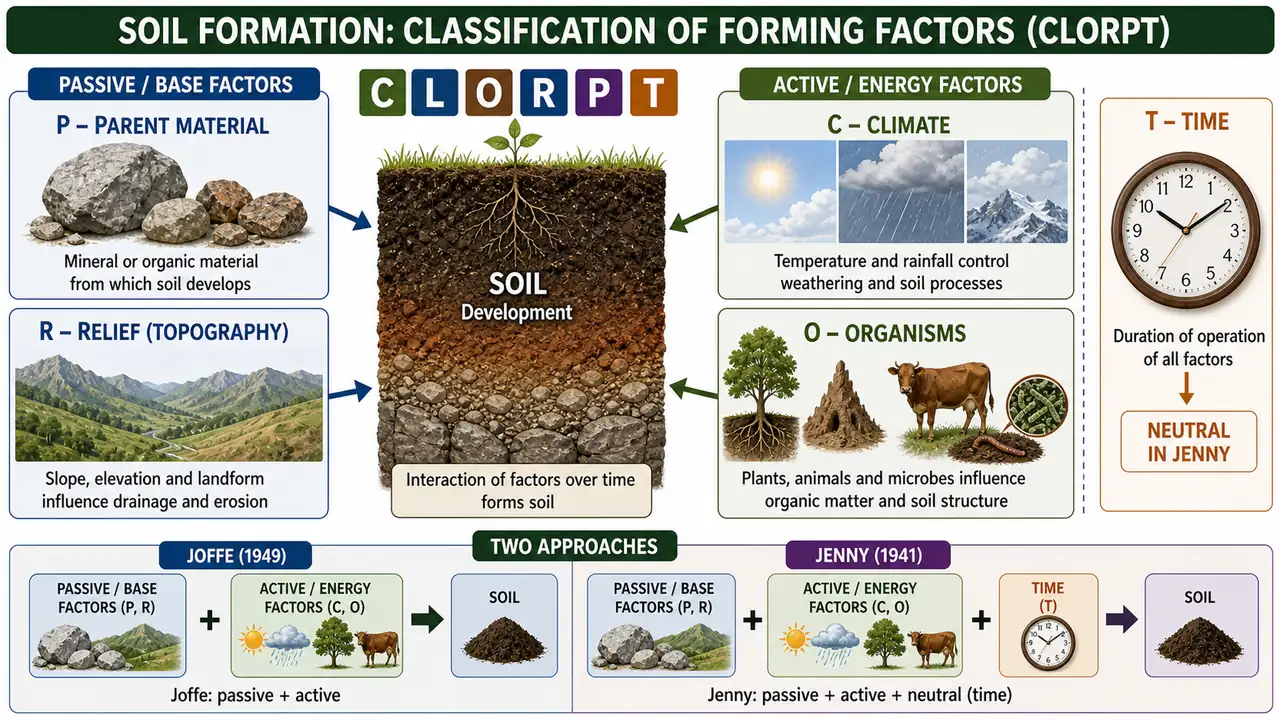
| Classification | According to Joffe | According to Jenny |
|---|---|---|
| Passive (provide base material) | Parent material, Relief, Time | Parent material, Relief |
| Active (supply energy) | Climate, Organisms | Climate, Organisms |
| Neutral (provides duration) | -- | Time |
A. Passive Soil Forming Factors
These provide the base material and conditions on which active factors work.
1. Parent Material
Parent material is the consolidated or unconsolidated mass from which soil forms. It is the starting point and significantly influences the soil's initial chemical and physical properties.
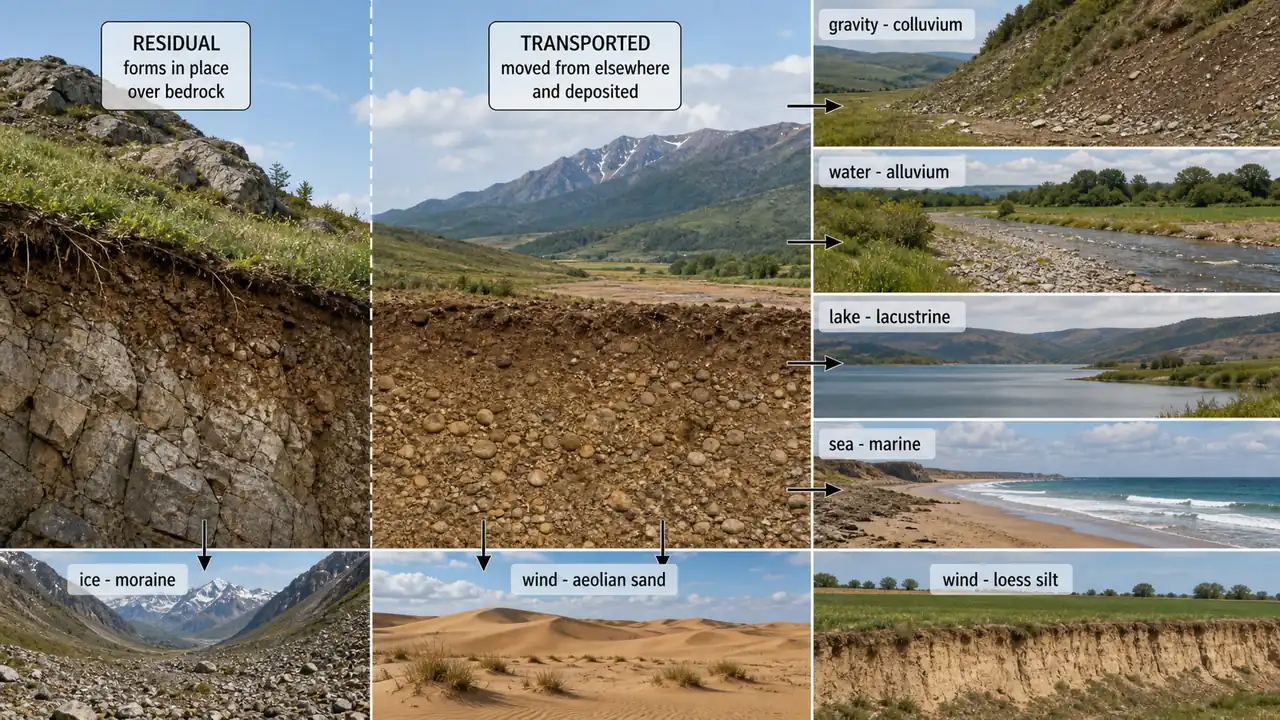
Two Groups of Parent Material
A. Sedentary (Residual) Soil:
- Formed in original place (in-situ)
- Takes long time to form soil
- Examples: soils formed directly from underlying igneous, sedimentary or metamorphic rocks
B. Transported Soil:
- Parent material transported from place of origin
- Named by the transporting agent
| Transporting Agent | Deposit Name | Description | Indian Agricultural Example |
|---|---|---|---|
| Gravity | Colluvium | Poorly sorted material near base of slopes | Hill-foot soils of Western Ghats |
| Water | Alluvium | Deposited along stream courses | Indo-Gangetic plain (rice, wheat) |
| Still water (lakes) | Lacustrine | Settled in quiet lake water | Dal Lake basin soils, Kashmir |
| Sea/Ocean | Marine | Deposited by sea and oceans | Coastal soils of Sundarbans |
| Glacial ice | Moraine | Picked up and deposited by glaciers | Soils of Ladakh, Himachal |
| Wind (sand) | Aeolian | Sand transported by air | Sand dunes of Rajasthan |
| Wind (silt) | Loess | Windblown silt with fine sand/clay | Among most fertile soils in world |
TIP
Exam Mnemonic: "Gravity Water Lakes Sea Ice Wind" = Colluvial, Alluvial, Lacustrine, Marine, Moraine, Aeolian/Loess. Colluvium (gravity) is frequently asked in exams, ARS and NET exams.
| Transportation Source | Known as |
|---|---|
| Gravity | Colluvial |
| Water | Alluvial, Marine, Locustrine |
| Ice | Glacial |
| Wind | Aeolian (Sandy soil) |
| Wind | Loess (Silt soil) |
- When windblown material is sand = aeolian; when silty = loess
- Biological parent material: Decomposed or partially decomposed biological matter
Soil Types Based on Dominant Influence
| Type | Dominant Influence | Example |
|---|---|---|
| Endodynamomorphic | Parent material properties dominate | Soils still resembling parent rock |
| Ectodynamomorphic | Climate and vegetation dominate | Normal profile development |
| Ectoendodynamorphic | Both parent material and other factors | Most soils in nature |
Parent Material and Soil Types
| Parent Material | Soil Type Produced | Agricultural Use |
|---|---|---|
| Acid igneous rocks (granite, rhyolite) | Light-textured soils (Alfisols) | Groundnut, millets |
| Basic igneous rocks (basalt) | Fine-textured clay soils (Vertisols) | Cotton, sorghum |
| Basic alluvium/aeolian | Fine to coarse soils (Entisols/Inceptisols) | Rice, wheat, sugarcane |
Key elements released during rock decay and their roles:
| Element | Role in Soil |
|---|---|
| Si, Al | Form skeleton of secondary clay minerals |
| Fe, Mn | Impart red colour; oxidation-reduction reactions |
| Na, K | Dispersing agents for clay and humus colloids |
| Ca, Mg | Flocculating effect -- produce favourable soil structure |
2. Relief or Topography
Topography refers to the configuration of the land surface and affects soil formation through its influence on water distribution, erosion, temperature and vegetation.
Slope Classification (FAO Guidelines, 1990)
| Land Surface | Slope (%) | Soil Formation Effect |
|---|---|---|
| Flat to almost flat | 0 - 2% | Deep soils, distinct horizons, may have drainage issues |
| Gently undulating | 2 - 5% | Good drainage, moderate profile development |
| Undulating | 5 - 10% | Some erosion, moderate depth |
| Rolling | 10 - 15% | Increased runoff and erosion |
| Hilly | 15 - 30% | Shallow, stony soils |
| Steeply dissected | > 30% (<300m elevation range) | Very shallow, weakly developed profiles |
| Mountainous | > 30% (>300m elevation range) | Skeletal soils with little profile development |
NOTE
This slope classification is frequently tested. Remember the sequence: Flat (0-2) < Gently undulating (2-5) < Undulating (5-10) < Rolling (10-15) < Hilly (15-30) < Steep/Mountainous (>30).
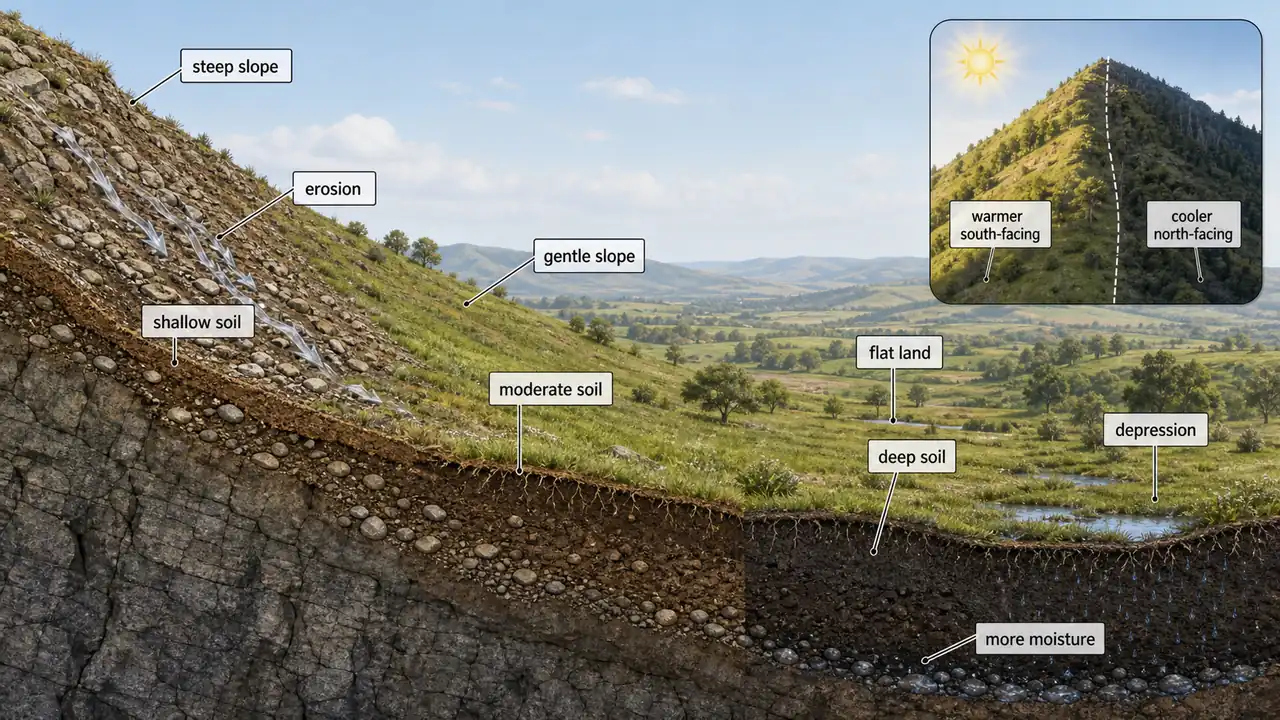
Topography and Soil Formation
| Position | Effect | Agricultural Example |
|---|---|---|
| Flat land | Full water percolation; distinct horizons; may have impaired drainage | Rice paddies on flat Indo-Gangetic plains |
| Steep slopes | Shallow, stony soils; accelerated erosion; weak horizons | Tea gardens on Darjeeling slopes (shallow soils) |
| Depressions | Extra moisture; more vegetation; dark, OM-rich soils (Mollisols) | Tarai region of UP -- lush sugarcane fields |
Aspect (Slope Exposure)
| Exposure | Condition | Effect on Farming |
|---|---|---|
| Southern (sun-facing) | Warmer, drier, more temperature fluctuation | Crops mature faster; need more irrigation |
| Northern | Cooler, more humid | Better moisture retention; slower growth |
| Eastern/Western | Intermediate | Moderate conditions |
3. Time
Soil formation requires thousands of years. The period from regolith stage to maturity is the Pedologic Time.
Weathering Stages Based on Time
| Stage | Characteristic | Soil Condition |
|---|---|---|
| Initial | Unweathered parent material | No soil development |
| Juvenile | Weathering started; much original material remains | Entisols, Inceptisols |
| Virile | Easily weatherable minerals decomposed; clay increases | Alfisols, Mollisols |
| Senile | Only most resistant minerals survive | Ultisols |
| Final | Soil development completed | Oxisols (laterites) |
IMPORTANT
Exam Mnemonic: "I Just Very Slowly Finished" for the five weathering stages: Initial, Juvenile, Virile, Senile, Final.

Changes with time:
- Nitrogen and organic matter increase with time (unless temperature is very high)
- CaCO3 decreases or is lost (unless climate is arid)
- H+ concentration increases in humid regions (soils become more acidic)
B. Active Soil Forming Factors
These supply energy that acts on the parent material to form soil.
1. Climate
Climate is the most significant factor controlling soil formation rate and type.
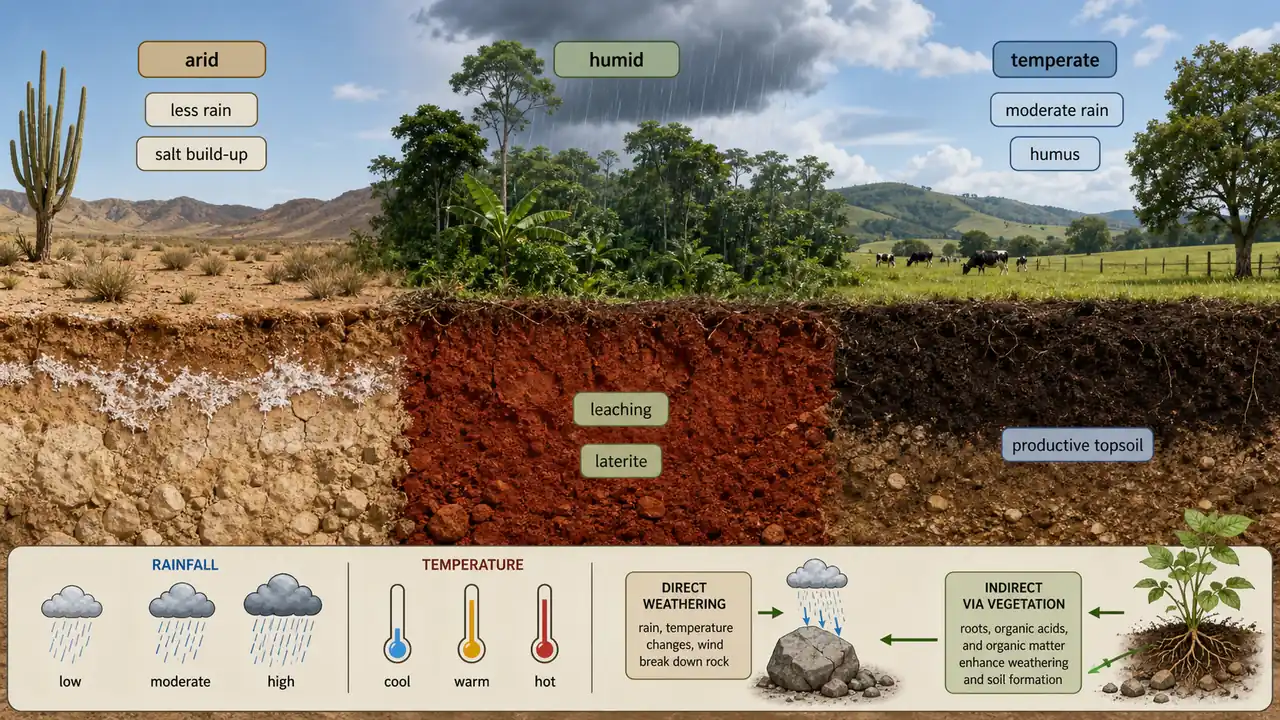
Major Climate Types and Their Soils
| Climate | Characteristics | Soil Type | Agricultural Use |
|---|---|---|---|
| Arid | Precipitation ≪ water need; dry most of year | Aridisols (saline/alkaline) | Limited — needs irrigation |
| Humid | Precipitation ≫ water need; leaching | Ultisols, Oxisols (acidic, leached) | Tea, coffee, rubber |
| Tropical/Subtropical | Warm-hot, humid | Laterites (Oxisols) | Plantation crops |
| Temperate | Cold humid, warm summers | Alfisols, Mollisols | Wheat, corn |
| Mediterranean | Moderate rain; dry hot summers | Alfisols | Grapes, olives |
| Continental | Warm summers, very cold winters | Mollisols (chernozems) | Wheat, barley |
Direct and Indirect Effects
| Effect Type | Mechanism | Agricultural Impact |
|---|---|---|
| Direct | Water and heat react with parent material | Determines weathering rate |
| Indirect | Determines flora and fauna that produce organic acids | Determines organic matter accumulation |
Precipitation Effects
| Rainfall Level | Soil Effect | Agricultural Consequence |
|---|---|---|
| Scanty (arid) | Salts accumulate at surface | Saline soils -- need leaching before cropping |
| High (humid) | Salts leached to lower horizons; soil becomes acidic | Need liming for pH correction |
Temperature Effects
- High temperature: Rapid OM decomposition; upward salt movement; hinders leaching
- Low temperature: Slow decomposition; OM accumulates; leaching increases
IMPORTANT
Jenny (1941): Weathering rate in tropical regions is 3x faster than temperate and 9x faster than arctic. This is why tropical soils are deeply weathered.
2. Organisms and Vegetation
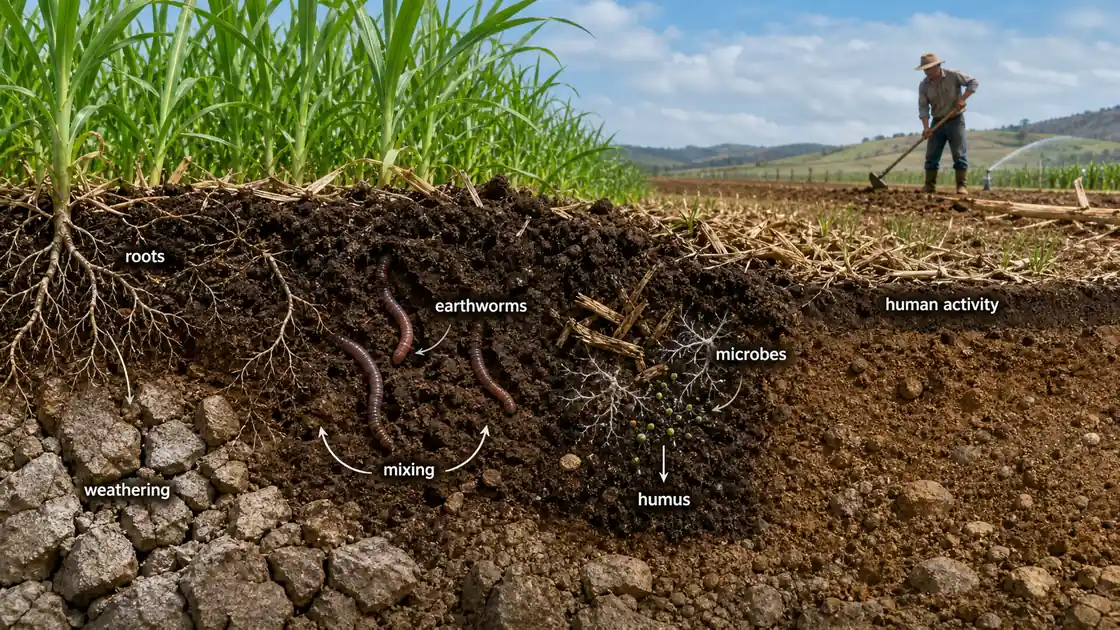
| Agent | Role in Soil Formation | Agricultural Example |
|---|---|---|
| Microorganisms | Humification and mineralization of vegetation | Decompose crop residues into humus |
| Burrowing animals | Mix soil mass; disturb parent material | Earthworms improve soil structure |
| Humans | Manipulate vegetation; agricultural practices | Deforestation, tillage, irrigation |
| Plant roots | Mechanical and chemical weathering; drainage | Deep-rooted crops break compacted layers |
Vegetation effects:
- Forests: Reduce temperature, increase humidity, reduce evaporation, increase precipitation
- Grasses: Reduce runoff; produce thick, dark, organic-rich A horizons due to dense roots
- Agricultural link: Grassland soils (like the Indo-Gangetic alluvium under historical grass cover) develop the most productive topsoils
Soil Forming Processes
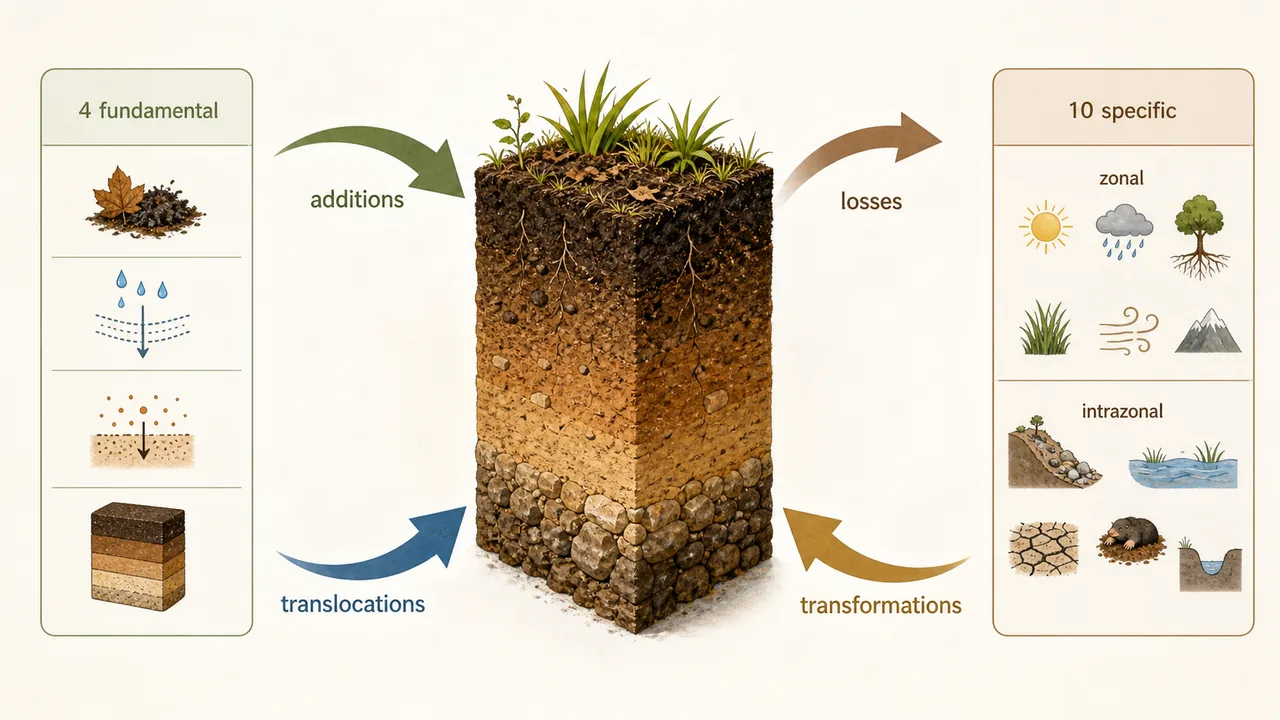
The basic framework (Simonson, 1959):
- Additions -- water, organic and mineral matter added to soil
- Losses -- materials removed from soil
- Transformations -- mineral and organic substances changed within soil
- Translocations -- materials moved within soil (leaching in solution; eluviation in suspension)
A. Fundamental Processes (4)
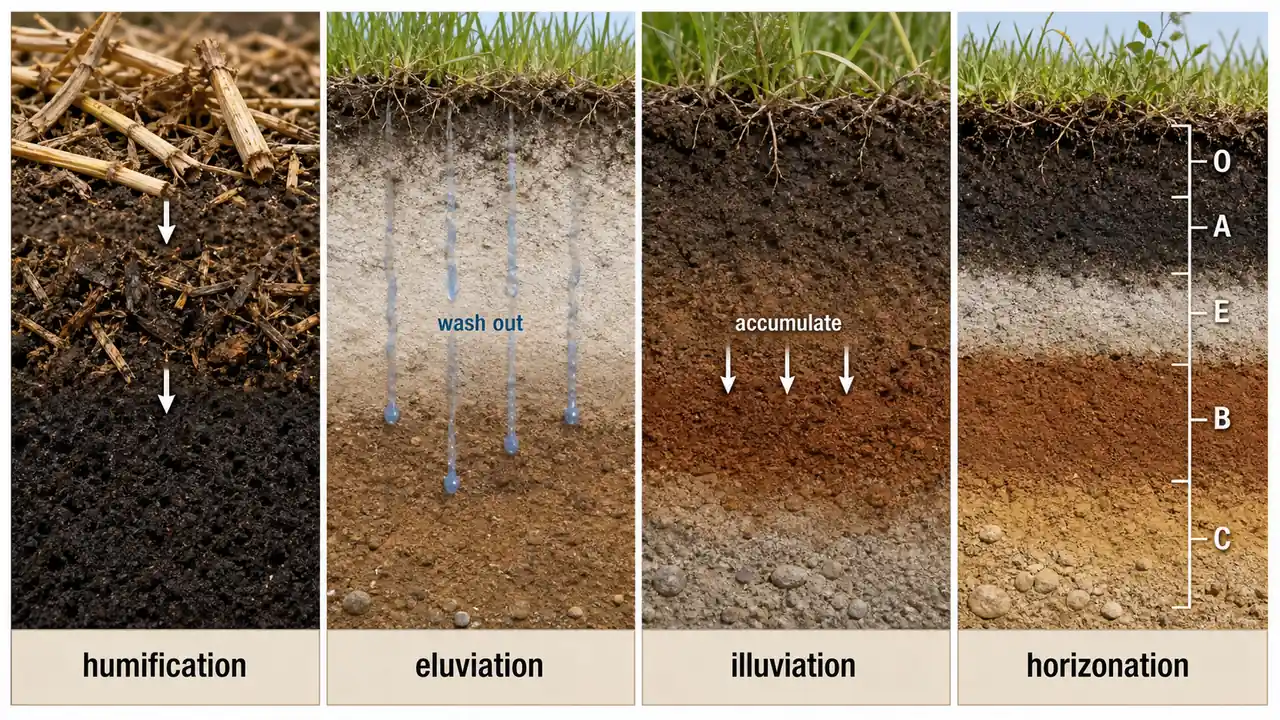
2. Eluviation
- Washing out -- removal of clay, Fe2O3, Al2O3, humus, CaCO3 from upper layers by percolating water
- Creates the E horizon (A2) -- typically lighter in colour
- Agricultural link: Over-irrigation can accelerate eluviation, leaching nutrients from the root zone
3. Illuviation
- Deposition of materials (from eluvial horizon) in the lower B horizon (especially Bt)
- "t" suffix stands for "ton" (German for clay) = clay accumulation
- Creates textural contrast between E and Bt horizons
- Agricultural link: A strong Bt horizon can impede root penetration and drainage
4. Horizonation
- Differentiation of soil into distinct horizons along depth
- Driven by humification, eluviation and illuviation
- Takes about 250 years in favourable conditions, over 1000 years in adverse conditions
- Agricultural link: Well-developed horizons indicate mature, productive soils
B. Specific Processes (10)
(a) Zonal Processes
| # | Process | Definition | Conditions | Soil Type | Agricultural Link |
|---|---|---|---|---|---|
| 1 | Calcification | Accumulation of CaCO3 in profile (Bk horizon) | Semi-arid, sub-humid | Aridisols, Mollisols | Calcareous soils for wheat, gram |
| 2 | Decalcification | Removal of CaCO3 by leaching | Sufficient rainfall | Transitional soils | Soil becomes less alkaline |
| 3 | Podzolization | Removal of sesquioxides; retains silica; acidic | Cold, humid; coniferous vegetation | Podzols (Spodosols) | Low fertility; forestry, pastures |
| 4 | Laterization | Removal of silica; retains sesquioxides (Fe, Al oxides) | Warm, humid tropical; 2000-2500 mm rain | Laterites (Oxisols) | Coffee, banana, coconut, shifting agriculture |
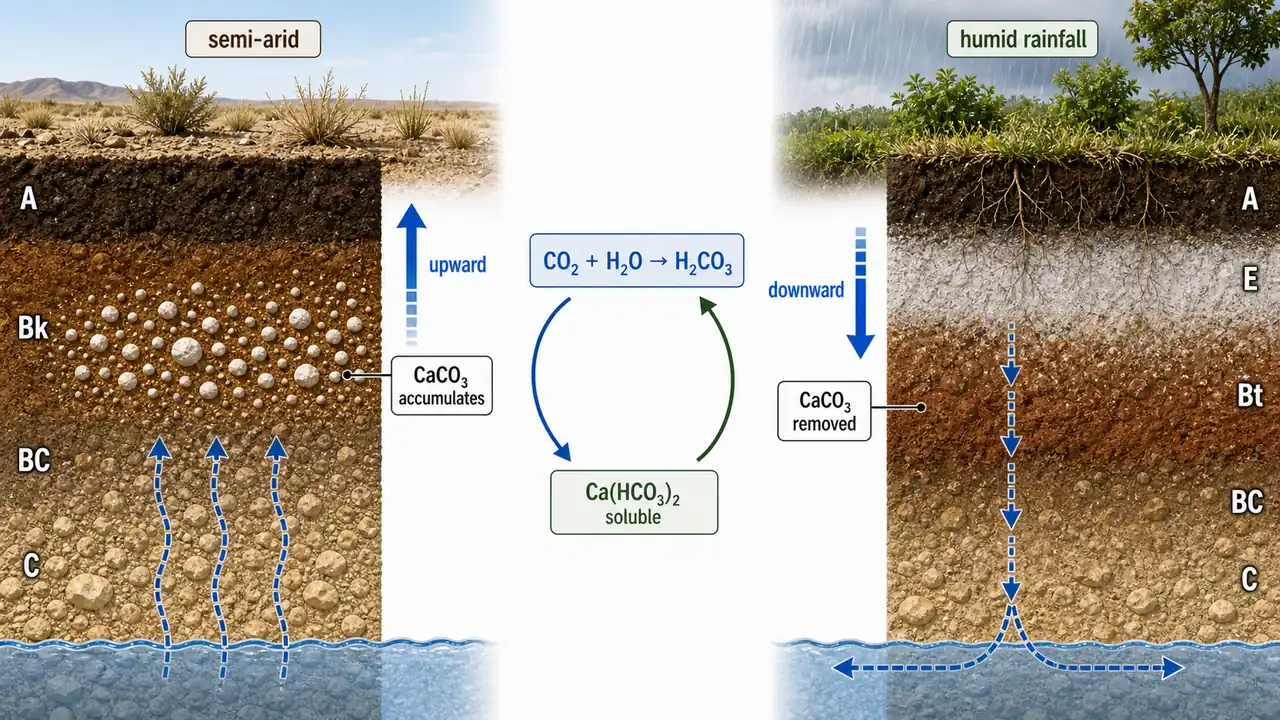
| Process | Climate Setting | Main Direction | Carbonate Result | Horizon Cue | Agricultural Meaning |
|---|---|---|---|---|---|
| Calcification | Semi-arid to sub-humid | Mostly upward movement with capillary rise and evaporation | CaCO3 accumulates in the profile | Bk horizon with carbonate nodules or soft lime | Produces calcareous soils often used for wheat and gram |
| Decalcification | Humid or sufficiently rainy conditions | Mostly downward leaching | CaCO3 is dissolved and removed from upper horizons | Carbonate decreases in upper profile; no strong Bk accumulation near surface | Soil becomes less alkaline and more leached over time |
| Formula Step | Markdown Form |
|---|---|
| Carbonic acid formation | CO2 + H2O -> H2CO3 |
| Soluble bicarbonate form | CaCO3 + CO2 + H2O -> Ca(HCO3)2 |
| Precipitation during calcification | Ca(HCO3)2 -> CaCO3 + H2O + CO2 |
IMPORTANT
Podzolization vs Laterization -- a high-yield exam comparison:
| Feature | Podzolization | Laterization |
|---|---|---|
| Climate | Cold and humid | Warm and humid (tropical) |
| Removes | Sesquioxides (Fe, Al) | Silica |
| Retains | Silica | Sesquioxides (Fe, Al) |
| Vegetation | Coniferous (acid-producing) | Rain forests |
| Soil produced | Podzols (acidic, ashy grey) | Laterites (iron-rich, brick-red) |
| Fertility | Low | Low to moderate |
Mnemonic: Podzolization = Pine forests, Poor in Fe/Al. Laterization = Laterite, Loses silica.
- Russian term "Podzol" -- pod (under) + zola (ash) = ash-like horizon beneath surface
- Laterite -- from Latin "later" (brick/tile); found in Malabar hills of Kerala, Tamil Nadu, Karnataka
(b) Intrazonal Processes
Influenced by local conditions (relief, parent material) more than climate.
| # | Process | Definition | Conditions | Agricultural Impact |
|---|---|---|---|---|
| 5 | Gleization | Formation of gley horizon (blue/grey/green) | Waterlogged, poor drainage, lack of O2 | Paddy soils; manganese toxicity risk |
| 6 | Salinization | Accumulation of soluble salts (sulphates, chlorides) | Arid/semi-arid; capillary rise | Major land degradation problem |
| 7 | Desalinization | Removal of excess salts by leaching | Improved drainage + ponding water | Reclamation of saline soils |
| 8 | Solonization | Accumulation of Na+ on exchange sites (pH > 8.5) | Sodic conditions | Black alkali soils; poor structure |
| 9 | Solodization | Removal of Na+ from exchange sites | Ca/Mg replace Na | Reclamation using gypsum |
| 10 | Pedoturbation | Physical mixing of soil material | Various agents | Disrupts horizon development |
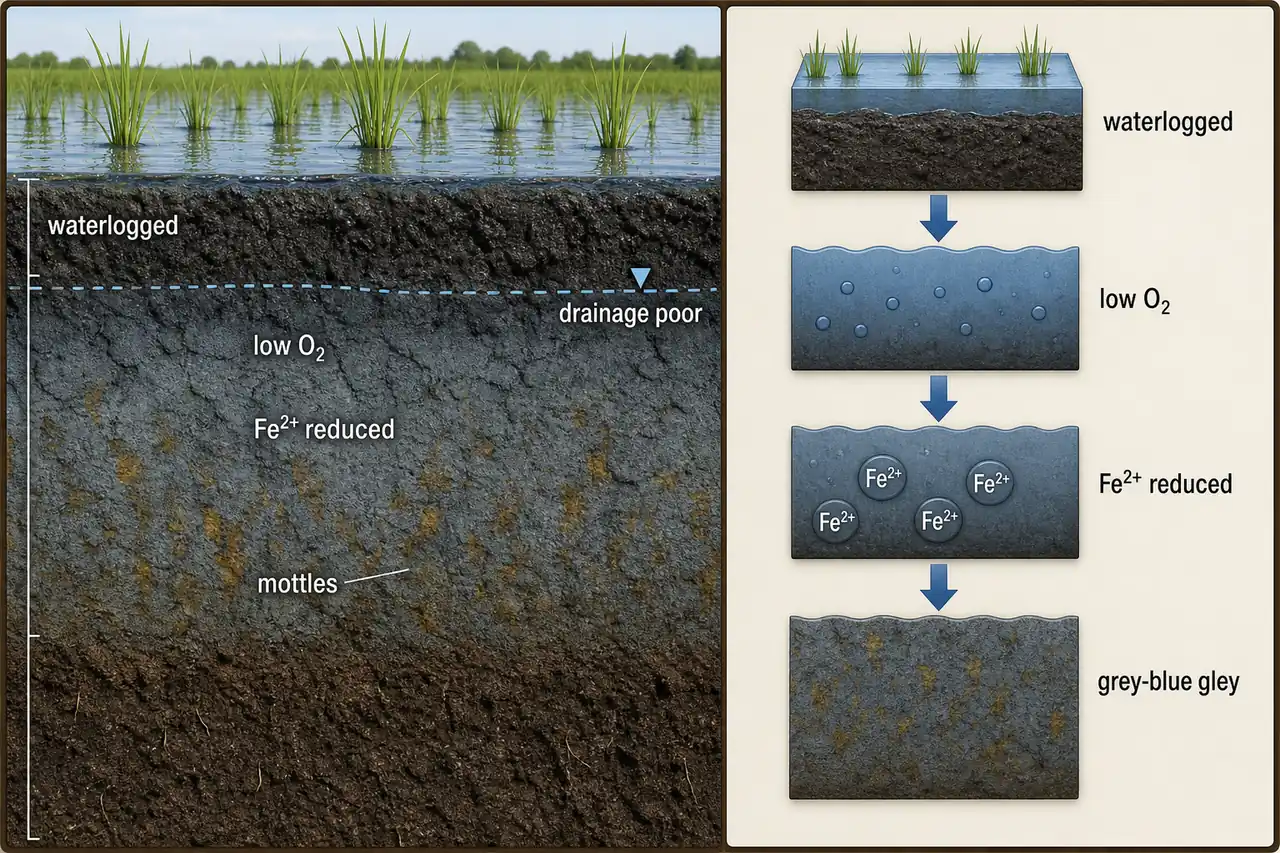
| Gleization Image Item | Full Content |
|---|---|
| Waterlogged | Surface or subsurface remains saturated for long periods, usually because drainage is poor |
| Low O2 | Oxygen becomes depleted in the root zone and subsoil under prolonged saturation |
| Fe2+ reduced | Ferric iron is reduced to ferrous iron in anaerobic conditions |
| Grey-blue gley | Reduced iron conditions give the soil its characteristic grey, blue, or greenish colour |
| Mottles | Yellow-brown mottles appear where oxidation returns temporarily during fluctuating water table conditions |
| Drainage poor | Gleization is a hallmark of hydromorphic soils with restricted drainage |
Gleization
- Russian origin: glei = blue, grey or green clay
- Develops in hydromorphic soils (waterlogged conditions)
- Iron reduced to soluble Fe2+ -- produces bluish-grey colour with yellow/brown mottling
- Agricultural link: Rice paddy soils are intentionally gleyed; the mottled pattern indicates fluctuating water table
Salinization and Desalinization
- Salinization occurs through capillary rise of saline groundwater or irrigation with poor drainage
- Desalinization = leaching with good water + artificial drainage
- Agricultural link: Millions of hectares in Punjab and Haryana affected by salinity; reclaimed through subsurface drainage
Solonization and Solodization
- Solonization: Na+ disperses soil colloids; creates black organo-clay coatings (black alkali soils)
- Solodization: Ca2+/Mg2+ replace Na+
2NaX + CaSO4 --> Na2SO4 + CaX
- Agricultural link: Gypsum (CaSO4) is applied to alkali soils to displace Na; the Na2SO4 formed is leached away
Pedoturbation Types
| Type | Agent | Example |
|---|---|---|
| Faunal | Animals (earthworms, ants, moles) | Earthworm casting mixes horizons |
| Floral | Plants (tree tipping) | Pits and mounds in forest soils |
| Argillic | Shrink-swell clays | Deep black cotton soils (Vertisols) -- self-mulching |
| Cryopedoturbation | Frost churning | Only in Gelisols (permafrost soils) |
TIP
Argillic pedoturbation in Vertisols is a favourite exam topic. The shrink-swell action of montmorillonite clay creates the characteristic deep cracks and self-mulching surface of black cotton soils.
Quick Reference: All 14 Soil Forming Processes
Complete List of 14 Processes
| # | Process | Category | Key Definition |
|---|---|---|---|
| 1 | Humification | Fundamental | Raw organic matter --> humus |
| 2 | Eluviation | Fundamental | Washing out from upper layers |
| 3 | Illuviation | Fundamental | Deposition in B horizon |
| 4 | Horizonation | Fundamental | Differentiation into horizons |
| 5 | Calcification | Zonal | CaCO3 accumulation |
| 6 | Decalcification | Zonal | CaCO3 removal |
| 7 | Podzolization | Zonal | Removes sesquioxides, retains silica |
| 8 | Laterization | Zonal | Removes silica, retains sesquioxides |
| 9 | Gleization | Intrazonal | Gley horizon under waterlogging |
| 10 | Salinization | Intrazonal | Salt accumulation |
| 11 | Desalinization | Intrazonal | Salt removal by leaching |
| 12 | Solonization | Intrazonal | Na+ accumulation (pH > 8.5) |
| 13 | Solodization | Intrazonal | Na+ removal |
| 14 | Pedoturbation | Intrazonal | Physical mixing of soil |
Summary Cheat Sheet
| Concept / Topic | Key Details |
|---|---|
| 2 stages of soil formation | Rock → Regolith (weathering) → True soil (pedogenic processes) |
| Topsoil formation time | 800–1000 years per inch — essentially non-renewable |
| Dokuchaiev (1889) | S = f(P, Cl, O); Father of Soil Science; only 3 factors |
| Jenny (1941) | S = f(Cl, O, R, P, T, ...); 5 factors — CLORPT |
| Active factors | Climate, Organisms (supply energy) |
| Passive factors | Parent material, Relief (provide base) + Time (neutral) |
| Most significant factor | Climate — controls rate and type of soil formation |
| Tropical weathering rate | 3× temperate, 9× arctic (Jenny) |
| Colluvium | Gravity-deposited material |
| Alluvium | Water-deposited (streams); Indo-Gangetic plain |
| Loess | Wind-deposited silt; among most fertile soils |
| Aeolian | Wind-deposited sand; Rajasthan dunes |
| Moraine | Glacial ice deposit |
| Lacustrine | Still lake water deposit |
| Slope: Flat | 0–2%; deep soils, distinct horizons |
| Slope: Hilly | 15–30%; shallow, stony soils |
| Weathering stages | Initial → Juvenile → Virile → Senile → Final ("I Just Very Slowly Finished") |
| 4 Fundamental processes | Humification, Eluviation, Illuviation, Horizonation |
| Horizonation time | 250 years (favourable) to 1000+ years (adverse) |
| Podzolization | Cold/humid; removes sesquioxides, retains silica; pine forests |
| Laterization | Warm/humid tropical; removes silica, retains sesquioxides; Kerala, Karnataka |
| Gleization | Waterlogged; Fe²⁺ → blue-grey gley horizon; paddy soils |
| Salinization | Salt accumulation via capillary rise; arid/semi-arid |
| Solonization | Na⁺ accumulation (pH > 8.5); black alkali soils |
| Solodization / Gypsum | Ca²⁺ replaces Na⁺; gypsum reclaims sodic soils |
| Pedoturbation — argillic | Shrink-swell clays; Vertisols; self-mulching surface |
| 14 total processes | 4 fundamental + 4 zonal + 6 intrazonal |
| Father of Soil Science | Dokuchaiev (1889); Exam tip: Equation: S = f(P, Cl, O) |
| Jenny's equation (1941) | S = f(Cl, O, R, P, T, ...); Exam tip: 5 factors -- "CLORPT" |
| Gypsum application | Reclaims alkali (sodic) soils; Exam tip: CaSO4 replaces Na on exchange sites |