🧗🏻 Soil Consistence: Hardness, Friability, Plasticity & Stickiness
Soil consistence at four moisture states (dry, moist, wet), cohesion and adhesion forces, soil crusting, compaction, and their impact on tillage and crop growth
A farmer in Madhya Pradesh tries to plough his black cotton soil at the wrong time. During the dry season, the soil is rock-hard and cracks his plough blade. After heavy rain, the same soil becomes so sticky that it clings to the plough and bullocks' hooves, making tillage impossible. But there is a narrow window after light rain when the soil is moist and crumbly -- perfect for ploughing. This behaviour of soil at different moisture levels is called soil consistence, and understanding it helps farmers choose the right time for tillage.
What is Soil Consistence?
Soil consistence is the resistance of a soil at various moisture contents to mechanical stresses or manipulations.
- It describes how soil behaves when you squeeze, press or reshape it
- It combines cohesive forces (attraction between similar soil particles) and adhesive forces (attraction between soil and other surfaces like a plough blade)
- Directly affects tillage operations, root penetration and seedbed preparation
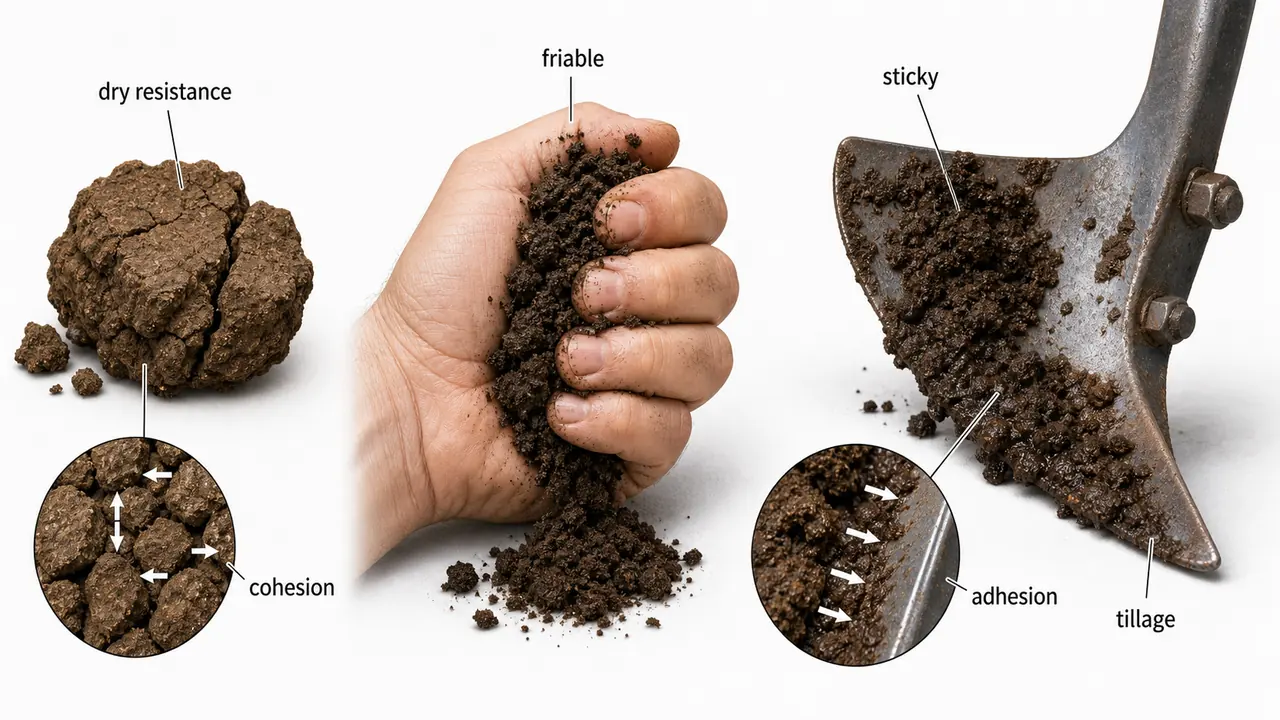
| Force | Definition | Example |
|---|---|---|
| Cohesion | Attraction between similar soil particles | Clay particles sticking to each other |
| Adhesion | Attraction between soil and foreign surfaces | Soil clinging to plough blade or fingers |
Four Types of Consistence
Consistence is described at four moisture states. The moisture content dramatically changes how soil responds to pressure.
Pro Content Locked
Upgrade to Pro to access this lesson and all other premium content.
Charged once for one year · ₹1188 total
Save ₹100/month vs ₹2388/year launch price
- All Agriculture & Banking Courses
- AI Lesson Questions (100/day)
- AI Doubt Solver (50/day)
- Glows & Grows Feedback (30/day)
- AI Section Quiz (20/day)
- 22-Language Translation (100/day)
- Recall Questions (20/day)
- AI Quiz (15/day)
- AI Quiz Paper Analysis (100/day)
- AI Step-by-Step Explanations (100/day)
- Spaced Repetition Recall (FSRS)
- AI Tutor
- Immersive Text Questions
- Audio Lessons — Hindi & English
- Mock Tests & Previous Year Papers
- Summary & Mind Maps
- XP, Levels, Leaderboard & Badges
- Generate New Classrooms
- Voice AI Teacher (AgriDots Live)
- AI Revision Assistant
- Knowledge Gap Analysis
- Interactive Revision (LangGraph)
🔒 Secure one-time yearly payment via Razorpay · No hidden fees
A farmer in Madhya Pradesh tries to plough his black cotton soil at the wrong time. During the dry season, the soil is rock-hard and cracks his plough blade. After heavy rain, the same soil becomes so sticky that it clings to the plough and bullocks' hooves, making tillage impossible. But there is a narrow window after light rain when the soil is moist and crumbly -- perfect for ploughing. This behaviour of soil at different moisture levels is called soil consistence, and understanding it helps farmers choose the right time for tillage.
What is Soil Consistence?
Soil consistence is the resistance of a soil at various moisture contents to mechanical stresses or manipulations.
- It describes how soil behaves when you squeeze, press or reshape it
- It combines cohesive forces (attraction between similar soil particles) and adhesive forces (attraction between soil and other surfaces like a plough blade)
- Directly affects tillage operations, root penetration and seedbed preparation
| Force | Definition | Example |
|---|---|---|
| Cohesion | Attraction between similar soil particles | Clay particles sticking to each other |
| Adhesion | Attraction between soil and foreign surfaces | Soil clinging to plough blade or fingers |
Four Types of Consistence
Consistence is described at four moisture states. The moisture content dramatically changes how soil responds to pressure.
IMPORTANT
The four consistence types: Hard (dry), Friable (moist), Plastic (wet), Sticky (wet). For agriculture, friable consistence is the most desirable -- it indicates the optimum moisture for tillage.
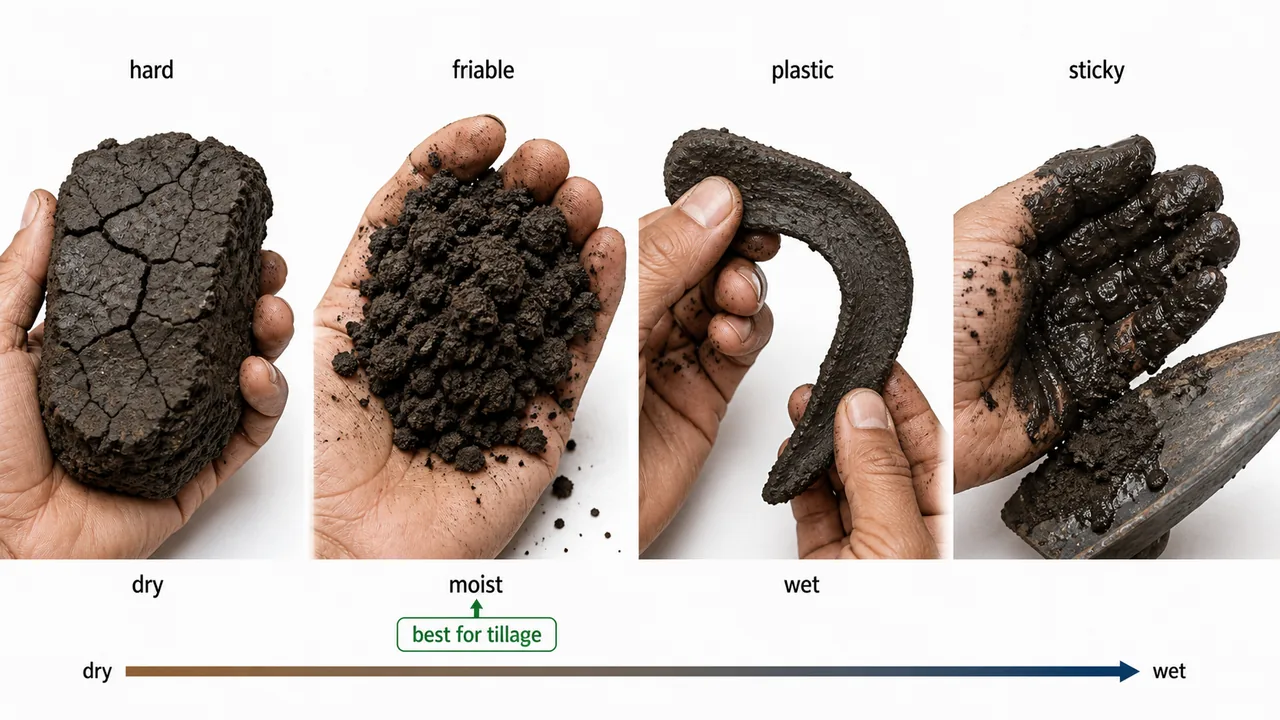
| Four Types Image Item | Full Content |
|---|---|
| Hard (dry) | Dry soil resists breakage and may become difficult or impossible to till when extremely hard |
| Friable (moist) | Moist soil crumbles easily and represents the optimum moisture condition for tillage |
| Plastic (wet) | Wet soil can be moulded into shape and retains that shape after pressure is removed |
| Sticky (wet) | Wet soil adheres to fingers, tools, or implements and becomes difficult to work |
| Moisture sequence | As water content increases, the usual field sequence is hard -> friable -> plastic -> sticky |
| Best stage for agriculture | The friable stage gives the best seedbed preparation, root environment, and workability |
1. Hard / Harsh Consistence (Dry State)
The soil is dry and shows pronounced hardness due to cementation between dried particles.
| Grade | Behaviour | Agricultural Impact |
|---|---|---|
| Loose | Non-coherent; falls apart | Sandy soils; no seedbed preparation needed |
| Soft | Breaks with slight pressure; becomes powder | Easy to work |
| Slightly hard | Breaks under moderate pressure | Manageable with implements |
| Hard | Breaks with difficulty | Needs heavy equipment or moisture |
| Very hard | Very resistant to pressure | Extremely difficult to till |
| Extremely hard | Cannot be broken by hand | Serious problem for seedling emergence and root growth |
Agricultural example: Black cotton soils (Vertisols) become extremely hard when dry, forming wide cracks. Farmers in Maharashtra wait for pre-monsoon showers before attempting to plough.
2. Friable Consistence (Moist State)
Describes the ease of crumbling at moist conditions. This is the optimum moisture range for tillage.
| Grade | Behaviour | Agricultural Impact |
|---|---|---|
| Loose | Non-coherent | Sandy soils |
| Very friable | Coherent but crumbles very easily | Excellent for seedbed |
| Friable | Easily crushed between thumb and forefinger | Ideal for tillage |
| Firm | Crushable with moderate pressure | Can be worked but needs more effort |
| Very firm | Only crushable under strong pressure | Difficult to till |
| Extremely firm | Completely resistant to crushing | Cannot be worked; influenced by clay type and humus |
TIP
For agricultural purposes, friable consistence is most desirable because it indicates soil that is easy to till, provides a good seedbed, and allows easy root penetration. Always plough when soil is in the friable range.
3. Plastic Consistence (Wet State)
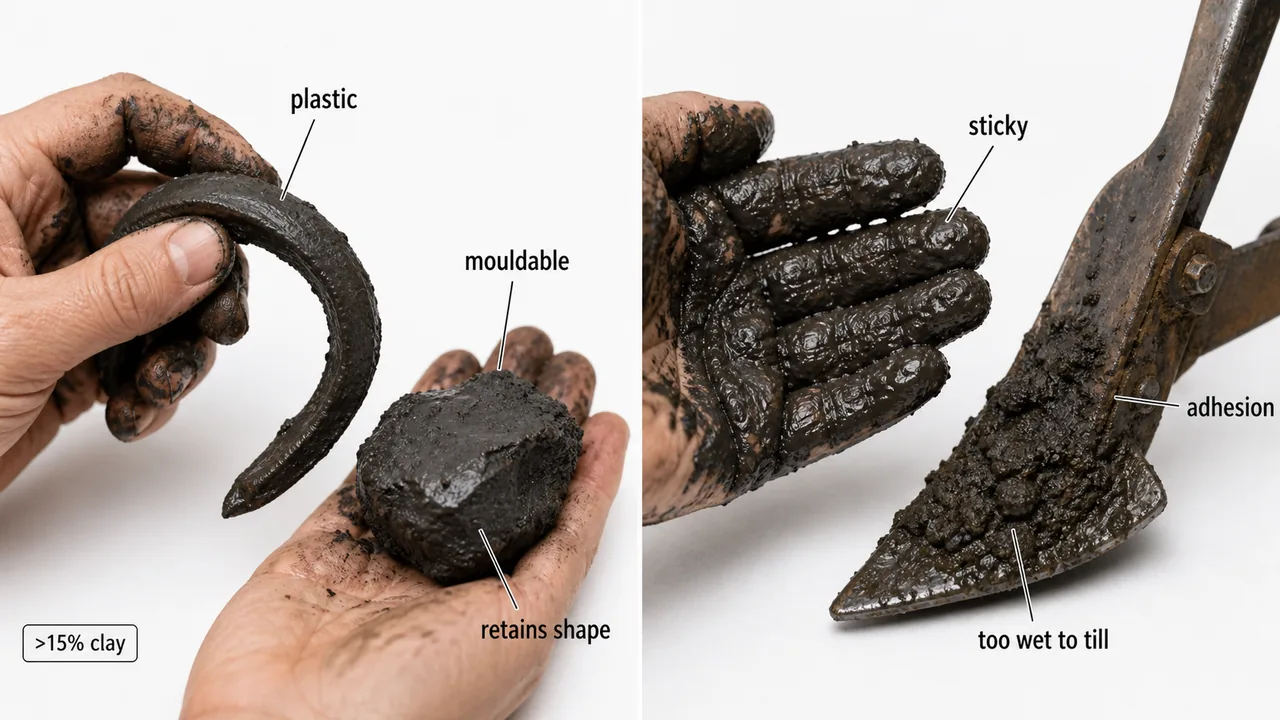
The soil can be moulded into any shape and retains that shape after force is removed.
| Grade | Behaviour |
|---|---|
| Non-plastic | Cannot be moulded; <15% clay |
| Slightly plastic | Barely mouldable |
| Plastic | Easily moulded and retains shape |
| Very plastic | Highly mouldable; very high clay content |
- Soils with less than 15% clay do not exhibit plasticity
- Plasticity depends on clay content and type of clay minerals
- Agricultural significance: Plastic soil is too wet to plough -- implements create clods that become brick-hard on drying
4. Sticky Consistence (Wet State)
The soil adheres to other objects (fingers, implements).
| Grade | Behaviour |
|---|---|
| Non-sticky | Does not stick to anything |
| Slightly sticky | Mild adhesion; easily removed |
| Sticky | Clings to implements; requires effort to remove |
| Very sticky | Clings tenaciously; makes tillage extremely difficult |
- The sticky point = moisture content at which soil ceases to stick to foreign objects
- Agricultural significance: Very sticky soil clogs implements, wastes energy, and produces poor seedbed quality
Consistence at a Glance
| Moisture State | Consistence Type | Key Property | Agricultural Significance |
|---|---|---|---|
| Dry | Hard / Harsh | Resistance to breakage | Problems with seedling emergence; deep cracks in Vertisols |
| Moist | Friable | Ease of crumbling | Optimum for tillage; best seedbed preparation |
| Wet | Plastic | Mouldability and shape retention | Too wet to work; >15% clay needed |
| Wet | Sticky | Adhesion to objects | Clogs implements; wastes energy |
TIP
Exam Mnemonic: "HFPS" -- Hard (dry), Friable (moist), Plastic (wet), Sticky (wet). Think of what happens as you add water: Hard soil becomes Friable, then Plastic, then Sticky.
Soil Crusting
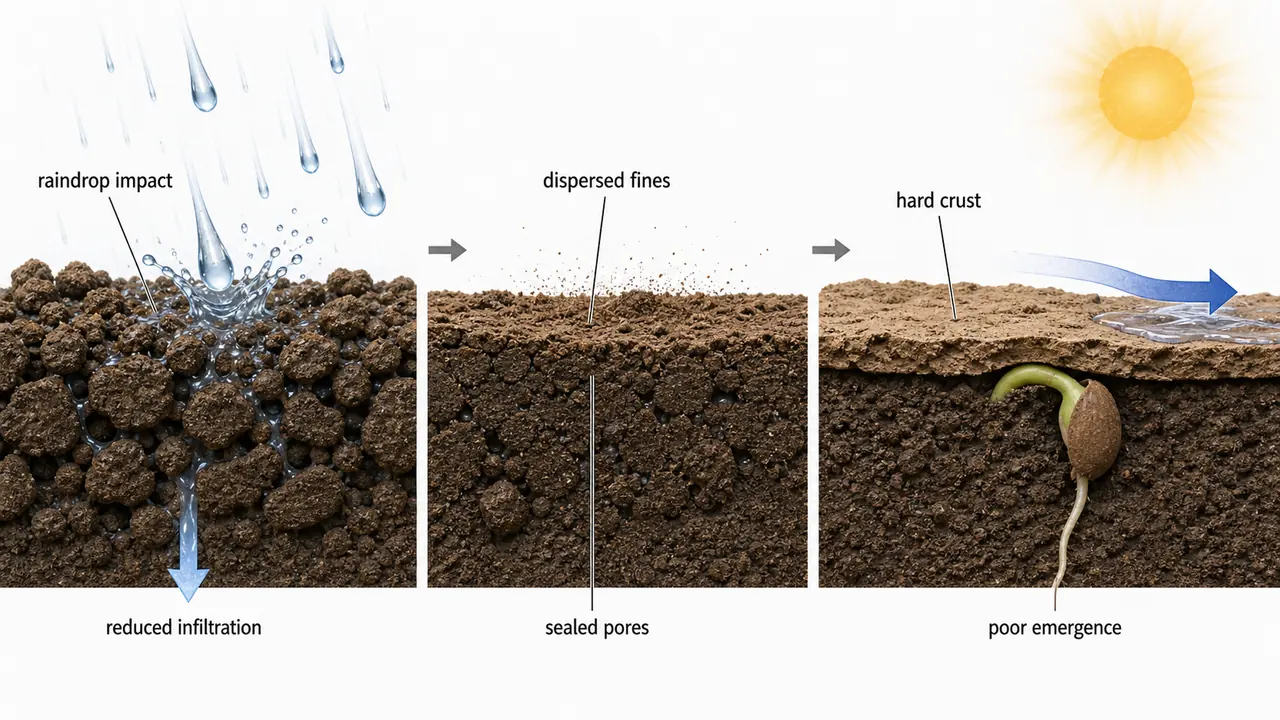
How Crusts Form
- Raindrop impact breaks apart surface aggregates
- Fine particles are dispersed and settle into surface pores
- Sun drying cements these fine particles into a hard, thin layer
| Factor | Effect on Crusting | Agricultural Impact |
|---|---|---|
| Raindrop impact | Breaks aggregates; disperses fines | Reduced infiltration |
| Sun drying | Cements dispersed particles | Hard surface crust |
| Low organic matter | Weak aggregates break easily | More crusting |
| High sodium | Promotes dispersion | Severe crusting |
Agricultural consequences of crusting:
- Reduced water infiltration -- more runoff
- Impaired seedling emergence -- young shoots cannot break through
- Reduced gas exchange -- affects root respiration
Prevention: Mulching, maintaining organic matter, avoiding bare soil during heavy rain.
- Soil strength is measured by penetrometer -- a probe that measures the force needed to push into the soil
Soil Compaction
Definition
Soil compaction is the mechanical increase in soil density by compression, reducing pore space.
Causes and Effects
| Cause | Effect | Agricultural Impact |
|---|---|---|
| Heavy machinery on wet soil | Creates plough pan | Restricted root growth below tillage depth |
| Repeated tillage at same depth | Compacted layer at plough sole | Poor drainage; waterlogging above pan |
| Livestock trampling | Surface compaction | Reduced infiltration in pastures |
| Raindrop impact | Surface sealing | Crusting (as above) |
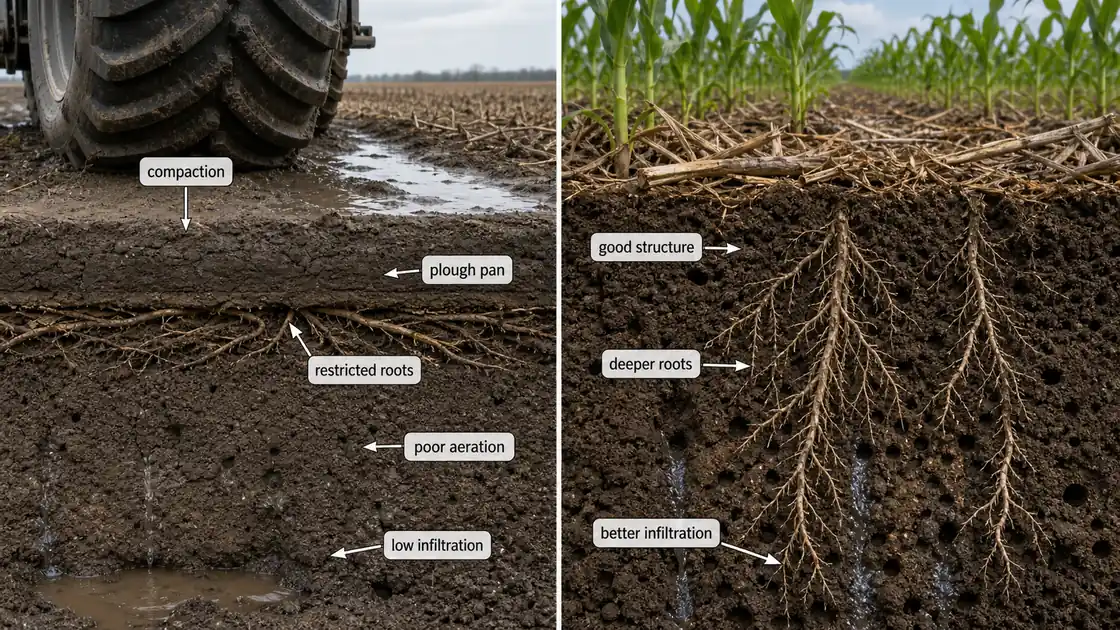
Compaction vs Ideal Condition
| Property | Compacted Soil | Ideal Soil |
|---|---|---|
| Bulk density | High (>1.6 g/cm3) | Low (~1.3 g/cm3) |
| Porosity | Low; few macro pores | ~50%; balanced macro/micro |
| Root penetration | Restricted | Easy |
| Water movement | Very slow | Adequate infiltration |
| Aeration | Poor | Good gas exchange |
Agricultural remediation:
- Subsoiling or deep ploughing to break compacted layers
- Avoiding tillage when soil is too wet
- Adding organic matter to improve aggregate stability
- Controlled traffic farming -- limiting machinery to fixed paths
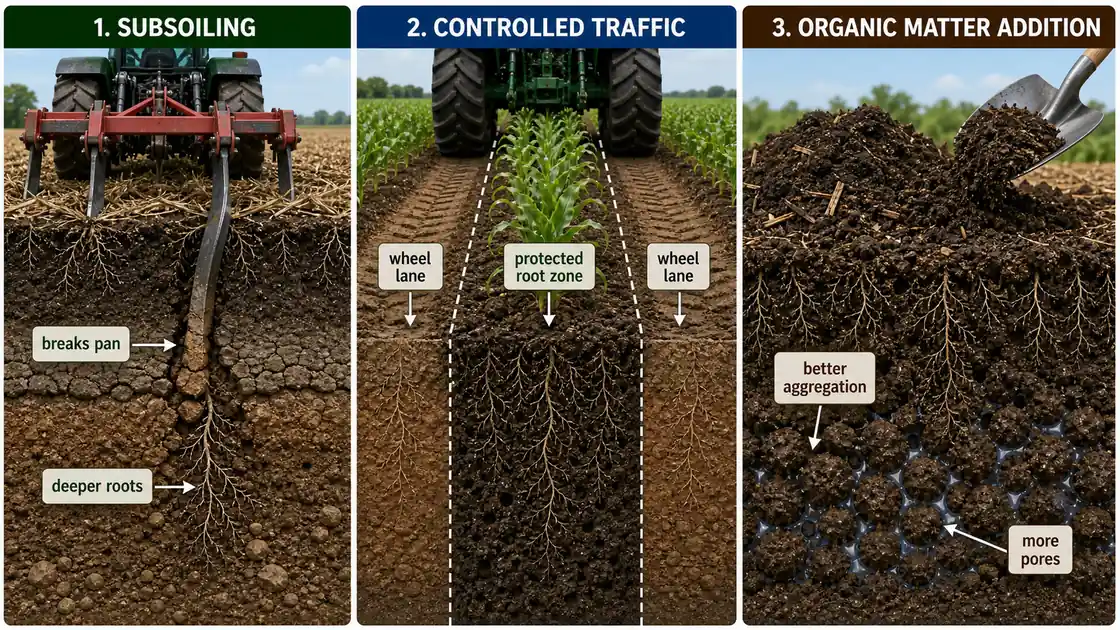
| Remediation Practice | Full Content |
|---|---|
| Subsoiling / deep ploughing | Breaks the plough pan and allows deeper root growth and better water entry |
| Controlled traffic farming | Keeps machinery on fixed wheel lanes so the crop root zone stays less compacted |
| Organic matter addition | Improves aggregation and creates more pore space, helping long-term recovery from compaction |
Summary Cheat Sheet
| Concept / Topic | Key Details |
|---|---|
| Consistence defined | Resistance of soil to mechanical stress at various moisture contents |
| Cohesion | Attraction between similar particles (clay-to-clay) |
| Adhesion | Attraction between soil and foreign surfaces (soil-to-plough) |
| 4 consistence types | Hard (dry) → Friable (moist) → Plastic (wet) → Sticky (wet) |
| Mnemonic | HFPS — Hard, Friable, Plastic, Sticky |
| Friable consistence | Most desirable for agriculture; optimum for tillage |
| Plasticity threshold | Soil needs >15% clay to exhibit plasticity |
| Sticky point | Moisture at which soil ceases to stick to foreign objects |
| Hard consistence — Vertisols | Rock-hard when dry; wide cracks; extremely difficult to till |
| Soil strength instrument | Penetrometer — measures force to push probe into soil |
| Crusting — cause | Raindrop impact breaks aggregates + sun drying cements fines |
| Crusting — effects | Reduced infiltration, impaired seedling emergence, poor gas exchange |
| Crusting — prevention | Mulching, maintaining OM, surface cover |
| Compaction — cause | Heavy machinery on wet soil; repeated tillage at same depth |
| Compaction — effects | Increased BD (>1.6 g/cm³), reduced porosity, restricted roots |
| Compaction — remedy | Subsoiling, OM addition, controlled traffic farming |
| Plough pan | Compacted layer at plough sole from repeated tillage |
| Ideal BD | ~1.3 g/cm³ with ~50% porosity |
| High Na soils | Promote dispersion → severe crusting |
| Four moisture states | Dry (Hard), Moist (Friable), Wet (Plastic), Wet (Sticky); Exam tip: "HFPS" mnemonic |
| Best for tillage | Friable (moist state); Exam tip: Optimum moisture range |