English
English for IBPS AFO and banking exams — functional grammar (tenses, voice, narration) and exam pattern practice (reading comprehension, error detection, cloze test, para jumbles, sentence correction).

Course Structure
What's Inside
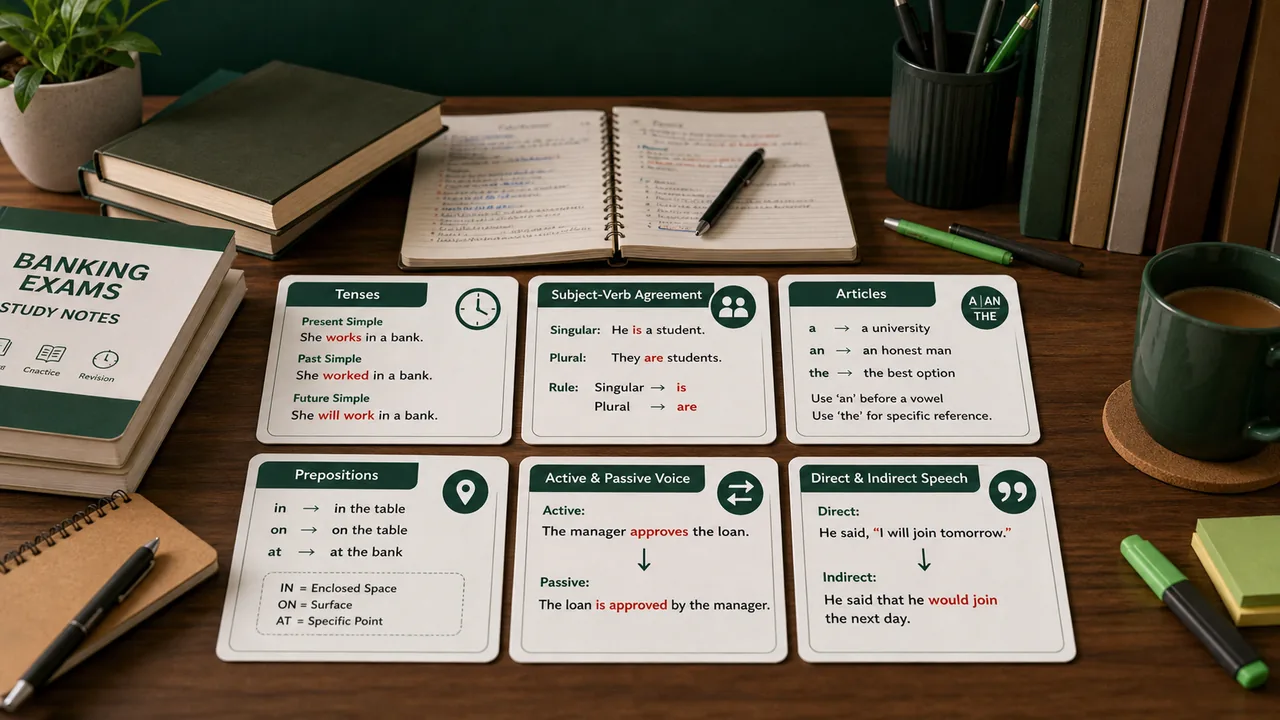

Functional Grammar
English grammar fundamentals — tenses, subject-verb agreement, articles, prepositions, conjunctions, active and passive voice, direct and indirect speech, modals — for banking exam English sections.

Exam Pattern
Reading comprehension, error detection, sentence correction, cloze test, para jumbles, fill in the blanks — pattern-based English practice for IBPS AFO, NABARD Grade A and RRB SO banking exams.

Vocabulary
English vocabulary for IBPS AFO, NABARD Grade A and banking exams — root words, synonyms, antonyms, one-word substitutions, idioms and phrases, vocabulary in context, and word formation rules to maximise verbal ability scores.
English Language is the most underestimated section in agriculture and banking competitive exams — and for many candidates, it is the one that determines selection. In IBPS AFO Prelims alone, 40 out of 105 questions are from English. The good news is that with focused preparation, English is also the fastest section to improve. Unlike agriculture knowledge that takes months to build, grammar rules and exam-pattern strategies can be mastered in 3–4 weeks of disciplined practice.
This course covers all three pillars of exam-ready English: functional grammar (the rules underlying error detection and sentence correction), vocabulary (root words, idioms, and phrases appearing in RC and cloze tests), and exam-pattern practice (actual question types from IBPS AFO, NABARD Pre, RBI Assistant, and SBI PO papers). Every section comes with explanations of why an answer is correct — not just what is correct — so the learning sticks.
The approach is exam-first: every grammar rule taught is immediately connected to the question type it governs. Every vocabulary set is drawn from actual banking and agriculture RC passages. Every practice set mirrors the difficulty and phrasing of real exam questions.
Course Structure
| Section | Topics | Lessons |
|---|---|---|
| 01 Functional Grammar | Sentences and their types, nouns, pronouns, adjectives, verbs and tenses, active/passive voice, direct/indirect narration, articles, prepositions, conjunctions, subject-verb agreement, common errors | 29 |
| 02 Vocabulary | Root words (Latin/Greek roots), synonyms and antonyms, idioms and phrases, one-word substitution, commonly confused words, contextual meaning, financial vocabulary | 14 |
| 03 Exam Pattern Practice | Reading comprehension (inference, tone, vocabulary-in-context), sentence rearrangement (basic and advanced), error detection (3 levels), cloze test (standard and column-based), fillers, practice tests | 17 |
| 04 Test Series | Full English section mock tests | 1 |
Key Facts to Know
Most-tested English concepts in IBPS AFO and NABARD:
| Question Type | What It Tests | Typical Count (Prelims) |
|---|---|---|
| Reading Comprehension | Inference, author's view, vocabulary in context | 10 questions |
| Cloze Test | Contextual word fit — grammar + meaning | 10 questions |
| Error Detection | Subject-verb agreement, tense, prepositions | 5–8 questions |
| Sentence Rearrangement | Logical flow, coherence of paragraphs | 5 questions |
| Fillers / Double Fillers | Grammar + vocabulary combined | 5 questions |
| RC Theme in IBPS AFO | Agriculture policy, banking, rural development | Every paper |
| Most-tested grammar rule | Subject-verb agreement (singular/plural confusion) | 2–3 questions |
| Most-tested vocabulary | Financial idioms (e.g., "in the red", "bottom line") | 1–2 questions |
| Passage length (RC) | 600–900 words | Standard |
Who Should Study This Course?
- IBPS AFO — Agricultural Field Officer (English section — 40 questions in Prelims, 25 in Mains)
- NABARD Grade A — Development Assistant (English Language paper in Prelims)
- IBPS RRB SO — Regional Rural Bank Specialist Officer
- RBI Assistant — English Language section (Prelims + Mains)
- SBI PO — English Language section (Prelims + Mains)
- SSC and State Exams — General English paper
Frequently Asked Questions
What is the difference between Active and Passive Voice in exam questions?
Voice transformation is tested primarily in error detection and sentence correction. The rule: in active voice, the subject performs the action ("The farmer ploughed the field"). In passive voice, the subject receives the action ("The field was ploughed by the farmer"). Common exam errors include incorrect auxiliary verbs (was/were/has been/have been), omitting "by", and tense inconsistency during transformation. The rule for tense in passive: Simple Present → is/are + V3; Simple Past → was/were + V3; Present Perfect → has/have been + V3.
How should I approach Para Jumbles under time pressure?
Para jumbles (sentence rearrangement) can be solved systematically: first identify the opening sentence (usually the one introducing a concept, a proper noun, or a broad statement — not a pronoun reference), then identify the closing sentence (usually a conclusion, result, or contrast). Then link middle sentences using connectors (however, therefore, moreover, consequently) and pronoun references (it, they, this, that). In IBPS AFO, sentence rearrangement passages frequently involve agriculture policy, RBI announcements, or rural economy topics — familiarity with the subject speeds up identification of logical order.
What type of errors appear most in Error Detection?
In IBPS AFO and NABARD papers, the five most-tested error types are: (1) subject-verb agreement (e.g., "the committee have" → "the committee has"), (2) pronoun-antecedent mismatch (e.g., "everyone should bring their" — debate on singular they), (3) wrong preposition (e.g., "different than" → "different from"), (4) misuse of articles (a/an/the before singular countable nouns), and (5) double negatives ("I don't have nothing" → "I don't have anything"). Error detection in recent IBPS papers often contains no error — always include "No Error" as a genuine option.
How many RC passages appear in NABARD Grade A Prelims?
NABARD Grade A Prelims English section typically carries 2 Reading Comprehension passages with 5 questions each, plus a cloze test (10 questions), error detection (5 questions), and sentence rearrangement (5 questions) — totalling 30 questions out of 200 in the prelims. In NABARD Mains, English carries 40 marks with descriptive writing (essay + précis writing). This course covers both prelims objective practice and mains-level comprehension skills.
Frequently Asked Questions
How many English questions appear in IBPS AFO?
IBPS AFO Prelims contains 40 English Language questions out of 105 total. This makes English the single largest section by question count in the preliminary exam. Questions are drawn from reading comprehension (10 questions typically), cloze test (10 questions), error detection (5–8 questions), sentence rearrangement / para jumbles (5 questions), and fillers (5 questions). Scoring well in English is often what separates selected candidates — it is the fastest section to improve with focused practice.
Is grammar important for banking exams or just vocabulary?
Both are critical, but grammar forms the backbone of error detection and sentence correction questions which carry predictable marks. Subject-verb agreement, tense consistency, pronoun reference, and preposition usage are the most-tested grammar rules in IBPS AFO, NABARD Pre, and RBI Assistant. Vocabulary (synonyms, antonyms, contextual meaning) dominates reading comprehension and cloze test questions. A balanced preparation — 60% grammar rules + 40% vocabulary building — delivers the best results across all question types.
What topics come in Reading Comprehension in banking exams?
RC passages in IBPS AFO, NABARD, and SBI PO consistently feature themes from: Indian economy and agriculture policy, banking and financial inclusion, environment and climate change, rural development schemes, and global trade. Passages are 600–900 words and carry 5–10 questions including vocabulary-in-context, inference, title/theme, and author's tone. The most common trap is reading the full passage before the questions — experienced candidates read the questions first, then search for answers in the passage.
How to improve vocabulary for competitive exams?
The most efficient vocabulary strategy for banking exams is root-word learning. A single Latin or Greek root (e.g., 'bene' = good) unlocks 8–12 related words. Our vocabulary section teaches 200+ high-frequency root words used in banking passage RC and cloze tests. Additionally, reading one editorial from The Hindu or Indian Express daily builds contextual usage. Exam-pattern vocabulary questions test: one-word substitution, idioms and phrases (especially financial idioms), and antonyms/synonyms of uncommon words in context.
What is the best strategy for Cloze Test in IBPS exams?
Cloze test passages in IBPS AFO are usually themed around banking, agriculture, or government policy. The strategy: read the full passage once for context, then eliminate options based on grammar (does the word fit the grammatical slot?) before checking meaning. The new-pattern cloze test (column-based) gives two or three words per blank — here, both grammatical fit and semantic coherence must be checked. Practising 20–25 cloze passages on agri/banking themes will expose you to the exact vocabulary and sentence structures used in the actual exam.