Functional Grammar
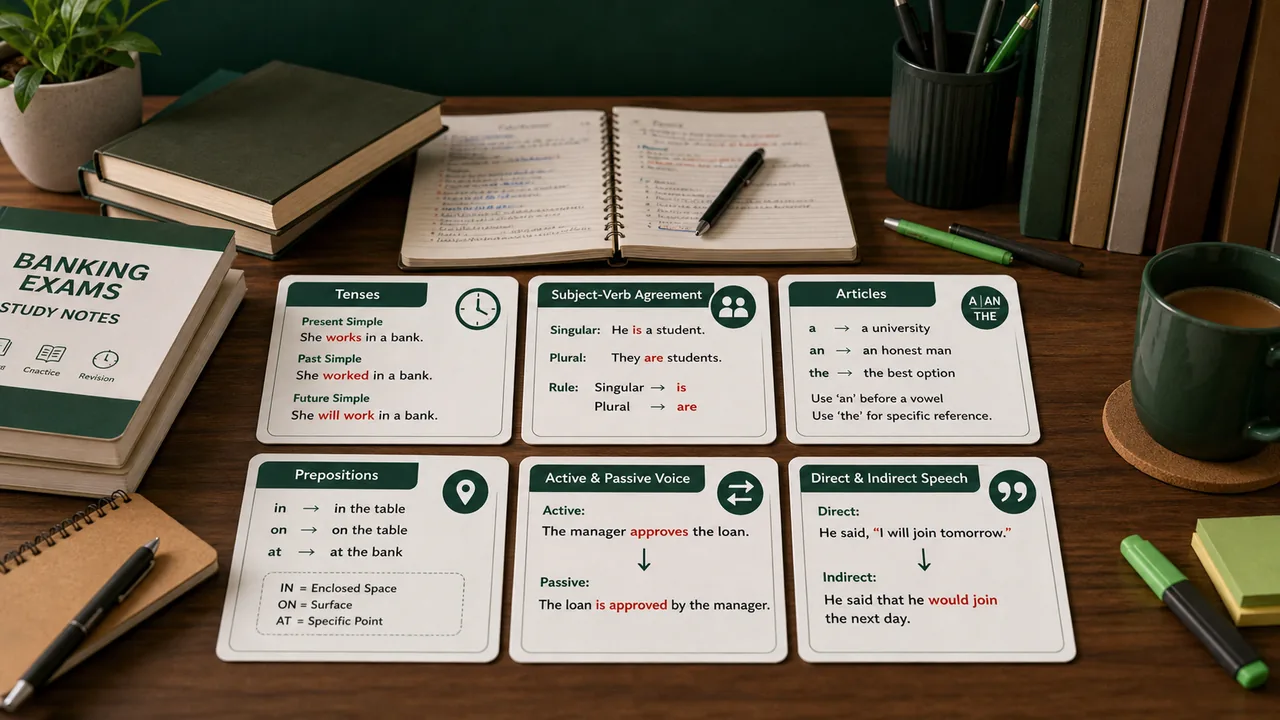
English grammar fundamentals — tenses, subject-verb agreement, articles, prepositions, conjunctions, active and passive voice, direct and indirect speech, modals — for banking exam English sections.
Frequently Asked Questions
What is functional grammar in exam preparation?
Functional grammar means studying grammar through actual sentence use. It includes tense, subject-verb agreement, articles, prepositions, conjunctions, voice, narration, and modal usage in the exact style asked in competitive exams.
Which grammar topics should I master first?
Start with subject-verb agreement, tense consistency, articles, prepositions, pronouns, and conjunctions. These form the base for error detection, sentence correction, and phrase replacement questions.
Is grammar enough to score well in English?
Grammar is essential, but not enough on its own. Strong scores usually come from combining grammar accuracy with vocabulary, reading comprehension, and familiarity with exam question patterns.
How do I revise grammar efficiently?
Revise rule groups with examples, then solve short pattern-wise practice sets immediately. Repeated error review is more useful than passive reading because it shows which grammar rules you still confuse under exam speed.
Why is subject-verb agreement so important in competitive English?
Subject-verb agreement is one of the most repeated grammar testing areas because it appears directly in error spotting, sentence correction, and even reading-based questions where one hidden agreement mistake changes the answer.
Which grammar errors are asked most often in banking exams?
Students most often face subject-verb agreement, tense consistency, article use, prepositions, pronoun reference, parallelism, modifiers, voice, narration, and modal usage errors.
How can I improve grammar without memorising too many rules?
Learn rules in small groups, attach each rule to examples, and practice through question patterns. Grammar becomes much easier when it is studied through repeated sentence use instead of only through rule lists.
Is functional grammar more useful for prelims or mains?
It helps in both. Prelims often test speed and recognition, while mains may combine grammar with deeper comprehension and contextual use. The same grammar base supports both stages.
What is the difference between learning grammar and applying grammar?
Learning grammar means knowing the rule, while applying grammar means spotting where the rule is broken inside a real sentence under time pressure. Competitive exams reward application far more than passive rule recall.
What is the biggest grammar-preparation mistake students make?
A common mistake is reading rules without practicing them immediately in sentence form. Another is revising grammar as isolated chapters while ignoring how the same rules appear repeatedly across exam-style question patterns.