IBPS PO & SBI PO
Exam Preparation
Everything you need to crack India's top banking exams. One course covers both IBPS PO (11 banks, 5,000+ vacancies) and SBI PO (highest salary, ₹80K+ in-hand). 4 subjects, 411 lessons, AI-powered quizzes, and spaced repetition — all in one place.
What is a Bank PO Exam?
A Bank Probationary Officer (PO) is an entry-level management cadre position in Indian public sector banks. Two major exams recruit POs every year: IBPS PO (for 11 nationalized banks) and SBI PO (exclusively for State Bank of India). Both follow a 3-stage selection: Prelims → Mains → Interview.
Bank PO is one of the most popular government job exams in India, with over 50 lakh candidates applying annually across both exams. The role offers job security, good salary (₹52K-85K/month starting), rapid promotions, and excellent perks including housing, medical benefits, and pension. POs are groomed for senior management — many reach General Manager or Executive Director level within 15-20 years.
Subject Modules
Complete coverage of all sections required for IBPS PO & SBI PO.
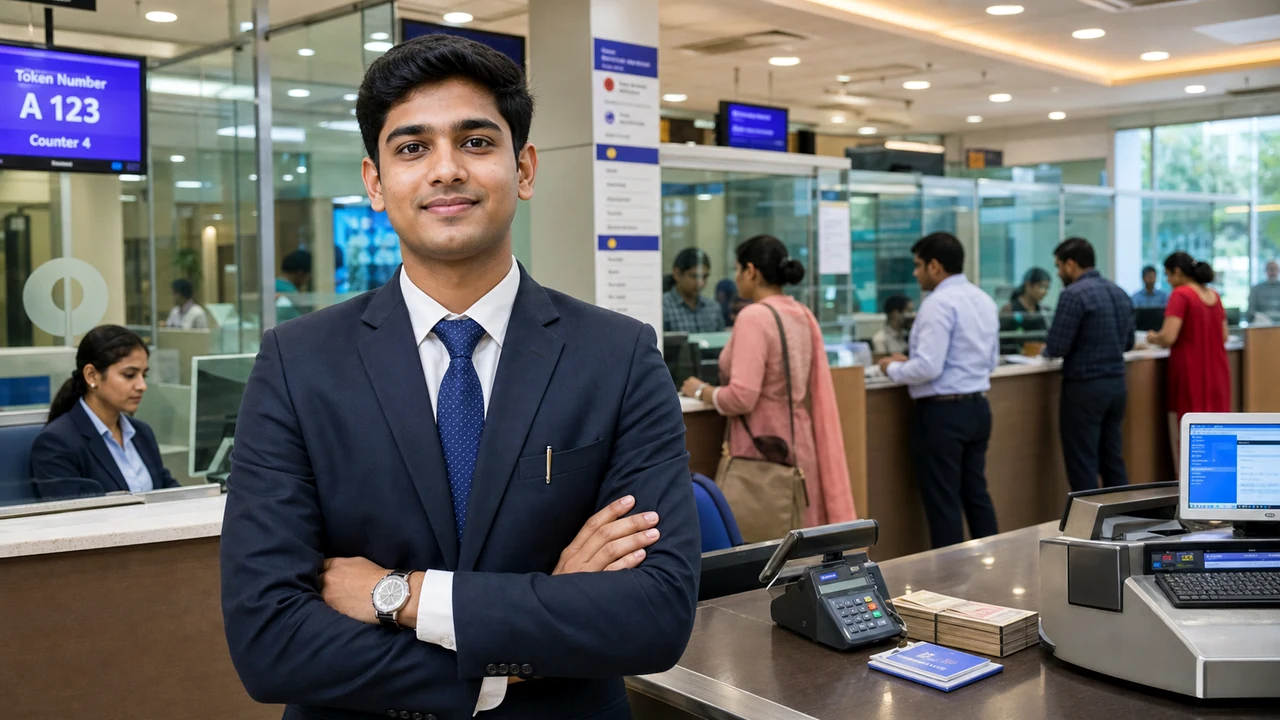

About IBPS PO & SBI PO Exam
Everything you need to know about IBPS PO and SBI PO exams — eligibility, exam pattern, syllabus, salary, cutoff, and preparation strategy.

Quantitative Aptitude
Master Quantitative Aptitude for banking and agriculture exams — data interpretation, number series, percentage, ratio, simplification, mixture and alligation, and faster calculation techniques.
English
English for IBPS AFO and banking exams — functional grammar (tenses, voice, narration) and exam pattern practice (reading comprehension, error detection, cloze test, para jumbles, sentence correction).

Reasoning Ability
Reasoning Ability for IBPS AFO, NABARD Grade A and RRB SO — puzzles and seating arrangement, syllogism, coding-decoding, input-output, blood relations and direction sense with practice MCQs.
IBPS PO vs SBI PO — Complete Comparison 2026
Both exams share ~90% syllabus. Key differences in salary, vacancies, and selection process.
| Parameter | IBPS PO | SBI PO |
|---|---|---|
| Conducting Body | Institute of Banking Personnel Selection | State Bank of India |
| Vacancies (2025) | ~4,500-5,200 | ~500-600 |
| Applications | ~30-35 lakh | ~25-30 lakh |
| Competition | High | Very High (fewer seats) |
| Difficulty | Moderate-High | High (tougher Mains) |
| In-hand Salary | ~₹52,000-60,000/month | ~₹80,000-85,000/month |
| Posting Banks | 11 PSU banks (preference-based) | SBI only (largest bank) |
| Descriptive Paper | 25 marks (Letter + Essay) | 50 marks (Letter + Essay) |
| Group Exercise | No | Yes (before Interview) |
| Merit Formula | 80% Mains + 20% Interview | 75% Mains + 25% (GE+Interview) |
| Exam Month (Prelims) | October | November-December |
| Notification Month | August | September-October |
Pro tip: Prepare for both exams together. Your IBPS PO preparation covers 90% of SBI PO. Just add extra descriptive writing practice and harder DI sets for SBI PO Mains.
IBPS PO Selection Process 2026
4-stage selection. Prelims is qualifying; final merit = 80% Mains + 20% Interview.
Online Preliminary Exam
Qualifying exam — English, Quant, Reasoning. 100 questions in 60 minutes. Sectional + overall cutoff must be cleared.
Online Main Exam
Objective (155 Qs, 200 marks, 3 hrs) + Descriptive (Letter/Essay, 25 marks, 30 min). Merit-based selection.
Interview
Conducted by participating banks. 100 marks. Final merit = 80% Mains + 20% Interview.
Provisional Allotment
Bank allotment based on merit + preference. Joining as Probationary Officer (Scale I) in any of 11 PSU banks.
SBI PO Selection Process 2026
4-stage selection. SBI uniquely includes Group Exercise. Merit = 75% Mains + 25% (GE+Interview).
Preliminary Exam
Qualifying — English, Quant, Reasoning. Same pattern as IBPS PO prelims. Top candidates shortlisted.
Main Exam
Objective (155 Qs, 200 marks, 3 hrs) + Descriptive (Letter/Essay, 50 marks, 30 min). Higher difficulty than IBPS.
Interview + Group Exercise
SBI uniquely includes Group Exercise (GE) along with Interview. Tests communication, leadership, decision-making.
Final Selection
Merit = 75% Mains + 25% (GE + Interview). Posting as Probationary Officer in SBI branches across India.
IBPS PO & SBI PO Exam Pattern 2026
IBPS PO Exam Pattern
Preliminary Exam
| Section | Qs | Marks | Time |
|---|---|---|---|
| English Language | 30 | 30 | 20 min |
| Quantitative Aptitude | 35 | 35 | 20 min |
| Reasoning Ability | 35 | 35 | 20 min |
| Total | 100 | 100 | 60 min |
Sectional + overall cutoff. No marks carried forward to Mains.
Main Exam (Objective)
| Section | Qs | Marks | Time |
|---|---|---|---|
| Reasoning & Computer Aptitude | 45 | 60 | 60 min |
| English Language | 35 | 40 | 40 min |
| Data Analysis & Interpretation | 35 | 60 | 45 min |
| General/Economy/Banking Awareness | 40 | 40 | 35 min |
| Objective Total | 155 | 200 | 180 min |
| + Descriptive (Letter + Essay) | 25 | 30 min | |
Negative marking: 0.25 for wrong answers. Descriptive evaluated only if objective cutoff cleared.
SBI PO Differences
- • Prelims pattern is identical to IBPS PO (100 Qs, 100 marks, 60 min)
- • Mains descriptive paper is 50 marks (vs 25 in IBPS) — more emphasis on writing
- • SBI includes Group Exercise before interview — tests leadership & communication
- • Mains difficulty is higher — DI and puzzle levels are tougher than IBPS
⚠ Negative marking: 0.25 marks deducted for each wrong answer in both IBPS PO and SBI PO. No penalty for unattempted questions.
Complete Syllabus — IBPS PO & SBI PO
5 core subjects. Master Reasoning & Quant first — they carry the most marks and are common to all banking exams.
Quantitative Aptitude
Data Interpretation
Bar, Pie, Line, Table, Radar, Caselet-based DI
Number Series
Missing number, wrong number — 5 questions guaranteed
Simplification & Approximation
BODMAS-based calculations, quick estimation
Quadratic Equations
Roots comparison — easy 5 marks in prelims
Arithmetic
Percentage, Ratio, Profit/Loss, SI/CI, Time & Work, Speed/Distance, Average, Partnership, Mixture
Probability & Permutation
Basic probability, PnC — 1-2 questions in Mains
Mensuration
Area, Volume — rare but appears in SBI PO Mains
Reasoning Ability
Seating Arrangement
Linear (single/double row), Circular, Square, Floor-based — 10-15 Qs
Puzzles
Scheduling, Box, Multi-parameter, Comparison — 10-15 Qs
Syllogisms
Direct, Reverse, Possibility-based — 3-5 Qs
Inequalities
Direct and Coded inequalities — 5 Qs (easy marks)
Blood Relations
Family tree, coded blood relations — 2-3 Qs
Coding-Decoding
New pattern, sentence coding — 3-5 Qs
Input-Output
Machine input rearrangement — 5 Qs (Mains)
Direction & Distance
Displacement problems — 1-2 Qs
Order & Ranking
Floor, position-based — 2-3 Qs
Data Sufficiency
Statement-conclusion based — 3-5 Qs (Mains)
Computer Aptitude
Logic gates, binary, flowcharts — combined in Mains section
English Language
Reading Comprehension
2-3 passages (500-700 words each) — 10-15 Qs, themes: economy, social, abstract
Cloze Test
New pattern cloze with context-based blanks — 5 Qs
Error Detection/Correction
Grammar-based sentence errors — 5 Qs
Para Jumbles
Sentence rearrangement — 5 Qs
Sentence Connectors
Column matching, fillers — 5 Qs (Mains)
Vocabulary
Synonyms, antonyms, idioms, phrase replacement
Descriptive Writing
Letter writing (formal/informal) + Essay (250 words) — Mains only
General & Banking Awareness
Banking Awareness
RBI policies, monetary policy, SLR/CRR, NEFT/RTGS/UPI, banking terms, Basel norms
Financial Awareness
Budget, GDP, fiscal/monetary policy, credit rating agencies, stock markets
Current Affairs
Last 6 months — appointments, awards, summits, schemes, MoUs, sports
Static GK
Bank HQ & taglines, financial organizations, important committees, Acts
Economy
Five Year Plans, NITI Aayog, GDP data, inflation indices, trade policy
Government Schemes
PM schemes, financial inclusion, Jan Dhan, MUDRA, Stand-Up India
Computer Knowledge
Computer Fundamentals
Hardware, software, memory types, I/O devices
Operating Systems
Windows, Linux basics, file management
Networking
Internet, protocols, LAN/WAN, cloud computing basics
MS Office
Word, Excel, PowerPoint shortcuts and features
DBMS
SQL basics, RDBMS concepts, normalization
Cyber Security
Phishing, malware, encryption, firewalls, digital signatures
Want AI-powered quizzes after every lesson?
Pro members get unlimited AI quizzes, spaced repetition & mock tests.
How to Prepare for Bank PO 2026
Build Reasoning & Quant Foundation (Month 1-2)
Start with basics — Number System, Percentage, Ratio for Quant. Learn Coding-Decoding, Inequality, Blood Relations for Reasoning. Practice 20 questions daily from each.
Master Puzzles & DI (Month 2-3)
Puzzles + DI = 50% of Mains marks. Practice 3 DI sets and 2 puzzle sets daily. Start with moderate difficulty, then attempt high-level SBI PO patterns.
English — Read Editorials Daily
Read one editorial from The Hindu or Indian Express daily. This improves RC speed, vocabulary, and comprehension. Practice grammar rules for Error Detection.
General Awareness — Last 6 Months Current Affairs
Start banking awareness + static GK from Month 1. Current affairs from last 6 months before exam. Use spaced repetition (AgriDots Recall) to retain facts and dates.
Mock Tests — 30+ Full-Length Tests (Month 3-4)
Take at least 30 mock tests before Prelims. Analyze every mock — find time-wasting patterns. Target: 70+ in Prelims, 100+ in Mains objective. Speed is everything.
Bank PO Salary & Career Growth 2026
IBPS PO Salary (11 PSU Banks)
SBI PO Salary (State Bank of India)
Career Progression Path
Promotions every 3-5 years based on performance + exams. Senior management salary: ₹1.5-3 lakh/month.
Use the shared IBPS salary calculator to compare IBPS PO, SBI PO, IBPS AFO, and officer Scale II-IV tracks on one page.
Eligibility — IBPS PO & SBI PO 2026
Any Bachelor's degree from a recognized university. Any stream — Arts, Science, Commerce, Engineering, Agriculture. Final year students can also apply.
20 to 30 years. Relaxation: SC/ST +5 years, OBC +3 years, PwD +10 years, Ex-Servicemen as per govt. rules.
Indian citizen. Subjects of Nepal, Bhutan, Tibetan refugees (settled before 1962), and persons of Indian origin migrated from specified countries are also eligible.
No minimum percentage required. Unlike many exams, Bank PO only requires a degree — your marks don't affect eligibility or selection. Even 50% graduates can become bank officers.
AI-Powered Learning System
Every lesson is an active learning experience. AI generates questions as you read, analyzes your answers, and schedules revisions — all built into the platform.
Read & Answer
Each lesson is divided into concept blocks. After reading a concept, tap the ? button — AI generates an MCQ from that exact paragraph to test your understanding.
Get AI Feedback
After completing all questions, AI analyzes your answers and gives personalized feedback — what you got right (Glows) and what to revisit (Grows).
Recall & Retain
The FSRS algorithm schedules review sessions at scientifically optimal intervals. Concepts you got wrong come back sooner — ones you mastered, later.
Inline Concept Questions
AI generates MCQs from each concept paragraph. Wrong answers highlight the exact source text so you can re-read and understand.
Section Quiz + Feedback
End-of-lesson quiz with 5 AI-generated questions. Get Glows (strengths) and Grows (weak areas) with direct links to concepts to revisit.
FSRS Spaced Repetition
Built on the FSRS algorithm used by Anki. Concepts you struggle with appear more frequently. Mastered ones are spaced out — no wasted revision time.
Source Highlighting
When you answer wrong, AI highlights the exact sentences in the lesson where the answer was. Scroll back, re-read, and learn from mistakes.
Which process converts NH₄⁺ to NO₃⁻?
Listen to Your Notes
Built-in text-to-speech in every lesson
Turn any lesson into audio. Listen while commuting, walking, or before sleep. Perfect for banking awareness revision. Supports English & Hindi voices with adjustable speed.
Translate in 22 Languages
Read banking concepts in your mother tongue
AI translates while keeping banking terms in English — CRR, SLR, NEFT, RTGS stay as-is. Understand concepts without losing technical accuracy.
IBPS PO Participating Banks 2026
Frequently Asked Questions
What is the difference between IBPS PO and SBI PO?
IBPS PO recruits for 11 public sector banks with ~5,000 vacancies, while SBI PO recruits only for State Bank of India with ~500 vacancies. SBI PO has higher salary (₹80K+ vs ₹52K+), includes Group Exercise, and has a tougher Mains exam. The Prelims syllabus is identical. About 90% of the preparation overlaps.
What is the IBPS PO salary in 2026?
After the 12th Bipartite Settlement, IBPS PO starting basic pay is ₹48,480. In-hand salary ranges from ₹52,000-60,000 depending on posting city (metro cities pay more due to HRA). With promotions, salary can reach ₹1.5-2 lakh/month at senior levels.
What is the SBI PO salary in 2026?
SBI PO gets 4 advance increments over other bank POs. Starting in-hand salary is approximately ₹80,000-85,000/month including all allowances. SBI also offers better perks including leased accommodation, medical benefits, and faster promotions.
Can I prepare for IBPS PO and SBI PO together?
Yes, absolutely. About 90% of the syllabus is common. Prelims pattern is identical. For Mains, the only difference is SBI PO has a harder descriptive paper (50 marks vs 25 marks) and includes Group Exercise. Prepare the core subjects together and add SBI-specific practice closer to its exam date.
How many attempts are allowed for IBPS PO?
There is no limit on the number of attempts for IBPS PO or SBI PO, as long as you meet the age criteria (20-30 years, with relaxations for reserved categories). You can appear every year until you reach the upper age limit.
What is the best strategy to crack Bank PO in first attempt?
Start with Reasoning and Quant fundamentals (2 months). Practice 50+ puzzles and 30+ DI sets. For English, read editorials daily and practice RCs. For GA, follow current affairs for last 6 months + static banking awareness. Take at least 30 full-length mock tests. Use spaced repetition for banking terms and current affairs.
Is graduation percentage important for IBPS PO?
No minimum percentage is required — you just need a Bachelor's degree from a recognized university in any discipline. Even final-year students can apply (must have results before joining). Your marks don't affect selection at all.
Which other exams can I prepare for alongside Bank PO?
IBPS Clerk and SBI Clerk share 85% syllabus with PO. IBPS RRB PO/Clerk shares 70-75%. RBI Assistant shares 80%. Even SSC CGL has significant overlap in Quant and Reasoning. One preparation covers 5-6 exams.
Choose Your Plan
No hidden fees. No locked content. Full access to every feature from day one.
₹59 charged monthly · Cancel anytime
Best for students who want full course access without AI features
🔒 Secure via Razorpay · No hidden fees
What's included
- All Agriculture & Banking Courses
- Summaries & Mind Maps
- Watch Already-Generated Classrooms
- Static Lesson Quizzes
- XP, Levels, Leaderboard & Badges
- IBPS · UP AGTA · ICAR · ASRB · SBI · RRB
- AI Doubt Solver
- Spaced Repetition Recall (FSRS)
- 22 Indian Language Translation
- Audio Lessons
Now ₹99/month · was ₹199
₹99 charged monthly · No yearly commitment
You save ₹100/month vs original price
🔒 Secure via Razorpay · No hidden fees
Everything in one plan
- All Agriculture & Banking Courses
- Unlimited AI-Powered Lesson Tests
- Audio Lessons — Hindi & English
- Interactive Infographics & Mind Maps
- Spaced Repetition Recall (FSRS)
- Glows & Grows AI Study Feedback
- 22 Indian Language Translation
- Pomodoro Focus Timer & Planner
- XP Points, Levels & Leaderboard
- Achievement Badges & Milestones
- Daily Streaks & Smart Reminders
- Memory Health Dashboard
- Instant Search Across All Content
- Live Telegram Feed Mirror
- Mock Tests & Previous Year Papers
- IBPS · UP AGTA · ICAR · ASRB · SBI · RRB
Billed monthly · 100 voice sessions/month
Everything in Pro + Voice AI Teacher
Seats Full — Launching SoonJoin the waitlist on the Pro page
Everything in Pro, plus:
- Voice Revision SessionsAsk doubts in Hindi or English. 100 sessions/month.
- AI Revision AssistantPersonalized revision based on weak areas. Adaptive difficulty.
- Knowledge Gap AnalysisSee exactly which concepts you're weak in before exam day.
- Live Doubts AnsweringReal-time voice chat with your AI teacher, 24/7.
Still thinking?
Start free — read 5 lessons, solve previous year papers, and see why 2000+ agriculture students trust AgriDots. No credit card required.
Prefer solving by subject and chapter first? Use the agriculture topic-wise question practice hub.