🏡 Introduction to Greenhouse Cultivation
Understand what a greenhouse is, why protected cultivation developed, and how controlled environments improve crop production.
If farmers want to grow high-value crops outside the normal season, protect plants from harsh weather, and manage water and nutrients more precisely, open-field farming is often not enough. That practical need led to greenhouse cultivation, where the crop environment is modified rather than left entirely to nature.
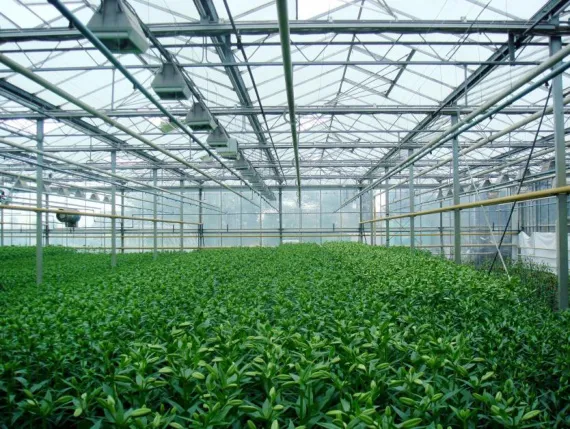
What Is a Greenhouse?
A greenhouse is a framed or inflated structure covered with transparent or translucent material in which crops are grown under a partially or fully controlled environment. It is large enough for workers to enter and carry out operations such as planting, irrigation, training, and plant protection.
The core idea is simple: instead of accepting outside temperature, humidity, wind, and rainfall exactly as they are, the grower modifies the crop microclimate to improve growth and yield.
Greenhouse cultivation is a practical form of protected agriculture and controlled environment agriculture.
How Greenhouse Cultivation Developed
Protected cultivation began in primitive form long before modern plastics. Early civilizations used covers and enclosed structures to protect crops from cold and adverse weather. Over time, this evolved through:
| Stage | Main feature | Practical significance |
|---|---|---|
| Early protection methods | Stone covers, paper covers, straw mats, hotbeds | Basic weather protection |
| Glasshouse period | Glass panes and framed houses | Better light transmission and durability |
| Plastic era after World War II | Polyethylene sheets replaced costly glass in many cases | Lower cost and wider adoption |
| Modern CEA phase | Automated control of temperature, humidity, irrigation, and CO2 | Precision production with high-value crops |
The major expansion of greenhouse cultivation happened after polyethylene became available as a low-cost covering material.
Why a Greenhouse Becomes Warmer
The greenhouse covering material allows most short-wave solar radiation to enter. This radiation warms the crop, soil, and internal surfaces. Those surfaces then reradiate energy as longer-wave heat, which is trapped more effectively inside the structure.
This leads to a rise in inside temperature compared with outside conditions.
The greenhouse effect inside the structure is desirable for crop production, especially in cool conditions, because it helps maintain a warmer crop environment.
The term "greenhouse effect" is also used in climate science for warming caused by atmospheric gases such as carbon dioxide. In greenhouse engineering, the same basic radiation principle is used in a controlled and productive way.
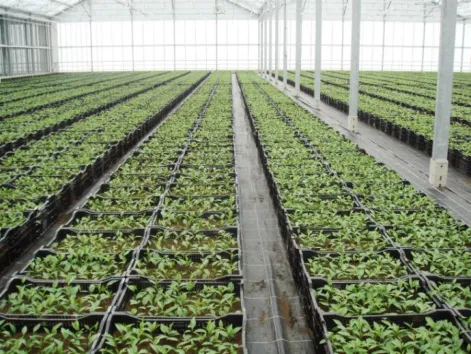
Why Grow Crops Under Protected Cultivation?
Greenhouses are used because they improve production control, crop scheduling, and produce quality. Their main advantages are:
- Multiple crops can be raised in a year under more suitable environmental conditions.
- Crop productivity can increase substantially compared with exposed conditions.
- Better quality produce can be obtained.
- Inputs such as water, fertilizers, and plant-protection chemicals can be used more efficiently.
- Pest and disease management is easier because the growing area is enclosed.
- Seed germination and nursery raising become more reliable.
- Tissue-culture plantlets can be hardened successfully under greenhouse care.
- Crop harvests can be timed to target market demand.
- Special growing media can be used effectively.
- Export-quality produce can be produced when management is precise.
- Environmental control systems can be automated.
- Protected cultivation creates scope for high-value entrepreneurship and self-employment.
Scope of Greenhouse Technology in India
In India, greenhouse cultivation is especially important for:
- off-season vegetable production
- floriculture and nursery industries
- protected seedling raising
- high-value horticulture near urban markets
- quality-sensitive crops requiring better climate control
Its relevance is highest where open-field conditions are too uncertain, too hot, too cold, too rainy, or too pest-prone for reliable premium production.
Summary Cheat Sheet
| Point | Key idea |
|---|---|
| Greenhouse | Covered structure used for partially or fully controlled crop production |
| Core purpose | Modify the crop microclimate for better growth and yield |
| Historical shift | Glasshouses were important first; plastics greatly expanded adoption |
| Greenhouse effect | Short-wave radiation enters, long-wave heat is trapped inside |
| Main benefits | Higher productivity, better quality, off-season production, better input use |
| Indian relevance | Valuable for vegetables, flowers, nurseries, and protected horticulture |
Lesson Doubts
Ask questions, get expert answers