🏗️ Types of Greenhouses
Learn how greenhouses are classified by shape, span arrangement, and utility, and understand where each type is most suitable.
Not every greenhouse is built for the same purpose. A nursery attached to a building, a naturally ventilated vegetable house, and a large commercial polyhouse may all grow crops under protection, but their structure, cost, and management needs are very different.
Why Greenhouses Are Classified
Greenhouses are classified to match local climate, land shape, investment capacity, crop type, and management intensity.
The most common basis of classification is:
- shape or structural form
- utility or environmental-control purpose
- degree of technology and investment
There is no single best greenhouse for all situations; suitability depends on need, climate, and cost.
Greenhouse Types Based on Shape
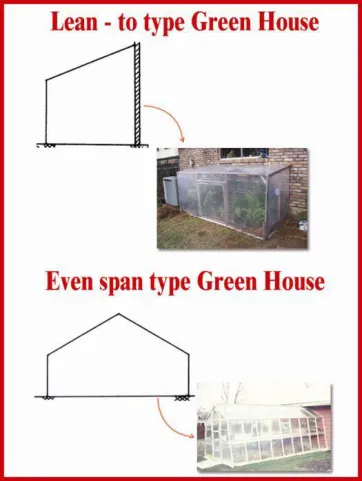
Lean-to greenhouse
A lean-to greenhouse is built against an existing building and uses that structure as one side or support.
Best suited for:
- small-scale growing
- backyard or teaching use
- locations where water, electricity, and heat access are already available
Main advantage: lower construction cost.
Main limitations: restricted space, weaker ventilation flexibility, and limited expansion.
Even-span greenhouse
An even-span greenhouse has two roof slopes of equal width and pitch. It is the common full-size free-standing form used on level land.
Its advantages are:
- better internal space than lean-to types
- more design flexibility
- more uniform air circulation
Its limitation is higher cost and greater heating or cooling demand.
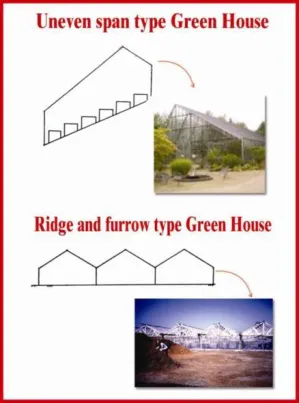
Uneven-span greenhouse
This type has two roof slopes of unequal width and is mainly suited to hilly terrain. It fits side slopes better than standard forms.
Its use is now less common because it is not as convenient for automation and modern large-scale protected cultivation.
Multi-Span and Commercial Forms
Ridge and furrow greenhouse
This structure combines two or more even-span houses joined along the eaves. The joined gutter carries rainwater away.
Its advantages are:
- less exposed wall area
- improved labor movement inside
- easier automation
- better fuel economy
It is widely suited to commercial protected cultivation.
Saw-tooth greenhouse
This is similar to ridge and furrow, but designed to improve natural ventilation through a roof opening pattern.
Saw-tooth design is especially important in warm regions because it improves passive ventilation.
Quonset greenhouse
A Quonset greenhouse has a curved roof made from pipe arches or hoops. It is commonly covered with polyethylene.
It is popular because it is:
- relatively low cost
- simple to fabricate
- suitable for small or medium protected units
Its curved shape, however, may reduce effective side-space use compared with some rigid-frame designs.
Classification Based on Utility
Greenhouses are also grouped by the kind of environmental support they provide.
Greenhouses with active heating
These use external energy to raise inside temperature when ambient conditions are too cold.
Greenhouses with active cooling
These use systems such as fan-pad cooling or fogging to reduce temperature in hot weather.
Naturally ventilated greenhouses
These depend mainly on roof vents, side vents, and structural design for airflow instead of heavy mechanical cooling.
In Indian conditions, naturally ventilated polyhouses are often more economical than fully climate-controlled systems for many horticultural crops.
Choosing a Greenhouse Type
Selection depends on a few practical questions:
| Decision factor | What it influences |
|---|---|
| Local climate | Need for heating, cooling, or natural ventilation |
| Land shape | Suitability of even-span, uneven-span, or attached structures |
| Crop value | Whether higher investment is justified |
| Scale of operation | Need for single-span or multi-span units |
| Automation requirement | Preference for ridge-furrow or other commercial designs |
| Budget | Material choice and structural complexity |
Summary Cheat Sheet
| Type | Main feature | Best use |
|---|---|---|
| Lean-to | Attached to building | Small, low-cost protected unit |
| Even-span | Equal roof slopes | Standard free-standing greenhouse |
| Uneven-span | Unequal roof slopes | Hilly terrain |
| Ridge and furrow | Connected spans with gutters | Large commercial operations |
| Saw-tooth | Multi-span with natural ventilation openings | Warm regions needing passive cooling |
| Quonset | Hoop-shaped, usually plastic-covered | Low-cost polyhouse cultivation |
Lesson Doubts
Ask questions, get expert answers