⚙️ Greenhouse Equipment and Environmental Control
Learn the main systems used to cool, ventilate, circulate air, and automate greenhouse environmental control.
A greenhouse becomes commercially useful only when the environment can be adjusted when the weather becomes too hot, too cold, too humid, or too stagnant. That is why environmental-control equipment is as important as the structure itself.
Why Greenhouse Equipment Is Needed
The purpose of greenhouse equipment is to keep the crop environment close to the desired set point. The major control targets are:
- temperature
- humidity
- air movement
- ventilation
- sometimes light and carbon dioxide
As greenhouse technology developed, control moved from manual regulation to thermostats, step controllers, dedicated processors, and computer-based systems.
Environmental control equipment improves crop quality, timing, uniformity, and energy efficiency.
Active Summer Cooling Systems
When inside temperature becomes too high, active cooling is needed. The most common greenhouse cooling principle is evaporative cooling, in which evaporation removes heat from the air.
Two major systems are widely used.
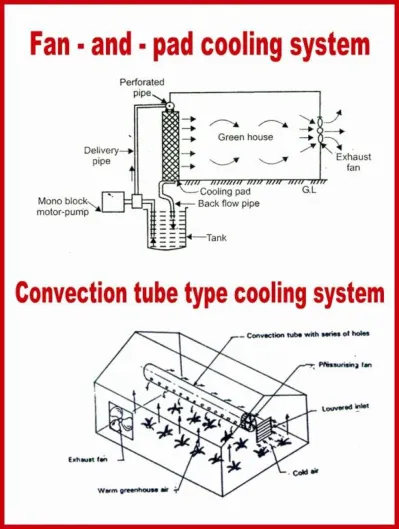
Fan-and-pad system
In this system:
- cooling pads are installed on one side of the greenhouse
- fans are placed on the opposite side
- outside air is pulled through the wet pad
- evaporation cools the incoming air before it passes over the crop
Advantages:
- simple and well established
- effective in hot, dry conditions
- suitable for many commercial houses
Limitation:
- cooling depends on outside air dryness and is less effective in humid weather
Fogging system
Here, fine droplets are produced under pressure and released into the greenhouse air. These tiny droplets evaporate quickly and cool the air directly.
Advantages:
- more uniform cooling through the house
- less leaf wetting when properly designed
- useful for nursery and propagation conditions
Fog systems generally cool more efficiently than large-droplet spray systems because droplet size is much smaller.
Winter Cooling and Air Tempering
Even in winter, a greenhouse may overheat during sunny conditions because solar radiation is trapped inside. So excess heat still has to be removed, but without exposing plants to damaging cold drafts.
This is why winter cooling is really controlled air exchange and air tempering.
Two common systems are:
Convection tube cooling
Cold incoming air is drawn in and then directed through a polyethylene tube with distribution holes. The cool air mixes with warmer greenhouse air above crop height before settling gradually into the crop zone.
This helps avoid sudden cold spots near plants.
Horizontal air flow (HAF) system
Small circulation fans move greenhouse air in a continuous pattern. Instead of introducing strong directional drafts, they maintain uniform air mixing.
Benefits of HAF:
- reduces hot and cold spots
- improves uniformity in the crop canopy
- supports more even humidity and temperature distribution
Ventilation Equipment
Ventilation may be natural or forced.
Natural ventilation
This uses roof vents, side vents, and structural openings to allow buoyancy-driven and wind-driven airflow. It is economical and common in naturally ventilated polyhouses.
Forced ventilation
This uses fans to move air in and out of the structure. It offers more control and becomes important when climate precision is required.
The choice depends on:
- local climate
- crop sensitivity
- greenhouse size
- investment level
Naturally ventilated systems are often preferred in Indian warm conditions when cost control is important.
Automation and Computer Control
Modern greenhouses often use automated systems to maintain environmental set points. These may regulate:
- fan operation
- pad wetting
- fogging cycles
- vent opening
- irrigation timing
- temperature and humidity monitoring
The level of automation may range from simple thermostatic control to full computer-based climate control.
Automation is valuable because greenhouse conditions can change quickly, and manual intervention is often too slow or inconsistent.
Choosing Equipment in Practice
Equipment choice is not only a technical issue. It also depends on economics and crop goals.
| Condition | More suitable approach |
|---|---|
| Low-cost protected cultivation | Natural ventilation with limited automation |
| Hot, dry climate | Fan-pad cooling can be effective |
| Need for uniform nursery environment | Fogging and controlled air movement |
| Large commercial greenhouse | Mechanical ventilation and automation |
| Sensitive high-value crop | More precise control systems justified |
Summary Cheat Sheet
| Equipment/system | Main purpose | Key note |
|---|---|---|
| Fan-pad cooling | Summer evaporative cooling | Best in relatively dry air |
| Fogging system | Uniform evaporative cooling | Uses fine droplets, useful for nurseries too |
| Convection tube | Winter air distribution and tempering | Prevents cold-air shock near plants |
| HAF fans | Internal air circulation | Reduces hot and cold spots |
| Natural ventilation | Low-cost air exchange | Important in warm-region polyhouses |
| Forced ventilation | Precise environmental control | Used where higher control is needed |
| Automation/computers | Continuous climate regulation | Improves uniformity and management efficiency |
Lesson Doubts
Ask questions, get expert answers