🧭 Greenhouse Planning
Learn how site selection, orientation, structural planning, and covering choice determine greenhouse performance and cost.
A greenhouse can fail even before construction starts if the wrong site, orientation, or covering material is chosen. Good greenhouse planning reduces operating problems later, especially poor light use, waterlogging, high wind damage, and difficult movement of labor and materials.
Why Planning Matters
The purpose of greenhouse planning is to create a structure that admits sufficient light, supports crop growth, resists local weather, and can be operated economically over many years.
Planning decisions affect:
- crop productivity
- construction cost
- operating cost
- labor efficiency
- durability of the structure
Greenhouse planning is a long-term technical and economic decision, not just a construction decision.
Site Selection
A greenhouse site should be selected so that it supports both crop growth and easy operation.
Important site-selection points are:
- level or nearly level land to reduce grading cost
- good solar exposure
- proper drainage
- good air movement
- access to water, power, labor, and transport
- protection from damaging wind where possible
Trees or buildings should not cast heavy shadows on the structure. Where windbreaks are needed, they should protect the house without reducing useful light.
Orientation of the Greenhouse
Orientation determines how efficiently the structure receives sunlight and how it responds to prevailing winds.
The ideal orientation depends on:
- latitude
- season of use
- type of crop
- greenhouse width and design
- local wind direction
In practice, orientation is chosen to balance good light interception with ventilation and practical site layout.
Structural Planning
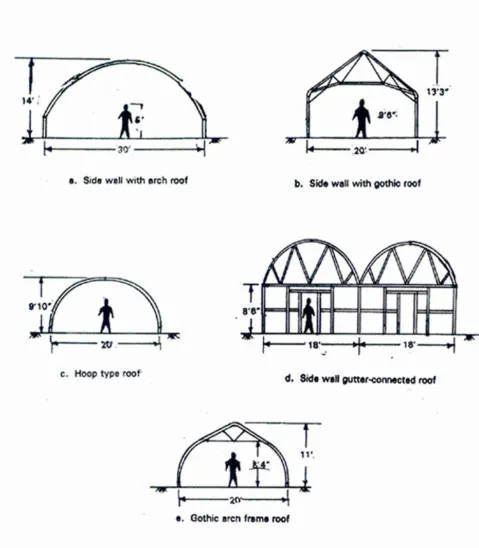
Structural planning decides the shape, span, height, and frame arrangement of the greenhouse.
The structure should:
- resist local wind and other loads
- minimize unnecessary shadow from structural members
- provide adequate working height
- suit the type of crop to be grown
For example:
- hoop or arch structures are common for low-cost polyhouses
- straight side-wall structures are better where tall crops or internal benches are needed
- gothic forms can improve side height while retaining structural strength
The final structure must suit both crop biology and engineering safety.
Choosing Covering Materials
Covering material strongly influences light transmission, heat conservation, durability, and cost.
Important selection criteria are:
| Criterion | Why it matters |
|---|---|
| Light transmission | Determines photosynthetic energy available to the crop |
| Weight | Affects structural design and handling |
| Impact resistance | Matters under hail, strong wind, or rough handling |
| Outdoor durability | Determines service life |
| Thermal behavior | Influences heat retention or overheating |
| Cost | Controls investment feasibility |
Typical service-life ranges are:
| Covering material | Approximate service life |
|---|---|
| Glass and acrylic sheet | About 20 years |
| Polycarbonate and FRP sheet | About 5-12 years |
| Ordinary polyethylene | Very short life, often only a season |
| UV-stabilized polyethylene | About 2-3 years |
What an Ideal Covering Material Should Do
An ideal covering material should:
- transmit visible light needed for photosynthesis
- limit unwanted radiation that causes overheating
- remain durable under outdoor exposure
- keep cost within economic limits
- provide useful life long enough to justify investment
In cool regions, higher thermal retention becomes more important. In hot regions, ventilation and heat-load management become more critical.
Summary Cheat Sheet
| Planning element | Main concern |
|---|---|
| Site selection | Level land, drainage, solar exposure, access, wind safety |
| Orientation | Better light interception and workable ventilation behavior |
| Structural planning | Strength, usable space, reduced shading, crop suitability |
| Covering material | Light transmission, durability, thermal behavior, cost |
| Ideal outcome | High crop performance with manageable construction and operating cost |
References
1 source • [1]
References
AENG252 Protected Cultivation and Post-Harvest Technology notes
Lesson Doubts
Ask questions, get expert answers