Principles of Organic Farming
Lecture notes covering Principles of Organic Farming as per ICAR 5th Dean Committee syllabus. Course Code: AGRO 107 | Credits: 2(1+1).
Frequently Asked Questions
What is AGRO 107 Principles of Organic Farming?
AGRO 107 is the BSc Agriculture course that introduces the concepts, principles, nutrient management, pest management, standards, and certification systems involved in organic farming. It helps students understand organic agriculture as a planned production system rather than simply farming without chemicals.
What is organic farming in simple words?
Organic farming is a system of agriculture that aims to maintain soil health, ecological balance, and long-term sustainability by relying more on biological processes, organic resources, and careful management than on synthetic chemical inputs. Its main focus is prevention and system design, not just substitution.
What is the difference between organic farming and conventional farming?
Conventional farming generally depends more on synthetic fertilizers and pesticides, while organic farming works within certification-based restrictions and emphasizes soil biology, composts, crop rotation, biocontrol, and ecological balance. Students are usually expected to compare them in terms of inputs, management, and long-term sustainability.
What nutrient sources are important in organic farming?
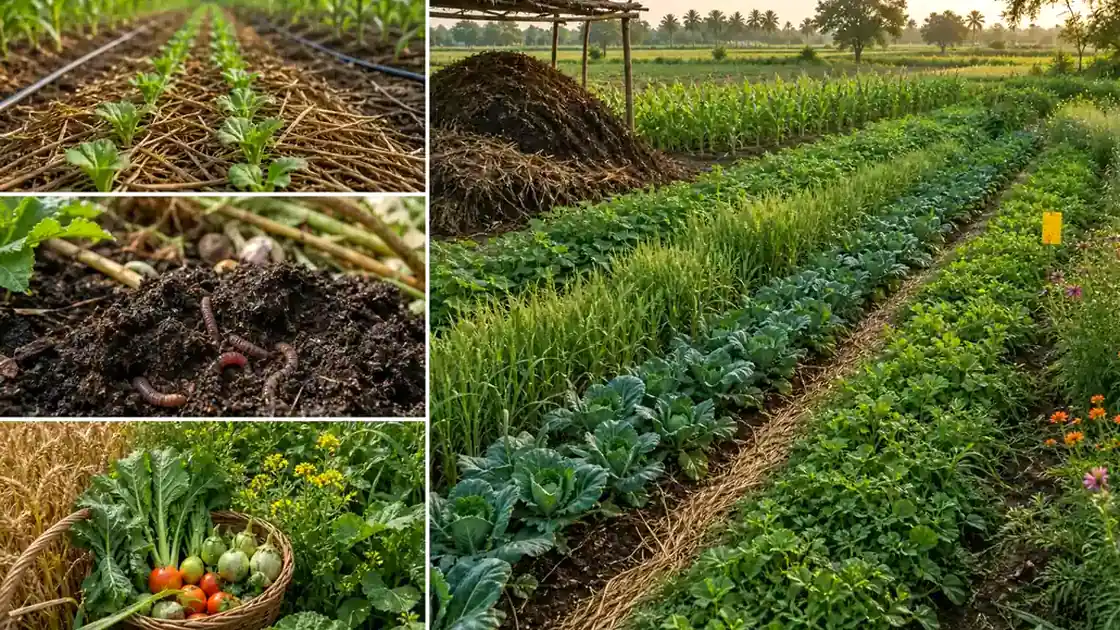
Important nutrient sources in organic farming commonly include compost, vermicompost, farmyard manure, green manures, crop residues, and approved biofertilizers or bio-inoculants. In AGRO 107, students study these resources along with restrictions on nutrient use under organic standards.
Is vermicompost important in AGRO 107?
Yes. Vermicompost is important because it is one of the practical organic nutrient sources commonly discussed and prepared in organic-farming training and labs. It is useful for understanding organic recycling, soil health, and nutrient management together.
How are pests, diseases, and weeds managed in organic farming?
Organic farming manages pests, diseases, and weeds through preventive and ecological approaches such as crop rotation, resistant varieties, sanitation, biological control, botanicals, habitat management, and approved low-risk inputs. The core idea is to build a resilient system rather than depend on routine synthetic control.
What is NPOP in organic farming?
NPOP stands for the National Programme for Organic Production in India. It is important in AGRO 107 because students are expected to understand the operational structure, standards, certification framework, and market trust associated with recognized organic production.
How should I prepare AGRO 107 for exams?
Prepare AGRO 107 by understanding principles, system comparisons, certification basics, nutrient sources, and organic crop-protection logic instead of memorizing isolated names. Students usually score better when they connect organic farming with soil health, standards, and real field management practices.