Rainfed Agriculture and Watershed Management
Lecture notes covering Rainfed Agriculture and Watershed Management as per ICAR 5th Dean Committee syllabus. Course Code: AGRO 309 | Credits: 2(1+1).
Frequently Asked Questions
What is AGRO 309 Rainfed Agriculture and Watershed Management?
AGRO 309 is the BSc Agriculture course that explains crop production under rainfall-dependent conditions together with watershed-based resource management. It helps students understand how to manage soil, water, drought risk, and crop planning where irrigation is limited or uncertain.
What is rainfed agriculture in simple words?
Rainfed agriculture is farming that depends mainly on rainfall rather than assured irrigation. It is important because a large share of crop production areas depend on seasonal rainfall and need management strategies that reduce moisture stress and climatic risk.
What are the main problems in rainfed agriculture?
The main problems usually include uncertain rainfall, drought, runoff losses, low soil-moisture storage, erosion, crop failure risk, and unstable yields. AGRO 309 studies these problems so students can understand why rainfed farming needs different planning from irrigated farming.
Why is water harvesting important in rainfed agriculture?
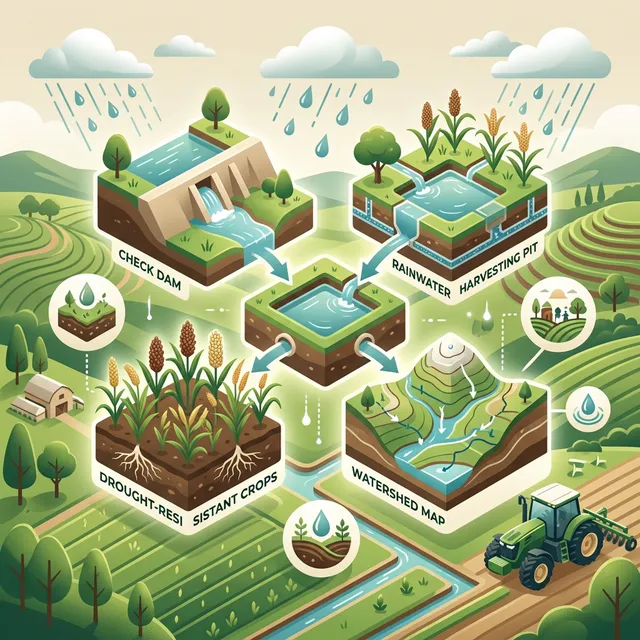
Water harvesting is important because it helps capture and store runoff or rainwater for later use, reducing moisture stress during dry spells. In AGRO 309, it is a key strategy for improving water availability and stability in rainfall-dependent farming systems.
What is supplemental irrigation in rainfed farming?
Supplemental irrigation is the limited application of water during critical crop stages when rainfall alone is not enough. It is important because even small amounts of timely water can protect yield better than waiting for full irrigation availability.
What is contingent crop planning for aberrant weather?
Contingent crop planning means adjusting crop choice, sowing time, variety, or management practice when weather behaves abnormally, such as delayed monsoon, long dry spells, or early withdrawal. Students study it because rainfed farming depends heavily on adaptation to weather uncertainty.
What is watershed management in agriculture?
Watershed management is the planned conservation and use of land, water, vegetation, and related resources within a natural drainage area. In agriculture, it is important because it links soil and moisture conservation with long-term productivity, runoff control, and community-level resource management.
How should I prepare AGRO 309 for exams and practicals?
Prepare AGRO 309 by understanding the logic of drought mitigation, moisture conservation, rainfall analysis, supplemental irrigation, water harvesting, and watershed components instead of memorizing terms in isolation. Students usually do better when they connect each concept to a real rainfed field problem and its practical solution.