Diseases of Field & Horticultural Crops & their Management-I
Lecture notes covering Diseases of Field & Horticultural Crops & their Management-I as per ICAR 5th Dean Committee syllabus. Course Code: PATH 272 | Credits: 3(2+1).
Frequently Asked Questions
What is PATH 272 in BSc Agriculture?
PATH 272 is an applied plant pathology course on major diseases of field and horticultural crops, focusing on symptoms, causal organisms, disease cycles, and practical management.
Why do students study crop diseases one by one in PATH 272?
They study diseases crop by crop because each crop has its own important pathogens, symptom patterns, favorable conditions, and management measures that must be recognized accurately in the field.
What are the most important things to remember for each crop disease?
The most important things are the symptom, causal organism, disease cycle or spread, favorable weather or field conditions, and the key management measures used under practical farming conditions.
Why is rice blast important in plant pathology?
Rice blast is important because it is one of the most destructive rice diseases, affecting leaves, nodes, and panicles and causing serious yield losses under favorable conditions.
Why is late blight important in tomato and potato disease study?
Late blight is important because it spreads rapidly under cool, humid conditions and can destroy foliage, fruits, and tubers, making it a classic example of severe epidemic disease.
What is integrated disease management in crop-specific diseases?
Integrated disease management means combining resistant varieties, clean seed or planting material, sanitation, crop rotation, field monitoring, cultural practices, and carefully timed chemical or biological measures.
Why do horticultural diseases appear frequently in this course with field-crop diseases?
They appear together because BSc Agriculture students need disease-recognition and management skills across both broad-acre crops and high-value horticultural crops.
Why do students collect and preserve disease specimens in practicals?
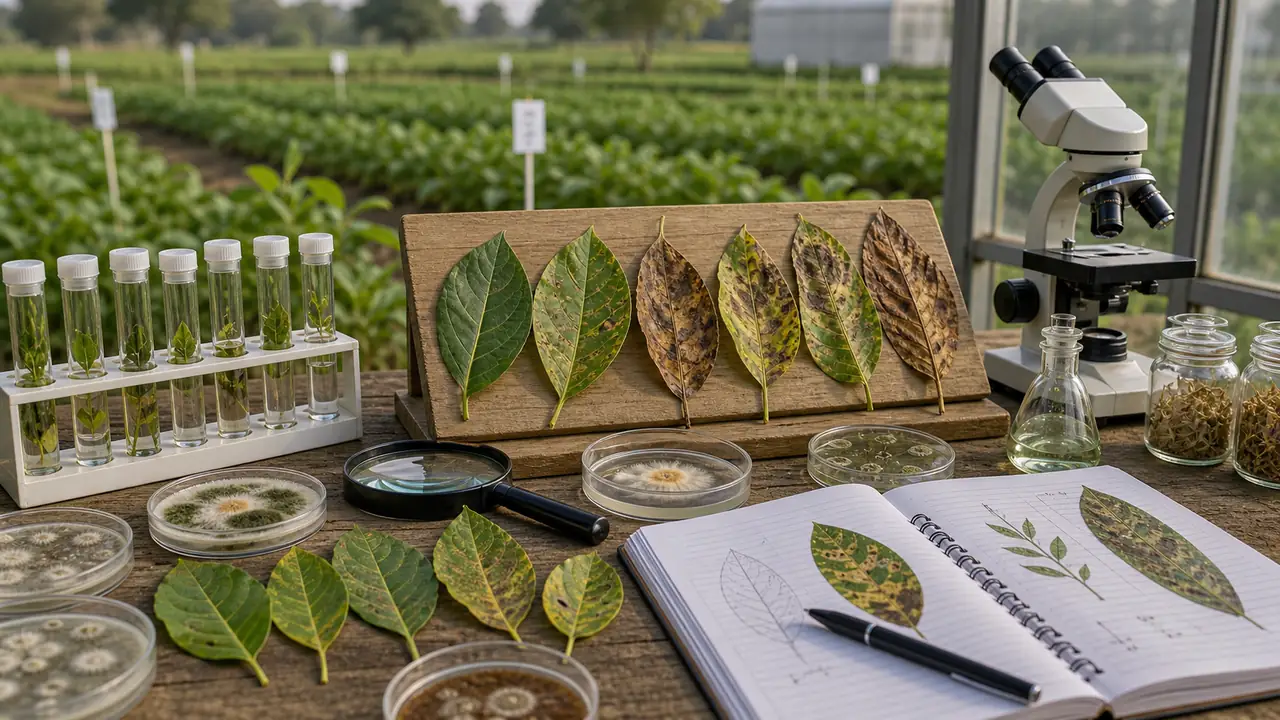
They do this because repeated observation of real symptoms and specimens improves disease recognition, diagnosis, and field memory far better than theory alone.