📈 Disease of Apple
Disease of Apple.
This lesson covers major apple diseases with clear exam-oriented points on pathogen identity, disease cycle, and management interventions.
Scab – Venturia inaequalis
Symptoms
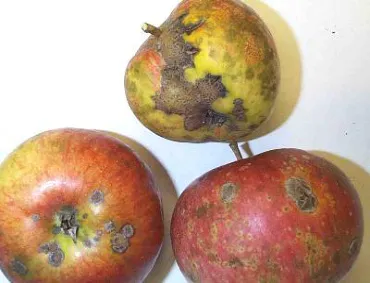
Symptom appears on leaves and fruits. On lower side of the leaf lesion appear as
olivaceous spots which turn dark brown to black and become velvety. On young foliage, the
spots have a radiating appearance with a feathery edge. On older leaves the lesions are more
definite in outline. The lesion may form a convex surface with corresponding concave area on
the opposite side. In severe infection leaf blade curved, dwarfed and distorted. Fruits show small,
rough, black circular lesions. The centre of the spots become corky and on mature fruits, yellow
halo is seen around the lesions.
Pathogen
The mycelium is internal. Ascospores are two celled, greenish, grey or yellowish in color.
Mode of Spread and Survival
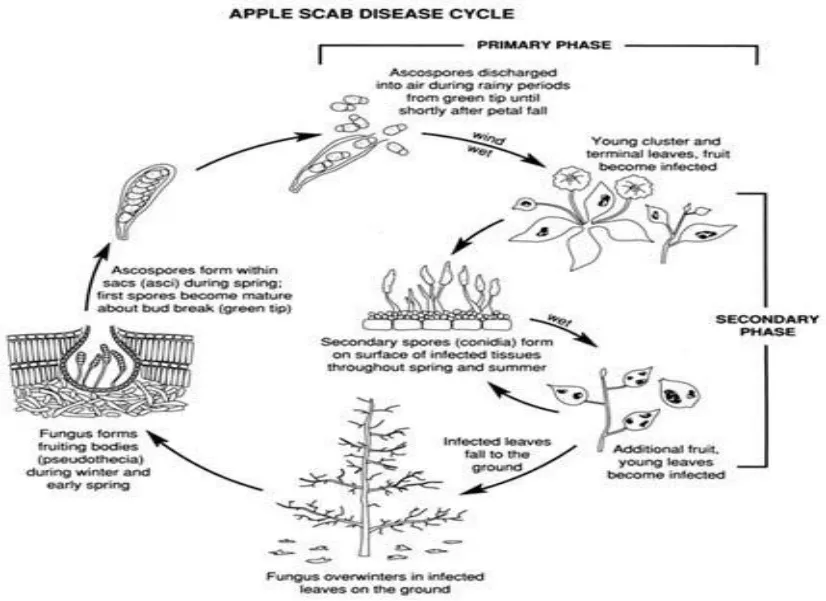
Pseudothecia formed in autumn and winter mature in spring to produce ascospores, the
chief inoculum for primary infection. The secondary spread is through conidia.
Disease cycle
This disease, caused by the fungus Venturia inaequalis (anamorph Spilocaea pomi ), may
be quite severe when rainy, cool weather occurs in the spring. Fungal spores are produced in
early spring on dead, fallen apple leaves about the time buds begin to develop. These spores are
splashed by rain and blown by wind to land on developing plant tissue and initiate infections.
After spots appear on the newly formed leaves, more spores are produced that spread infection to
other parts of the tree. Again, rainy weather greatly encourages spore spread and infection during
the secondary phase of spore production. The fungus over winters on fallen leaves.
Clean cultivation, collection and destruction of fallen leaves and pruned materials in
winter to prevent the sexual cycle. Spray Tridemorph 0.1% before flowering. Spray Mancozeb
0.25 % at bearing stage. Spray 5 % urea prior to leaf fall in autumn and 2 % before bud break to
hasten the decomposition of leaves.
| S.No | Tree stage | Fungicide/100lit |
|---|---|---|
| 1 | Silver tip to given tip | Captafol 200 gm (or) Captan 300 g or Mancozeb 400 g |
| 2 | Pink bud or 15 days after 1 st spray |
Captan 250 g or Mancozeb 300 g |
| 3 | Petal fall | Carbendazim 50 g |
| 4 | 10 days later | Captan 200 g.or Mancozeb 300g |
| 5 | 14 days after fruit set | Captofol 150 g |
Add stickers – teepol or triton 6 ml/10 lit of spray fluid.
Powdery mildew – Podosphaera leucotricha .
Symptom
Powdery mildew may be found on buds, blossoms, leaves, twigs, and fruit. In spring,
infected flower buds open 5-8 days later than healthy buds. The buds are killed or distorted.
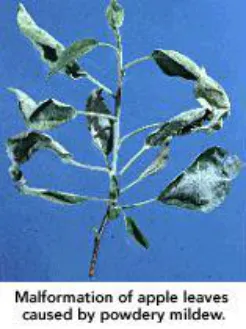
Symptoms first appear in the spring on the lower surface of leaves, usually at the ends of
branches. Small, whitish felt-like patches of fungal growth appear and quickly cover the entire
leaf. Diseased leaves become narrow, crinkled, stunted and brittle, which results in their drying
out and fall. The fungus spreads rapidly to twigs, which stop growing and become stunted. In
some cases the twigs may be killed back. Leaves and blossoms from infected buds will be
diseased when they open the next spring. Infected blossoms shrivel and produce no fruit. Fruit
symptoms are not usually seen unless the disease has built up to high levels on susceptible
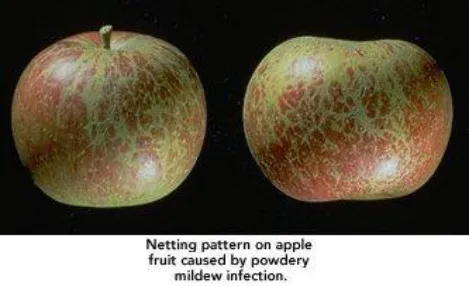
cultivars. The fruit surface may become russetted or discolored, and dwarfed. Heavily mildewed
trees are weakened, and are more susceptible to other pests and winter injury. It is the only
fungal apple disease that is capable of infecting without wetting from rain or dew. In nurseries
the fungus may spread to all developing leaves and cause stunting of vegetative terminal growth.
Pathogen
Powdery mildew is caused by, Podosphaera leucotricha, an ascomycetous heterothallic
fungus. Conidia are ellipsoidal, truncate and hyaline. Perithecia are subglobose, are densely
gregarious, and rarely scattered, and have apical and basal appendages. The asci in the perithecia
are oblong to subglobose. Eight ascospores are present in the ascus. The fungus over winters as
fungal strands (mycelium) in vegetative or fruit buds which were infected the previous season.
Mode of Spread and Survival
The fungus overwinters in the form of mycelium in diseased vegetative buds and fruits.
Secondary spread is through wind borne conidia.
Disease Cycle
The mildew fungus over winters mainly as mycelium in dormant blossom and shoot buds
produced and infected the previous growing season. Conidia are produced and released from the
unfolding leaves as they emerge from infected buds at about tight cluster stage. Conidia
germinate in the high relative humidity usually available on the leaf surface at 10-25˚C with an
optimum of 19-22˚C. Germination does not occur in free moisture. Early-season mildew
development is affected more by temperature than by relative humidity. Abundant sporulation
from over wintering shoots and secondary lesions on young foliage leads to a rapid buildup of
inoculum. Secondary infection cycles may continue until susceptible tissue is no longer
available. Since leaves are most susceptible soon after emergence, infection of new leaves may
occur as long as shoot growth continues. Fruit infection occurs from pink to bloom. Over
wintering buds are infected soon after bud initiation. Heavily infected shoots and buds are low in
vigor and lack winter hardiness, resulting in a reduction of primary inoculum at temperatures
below -24˚C.
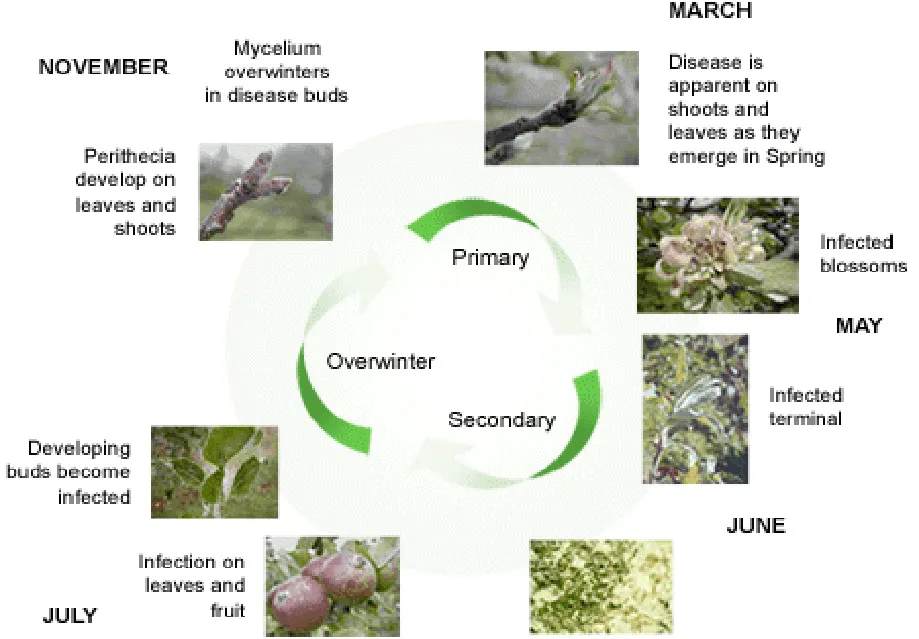 Management:
Spray Dinocap 0.05% or Chinomethionate 0.1%
Fire blight- Erwinia amylovora
Symptom
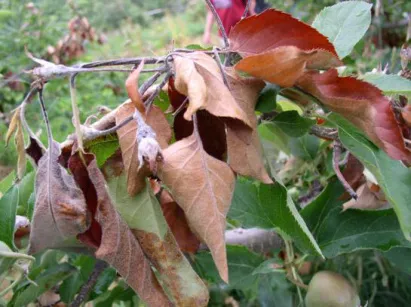
The initial symptom usually occurs on leaves, which become water soaked, then shrivel turn
brownish to black in colour and fall or remain hanging in tree. The symptom spread to twigs.
Terminal twigs wilt from tip to downward and also spread to branches.Fruits becomes water
soaked, turns brown, shrivels and finally becomes black. Oozing may be seen in the affected
area.
Pathogen
The bacterium is rod shaped and motile by peritrichous flagella. Bacterium occurs
usually singly but pairs or chais of 3 of 4 bacteria also exist. Each bacterial cell is enclosed in a
capsule.
Mode of Spread and Survival
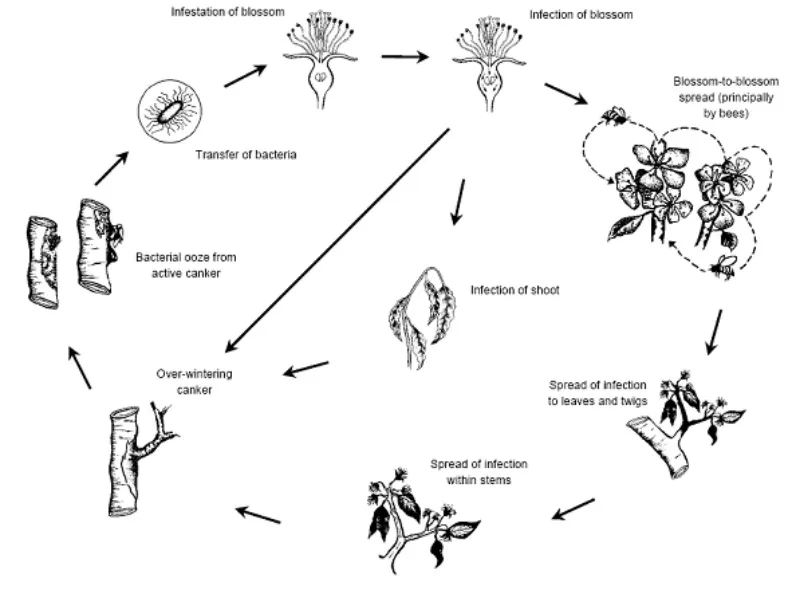
The bacterium overwinters at the margin of cankers formed during previous season. They
survive most often in large branches and seldom in twigs less than 1 cm in dia. Flies, Wasps and
honey bees and rain splashes spread the bacteria into freshly wounded tissues inside the leaf.
Young tender twigs are infected by bacteria through their lenticels, through wounds made by
various agents and through insects carrying bacteria and feeding on the twigs.
Disease Cycle
Management
Removal and destruction of affected parts. Removal of blighted twigs. Spray with
Streptomycin 500 ppm.
Soft rot – Penicillium expansum
Symptom
Young spots starts from stem end of the fruit as light brown watery rot. As the fruit
ripens area of the rotting increases, skin becomes wrinkled. A peculiar musty odour is emitted
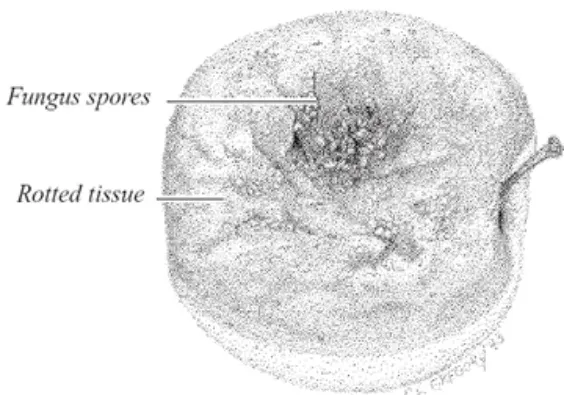 under humid condition a bluish green sporulating growth appears. Infection take place by
wounds in the skin caused by insects and during handing in storage and transport.
Pathogen
Conidiophores give rise to 1-3 main branches. They in turn produce crowdwd whorls of
branchlets. Conidia are formed in chains. Conidia are green or bluish green in mass .
Mode of Spread and Survival
The fungal spores are spread by air. Mycelium can infect through bruisedor wounded
fruits in close contact. Infection of the fruit usually take place through wounds in the skin, such
as wounds caused by insect bites, careless picking, rough handling during washing, grading,
packing, transit and storage. Infection is also through lenticels.
Disease cycle
Spores of the soft rot fungus are present almost everywhere and can survive long periods
of unfavorable conditions. Bulk bins, field crates, pack house lines, and storage rooms are
usually contaminated. Injuries to fruit, especially during picking and handling operations, are the
primary points of entry. At ordinary temperatures, infected fruit can rot in 2 weeks or less.
Management
Careful handling of fruits without causing any wounds. Dipping the fruits aureofunginsol
@ 500 ppm for 20 min gives best control.
Bitter rot – Glomerella cingulata
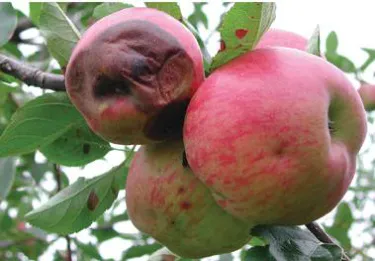
Symptom
Faint, light brown discolouration beneath the skin develops. The discolouration expands in a
cone shape. The circular, rough lesions become depressed. The lesions increased and covers
entire areas of fruits. Diny black dots appear beneath the cuticle which gives rise to acervuli .
Pink masses of spores are found arranged in defined rings.
Disease Cycle
The fungus over winters in mummified fruit, in cracks and crevices in bark, and in cankers
produced by the bitter rot fungus or by other diseases, such as fire blight. Jagged edges of broken
limbs are also ideal sites. The bitter rot fungus is one of the few rot organisms that can penetrate
unbroken skin of fruit. Although penetration is direct, wounds can be colonized rapidly by the
fungus. Spores are waterborne and are released during rainfall throughout the growing season.
Fruit infection can occur early but is more common from mid to late season. Often, the first
infections appear in cone-shaped areas within the tree beneath mummies or a canker. Factors
which determine the time of appearance of bitter rot are the maturity of fruit, temperature and
humidity, and the presence of disease in the area. The optimum conditions for disease
development include rainfall, relative humidity of 80 to 100 percent, and warm temperatures.
Infection can occur in as little as five hours at 26˚C.
Management
Spray Mancozeb 0.25 % in field. Treatment with Mancozeb 0.25 % to check the disease
in storage.
Summary Cheat Sheet
| Focus Area | Key Takeaway |
|---|---|
| Major diseases | Revise causal organisms, hallmark symptoms, and crop stage of attack. |
| Spread and survival | Link each disease with inoculum source, vector, and favorable conditions. |
| Management | Prioritize integrated management: sanitation, resistant varieties, and timely sprays. |
References
1 source • [1]
References
Class notes and standard plant pathology references
Lesson Doubts
Ask questions, get expert answers