📈 Diseases of Brinjal
Diseases of Brinjal.
This lesson discusses important brinjal diseases, including symptom complexes, pathogen details, spread mechanisms, and integrated management.
Bacterial Wilt : Pseudomonas solanacearum
Symptoms
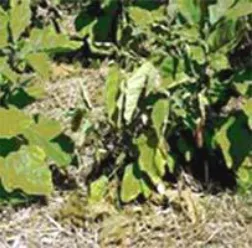
Bacterial wilt symptoms on leaf surface Wilting, stunting, yellowing of the foliage and
finally collapse of the entire plant are the characteristic symptoms of the disease. Lower leaves
may droop first before wilting occurs. The vascular system becomes brown. Bacterial ooze
comes out from the affected parts. Plant show wilting symptoms at noontime will recover at nights, but die
soon.
Pathogen
The bacterium is non acid fast, non spore forming, non capsulated and motile by a polar
flagellum. The bacterium produces acid but no gas in dextrose, sucrose, lactose and glycerol.
Starch hydrolyzed with slight liquefaction of gelatin.
Mode of spread and survival
The bacterium infects banana, chillies, fennel, ginger, potato, radish, tomato etc., the
bacterium though a non spore former is found to be alive and viable for more than 16 months
under laboratory conditions. The pathogen is found to be alive in the infected plant debris for
about 10 months. Presence of root knot nematode, Meloidogyne javanica increases the wilt
incidence.
Management
Use resistant variety .Crop rotation with cruciferous vegetables such as cauliflower help
in reducing the disease incidence. Fields should be kept clean and effected parts are to be
collected and burnt. Spray Copper fungicides to control the disease (2% Bordeaux mixture.). The
disease is more prevalent in the presence of root knot Nematodes, so control of these nematodes
will suppress the disease spread.
 Cercospora Leaf Spot : Cercospora solani -melongenae, C. solani
Symptoms
The leaf spots are characterized by chlorotic lesions, angular to irregular in shape, later
turn grayish-brown with profuse sporulation at the centre of the spot. Severely infected leaves
drop off prematurely, resulting in reduced fruit yield.
Pathogen
The fungus produces stromata which are globular. Conidiophores in mass are medium
dark and slightly olivaceous brown in colour and paler towards the tip. Conidia are sub hyaline
to pale olivaceous.
Mode of spread and survival
The disease is spread by air borne conidia.
Management
Pant Samrat variety is resistant to both the leaf spots. Diseases can be managed by
growing resistant varieties. Spraying 1 per cent Bordeaux mixture or 2 g Copper oxychloride or
2.5 g Zineb per litre of water effectively controls leaf spots.
Alternaria leaf Spot : Alternaria melongenae, A. solani
Symptoms
Cracks appearing in leaf spot. The two species of Alternaria occur commonly, causing
the characteristic leaf spots with concentric rings. The spots are mostly irregular, 4-8 mm in
diameter and may coalesce to cover large areas of the leaf blade. Severely affected leaves may
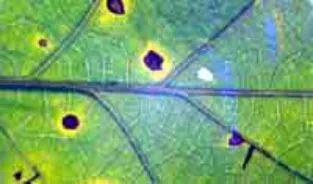
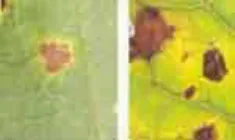 drop off. A. melongenae also infects the fruits causing large deep-seated spots. The infected
fruits turn yellow and drop off prematurely.
Pathogen
Mycelium is septate, branched, light brown to dark brown. It is inter and intra cellular.
Conidiophores emerge through stomata and dark colored. Conidia are single celled, muriform,
beaked and produced in chains. The conidia are with 5-10 transverse septa and a few longitudinal
or oblique septa.
Mode of spread and survival
The disease is spread by wind borne conidia.
Management
Spraying 1 per cent Bordeaux mixture or 2 g Copper oxychloride or 2.5 g Zineb per litre
of water effectively controls leaf spots.
Little Leaf of Brinjal
Economic Importance
This disease of brinjal was reported from India in 1938 and as far as known it occurs only
in India and Sri Lanka. In almost all the states of the country it has become a serious problem
facing brinjal cultivation. The yield loss is hundred per cent in the diseased plants.
Symptom
The characteristic symptom is the smallness of the leaves. The petioles are so short and
the leaves appear to be sticking to be stem. Such leaves are narrow, soft, smooth and yellow.
Newly formed leaves are much more shorter. The internodes of the stem are also shortened.
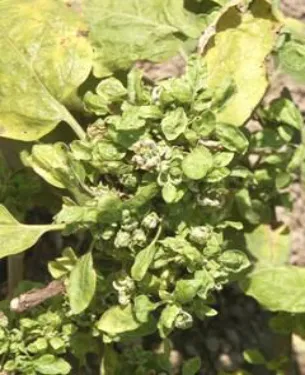 Axillary buds get enlarged but their petioles and leaves remain shortened. This gives the plant a
bushy appearance. Mostly, there is no flowering but if flowers are formed they remain green.
Fruiting is rare.
Pathogen
Little leaf was first considered a disease caused by a virus. In 1969 it was attributed to a
mycoplasma-like organism, closely related to aster-yellows and curly top.
It is a sap transmissible disease. The organism has been transmitted to Datura, tomato and
tobacco. It occurs in nature on Datura fastuosa and Vinca rosea . Natural transmission is through
a vector, Cestius phycytis ( Eutettix phycytis ) while Empoasca devastans is a less effective vector.
Perennation of the organism is through its weed hosts.
Mode of spread and survival
The disease is transmitted by leaf hoppers , Hishimonas phycitis and Empoasca devastans
and grafting. E. devastans is less effective vector. Perennation of virus is through weed host.
This disease has a very wide host range.
Management
The severity of the disease can be reduced by destruction of affected plants and spraying
of insecticides. New crop should be planted only when diseased plants in the field and its
neighbourhood have been removed.
| Methyldemeton 25 EC | 2 ml / litre |
|---|---|
| Dimethoate 30 EC | 2 ml/ litre |
| Malathion 50 EC | 2 ml/litre |
has been recommended for vector control.
Although mycoplasmas are reported to be suppressed by tetracyclines field application
of this method has not yet been recommended. Varietal resistance has not been systematically
studied. Cultivars such as Pusa Purple Cluster, Arka Sheel, Aushy, Manjari Gota and Banaras
Giant show moderate resistance to resistance in the field. Other cultivars found tolerant to the
disease are Black Beauty, Brinjal Round and Surati.
Damping off: Pythium aphanidermatum, Pythium indicum,, Phytophthora parasitica,
Rhizoctonia solani and Sclerotium rolfsii .
Symptom
Sudden collapsing of the seed lings occur in the seed bed. The seedlings are attacked at
the collar region and the attacked seedlings are toppled down. The disease spreads through fungi
present in the soil. The disease spreads through fungi present in the soil.
Management
The disease can be controlled by seed treatment with agrosan or ceresin @2gm/kg of
seed.
Tobacco mosaic virus (TMV)
Symptoms
Mosaic mottling of leaves and stunting of plants are the characteristic symptoms of potato
virus Y Mosaic symptoms are mild in early stages but later become severe. Infected leaves are
deformed, small and leathery. Very few fruits are produced on infected plants. The important
symptom produced by tobacco mosaic virus is conspicuous mottling of leaves. Leaves also
develop blisters in advanced cases. Severely infected leaves become small and misshapen. Plants
infected early remain stunted. PVY is easily sap transmitted.
It is transmitted in the field through aphids, Aphis gossypii and Myzus persicae and
perpetuates on weed hosts like Solanum nigrum and S.xanthocarpum. TMV is transmitted by
sap, contaminated implements and clothes, soil debris and hands of labour. It can perpetuate on many
cultivated plants like cucurbits, legumes, pepper, tobacco, tomato and weed hosts. The virus survives in plant debris
in soil.
Management
Destroy all weeds and avoid planting cucumber, pepper, tobacco, tomato near brinjal
seed beds and field. Wash hands with soap and water before working in seed beds. Prohibit
smoking or chewing of tobacco who are handling brinjal seedlings. Spray insecticides like
Dimethoate 2 ml/litre or Metasystox 1 ml/litre of water to control the insect vectors.
Collar rot : Sclerotium rolfsii
Symptoms
The disease occasionally occurs in serious form. The lower portion of the stem is affected
from the soil borne inoculum (sclerotia). Decortications is the main symptom. Exposure and
necrosis of underlying tissues may lead to collapse of the plant. Near the ground surface on the
stem may be seen the mycelia and sclerotia. Lack of plant vigour, accumulation of water around
the stem, and mechanical injuries help in development of this disease.
Management
Seed treatment with 4 g of Trichoderma viride formulation per kg seed will help in
reducing the disease. Spraying with Mancozeb @ 2g/Litre of water. Collection and destruction of
diseased parts and portions of the plant.
Fruit rot : Phomopsis vexans
Symptoms
Affects all above the ground plant parts. Spots generally appear first on seedling stems or
leaves. Girdle seedling stems and kill the seedlings. Leaf spots are clearly defined, circular, up to
about 1 inch in diameter, and brown to gray with a narrow dark brown margin. Fruit spots are
much larger, affected fruit are first soft and watery but later may become black and mummified.
Center of the spot becomes gray, and black pycnidia develop.
Pathogen
Pycnidia with or without beak are found in the affected tissue. They are globose or
irregular. Conidiophores in the pycnidium are hyaline, simple or branched. Conidia are hyaline,
one celled and sub cylindrical. Ascospores are hyaline, narrowly ellipsoid to bluntly fusoid with
one septum.
Mode of spread and survival
The fungus survives in the infected plant debris in the soil. It is seed borne. The spores
are spread by rain splashes. The fungus spreads through implements and insects.
Management
Seeds should be dipped in hot water at 50˚C for 30 min. spraying with difolation 0.2% or
captan 0.2% in the nursery and field at 7 – 10 days interval controls the disease. Deep summer
ploughing, three year crop roation and collection and destruction of diseased plant debris are
some of the other control methods. Spraying the crop in the field with zineb 0.2% or Bordeaux
mixture 0.8% is effective in controlling Phomopsis blight.
Summary Cheat Sheet
| Focus Area | Key Takeaway |
|---|---|
| Major diseases | Revise causal organisms, hallmark symptoms, and crop stage of attack. |
| Spread and survival | Link each disease with inoculum source, vector, and favorable conditions. |
| Management | Prioritize integrated management: sanitation, resistant varieties, and timely sprays. |
References
1 source • [1]
References
Class notes and standard plant pathology references
Lesson Doubts
Ask questions, get expert answers