🧫 Soil aggregates
Covers aggregate formation, stability, and their role in soil porosity and physical behavior.
Soil aggregates determine pore continuity, aeration, water movement, and erosion resistance. This lesson explains aggregate formation, stability, and their agronomic significance.
Soil aggregates are ‘clumps’ of soil particles that are held together by moist clay,
organic matter (such as roots), by organic compounds (from bacteria and fungi) and by
fungal hyphae ( pronounced “highfee” ). Aggregates vary in size from about 2 thousandths of
a millimetre across up to about 2 millimetres across, and are made up of particles of varying
sizes. Some of these particles fit closely together and some do not and this creates spaces
of many different sizes in the soil. These spaces, or pores, within and between soil
aggregates are essential for storing air and water, microbes, nutrients and organic matter.
Soils with many aggregates are called "well-aggregated". Such soils are more stable and
less susceptible to erosion.
There are two ways that bacteria could be involved in soil aggregation. One way is
by producing organic compounds called polysaccharides. Bacterial polysaccharides are more
stable than plant polysaccharides, resisting decomposition long enough to be involved in
holding soil particles together in aggregates. The other way bacteria are involved in soil
aggregation is by developing a small electrostatic charge that attracts the electrostatic
charge on clay surfaces, bringing together small aggregates of soil.
Fungi grow in long, threadlike structures, called hyphae. The amount of aggregation
in the soil has been found to relate to the length of fungal hyphae in the soil. Fungi help to
form aggregates in the soil by enmeshing soil particles with their hyphae and forming cross
links between soil particles. Mycorrhizal fungi and fungi that colonise fresh organic matter
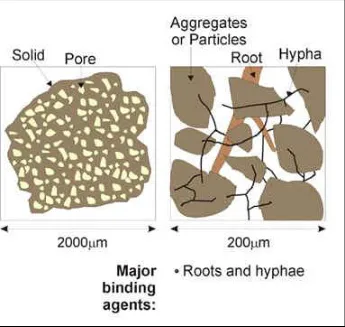
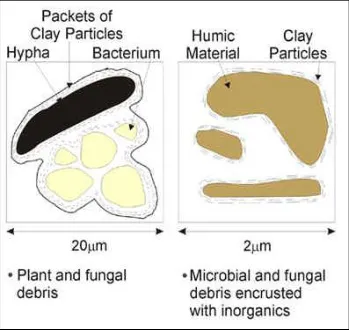 are believed to be the most important for assisting with stabilisation of soil particles into
aggregates.
Significance of soil aggregation
Crop growth is often constrained by poor root development, by slow water infiltration
and water movement through the soil, and by poor soil aeration. These constraints are often
associated with poor soil porosity. Soil aggregation is important to developing and
maintaining good soil porosity and hence to good root growth and to movement of soil
water and gases. With more soil in water stable aggregates, it is expected that:
-
The rate of water infiltration and percolation will increase
-
Soil crusting will be less – which improved root penetration and access to soil
moisture and nutrients and emergence of seedlings
- Resistance to the splash effect of raindrops will increase and soil erodibility will
decrease; and
- Runoff will decrease, making more water available to the crop.
The importance of soil physical properties to crop growth, including soil aggregation
properties, is often under-estimated by producers, and practical exercises can be useful in
conveying information on the importance of these properties.
Soil Consistence
Soil consistence is defined as “the resistance of a soil at various moisture contents
to mechanical stresses or manipulations”.
It combines both the ‘ cohesive ’ and ‘ adhesive ’ forces, which determine the ease
with which a soil can be reshaped or ruptures.
Adhesion
Molecular attraction that holds the surfaces of two substances (eg. Water and soil particles) in contact
Cohesion
Holding together: force holding a solid or liquid together, owing to attraction between like molecules. Decreases with rise in temperature
Soil consistence is described at three moisture levels namely ‘wet’, ‘moist’ and
‘dry’.
1. Wet soils : Consistency is denoted by terms stickiness and plasticity
Stickiness is grouped into four categories namely i) non sticky, ii) slightly
sticky, iii) sticky and iv) very sticky
Plasticity of a soil is its capacity to be moulded (to change its shape
depending on stress) and to retain the shape even when the stress is
removed. Soils containing more than about 15% clay exhibit plasticity –
pliability and the capacity of being molded. There are four degrees in
plasticity namely i) non plastic, ii) slightly plastic, iii) plastic and iv) very
plastic.
2. Moist soil : Moist soil with least coherence adheres very strongly and resists
crushing between the thumb and forefinger. The different categories are
i. Loose-non coherent
ii. Very friable - coherent, but very easily crushed
iii. Friable - easily crushed
iv. Firm - crushable with moderate pressure
v. Very firm - crushable only under strong pressure
vi. Extremely firm - completely resistant to crushing. (type and amount
of clay and humus influence this consistency)
3. Dry soil : In the absence of moisture, the degree of resistance is related to the
attraction of particles for each other. The different categories are
i) Loose - non coherent
ii) Soft - breaks with slight pressure and becomes powder
iii) Slightly hard - break under moderate pressure
iv) Hard - breaks with difficulty with pressure
v) Very hard - very resistant to pressure
vi) Extremely hard - extreme resistance and cannot be broken
Soil crusting
Formation mechanism:
Soil crusts usually are formed as a result of compaction at the immediate surface
due to an externally applied force. This force is supplied primarily by the impact of
raindrops as the soil is wetted and the radiant energy of the sun as the soil dries.
When the rain drops fall on dry soil.
Bulk density and particle density of soils & porosity
Particle Density
The weight per unit volume of the solid portion of soil is called particle density.
Generally particle density of normal soils is 2.65 grams per cubic centimeter. The particle
density is higher if large amount of heavy minerals such as magnetite, limonite and hematite are
present in the soil. With increase in organic matter of the soil the particle density decreases.
Particle density is also termed as true density.
Table Particle density of different soil textural classes
| Textural class | 3 Particle density (g/ cm ) |
|---|---|
| Coarse sand | 2.655 |
| Fine sand | 2.659 |
| Silt | 2.798 |
| Clay | 2.837 |
Bulk Density
The oven dry weight of a unit volume of soil inclusive of pore spaces is called bulk
density. The bulk density of a soil is always smaller than its particle density. The bulk density of
, whereas that of organic matter is about 0.5. Bulk density normally
sandy soil is about 1.6 g / cm
decreases, as mineral soils become finer in texture. The bulk density varies indirectly with the
total pore space present in the soil and gives a good estimate of the porosity of the soil. Bulk
density is of greater importance than particle density in understanding the physical behavior of
the soil. Generally soils with low bulk densities have favorable physical conditions.
Bulk density of different textural classes
| Textural class | Bulk density (g/cc) | Pore space (%) |
|---|---|---|
| Sandy soil | 1.6 | 40 |
| Loam | 1.4 | 47 |
| Silt loam | 1.3 | 50 |
| Clay | 1.1 | 58 |
Factors affecting bulk density
Pore space
Since bulk density relates to the combined volume of the solids and pore
spaces, soils with high proportion of pore space to solids have lower bulk
densities than those that are more compact and have less pore space.
Consequently, any factor that influences soil pore space will affect bulk
density.
Texture
Fine textured surface soils such as silt loams, clays and clay loams
generally have lower bulk densities than sandy soils. This is because the fine
textured soils tend to organize in porous grains especially because of
adequate organic matter content. This results in high pore space and low
bulk density. However, in sandy soils, organic matter content is generally
low, the solid particles lie close together and the bulk density is commonly
higher than in fine textured soils.
Organic matter content
More the organic matter content in soil results in high pore space there by
shows lower bulk density of soil and vice-versa.
Porosity
Soil porosity refers to that part of a soil volume that is not occupied by soil
particles or organic matter.
The pore space of a soil is the space occupied by air and water. The amount
or ratio of pore space in a soil is determined by the arrangement of soil particles
like sand, silt and clay. In sandy soils, the particles are arranged closely and the
pore space is low. In clay soils, the particles are arranged in popous aggregates and
the pore space is high. Presence of organic matter increases the pore space.
Factors influencing pore space
Soil texture
Sandy surface soil : 35 to 50 %
Medium to fine textured soils : 50 to 60 %
Compact sub soils : 25 to 30%
Crops / vegetation
Some crops like blue grass increases the porosity to 57.2% from the original 50%
Cropping reduces the porosity as cultivation reduces the organic matter content and
hence decrease in granulation. Virgin soils have more pore space.
Continuous cropping reduces pore space than intermittent cropping. More the
number of crops per year, lesser will be the pore space particularly macro pores.
Conservation tillage and no tillage reduces porosity than conventional tillage
Size of pores
-
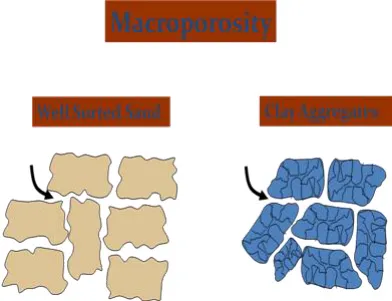
Macro pores (non-capillary pores) : diameter >0.05 mm
-
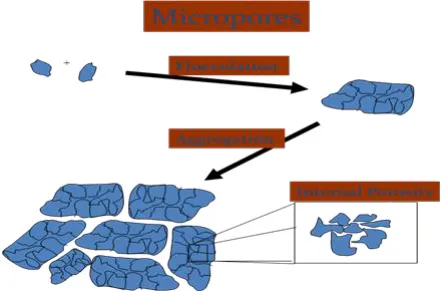
Micro pores (capillary pores) : diameter < 0.05 mm
In macro pores, air and water moves freely due to gravitation and mass flow. In
micro pores, the movement of air and water is very slow and restricted to capillary
movement and diffusion.
Sandy soil have more macro pores and clay soils have more micro pores. So in
sandy soils, water and air movement is rapid due to macro pores though the pore
space is higher and in clay soils the air and water is slower due to micro pores
though the total pore space is higher.
Loamy soils will have 50% porosity and have equal portion of macro and micro
pores.
Significance and manipulation of soil porosity
The bulk density and pore space are inter related. Development of low bulk
density values also means the development of large amount of pore spaces. In
nature, low bulk density values are usually found in soilswith high organic matter
contents. High biological activities are necessary for formation and large
accumulation of organic matter. Together with the effect of soil organisms, the
high humus content will encourage aggregation, increasing in this way soil
porosity, and thereby decreasing bulk density values. The cultivation effect of the
 soil macro and micro fauna produces an intricate system of macropores, which is a
major factor for lowering the bulk density of soil. Continous cropping is noted to
decrease the amount of organic matter in soils, and is expected to decrease soil
aggregation. Tillage by ploughing is designed to increase the pore space in soils,
but is infact decrasing organic matter. To alleviate these problems conservation
tillage and no tillage have been introduced. Though many claimed that this
increased the organic matter, the later have not always increased the total pore
space.
*
Summary Cheat Sheet
Quick Recall Points
- Soil aggregates are clusters of particles bound by organic matter, clays, and oxides.
- Stable aggregation improves infiltration, aeration, and resistance to erosion.
- Atterberg limits describe consistency behavior with changing moisture.
Exam Traps
- High clay does not always mean good aggregation; organic matter and biology matter.
- Poor aggregation can lead to crusting and restricted seedling emergence.
References
2 sources • [1] [2]
References
Lesson Doubts
Ask questions, get expert answers