🧫 Soil Compaction, Colour, and Density
Explains compaction, colour interpretation, density, and porosity for practical soil evaluation.
This lesson introduces soil compaction and soil colour as key physical indicators used to interpret soil behavior and field conditions.
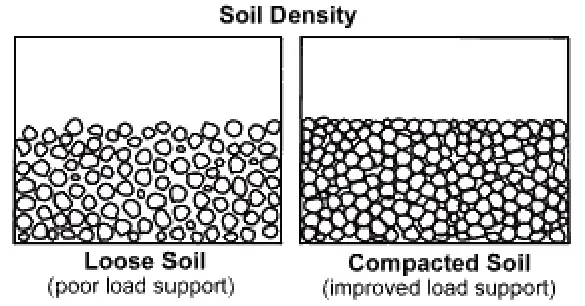
Soil compaction
Soil compaction is defined as the method of mechanically increasing the
density of soil. In construction, this is a significant part of the building process. If
performed improperly, settlement of the soil could occur and result in unnecessary
maintenance costs or structure failure. Almost all types of building sites and
construction projects utilize mechanical compaction techniques.
Soil Colour
Soil colour indicates many soil features. A change in soil colour from the
adjacent soils indicates a difference in the soil`s mineral origin (parent material) or
in the soil development. Soil colour varies among different kinds as well as within
the soil profile of the same kind of soil. It is an important soil properties through
which its description and classification can be made.
Kinds of soil colour
Soil colour is inherited from its parent material and that is referred to as
lithochromic, e.g. red soils developed from red sandstone. Besides soil colour also
develops during soil formation through different soil forming processes and that is
referred to as acquired or pedochromic colour, e.g. red soils developed from
granite or schist.
Factors affecting soil colour
There are various factors or soil constituents that influence the soil colour which
are as follows:
Organic matter: soils containing high amount of organic matter show the
colour variation from black to dark brown.
Iron compounds: soil containing higher amount of iron compounds
generally impart red, brown and yellow tinge colour.
Silica, lime and other salts: Sometimes soils contain either large amounts
of silica and lime or both.
Due to presence of such materials in the soil the colour of the soil appears like
white or light coloured.
Mixture of organic matter and iron oxides: Very often soils contain a
certain amount of organic matter and iron oxides. As a result of their
existence in soil, the most common soil colour is found and known as
brown.
Alternate wetting and drying condition: During monsoon period due to
heavy rain the reduction of soil occurs and during dry period the oxidation of
soil also takes place.due to development of such alternating oxidation and
reduction condition,the colour of soil in different horizons of the soil profile
is variegated or mottled. This mottled colour is due to residual products of
this process especially iron and manganese compounds.
Oxidation-reduction conditions: when soils are waterlogged for a longer
period, the permanent reduced condition will develop. The presence of
ferrous compounds resulting from the reducing condition in waterlogged
soils impart bluish and greenish colour.
Therefore, it may be concluded that soil colour indirectly indicative of many
other important soil properties.besides soil colour directly modify the soil
temperature e.g.dark coloured soils absorb more heat than light coloured
soils.
Determination of soil colour
The soil colours are best determined by the comparison with the Munsell
colour.
This colour chart is commonly used for this purpose.the colour of the soil is a
result of the light reflected from the soil.soil colour rotation is divided into three
parts:
Hue - it denotes the dominant spectral colour (red,yellow,blue and green).
Value - it denotes the lightness or darkness of a colour (the amount of reflected
light).
Chroma - it represents the purity of the colour (strength of the colour).
The Munsell colour notations are systematic numerical and letter designations of
each of these three variables (Hue,Value and Chroma).For example,the numerical
notation 2.5 YR6/6 suggests a hue of 2.5 YR,value of 5 and chroma of 6. The
equivalent or parallel soil colour name for this Munsell notation is red.
Soil water
Water, an excellent solvent for most of the plant nutrients,is a primary requisite for
plant growth,
Importance of Soil Water
Soil water serves as a solvent and carrier of food nutrients for plant growth
Yield of crop is more often determined by the amount of water available
rather than the deficiency of other food nutrients
Soil water acts as a nutrient itself
Soil water regulates soil temperature
Soil forming processes and weathering depend on water
Microorganisms require water for their metabolic activities
Soil water helps in chemical and biological activities of soil
It is a principal constituent of the growing plant
Water is essential for photosynthesis
Water serves four functions in plants:
it is the major constituents of plant protoplasm(85-95%)
it is essential for photosynthesis and conversion of strarches to sugars
it is the solvent in which nutrients move into and through plant parts to
capture sunlight.
In fact, the soil water is a great regulator of physical, chemical and
biological activities in the soil.
Plants absorb some water through leaf stomata (openings), but most of the water
used by plants is absorbed by the roots from the soil. For optimum water used, it is
vital to know how water moves into and through the soil, how the soil stores water,
how the plant absorbs it, how nutrients are lost from the soil by percolation, and
how to measure soil water content and losses.
Soil also serves as a regulated reservoir for water because it receives precipitation
and irrigation water.
A representative cultivated loam soil contains approximately 50% solid particles
(sand, silt, clay and organic matter), 25% air and the rest 25%mater.only half of
this water is available to plants because of the mechanics of water storage in the
soil.
Structure of water
Water can participate in a series of reactions occurring in soils and plants,
only because of its structural behavior. Water is simple compound, its individual
molecules containing one oxygen atom and two much smaller hydrogen atoms.
The elements are bonded together covalently, each hydrogen or proton sharing its
single electron with the oxygen. Instead of the atoms being arranged linearly (H-O
H) the hydrogen atoms are attached to the oxygen as a v shaped.
Factors Affecting Soil Water
1. Texture: Finer the texture, more is the pore space and also surface area, greater
is the retention of water.
2. Structure: Well-aggregated porous structure favors better porosity, which in
turn enhance water retention.
3. Organic matter: Higher the organic matter more is the water retention in the
soil.
4. Density of soil: Higher the density of soil, lower is the moisture content.
5. Temperature: Cooler the temperature, higher is the moisture retention.
6. Salt content: More the salt content in the soil less is the water available to the
plant.
7. Depth of soil: More the depth of soil more is the water available to the plant.
8. Type of clay: The 2:1 type of day increases the water retention in the soil.
Classification of soil water
Soil water has been classified from a physical and biological point of view
as Physical classification of soil water, and biological classification of soil water.
Physical classification of soil water
i) Gravitational water ii) Capillary water and iii) Hygroscopic water
1. Gravitational water: Gravitational water occupies the larger soil pores (macro
pores) and moves down readily under the force of gravity. Water in excess of the
field capacity is termed gravitational water. Gravitational water is of no use to
plants because it occupies the larger pores. It reduces aeration in the soil. Thus, its
removal from soil is a requisite for optimum plant growth. Soil moisture tension at
gravitational state is zero or less than 1/3 atmosphere.
Factors affecting gravitational water
i. Texture: Plays a great role in controlling the rate of movement of gravitational
water. The flow of water is proportional to the size of particles. The bigger the
particle, the more rapid is the flow or movement. Because of the larger size of
pore, water percolates more easily and rapidly in sandy soils than in clay soils.
ii. Structure: It also affects gravitational water. In platy structure movement of
gravitational water is slow and water stagnates in the soil. Granular and crumby
structure helps to improve gravitational water movement. In clay soils having
single grain structure, the gravitational water, percolates more slowly. If clay soils
form aggregates (granular structure), the movement of gravitational water
improves.
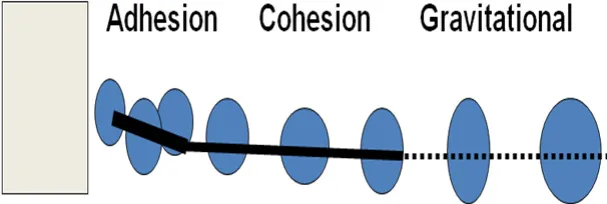
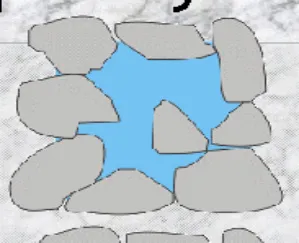
2. Capillary water: Capillary water is held in the capillary pores (micro pores).
Capillary water is retained on the soil particles by surface forces. It is held so
strongly that gravity cannot remove it from the soil particles. The molecules of
capillary water are free and mobile and are present in a liquid state. Due to this
reason, it evaporates easily at ordinary temperature though it is held firmly by the
soil particle; plant roots are able to absorb it. Capillary water is, therefore, known
as available water. The capillary water is held between 1/3 and 31 atmosphere
pressure.
Factors affecting capillary water
 The amount of capillary water that a soil is able to hold varies considerably.
The following factors are responsible for variation in the amount of capillary
water.
i. Surface tension: An increase in surface tension increases the amount of
capillary water.
ii. Soil texture: The finer the texture of a soil, greater is the amount of capillary
water holds. This is mainly due to the greater surface area and a greater number of
micro pores.
iii. Soil structure: Platy structure contains more water than granular structure.
iv. Organic matter: The presence of organic matter helps to increase the capillary
capacity of a soil. Organic matter itself has a great capillary capacity.
Undecomposed organic matter is generally porous having a large surface area,
which helps to hold more capillary water. The humus that is formed on
decomposition has a great capacity for absorbing and holding water. Hence the
presence of organic matter in soil increases the amount of capillary water in soil.
3. Hygroscopic water: The water that held tightly on the surface of soil colloidal
particle is known as hygroscopic water. It is essentially non-liquid and moves
primarily in the vapour form.
Hygroscopic water is held very tenaciously (31 to 10000 atmosphere) by soil
particles that plants cannot absorb it. Some microorganism may utilize hygroscopic
water. As hygroscopic water is held tenaciously by surface forces its removal from
the soil requires a certain amount of energy. Unlike capillary water which
evaporates easily at atmospheric temperature, hygroscopic water cannot be
separated from the soil unless it is heated
Factors affecting hygroscopic water:
Hygroscopic water is held on the surface of colloidal particles by the dipole
orientation of water molecules. The amount of hygroscopic water varies inversely
with the size of soil particles. The smaller the particle, the greater is the amount of
hygroscopic water it adsorbs.
Fine textured soils like clay contain more hygroscopic water than coarse - textured
soils. The amount of clay and also its nature influences the amount of hygroscopic
water. Clay minerals of the montmoril1onite type with their large surface area
adsorb more water than those of the kaolinite type, while illite minerals are
intermediate.
B. Biological Classification of Soil Water: There is a definite relationship
between moisture retention and its utilization by plants. This classification based
on the availability of water to the plant. Soil moisture can be divided into three
parts.
i. Available water: The water which lies between wilting coefficient and field
capacity. It is obtained by subtracting wilting coefficient from moisture equivalent.
ii. Unavailable water: This includes the whole of the hygroscopic water plus a
part of the capillary water below the wilting point.
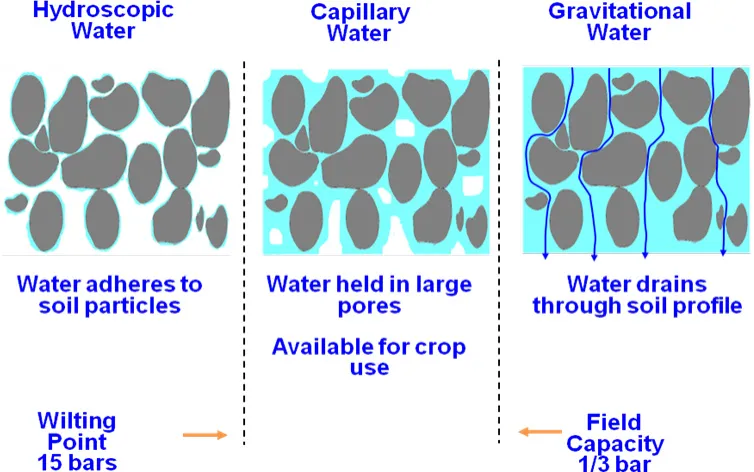 iii. Super available or superfluous water: The water beyond the field capacity
stage is said to be super available. It includes gravitational water plus a part of the
capillary water removed from larger interstices. This water is unavailable for the
use of plants. The presence of super-available water in a soil for any extended
period is harmful to plant growth because of the lack of air.
Summary Cheat Sheet
Quick Recall Points
- Compaction increases bulk density and reduces macroporosity.
- Soil colour is interpreted through the Munsell system (hue, value, chroma).
- Density and porosity directly affect root growth and water movement.
Exam Traps
- High bulk density generally indicates greater compaction stress.
- Soil colour indicates drainage and organic matter trends but is not a standalone fertility test.
References
2 sources • [1] [2]
References
Lesson Doubts
Ask questions, get expert answers