🧫 Soil Water Retention and Moisture Constants
Covers field capacity, wilting point, and plant-available water for irrigation and crop planning.
Retention of Water by Soil
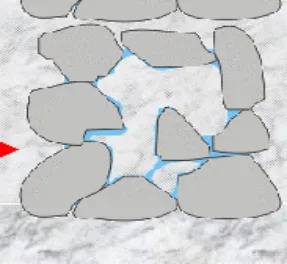
The soils hold water (moisture) due to their colloidal properties and aggregation
qualities. The water is held on the surface of the colloids and other particles and in
the pores. The forces responsible for retention of water in the soil after the drainage
has stopped are due to surface tension and surface attraction and are called surface
moisture tension. This refers to the energy concept in moisture retention
relationships. The force with which water is held is also termed as suction.
The water retained in the soil by following ways
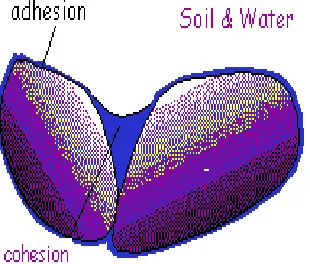
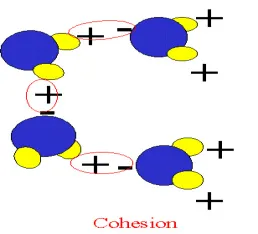
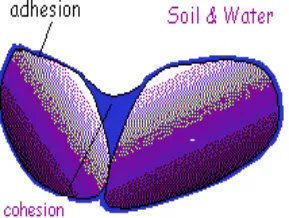
1. Cohesion and adhesion forces: These two basic forces are responsible for
water retention in the soil. One is the attraction of molecules for each other i.e.,
cohesion. The other is the attraction of water molecules for the solid surface of soil
i.e. adhesion. By adhesion, solids (soil) hold water molecules rigidly at their soil
water interfaces. These water molecules in turn hold by cohesion. Together, these
forces make it possible for the soil solids to retain water.
Adhesion
Cohesion
2. Surface tension: This phenomenon is commonly evidenced at water- air
interfaces. Water behaves as if its surface is covered with a stretched elastic
membrane. At the surface, the attraction of the air for the water molecules is much
less than that of water molecules for each other. Consequently, there is a net
downward force on the surface molecules, resulting in sort of a compressed film
(membrane) at the surface. This phenomenon is called surface tension.
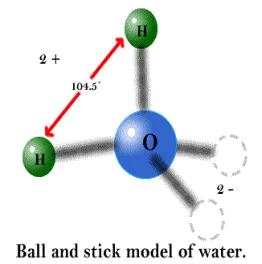
3. Polarity or dipole character: The retention of water molecules on the surface
of clay micelle is based on the dipole character of the molecule of water. The water
molecules are held by electrostatic force that exists on the surface of colloidal
particles. By virtue of their dipole character and under the influence of electrostatic
forces, the molecules of water get oriented (arranged) on the surface of the clay
particles in a particular manner.
Each water molecule carries both negative and positive charges. The clay particle
is negatively charged. The positive end of water molecule gets attached to the
negatively charged surface of clay and leaving its negative end outward. The water
molecules attached to the clay surface in this way present a layer of negative
charges to which another layer of oriented water molecules is attached. The
number of successive molecular layers goes on increasing as long as the water
molecules oriented. As the molecular layer gets thicker, orientation becomes
weaker, and at a certain distance from the particle surface the water molecules
cease to orientate and capillary water (liquid water) begins to appear. Due to the
 forces of adsorption (attraction) exerted by the surface of soil particles, water gets
attached on the soil surface. The force of gravity also acts simultaneously, which
tries to pull it downwards. The surface force is far greater than the force of gravity
so water may remain attached to the soil particle. The water remains attached to the
soil particle or move downward into the lower layers, depending on the
magnitudeof the resultant force.
Potentials
Soil water potential :
The retention and movement of water in soils, its uptake and translocation in
plants and its loss to the atmosphere are all energy related phenomenon. The more
strongly water is held in the soil the greater is the heat (energy) required. In other
words, if water is to be removed from a moist soil, work has to be done against
adsorptive forces. Conversely, when water is adsorbed by the soil, a negative
amount of work is done. The movement is from a zone where the free energy of
water is high (standing water table) to one where the free energy is low (a dry soil).
This is called soil water energy concept.
Free energy of soil solids for water is affected by:
i) Matric (solid) force i.e., the attraction of the soil solids for water (adsorption)
which markedly reduces the free energy (movement) of the adsorbed water
molecules.
ii) Osmotic force i.e ., the attraction of ions and other solutes for water to reduce
the free energy of soil solution.
Matric and Osmotic potentials are negative and reduce the free energy level of the
soil water. These negative potentials are referred as suction or tension.
iii) Force of gravity : This acts on soil water, the attraction is towards the earth's
center, which tends to pull the water down ward. This force is always positive. The
difference between the energy states of soil water and pure free water is known as
soil water potential. Total water potential (Pt) is the sum of the contributions of
gravitational potential (Pg), matric potential (Pm) and the Osmotic potential or
solute potential (Po).
Pt = Pg + Pm + Po
Potential represents the difference in free energy levels of pure water and of soil
water. The soil water is affected by the force of gravity, presence of soil solid
(matric) and of solutes.
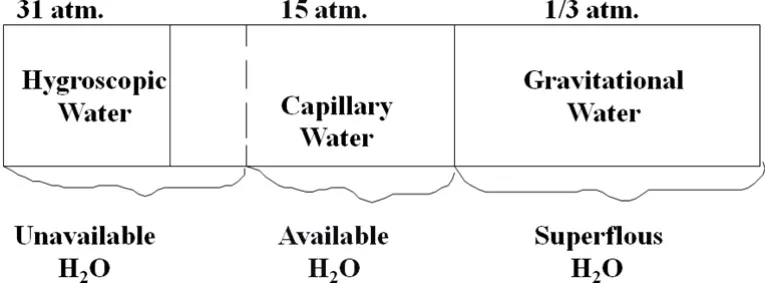
Soil moisture constants
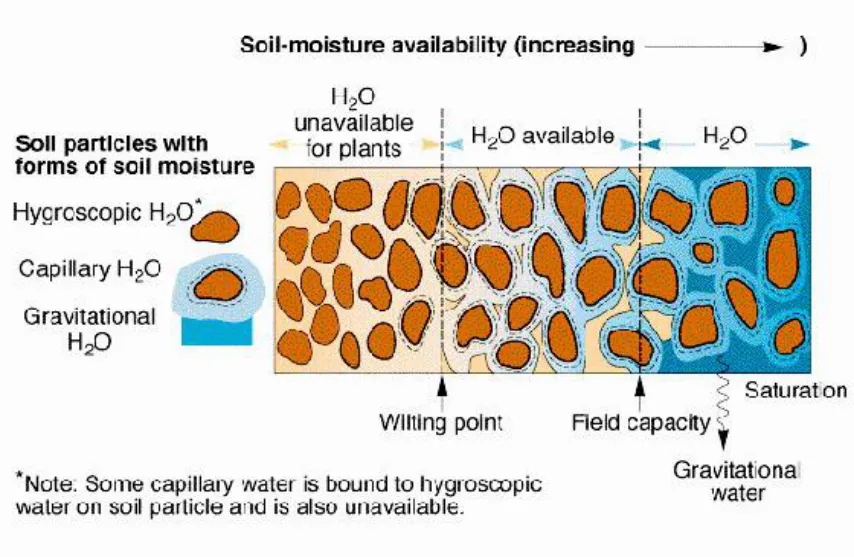
Earlier classification divided soil water into gravitational, capillary and
hygroscopic water. The hygroscopic and capillary waters are in equilibrium with
the soil under given condition. The hygroscopic coefficient and the maximum
capillary capacity are the two equilibrium points when the soil contains the
maximum amount of hygroscopic and capillary waters, respectively. The amount
of water that a soil contains at each of these equilibrium points is known as soil
moisture constant.
The soil moisture constant, therefore, represents definite soil moisture relationship
and retention of soil moisture in the field.
The three classes of water (gravitational, capillary and hygroscopic) are however
very broad and do not represent accurately the soil - water relationships that exists
under field conditions.
Though the maximum capillary capacity represents the maximum amount of
capillary water that a soil holds, the whole of capillary water is not available for
the use of the plants. A part of it, at its lower limit approaching the hygroscopic
coefficient is not utilized by the plants. Similarly a part of the capillary water at its
upper limit is also not available for the use of plants. Hence two more soil
constants, viz., field capacity and wilting coefficient have been introduced to
express the soil-plant-water relationships as it is found to exist under field
conditions.
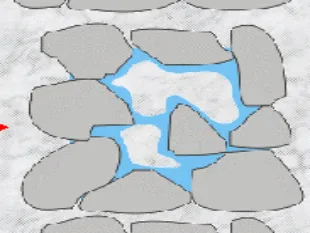
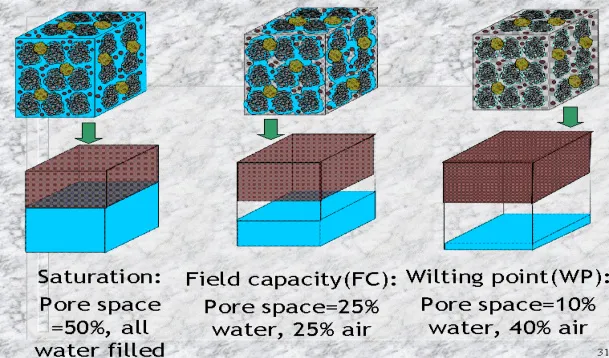
1. Field capacity : Assume that water is applied to the surface of a soil. With
the downward movement of water all macro and micro pores are filled up. The soil
is said to be saturated with respect to water and is at maximum water
holding capacity or maximum retentive capacity. It is the amount of water held in
the soil when all pores are filled.Sometimes, after application of water in the soil
all the gravitational water is drained away, and then the wet soil is almost
uniformly moist. The amount of water held by the soil at this stage is known as the
field capacity or normal moisture capacity of that soil. It is the capacity of the soil
to retain water against the downward pull of the force of gravity. At this stage
only micropores or capillary pores are filled with water and plants absorb
water for their use. At field capacity water is held with a force of 1/3
atmosphere. Water at field capacity is readily available to plants and
microorganism.
2. Wilting coefficient : As the moisture content falls, a point is reached when the
water is so firmly held by the soil particles that plant roots are unable to draw it.
The plant begins to wilt. At this stage even if the plant is kept in a saturated
atmosphere it does not regain its turgidity and wilts unless water is applied to the
soil. The stage at which this occurs is termed the Wilting point and the percentage
amount of water held by the soil at this stage is known as the Wilting Coefficient.
It represents the point at which the soil is unable to supply water to the plant.
Water at wilting coefficient is held with a force of 15 atmosphere.
3. Hygroscopic coefficient : The hygroscopic coefficient is the maximum amount
of hygroscopic water absorbed by 100 g of dry soil under standard conditions of
humidity (50% relative humidity) and temperature (15°C). This tension is equal to
a force of 31 atmospheres. Water at this tension is not available to plant but may be
available to certain bacteria.
4. Available water capacity : The amount of water required to apply to a soil at the
wilting point to reach the field capacity is called the "available" water. The water
supplying power of soils is related to the amount of available water a soil can hold.
The available water is the difference in the amount of water at field capacity (- 0.3
bar) and the amount of water at the permanent wilting point (- 15 bars).
5. Maximum water holding capacity : It is also known as maximum retentive
capacity. It is the amount of moisture in a soil when its pore spaces both micro and
macro capillary are completely filled with water. It is a rough measure of total pore
space of soil. Soil moisture tension is very low between 1/100 [th] to 1/1000 [th]
atmosphere or pF 1 to 0.
of an
6. Sticky point moisture : It represents the moisture content of soil at which it no
longer sticks to a foreign object. The sticky point represents the maximum
moisture content at which a soil remains friable. Sticky point moisture values vary
nearly approximate to the moisture equivalent of soils. Summary of the soil
moisture constants, type of water and force with which it held is given in following
table.
Soil water capacity
 Moisture equivalent : It is defined as the percentage of water held by one
centimeter thick moist layer of soil subjected to a centrifugal force of 1000 times
of gravity for half an hour.
Soil moisture constants and range of tension and pF
| S.No. | Moisture class | Tension (atm) | pF |
|---|---|---|---|
| 1 | Chemically combined | Very high | --- |
| 2 | Water vapour | Held at saturation point in the soil air |
--- |
| 3 | Hygroscopic | 31 to 10,000 | 4.50 to 7.00 |
| 4 | Hygroscopic coefficient | 31 | 4.50 |
| 5 | Wilting point | 15 | 4.20 |
| 6 | Capillary | 1/3 to 31 | 2.54 to 4.50 |
| Moisture equivalent | 1/3 to 1 | 2.70 to 3.00 | |
| Field capacity | 1/3 | 2.54 | |
| Sticky point | 1/3 (more or less) | 2.54 | |
| Gravitational | Zero or less than 1/3 | <2.54 | |
| Maximum water holding capacity |
Almost zero |
--- |
Relationship between soil moisture and tension
*
Summary Cheat Sheet
Quick Recall Points
- Field capacity and permanent wilting point define plant-available water.
- Gravitational water drains quickly; capillary water is most useful to plants.
- Texture and structure control retention behavior.
Exam Traps
- Total water content is not equal to available water.
- Hygroscopic water is held too tightly for most crop uptake.
References
2 sources • [1] [2]
References
Lesson Doubts
Ask questions, get expert answers