🧫 Movement of soil water
Explains saturated and unsaturated water flow, infiltration, and hydraulic conductivity in soils.
This lesson explains key concepts in a structured way and connects them to practical agricultural applications and exam-oriented understanding.
Methods of determination of soil moisture –
Soil Water Movement
i) Saturated Flow
ii) Unsaturated Flow
iii) Water Vapour Movement
Saturated flow : This occurs when the soil pores are completely filled with water.
This water moves at water potentials larger than – 33 kPa. Saturated flow is water
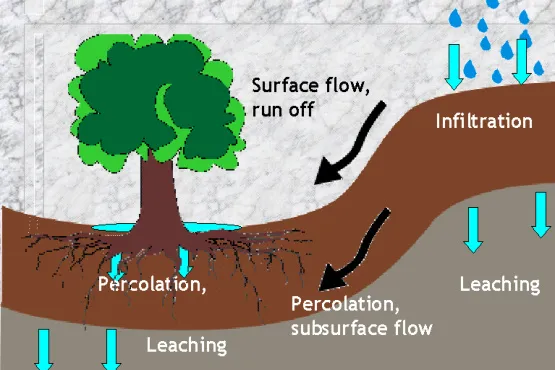
flow caused by gravity’s pull. It begins with infiltration, which is water movement
into soil when rain or irrigation water is on the soil surface. When the soil profile is
wetted, the movement of more water flowing through the wetted soil is termed
percolation.
Hydraulic conductivity can be expressed mathematically as
V = kf
Where,
V = Total volume of water moved per unit time
f = Water moving force
k = Hydraulic conductivity of soil
Factors affecting movement of water
- Texture, 2.Structure, 3.Amount of organic matter, 4.Depth of soil to hard pan,
5.Amount of water in the soil, 6.temperature and 7. Pressure
Vertical water flow
The vertical water flow rate through soil is given by Darcy’s law . The law states
that the rate of flow of liquid or flux through a porous medium is proportional to
the hydraulic gradient in the direction of floe of the liquid.
(dw) At
QW = - k (dw) At / Ds
Where,
QW = Quantity of water in cm [-1 ]
k = rate constant (cm/s)
dw = Water height (head), cm
A = Soil area (cm
t = Time
)
ds = Soil depth (cm)
(ii) Unsaturated Flow
It is flow of water held with water potentials lower than- 1/3 bar. Water will
move toward the region of lower potential (towards the greater “pulling” force). In
a uniform soil this means that water moves from wetter to drier areas. The water
movement may be in any direction .The rate of flow is greater as the water
potential gradient (the difference in potential between wet and dry) increases and
as the size of water filled pores also increases. The two forces responsible for this
movement are the attraction of soil solids for water (adhesion) and capillarity.
Under field conditions this movement occurs when the soil macropores (non
capillary) pores with filled with air and the micropores (capillary) pores with water
and partly with air.
Factors Affecting the Unsaturated Flow
Unsaturated flow is also affected in a similar way to that of saturated flow.
Amount of moisture in the soil affects the unsaturated flow. The higher the
percentage of water in the moist soil, the greater is the suction gradient and the
more rapid is the delivery.
( iii) Water Vapour Movement
The movement of water vapour from soils takes place in two ways: (a)
Internal movement—the change from the liquid to the vapour state takes place
within the soil, that is, in the soil pores and (b) External movement—the
phenomenon occurs at the land surface and the resulting vapour is lost to the
atmosphere by diffusion and convection.
The movement of water vapour through the diffusion mechanism taken
place from one area to other soil area depending on the vapour pressure gradient
(moving force).This gradient is simply the difference in vapour pressure of two
points a unit distance apart. The greater this difference, the more rapid the
diffusion and the greater is the transfer of water vapour during a unit period.
Soil conditions affecting water vapour movement :
There are mainly two soil conditions that affect the water vapour movement
namely moisture regimes and thermal regimes. In addition to these, the various
other factors which influence the moisture and thermal regimes of the soil like
organic matter, vegetative cover, soil colour etc. also affect the movement of water
vapour. The movement takes place from moist soil having high vapour pressure to
a dry soil (low vapour pressure). Similarly the movement takes place from warmer
soil regions to cooler soil region.In dry soils some water movement takes place in
 the vapour form and such vapour movement has some practical implications in
supplying water to drought resistant plants.
Entry of Water into Soil
Infiltration : Infiltration refers to the downward entry or movement of water into
the soil surface
It is a surface characteristic and hence primarily influenced by the condition
of the surface soil.
Soil surface with vegetative cover has more infiltration rate than bare soil
Warm soils absorb more water than colder ones
Coarse surface texture, granular structure and high organic matter content in
surface soil, all help to increase infiltration
Infiltration rate is comparatively lower in wet soils than dry soils
Factors affecting infiltration
i. Clay minerals
ii. Soil Texture
iii. Soil structure
iv. Moisture content
v. Vegetative cover
vi. Topography
Percolation : The movement of water through a column of soil is called
percolation. It is important for two reasons.
i) This is the only source of recharge of ground water which can be used through
wells for irrigation
ii) Percolating waters carry plant nutrients down and often out of reach of plant
roots (leaching)
In dry region it is negligible and under high rainfall it is high
Sandy soils have greater percolation than clayey soil
Vegetation and high water table reduce the percolation loss
Permeability : It indicates the relative ease of movement of water with in the soil.
The characteristics that determine how fast air and water move through the soil is
known as permeability. The term hydraulic conductivity is also used which refers
to the readiness with which a soil transmits fluids through it
Drainage
The frequency and duration of periods when the soil is free from saturation
with water. It controls the soil cum water relationship and the supply of nutrients to
the plants.
Drainage class
Very poorly drained
Poorly drained
Imperfect
Moderately well
Well
Somewhat excessive
Excessive
Hysterisis
The moisture content at different tensions during wetting of soil varies from the
moisture content at same tensions during drying. This effect is called as hysterisis.
This is due to the presence of capillary and non capillary pores. The moisture
content is always low during sorption and high during desorption. Hystersis
phenomenon exists in soil minerals as a consequence of shrinking and swelling.
Shrinking and swelling affect pore size on a microbasis as well as on the basis of
overall bulk density. So, hystersis phenomenon occurs due to factors like shape
and size of soil pores and their interconnection with each other pore configuration,
nature of soil colloids bulk density of soil and entrapped air. The most important
factor affecting hystersis is the entrapment of air in the soil under rewetting
condition. This clogs some pores and prevent effective contact between others.
Methods of determination of soil moisture
Two general types of measurements relating to soil water are ordinarily used
i) By some methods the moisture content is measured directly or indirectly
ii) Techniques are used to determine the soil moisture potential (tension or
suction)
Measuring soil moisture content in laboratory
1. Gravimetric method: This consists of obtaining a moist sample, drying it in an
oven at 105°C until it losses no more weight and then determining the percentage
of moisture. The gravimetric method is time consuming and involves laborious
processes of sampling, weighing and drying in laboratory.
2. Electrical conductivity method: This method is based upon the changes in
electrical conductivity with changes in soil moisture. Gypsum blocks inside of with
two electrodes at a definite distance are apart used in this method. These blocks
require previous calibration for uniformity. The blocks are buried in the soil at
desired depths and the conductivity across the electrodes measured with a modified
Wheatstone bridge. These electrical measurements are affected by salt
concentration in the soil solution and are not very helpful in soils with high salt
contents.
Measuring soil moisture potential insitu (field)
Suction method or equilibrium tension method: Field tensiometers measure the
tension with which water is held in the soils. They are used in determining the need
for irrigation. The tensiometer is a porous cup attached to a glass tube, which is
connected to a mercury monometer. The tube and cup are filled with water and cup
inserted in the soil. The water flows through the porous cup into the soil until
equilibrium is established. These tension readings in monometer, expressed in
terms of cm or atmosphere, measures the tension or suction of the soil.
If the soil is dry, water moves through the porous cup, setting up a negative tension
(or greater is the suction). The tensiometers are more useful in sandy soils than in
fine textured soils. Once the air gets entrapped in the tensiometer, the reliability of
readings is questionable.
Summary Cheat Sheet
Quick Recall Points
- Water movement occurs under gradients of potential energy.
- Darcy's law is central to saturated flow analysis.
- Hydraulic conductivity varies with texture, structure, and moisture status.
Exam Traps
- Conductivity in saturated and unsaturated conditions is not the same.
- High infiltration does not always imply high long-term water retention.
References
2 sources • [1] [2]
References
Lesson Doubts
Ask questions, get expert answers