📜 Historical Banking Developments in India
A comprehensive look at the evolution of Indian banking — from pre-independence origins through nationalization, liberalization, and key reform committees.
Historical Banking Developments in India
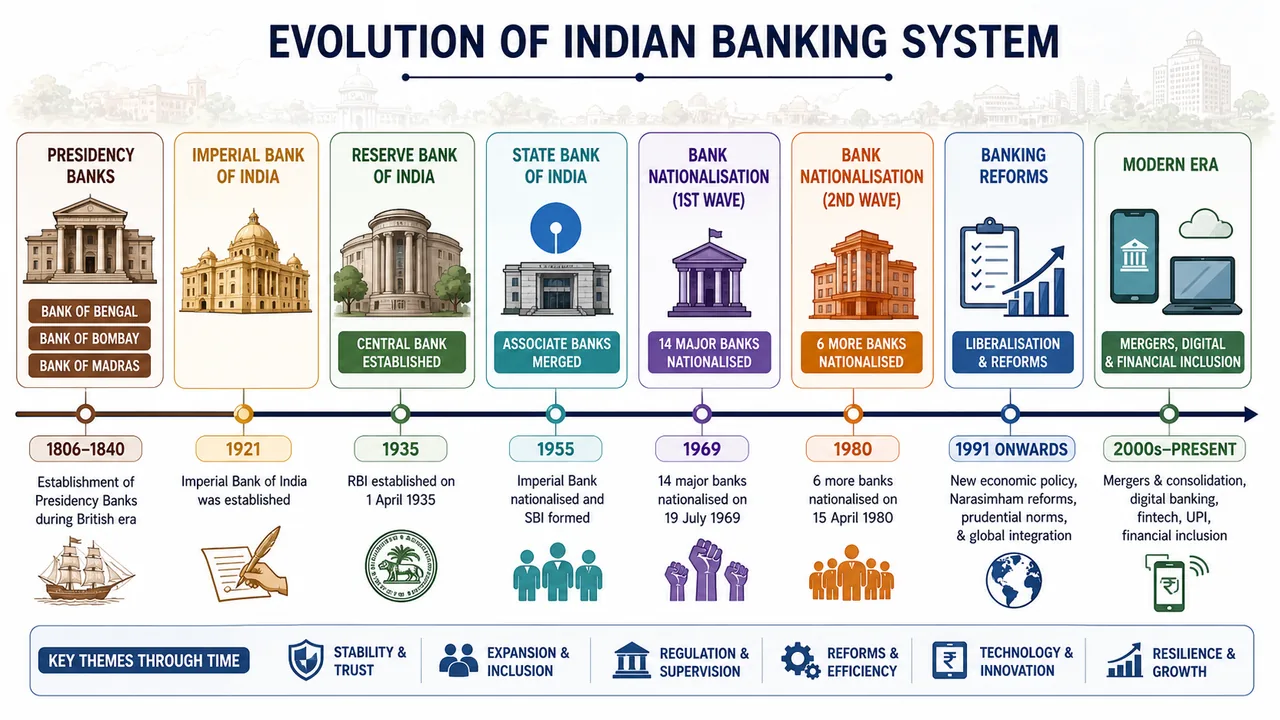
The Indian banking system has evolved through distinct phases — from colonial-era origins to post-independence nationalization, and finally to liberalization-driven reforms. Understanding this timeline is essential for banking exams.
Pre-Independence Banking
Before 1947, India's banking system was highly fragmented. Financial institutions were primarily established by European agency houses to serve colonial trade interests rather than domestic developmental needs. Over time, as the Indian independence movement grew, visionary Indian entrepreneurs began establishing indigenous joint-stock banks to empower the local economy.
- Bank of Hindustan (1770) — First bank established in India (in Calcutta). It was liquidated in 1829–32.
- General Bank of India (1786) — Short-lived early bank.
- Presidency Banks — Three banks established under British rule:
- Bank of Bengal (1806)
- Bank of Bombay (1840)
- Bank of Madras (1843)
- These three merged in 1921 to form the Imperial Bank of India.
- Allahabad Bank (1865) — First purely Indian joint-stock bank.
- Punjab National Bank (1894) — First bank managed entirely by Indians (founded by Lala Lajpat Rai).
- Reserve Bank of India — Established on 1st April 1935 under the RBI Act, 1934, based on the recommendations of the Hilton Young Commission (1926).
Nationalization of Banks
Nationalization was a landmark step to align the banking sector with India's development priorities — channeling credit to agriculture, rural areas, and priority sectors.
Early Step — Nationalization of RBI (1949)
At the dawn of independence, the newly formed Government of India realized that it could not steer a rapidly developing, planned economy if its central monetary authority was controlled by private shareholders with profit-driven motives.
- While originally established as a privately-owned shareholders' bank in 1935, the Reserve Bank of India was the first financial institution to be nationalized in post-independence India.
- It was formally nationalized on 1st January 1949 under the Reserve Bank (Transfer to Public Ownership) Act, 1948.
- Following this, the RBI became completely owned by the Government of India, charging it fully with regulating the nation's monetary policy and banking framework.
Phase 1 — Nationalization of SBI (1955)
In the early 1950s, the rural credit system was severely broken and dominated by informal moneylenders charging extortionate interest rates. The government urgently needed a massive, state-backed banking apparatus to penetrate deep into rural India and formalize agricultural credit.
- The Imperial Bank of India was nationalized and converted into the State Bank of India (SBI) on 1st July 1955 under the SBI Act, 1955.
- This was based on recommendations of the All India Rural Credit Survey Committee (1954) chaired by A.D. Gorwala.
- SBI's subsidiaries (State Bank of Bikaner & Jaipur, State Bank of Hyderabad, etc.) were formed under the SBI (Subsidiary Banks) Act, 1959.
Phase 2 — First Nationalization (1969)
Despite the creation of the SBI, private commercial banks continued to lend almost exclusively to large, urban industrial conglomerates. Agriculture, small-scale industries, and exports were completely starved of formal credit. To mandate "social banking" and force banks to lend to priority sectors, the government took absolute control over the largest private banks.
- On 19th July 1969, the Government of India nationalized 14 major commercial banks with deposits of ₹50 crore or more.
- This was done under the Banking Companies (Acquisition and Transfer of Undertakings) Ordinance, 1969, during the tenure of PM Indira Gandhi.
- Objective: Social control of banking — extend credit to agriculture, small industries, and weaker sections.
The 14 banks nationalized in 1969:
| # | Bank |
|---|---|
| 1 | Central Bank of India |
| 2 | Bank of Maharashtra |
| 3 | Dena Bank |
| 4 | Punjab National Bank |
| 5 | Syndicate Bank |
| 6 | Canara Bank |
| 7 | Indian Bank |
| 8 | Indian Overseas Bank |
| 9 | Bank of Baroda |
| 10 | Union Bank of India |
| 11 | Allahabad Bank |
| 12 | United Bank of India |
| 13 | UCO Bank |
| 14 | Bank of India |
Phase 3 — Second Nationalization (1980)
- On 15th April 1980, 6 more banks with deposits of ₹200 crore or more were nationalized.
- Total nationalized banks became 20 (14 + 6).
The 6 banks nationalized in 1980:
| # | Bank |
|---|---|
| 1 | Andhra Bank |
| 2 | Corporation Bank |
| 3 | New Bank of India |
| 4 | Oriental Bank of Commerce |
| 5 | Punjab & Sind Bank |
| 6 | Vijaya Bank |
NOTE
New Bank of India was later merged with Punjab National Bank in 1993, reducing the count to 19 nationalized banks.
PSB Mega Merger (2020)
In April 2020, the Government carried out a major consolidation:
| Merged Banks | Into |
|---|---|
| Oriental Bank of Commerce + United Bank of India | Punjab National Bank |
| Syndicate Bank | Canara Bank |
| Andhra Bank + Corporation Bank | Union Bank of India |
| Allahabad Bank | Indian Bank |
After the merger, India has 12 Public Sector Banks.
Important Banking Committees
As the banking sector grew over the decades, it periodically faced structural bottlenecks, massive non-performing asset (NPA) crises, and outdated regulations. To navigate these challenges, the Government and the RBI frequently appointed expert committees to chart out reform roadmaps.
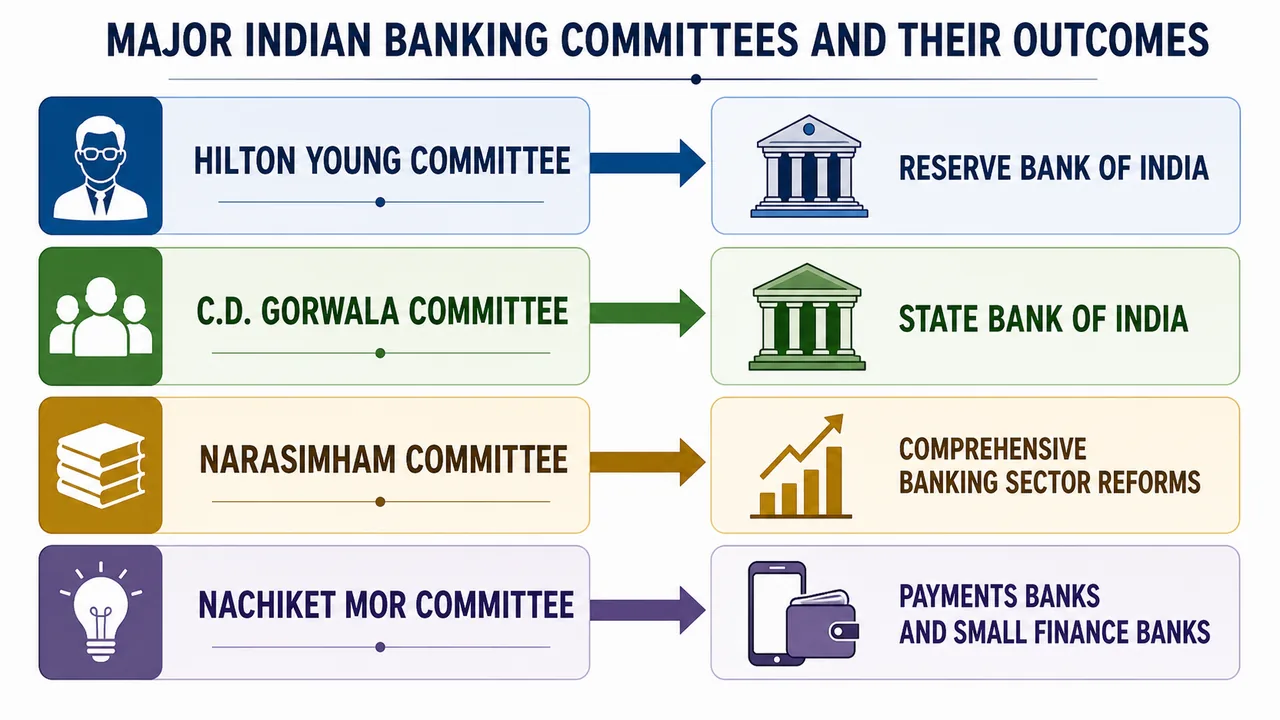
Hilton Young Commission (1926)
- Also known as the Royal Commission on Indian Currency and Finance.
- Recommended the establishment of a central bank for India.
- Led to the creation of the Reserve Bank of India in 1935.
All India Rural Credit Survey Committee (1954)
- Chaired by A.D. Gorwala.
- Recommended nationalization of the Imperial Bank of India → led to SBI formation (1955).
- Also recommended creation of a National Rural Credit Fund.
Narasimham Committee I (1991)
Chaired by M. Narasimham, this committee was constituted to recommend reforms in India's financial system. It did not recommend further nationalization; instead, it advocated liberalization, prudential regulation, and greater operational autonomy for banks.
Key Recommendations:
- Recommended reduction of high SLR and CRR to improve banking efficiency.
- Introduced prudential norms for income recognition, asset classification, and provisioning.
- Suggested capital adequacy norms in line with Basel standards.
- Proposed phased reduction of priority sector lending targets.
Background:
- Set up in 1991 amid a balance of payments crisis.
- Aimed to strengthen the financial system and improve competitiveness.
- Laid the foundation for banking sector reforms in the post-liberalization era.
Narasimham Committee II (1998)
- Constituted in 1998 to review the progress of reforms.
- Recommended:
- Strengthening of capital adequacy — suggested moving towards higher CRAR norms.
- Mergers of strong banks (not weak with weak).
- 3-tier banking structure: 2–3 large international banks, 8–10 national banks, local area banks.
- Tightening of NPA norms — move towards 90-day NPA recognition (implemented later).
- Review of the directed credit (priority sector lending) framework.
Khan Committee (2004)
- Focused on restructuring of Regional Rural Banks (RRBs).
- Recommended amalgamation of RRBs at the state level (sponsor bank-wise).
- Led to the consolidation of RRBs from 196 to around 43 (as of 2024).
Nachiket Mor Committee (2013)
- Recommended the creation of Payments Banks and Small Finance Banks.
- Focused on comprehensive financial services for small businesses and low-income households.
- Led to RBI issuing guidelines for Payments Banks and SFBs in 2014–15.
P.J. Nayak Committee (2014)
- Focused on governance reforms in PSBs.
- Recommended:
- Government reduce its stake in PSBs below 50% and transfer shares to a Bank Investment Company (BIC).
- Greater board-level autonomy for PSBs.
- Professional recruitment of top management (MD/CEO selection via independent process).
Timeline of Key Events
| Year | Event |
|---|---|
| 1770 | Bank of Hindustan established (first bank in India) |
| 1806 | Bank of Bengal (first Presidency Bank) |
| 1865 | Allahabad Bank (first Indian joint-stock bank) |
| 1894 | Punjab National Bank (first bank managed by Indians) |
| 1921 | Three Presidency Banks merged → Imperial Bank of India |
| 1926 | Hilton Young Commission recommends central bank |
| 1935 | RBI established (1st April) |
| 1949 | Banking Regulation Act enacted; RBI nationalized |
| 1955 | Imperial Bank → SBI (1st July) |
| 1969 | First nationalization — 14 banks (19th July) |
| 1975 | Regional Rural Banks established |
| 1980 | Second nationalization — 6 banks (15th April) |
| 1991 | Narasimham Committee I — liberalization reforms |
| 1998 | Narasimham Committee II — further reforms |
| 2004 | Khan Committee — RRB restructuring |
| 2013 | Nachiket Mor Committee — Payments Banks / SFBs |
| 2014 | P.J. Nayak Committee — PSB governance |
| 2020 | PSB mega merger — 10 banks merged into 4, total PSBs now 12 |
Summary Cheat Sheet
| Concept / Topic | Key Details / Explanation |
|---|---|
| First Bank in India | Bank of Hindustan (1770), Calcutta; liquidated 1829–32 |
| Presidency Banks | Bank of Bengal (1806), Bombay (1840), Madras (1843) → merged 1921 → Imperial Bank of India |
| First Indian Joint-Stock Bank | Allahabad Bank (1865) |
| First Bank by Indians | Punjab National Bank (1894) — Lala Lajpat Rai |
| RBI Established | 1st April 1935 under RBI Act 1934; recommended by Hilton Young Commission (1926) |
| RBI Nationalization | 1st January 1949 under the Reserve Bank (Transfer to Public Ownership) Act, 1948 |
| SBI Formation | Imperial Bank nationalized → SBI on 1st July 1955; recommended by Gorwala Committee (1954) |
| First Nationalization (1969) | 14 banks with deposits ≥ ₹50 crore; under PM Indira Gandhi |
| Second Nationalization (1980) | 6 banks with deposits ≥ ₹200 crore; total = 20 PSBs |
| PSB Mega Merger (2020) | 10 banks merged into 4; current PSB count = 12 |
| Narasimham I (1991) | Chaired by M. Narasimham; reduce SLR/CRR, prudential norms, Basel-linked capital adequacy, phased PSL reduction |
| Narasimham II (1998) | Higher CRAR, 3-tier structure, 90-day NPA norm, strong bank mergers |
| Khan Committee (2004) | RRB amalgamation at state level (196 → ~43) |
| Nachiket Mor (2013) | Recommended Payments Banks and Small Finance Banks |
| P.J. Nayak (2014) | PSB governance — Bank Investment Company, reduce govt stake below 50% |
Lesson Doubts
Ask questions, get expert answers