🚀 Recent Changes in Banking
EASE reform agenda for PSBs — from EASE 1.0 to EASE 8.0 (EASERise), key achievements, digital transformation, and current performance metrics.
Recent Changes in Banking
Enhanced Access and Service Excellence (EASE)
Enhanced Access and Service Excellence (EASE) is a comprehensive reform initiative aimed at improving the overall functioning of Public Sector Banks (PSBs) in India.
The acronym EASE stands for:
- Enhanced
- Access
- Service
- Excellence
The 'S' in EASE specifically denotes 'Service', emphasizing the initiative's focus on enhancing customer service and experience within PSBs.
How EASE Works
- The EASE Reform Agenda is finalized on a yearly basis at the start of each financial year (FY).
- It is guided by the EASE Steering Committee of member PSBs under the aegis of the Indian Banks' Association (IBA).
- A structured quarterly evaluation is conducted to assess progress based on defined metrics, data submissions, and relative performance among PSBs.
- Timelines are defined within the FY, and metrics are scheduled for operationalization from April onwards.
EASE Versions
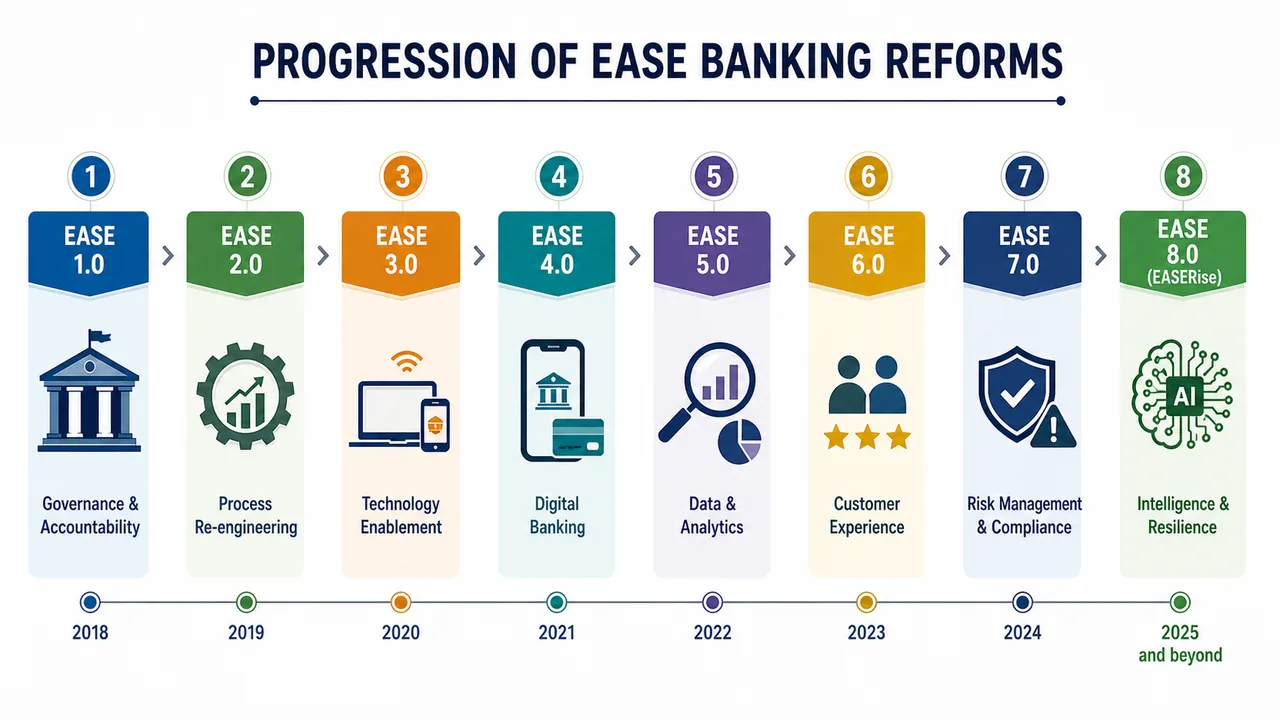
The EASE agenda has undergone multiple iterations, each building upon the previous:
| Version | Year | Focus Area |
|---|---|---|
| EASE 1.0 | FY 2018-19 | Foundation — clean banking, governance |
| EASE 2.0 | FY 2019-20 | Tech-enabled banking, customer responsiveness |
| EASE 3.0 | FY 2020-21 | Smart lending, digital payments |
| EASE 4.0 | FY 2021-22 | Co-lending, analytics-driven HR |
| EASE 5.0 | FY 2022-23 | Digital customer experience |
| EASE 6.0 | FY 2023-24 | Operational efficiency, risk management |
| EASE 7.0 | FY 2024-25 | AI integration, inclusive banking |
| EASE 8.0 | FY 2025-26 | EASERise — Risk & Resilience, Innovation, Socio-Economic Impact, Excellence |
EASE 8.0 — EASERise (FY 2025-26)
The latest iteration, EASE 8.0, has been launched as EASERise with four core themes:
Key Reforms Under EASE 8.0
Risk & Resilience
- 11 PSBs have set up Resiliency Operations Centres to strengthen IT governance and infrastructure resilience.
- PSBs have embedded advanced capabilities in Loan Management Systems — bureau analysis tools, automated MCA financial statements retrieval, Account Aggregator integration, data-driven underwriting models, and GST integration.
Innovation
- 7 PSBs have deployed at least one Gen-AI use case to enhance operational efficiency and customer service.
- 7 PSBs have established centralized Business Intelligence units for proactive market assessment and outbound field sales.
- 10 PSBs have AI-driven voice bots and WhatsApp chatbots for recovery actions.
Socio-Economic Impact
- 5 PSBs have governance frameworks with representation of Divyangjans in Customer Service and Grievance Redressal Cells, along with Digital Accessibility Cells.
- PSBs have rolled out Braille-enabled debit and credit cards, priority call routing, regional language interfaces, and dedicated service cells for Divyangjans and senior citizens.
Excellence
- Improved customer grievance redressal — remediation action tagging integrated with CRM Portals.
- 11 PSBs have collection mobile applications for monitoring and follow-up.
- Digital tools/portals for monitoring SARFAESI/DRT/NCLT cases.
- Dedicated CASA acquisition sales teams through digital assisted journeys.
Key Achievements of EASE Reforms (as of Dec 2025)
As per RBI's provisional data (31.12.2025), PSBs have shown remarkable improvement:
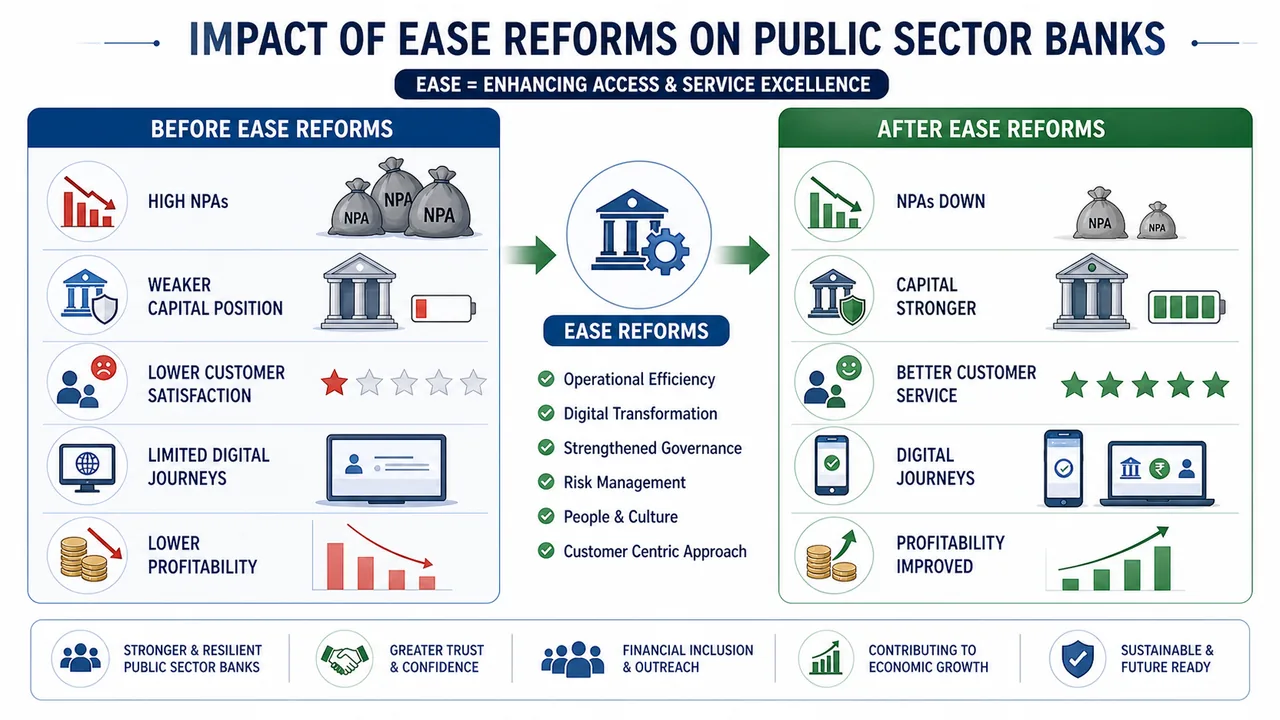
| Metric | Before Reforms | Current (Dec 2025) |
|---|---|---|
| Net Profit (9M FY26) | — | ₹1.46 lakh crore |
| Gross NPA Ratio | 14.58% peak (Mar 2018) | 2.10% (₹2.54 lakh crore) |
| CRAR (Capital Adequacy) | 11.45% (Mar 2015) | 15.46% (+401 bps) |
| PSBs under PCA | 11 out of 21 (FY 2017-18) | 0 (FY 2024-25) |
| Return on Total Assets | -0.87% (FY 2017-18) | 1.10% (FY 2024-25) |
| Digital Lending | Manual processes | All PSBs have digital journeys |
| Grievance Redressal | Manual systems | Centralized integrated portals at all PSBs |
IMPORTANT
Exam Insight: The GNPA ratio decline from 14.58% (Mar 2018) to 2.10% (Dec 2025) and the fact that zero PSBs are under PCA (vs. 11 in FY18) are frequently tested statistics showing the success of banking reforms.
References
1 source • [1]
References
Summary Cheat Sheet
| Concept / Topic | Key Details / Explanation |
|---|---|
| EASE Full Form | Enhanced Access and Service Excellence; 'S' stands for Service |
| EASE Purpose | Reform initiative to improve functioning of Public Sector Banks (PSBs) |
| EASE Governed By | EASE Steering Committee under Indian Banks' Association (IBA); quarterly evaluation |
| EASE 8.0 (EASERise) | FY 2025-26; Four themes: Risk & Resilience, Innovation, Socio-Economic Impact, Excellence |
| Gen-AI Adoption | 7 PSBs deployed Gen-AI use cases; 10 PSBs have AI voice bots/WhatsApp chatbots |
| IT Resilience | 11 PSBs have Resiliency Operations Centres |
| GNPA Ratio | Peak 14.58% (Mar 2018) → 2.10% (Dec 2025) |
| CRAR | 11.45% (Mar 2015) → 15.46% (Dec 2025), +401 bps |
| PSBs under PCA | 11 of 21 in FY 2017-18 → 0 in FY 2024-25 |
| Return on Assets | -0.87% (FY18) → 1.10% (FY25) |
| Divyangjan Initiatives | Braille cards, priority call routing, regional language UIs, Digital Accessibility Cells |
Lesson Doubts
Ask questions, get expert answers