🌿 Green Financing
Introduction to green finance, global and Indian initiatives, sustainability disclosure, methods of green financing, and regulatory frameworks.
Green Financing
Green finance channels funds towards projects that reduce environmental harm and promote long-term sustainability. In simple terms, it is the practice of directing money — through loans, bonds, investments, and insurance — into activities that are environmentally responsible. It supports eco-friendly projects and sustainable development, aiming to benefit both present and future generations by conserving Earth's resources.
Sustainable development seeks to avoid ecological impacts like resource depletion, pollution, and climate change. Rather than halting economic progress, it focuses on preserving natural environments while promoting economic growth — ensuring that development today does not come at the cost of tomorrow's resources.
Why Green Finance?
Climate change and environmental degradation have significant financial implications that make green finance essential:
- Erratic weather patterns lead to inconsistent food production and highly volatile food prices, directly affecting economies dependent on agriculture.
- Climate variability causes frequent natural disasters, resulting in loss of products, resources, and infrastructure — devastating communities and supply chains.
- Economic losses from these disasters translate into credit risks, defaults, and loan losses for financial institutions, making environmental risk a banking risk.
- Significant investments are needed to combat global warming, but public resources are limited. Governments alone cannot fund the transition — this is precisely why institutional and private finance must step in.
- Institutional finance plays a vital role in promoting climate-friendly projects and sustainable development through green finance, bridging the gap between public funding shortfalls and the massive capital required.
Global Scenario
- Global warming is caused by human activities (burning fossil fuels, deforestation, industrial processes), leading to climate change — a long-term shift in temperatures and weather patterns.
- Climate change and global warming are interconnected and often used interchangeably, though global warming specifically refers to the rise in Earth's average temperature.
- International initiatives like the Montreal Protocol (protecting the ozone layer), Kyoto Protocol (binding emission reduction targets for developed nations), and Paris Agreement (limiting global warming to 1.5°C above pre-industrial levels) aim to address climate change and global warming through coordinated global action.
- The focus is now shifting towards the Circular Carbon Economy (CCE) for sustainable development — a framework that treats carbon as a resource rather than waste.
- CCE involves the four R's: Reduce (cut emissions), Reuse (repurpose carbon), Recycle (convert waste carbon), and Remove (capture and store carbon). Remember: it is Remove, not Retain.
- Renowned programs like the Equator Principles (a risk management framework for large infrastructure projects), UNEP (United Nations Environment Programme), and Principles for Responsible Investment encourage green financing practices globally.
- Sustainable Stock Exchanges offer indices tracking companies implementing ESG (Environmental, Social, and Governance) principles, allowing investors to identify and invest in responsible companies.
- BSE (Bombay Stock Exchange) and NSE (National Stock Exchange) in India are part of this initiative, publishing separate ESG indices that track sustainability-focused companies.
Sustainability Disclosure
Sustainability disclosure is the practice of companies reporting how their operations impact the environment and society, and how environmental risks affect their business.
- Financial and non-financial companies must regularly report their exposure to ESG-related risks — this transparency helps investors, regulators, and the public assess a company's true sustainability performance.
- G20 encourages voluntary adoption of recommendations by the Task Force on Climate-related Financial Disclosures (TCFD) to foster sustainability disclosure. The G20 (not IMF, WTO, or NATO) is the key organization promoting these disclosures.
- TCFD, established by the Financial Stability Board, focuses on climate-related financial disclosures — helping companies communicate their climate risks and opportunities in a standardized way.
Directed and Concessional Lending
Directed and concessional lending is a policy tool where governments or central banks provide refinancing credit at low interest rates to commercial banks, who then pass these benefits to borrowers.
- The aim is to finance projects for renewable energy and green industries by making capital cheaper and more accessible, thereby encouraging the private sector to invest in sustainable activities.
Micro and Macro-Prudential Regulations
Several countries have introduced prudential regulations — rules governing how banks assess and manage risk — that incorporate environmental factors into banking supervision:
| Country | Year | Regulation |
|---|---|---|
| China | 2006 | Introduced regulations linking credit to companies' environmental compliance — banks must consider a borrower's environmental record before lending |
| Lebanon | 2010 | Implemented differential reserve requirements for commercial banks based on their green project portfolio — banks with more green projects enjoy lower reserve requirements |
| Brazil | 2011 | Introduced differential capital adequacy assessments based on exposure to projects with environmental and social risks — higher-risk exposure means higher capital buffers |
These regulations essentially make it financially advantageous for banks to lend to environmentally responsible projects.
Establishment of Green Financial Institutions
- Many nations have established green finance institutions in both the public and private sectors — dedicated entities whose sole purpose is to channel funds into sustainable projects.
- In 2012, Britain (UK) established the UK Green Investment Bank plc with a GBP 3 billion investment. This was one of the world's first public green banks, created specifically to accelerate private investment in green infrastructure.
- Green finance is facilitated through partner banks — existing commercial banks that act as intermediaries to distribute green finance products.
- Countries receive assistance from organizations like the Asian Development Bank (ADB) and the United States Agency for International Development (USAID) through partial credit and bond guarantees, which reduce risk for private investors.
Indian Experience
India has been progressively building a green finance framework, with initiatives spanning regulation, policy, and incentive mechanisms:
| Year | Initiative |
|---|---|
| 2007 | RBI issued notification on "Corporate Social Responsibility, Sustainable Development and Non-financial Reporting — Role of Banks" — the first formal recognition of banks' responsibility in sustainable development |
| 2007 | SEBI (Securities and Exchange Board of India) mandated sustainability disclosure for the top 100 listed entities and issued guidelines for green bond issuance |
| 2008 | The National Action Plan on Climate Change (NAPCC) was formulated to outline a policy framework for mitigating climate change impact — India's primary climate action document |
| 2011 | The Finance Ministry established the Climate Change Finance Unit (CCFU) to coordinate green finance initiatives across government departments |
| 2013 | The Companies Act, 2013 made it mandatory for eligible companies to spend at least 2% of average net profits on CSR activities — making India one of the first countries to mandate corporate social responsibility spending |
| 2015 | RBI included loans for renewable energy projects in the Priority Sector Lending (PSL) basket — ensuring banks allocate a portion of their lending to green energy |
| 2015 | RBI expanded PSL scheme to include small renewable energy projects, broadening access to finance for smaller players |
Additional Indian Initiatives
- The Government of India launched two phases of FAME (Faster Adoption and Manufacturing of Hybrid and Electric Vehicles) to promote hybrid and electric vehicle production and sales. This scheme provides subsidies and incentives to reduce the cost of EVs for consumers.
- State Bank of India introduced a 'green car loans' scheme with lower interest rates for electric vehicles to counter the high up-front costs that discourage EV adoption.
- A Production Linked Incentive (PLI) Scheme was introduced for manufacturing high-efficiency modules in renewable energy — incentivizing domestic manufacturing of solar panels and other green technology components.
- India announced a target to reach 450 GW of renewable energy generation by 2030 in September 2019, signaling a massive commitment to clean energy.
Methods of Green Financing
Green financing uses a variety of financial instruments, each designed for specific sustainability objectives:
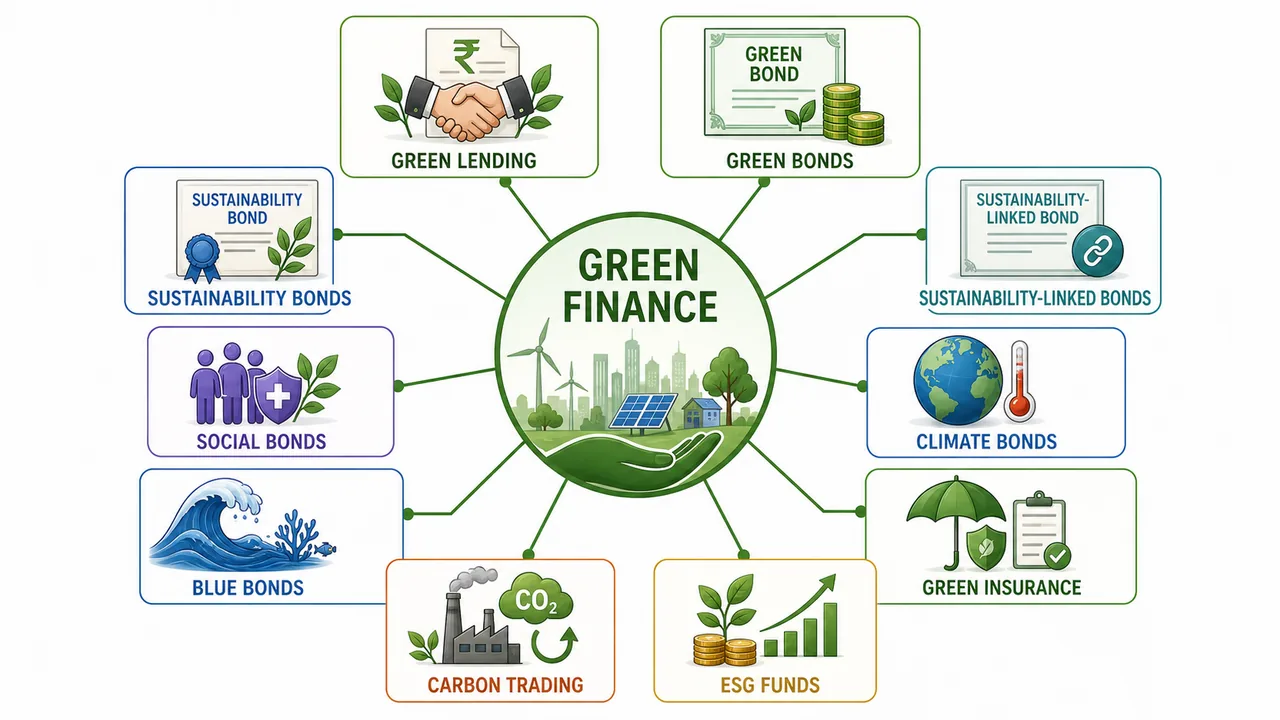
1. Green Lending
- Green lending involves providing loans based on environmental criteria for planned fund usage. Unlike traditional loans, the borrower must demonstrate that the funds will be used for environmentally beneficial purposes.
- It is a component of sustainable investment aimed at sustainable development.
- The objective is to reduce the environmental impact of new lending activities by ensuring that bank credit flows towards cleaner, greener projects.
2. Green Bonds
Green bonds are among the most prominent instruments of green finance:
- Green bonds are specialized fixed-income securities used to raise funds for environmental projects. They work like regular bonds — an investor lends money and receives periodic interest — but with the mandate that proceeds must fund green activities.
- They are typically backed by the issuer's balance sheet and carry the same credit rating as other debt obligations, meaning they are no riskier than conventional bonds.
- The primary purpose is to support sustainability and environmental initiatives.
- Projects funded by green bonds include pollution prevention, energy efficiency, clean transportation, and sustainable agriculture.
- They often offer tax incentives to attract investors, making them financially competitive with traditional bonds.
- The World Bank is a major issuer of green bonds, having issued 164 bonds worth $14.4 billion since 2008.
- In India, 76% of green bonds issued since 2015 were denominated in US dollars.
- The World Bank has allocated green bond proceeds to various projects in India.
3. Sustainability Bonds
- Green bonds and sustainability bonds are sometimes used interchangeably, but they have distinct differences that are important to understand.
- Sustainability bonds finance projects with both environmental and socio-economic benefits — for example, a project that provides clean water (environmental) to underserved communities (social).
- Green bonds specifically fund projects that benefit only the environment.
- While all sustainability bonds are green bonds, not all green bonds are sustainability bonds — a green bond funding solar panels is green but not necessarily "sustainable" in the broader socio-economic sense.
4. Sustainability-Linked Bonds
- Sustainability-Linked Bonds are unique because they finance general corporate purposes for environmentally conscious organizations — the proceeds are not tied to specific green projects.
- Instead, the terms of these bonds, such as coupon rate or tenure, are based on the issuer's ability to achieve specific sustainability performance targets (e.g., reducing carbon emissions by 30%). If the issuer fails to meet targets, the coupon rate may increase as a penalty.
5. Social Bonds
- Social Bonds finance projects with positive socio-economic outcomes — such as affordable housing, healthcare access, or education infrastructure.
- These projects have a neutral or positive impact on the environment, distinguishing them from purely environmental instruments.
6. Climate Bonds
- Green bonds and sustainability bonds are commonly equated with climate bonds, but there is a specific distinction.
- Climate bonds specifically target projects aimed at reducing carbon emissions or mitigating climate change effects — such as wind farms, carbon capture technology, or flood defenses.
- All climate bonds are green bonds, but not all green bonds are climate bonds — a green bond funding biodiversity conservation is green but not a climate bond.
- The Climate Bonds Initiative certifies climate bonds and sets standards for their certification, ensuring credibility and transparency.
7. Blue Bonds
- Blue bonds finance projects focused on protecting the ocean and related ecosystems — a specialized subset of green bonds.
- They support initiatives such as sustainable fisheries, coral reef preservation, and pollution reduction in marine environments.
- All blue bonds are categorized as green bonds, but not all green bonds are blue bonds — only those specifically targeting ocean and water ecosystems qualify.
8. Green Insurance
- Green insurance provides coverage for environmental risks and promotes sustainable practices.
- It incentivizes companies to adopt eco-friendly operations by offering favorable terms (lower premiums, broader coverage) for sustainable businesses, effectively rewarding green behavior.
9. Carbon Trading
- Carbon trading is a market-based approach to controlling pollution by providing economic incentives for reducing emissions — it puts a price on carbon.
- Under cap-and-trade systems, companies receive emission permits (carbon credits) and can trade them on an open market.
- Companies that reduce emissions below their cap can sell surplus credits for profit; those that exceed their cap must buy additional ones, creating a financial incentive to pollute less.
10. Green Funds / ESG Investing
- Green funds channel investments into companies and projects that demonstrate strong Environmental, Social, and Governance (ESG) performance.
- ESG investing integrates sustainability factors into investment decision-making alongside traditional financial analysis — not replacing financial returns, but adding sustainability criteria as an additional lens.
Green Economy
A green economy is a broader economic model that goes beyond individual financial instruments:
- Green economy aims to reduce environmental hazards and promote sustainable development at a systemic level.
- It emphasizes minimizing ecological deficiencies while preserving the environment — balancing economic output with environmental health.
- There is a close connection between green economics (practical policy-focused) and ecological economics (theoretical, studying the relationship between ecosystems and economic systems).
- Green economy focuses on practical applications and policies that governments and businesses can implement.
- According to a UNEP report, a green economy must prioritize fairness and equity — ensuring that the benefits of the green transition are shared broadly and do not leave vulnerable populations behind.
- It advocates for a just transition to a low-carbon, resource-efficient, and socially inclusive economy.
Green Money / Green Deposits
Green deposits are a relatively new instrument in India's green finance ecosystem:
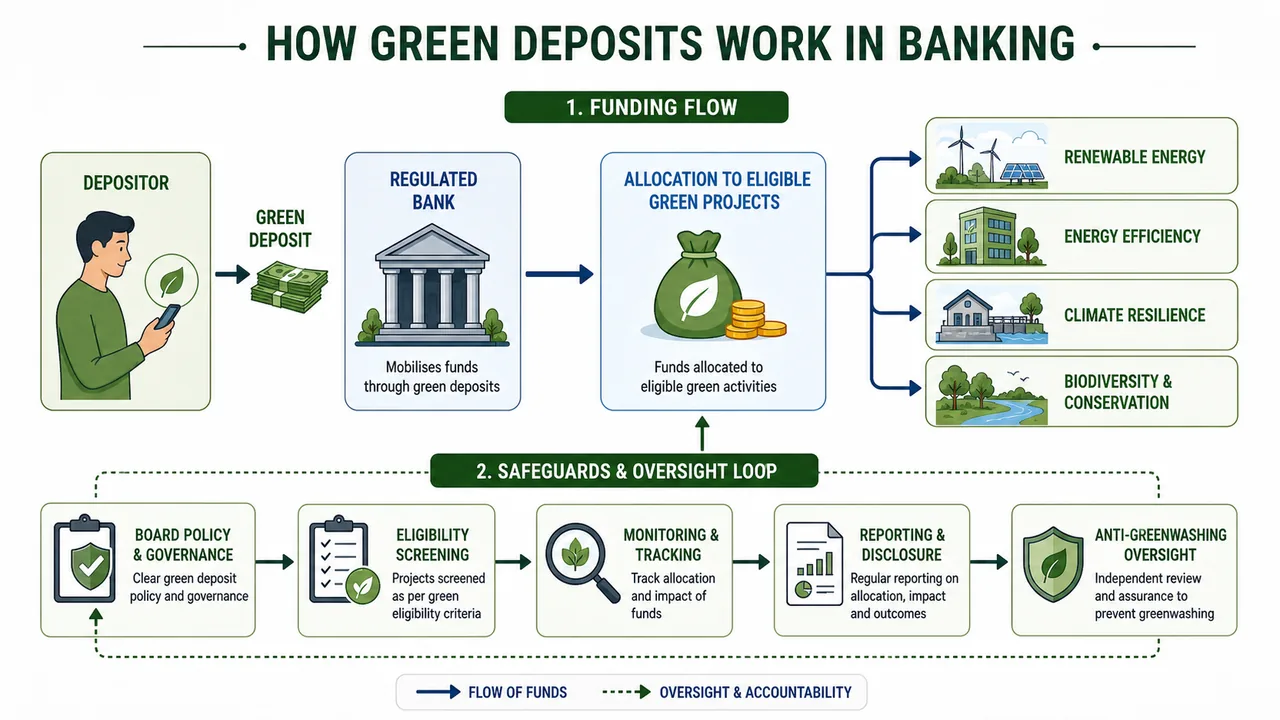
- RBI introduced a framework for accepting green deposits via circular dated April 11, 2023 — the first formal regulation governing green deposits in India.
- Aim: Encourage regulated entities to offer green deposits, protect depositors' interests, aid sustainability agendas, address greenwashing concerns, and boost credit flow to green projects. This framework ensures that deposits labelled "green" are genuinely used for environmental purposes.
- Proceeds allocation is based on the official Indian green taxonomy — a classification system that defines which activities qualify as "green."
- Green deposits fund activities promoting energy efficiency, carbon emission reduction, climate resilience, and biodiversity enhancement.
Key Rules of the RBI Green Deposit Framework
- Raise first, then allocate: Green deposits must be raised first, then allocated to green activities. Reverse sequencing is not allowed — banks cannot retroactively label existing deposits as "green."
- PSL classification: Green activities/projects financed under the framework can be classified under Priority Sector Lending (PSL) if they meet the requirements laid down in RBI's PSL guidelines.
- Denomination: Green deposits must be denominated in Indian Rupees only — they cannot be accepted in foreign currencies. This ensures alignment with domestic regulatory oversight and the Indian green taxonomy.
- Interest rates: Interest rates on green deposits follow the same guidelines as regular deposits of the bank or NBFC. There is no separate interest rate regulation — the RE's existing board-approved interest rate policy applies.
- Premature withdrawal: Premature withdrawal of green deposits is allowed at the option of the depositor, subject to the general terms and conditions applicable to other fixed deposits of the entity. The depositor is not locked in differently from a regular term deposit.
- Board-approved policy: REs shall put in place a comprehensive Board-approved policy on green deposits, laying down therein all aspects in detail for the issuance and allocation of green deposits. This policy must cover eligibility criteria, proceeds allocation, and reporting requirements.
- Overdraft facility: Banks are allowed to offer overdraft facility to customers against Green Deposits, providing liquidity to depositors.
- DICGC insurance: Green deposits are like regular term deposits, and thus are insured by DICGC (Deposit Insurance and Credit Guarantee Corporation) within the existing limit (currently ₹5 lakh).
- Temporary parking: The Framework explicitly allows Regulated Entities (REs) to temporarily park unallocated green deposit proceeds in liquid instruments (for a period not exceeding one year), pending allocation to green projects.
- No penalty for non-allocation: The RBI's framework does not envisage any penalty for non-allocation of proceeds towards green activities/projects; however, it shall be subject to supervisory review.
- Green money refers to funds dedicated to environmental preservation and enhancement — any capital specifically earmarked for ecological purposes.
- Also known as eco-currency, used within the context of green economy and ecological ideologies.
Greenwashing
Greenwashing is the dark side of the green finance movement — a practice that undermines genuine sustainability efforts:
- Greenwashing refers to deceptive marketing tactics by organizations that make their products, services, or policies appear more environmentally friendly than they actually are.
- Purpose: Create a false impression of promoting sustainability to mislead consumers, investors, and regulators.
- Methods: Employed to gain public support and financial assistance — companies may use vague language ("eco-friendly," "natural") or highlight minor green initiatives while ignoring major environmental harm.
- Goal: Present policies, processes, and products as eco-friendly for marketing advantage without making meaningful changes to reduce environmental impact.
WARNING
Exam Tip: Greenwashing is the opposite of genuine green finance — it is about creating a false appearance of environmental responsibility without meaningful action. The RBI's green deposit framework specifically addresses greenwashing concerns.
Summary Cheat Sheet
| Concept / Topic | Key Details / Explanation |
|---|---|
| Green Finance | Directing funds (loans, bonds, investments, insurance) towards projects that reduce environmental harm and promote sustainability |
| Sustainable Development | Avoids resource depletion, pollution, climate change; preserves natural environments while promoting economic growth |
| Why Green Finance Matters | Climate variability causes credit risks, defaults, loan losses; public resources insufficient — institutional/private finance must bridge the gap |
| Montreal Protocol | Protects the ozone layer |
| Kyoto Protocol | Binding emission reduction targets for developed nations |
| Paris Agreement | Limiting global warming to 1.5°C above pre-industrial levels |
| Circular Carbon Economy (CCE) | Four R's: Reduce, Reuse, Recycle, Remove (NOT Retain) |
| ESG | Environmental, Social, and Governance — sustainability criteria for investing; BSE and NSE publish separate ESG indices |
| TCFD | Task Force on Climate-related Financial Disclosures; established by Financial Stability Board; promoted by G20 |
| Sustainability Disclosure | Companies report ESG-related risks; G20 encourages voluntary TCFD adoption |
| Directed & Concessional Lending | Govts/central banks provide refinancing at low interest rates to banks for renewable energy/green industries |
| China (2006) | Linked credit to environmental compliance |
| Lebanon (2010) | Differential reserve requirements based on green project portfolio |
| Brazil (2011) | Differential capital adequacy based on environmental/social risk exposure |
| UK Green Investment Bank | Established 2012 with GBP 3 billion; one of world's first public green banks |
| India — RBI 2007 | First notification on banks' role in CSR, Sustainable Development, Non-financial Reporting |
| India — SEBI 2007 | Mandated sustainability disclosure for top 100 listed entities; green bond guidelines |
| India — NAPCC 2008 | National Action Plan on Climate Change — India's primary climate action document |
| India — CCFU 2011 | Climate Change Finance Unit under Finance Ministry |
| India — Companies Act 2013 | Mandatory 2% of average net profits on CSR for eligible companies |
| India — PSL 2015 | RBI included renewable energy projects in Priority Sector Lending |
| India — Renewable Target | 450 GW of renewable energy by 2030 (announced Sept 2019) |
| FAME Scheme | Faster Adoption and Manufacturing of Hybrid and Electric Vehicles — subsidies for EVs |
| Green Bonds | Fixed-income securities for environmental projects; same credit rating as other debt; World Bank issued 164 bonds worth $14.4 billion since 2008; in India 76% denominated in USD |
| Sustainability Bonds | Finance projects with both environmental AND socio-economic benefits |
| Sustainability-Linked Bonds | General corporate purpose; coupon/tenure linked to sustainability performance targets — penalty if targets missed |
| Social Bonds | Finance projects with positive socio-economic outcomes; neutral/positive environmental impact |
| Climate Bonds | Specifically target carbon emission reduction/climate change mitigation; certified by Climate Bonds Initiative |
| Blue Bonds | Finance ocean/marine ecosystem protection — fisheries, coral reefs, pollution reduction |
| Green Insurance | Coverage for environmental risks; favorable terms for sustainable businesses |
| Carbon Trading | Cap-and-trade: companies get emission permits; can sell surplus credits or buy additional ones |
| Green Funds / ESG Investing | Investments in companies with strong ESG performance alongside traditional financial analysis |
| Green Economy | Low-carbon, resource-efficient, socially inclusive economy (UNEP); close to ecological economics |
| Green Deposits — RBI Framework | Circular dated 11 April 2023; proceeds per Indian green taxonomy; fund energy efficiency, carbon reduction, biodiversity |
| Green Deposits — Key Rules | INR only (no foreign currency); interest rates same as regular deposits; premature withdrawal allowed (general FD terms apply); Board-approved policy mandatory; raise first, then allocate (no reverse sequencing); eligible for PSL classification; DICGC insured (within ₹5 lakh limit); overdraft facility allowed; unallocated proceeds parked in liquid instruments for max 1 year; no penalty for non-allocation (subject to supervisory review) |
| Greenwashing | Deceptive marketing creating false impression of environmental responsibility; uses vague language like "eco-friendly" without meaningful action |
Lesson Doubts
Ask questions, get expert answers