💸 Fund Transfer Systems
Comprehensive guide to RTGS, NEFT, and International Remittance Schemes.
Fund Transfer Systems
E-Payments
Electronic payments in India are regulated under the Payment and Settlement Systems Act 2007, with operational directions issued by the Reserve Bank of India (RBI).
Access Criteria for Payment Systems
Use of these systems is not automatic; criteria must be met. The RBI revised these access criteria (Master Directions updated July 28, 2021) creating distinct sets of rules for:
- Centralized payment systems (Real Time Gross Settlement - RTGS, National Electronic Fund Transfer - NEFT, and National Automated Clearing House - NACH).
- Decentralized payment systems (clearing houses at various local centres).
Access criteria for Centralized Payment Systems: Membership is open to all licensed banks that meet specific financial health indicators to ensure system stability:
- Minimum CRAR (Capital to Risk (Weighted) Assets Ratio) of 9% as per the latest audited balance sheet.
- Net NPAs (Non-Performing Assets) below 5%.
- Minimum net-worth of Rs. 25 crore.
Real Time Gross Settlement (RTGS)
RTGS is a system where the processing of funds transfer instructions takes place at the time they are received (real-time) and the settlement of funds transfer instructions occurs individually on an instruction by instruction basis (gross settlement). This ensures instant finality with no waiting period, making it the fastest way to move large funds. It is a domestic-only system — funds can only be transferred between bank accounts within India.
- Management: The system is operated by the RBI and managed by a Standing Committee.[3]
- Who Can Initiate: Any individual, firm, or corporate holding an account at an RTGS-enabled bank branch can initiate transactions for high-value transfers.[3]
- Membership: Open to licensed banks and members of the Indian Financial Network (INFINET) — the RBI's secure private network connecting banks for interbank communication — and Structured Financial Messaging System (SFMS) — a secure messaging platform (like SWIFT for India) used to transmit payment instructions. Members must maintain a current account, settlement account, and subsidiary general ledger account with the RBI. This includes the RBI itself, banks, primary dealers, and clearing houses.
- Access Options: Members can access the system via three modes: thick-client (dedicated secure software installed at the bank's premises), Web-API (automated interface integrated directly with the bank's Core Banking Solution), and Payment Originator (PO) module (a simplified interface for initiating and managing payment instructions).
- Transaction Type Code (TTC): Every RTGS payment message carries a TTC — a 4-digit code that identifies the nature/purpose of the transaction (e.g., customer transfer, interbank settlement, government payment). Values range from ”0000” to “9999”, allowing granular categorization and reporting.
- Priority: Not all RTGS transactions are equally urgent. Time-sensitive payments (e.g., government securities settlement, critical interbank payments) need to jump ahead of routine transfers. The RBI can assign top priority (”01” to “10”), while other members use ”11” to “99” — higher priority messages are processed first in the queue.
- Settlement: Final settlement occurs when the Settlement Account is debited and the receiver's account is credited.
- Irrevocability: Once settled in the RBI system, RTGS transactions are final and irrevocable — they cannot be reversed or recalled.[3]
Transaction Time (w.e.f. 14.12.20)
Since December 14, 2020, RTGS operates on a 24 x 7 basis, meaning it is available round the clock, every day of the year.
- Cut-off timings:
- Open for Business: 00.00 hours
- Cut-off for customer-bank transactions: 23.50 hours
- End of day: 00.00 hours
- Intraday Liquidity (IDL) Facility: To ensure smooth operations, the RBI may grant IDL to banks to settle RTGS transactions. If a bank delays repayment or adjustment of this liquidity, they must pay interest at twice the Repo Rate.
- Exit: Members wishing to leave the system must provide 30 days prior notice to the RBI.
Obligations of Members
Strict timelines ensure the efficiency of the RTGS system:
- Originating Bank: Must release the payment message to the RTGS system within 30 minutes of debiting the customer’s account.
- Receiving Bank: Must credit the amount to the customer’s account within 30 minutes of receiving the payment message at their member interface.
- Compensation for Delay: If the receiver bank delays credit (or return of funds), they must pay compensation to the customer at the current repo rate plus 2% per day.
- UTR (Unique Transaction Reference): Every RTGS transaction is assigned a 22-character UTR for tracking (format: 00000RCIYYMMDDnnnnnnnnnnnn).
- Record Preservation: Transaction records must be preserved for at least 10 years.
- Minimum Amount: The system is for high-value transactions; the minimum amount is Rs. 2 lac with no upper ceiling.[3]
- Advance Instructions: Customers can give instructions up to 3 working days in advance.
- Hybrid Feature: This mechanism optimizes liquidity by combining "Netting" (offsetting incoming and outgoing payments) with "Gross Settlement".
- How it works: Instead of needing the full amount for every transaction immediately, the system checks every 5 minutes to see if payments can cancel each other out.
- Example: If Bank A owes Bank B ₹100cr, and Bank B owes Bank A ₹80cr, normally Bank A needs ₹100cr. With Hybrid, Bank A only needs ₹20cr (the difference) to settle both.
- Urgency: If a transaction isn't settled via this offsetting within 2 cycles (10 minutes), the system stops waiting and settles it on a pure "Gross" basis (full amount required) to prevent delays.
- FCRA Transaction Code: Effective 15.03.23, the Foreign Contribution (Regulation) Act (FCRA) transaction code must be included in RTGS and NEFT systems for all foreign contribution transactions. This applies when inward foreign donations/contributions (received by NGOs, political parties, etc.) are credited to Indian accounts via these systems — for regulatory compliance and tracking. This does not enable outward remittances; NEFT/RTGS remain domestic-only.
Service Fees
- Monthly Membership Fee: Scheduled Commercial Banks (SCBs) pay Rs. 5000, while others pay Rs. 2500.
- Transaction Fee: A nominal fee of Rs. 0.50 per transaction.
- Time Varying Tariff: These were charges that varied based on the time of day the transaction was initiated (e.g., higher charges during peak hours). This was waived by the RBI effective from 01.07.19 to promote digital transactions.
RBI Prescribed Customer Charges:[4]
- Inward RTGS (Receiving Funds): No charges.
- Outward RTGS via Online (Internet/Mobile Banking): No charges (waived by RBI w.e.f. 01.07.2019 to promote digital transactions).
- Outward RTGS via Branch:
- Rs. 2 lac to < Rs. 5 lac: Maximum Rs. 24.50 (exclusive of tax).
- Rs. 5 lac and above: Maximum Rs. 49.50 (exclusive of tax).
National Electronic Funds Transfer (NEFT)
Unlike RTGS, NEFT is a deferred net settlement system. Instead of processing transactions instantly one-by-one, the system waits and bundles them into specific time slots (batches) to reach a final "net" position. This makes it highly efficient for high-volume transfers. Like RTGS, it is a domestic-only system — it cannot be used to send money abroad, though it can receive inward foreign remittances into Indian accounts.
What does "Net" mean? Suppose Bank A owes Bank B ₹500cr across many transactions, and Bank B owes Bank A ₹300cr. Instead of moving the full amounts separately, the system offsets them — only the net difference of ₹200cr actually moves. This reduces the total liquidity required across the banking system.
- Management: Owned and operated by the RBI as a centralised payment system.[1]
- Who Can Use: Any individual, firm, or corporate holding an account at a NEFT-enabled bank branch can initiate transactions.[1]
- Scope of Transactions: NEFT is not limited to bank-to-bank transfers. It also supports credit card bill payments, loan EMI repayments, tax payments, and inward foreign remittances (money arriving into India from abroad) into Indian accounts.[2]
- Domestic Only: Both NEFT and RTGS operate within India only (via INFINET/SFMS network). They cannot be used to send money abroad. For outward foreign remittances, separate channels are used — SWIFT (international interbank), or LRS (Liberalised Remittance Scheme, up to USD 2,50,000/year for individuals).
- Batch System: Transactions are not real-time but are settled in batches. It is an account-to-account transfer system.
- NEFT Settlement Batches: The NEFT system operates with 48 settlement batches in a 24-hour period. Effective 16.12.19, it is available 24x7, including holidays. Transactions are processed and settled every 30 minutes.
- Batch Timing: NEFT processes transactions in half-hourly intervals. The first batch begins at 12:30 AM, and the final batch concludes at 12:00 AM the next day.
- Benefits of 48 Batches:
- Efficiency: The frequent half-hourly batches allow for continuous processing of transactions, ensuring funds are transferred quickly and efficiently.
- Timely Settlement: With 48 batches, the NEFT system offers regular intervals for settlement, making it ideal for daily fund transfers and financial operations.
- Settlement Period: The timeline is B + 2 — here "B" is the batch settlement time (the moment RBI settles that particular 30-minute batch). The destination bank must credit the beneficiary account within 2 hours of B, or return the funds. Penalty for delay is Repo rate + 2%.
- Return of Failed Credits: If credit cannot be effected (e.g., invalid account), the originating bank must return the funds within the same B + 2 window. Delay in return attracts the same penalty of Repo rate + 2%.[2]
- Limits: There is no minimum or maximum amount limit for NEFT transactions.
- Confirmation: Sending banks must provide a positive confirmation message to the remitter for all successful NEFT credits.
- UTR (Unique Transaction Reference): Every NEFT transaction gets a 16-character UTR for tracking and dispute resolution.
- IFSC Code: The Indian Financial System Code is essential for routing. It is 11 characters long (First 4: Bank code, 5th: '0', Last 6: Branch code). Example: SBI New Delhi Main Branch → SBIN0000691; required for all NEFT, RTGS, and IMPS transactions.
NEFT Service Charges (Outward):
| Mode | Transaction Amount | Charges (Branch) |
|---|---|---|
| Online (Internet/Mobile) | Any Amount | No charges (waived w.e.f 01.01.2020) |
| Branch Initiated | Up to Rs. 10,000 | Rs. 2.50 |
| > Rs. 10,000 to Rs. 1 lac | Rs. 5 | |
| > Rs. 1 lac to Rs. 2 lac | Rs. 15 | |
| > Rs. 2 lac | Rs. 25 |
Payment Codes Overview:
| Code | Full Form | Purpose | Format | Example |
|---|---|---|---|---|
| UTR | Unique Transaction Reference | Tracks & identifies each transaction | RTGS: 22 chars (00000RCIYYMMDDnnnnnnnnnnnn) / NEFT: 16 chars (BKIDYYMMDDnnnnnn) | Generated per transaction |
| MICR | Magnetic Ink Character Recognition | Automated machine reading of cheques | 9 digits (3 City + 3 Bank + 3 Branch) | Printed in magnetic ink at cheque bottom |
| IFSC | Indian Financial System Code | Identifies specific bank branch for NEFT/RTGS/IMPS | 11 chars (4 Alpha Bank + 0 + 6 Numeric Branch) | SBI New Delhi Main: SBIN0000691 |
RTGS vs NEFT — Key Differences
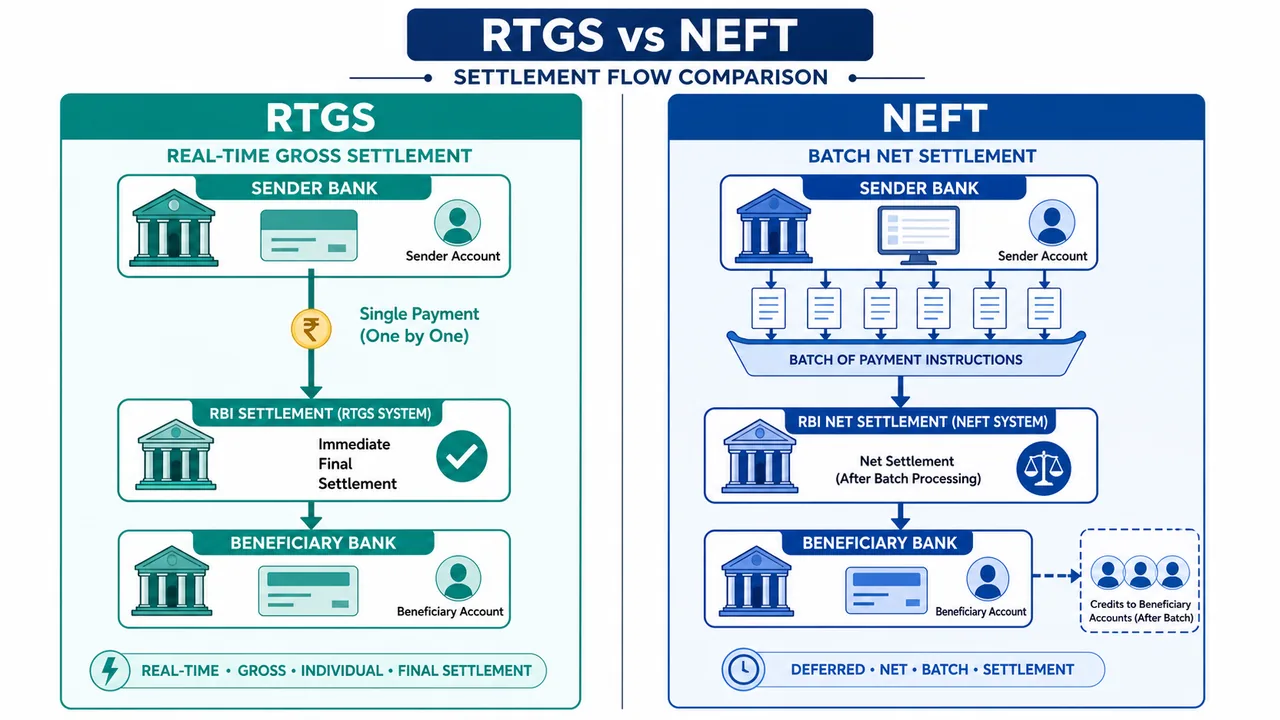
| Feature | RTGS | NEFT |
|---|---|---|
| Full Form | Real Time Gross Settlement | National Electronic Funds Transfer |
| Settlement Type | Gross — each transaction settled individually | Net — transactions bundled into batches |
| Settlement Speed | Instantaneous (real-time) | Deferred — every 30 minutes |
| Batches | No batches | 48 batches per day |
| Minimum Amount | Rs. 2 lakh | No minimum |
| Maximum Amount | No upper limit | No upper limit |
| Availability | 24×7 (since 14.12.2020) | 24×7 (since 16.12.2019) |
| Best For | High-value, time-critical transfers | Low/medium value, routine transfers |
| Settlement Period | Instant (real-time finality) | B + 2 hours |
| Delay Penalty | Repo rate + 2% per day | Repo rate + 2% |
| Irrevocability | Yes — final once settled | Not explicitly irrevocable (returns possible) |
| UTR Format | 22 characters | 16 characters |
| Online Charges | Free (waived w.e.f. 01.07.2019) | Free (waived w.e.f. 01.01.2020) |
| Branch Charges (Outward) | Rs. 24.50 (2–5L) / Rs. 49.50 (>5L) | Rs. 2.50–Rs. 25 (slab-based) |
| Operated By | RBI | RBI |
| Confirmation | Settlement Account debit confirmation | Positive confirmation message to remitter |
| Advance Instructions | Up to 3 working days | Not specified |
| Record Preservation | 10 years | Not specified separately |
Remittance Schemes
These schemes facilitate special types of fund transfers, often cross-border.
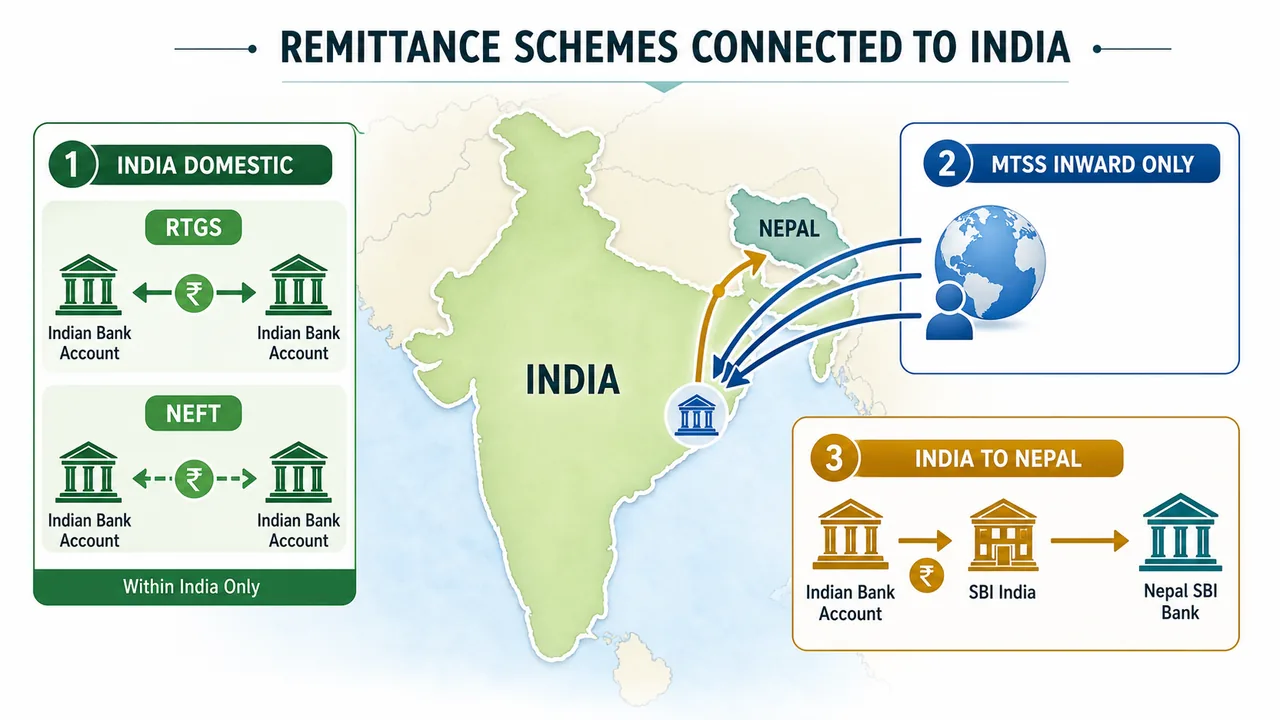
Money Transfer Service Scheme (MTSS)
A system strictly for personal "inward" remittances (money coming IN to India from abroad), used typically by migrant workers sending money home. It cannot be used for commercial trade or outbound payments.
Personal vs Commercial: "Personal" means the remittance is for family maintenance, personal expenses, or gifts — not for payment of goods, services, or business transactions. A worker abroad sending money to family = allowed. A business paying an Indian supplier = not allowed under MTSS.
- Agent Requirement: Agents in India must have a Minimum Net Owned Fund of Rs. 50 lac.
- Transaction Cap: Maximum USD 2500 per remittance.
- Frequency: A single individual can receive a maximum of 30 remittances per year.
- Overseas Principal: The foreign tie-up partner must have a Minimum Net Worth of USD 1 million.
- Cash Limit: Detailed limits exist for payout; generally, Rs. 50,000 max can be paid in cash, with the rest credited to a bank account.
Indo-Nepal Remittance Scheme
A cross-border, one-way remittance facility from India to Nepal.
- Account-based: If the remitter transfers to a Nepal bank account, the ceiling is Rs. 2 lac per transaction, with no limit on the number of transactions.
- Walk-in/Non-customer: For those without an account or paying cash, the ceiling is Rs. 50,000 per remittance, with a maximum of 12 transactions per year.
- Cash Deposit: Cash deposits are allowed up to Rs. 50,000.
- Process: The funds are routed through SBI (India) to Nepal SBI Bank Ltd.
- Charges (for up to Rs. 50k): Originating bank charges Rs. 5 + SBI charges Rs. 20. Total Rs. 25. If the beneficiary does not have an account with Nepal SBI, an additional courier charge of Rs. 50/75 applies.
References
4 sources • [1] [2] [3] [4]
References
Used for: Official RBI FAQ covering NEFT operations, membership, and eligibility.
RBI — NEFT Procedural Guidelines
OfficialUsed for: Detailed procedural guidelines including return transaction timelines, scope of transactions, and settlement rules.
Used for: Official RBI FAQ covering RTGS operations, irrevocability, minimum limits, and who can initiate transactions.
Used for: RBI circular waiving customer charges for online RTGS and NEFT transactions w.e.f. 01.07.2019.
Summary Cheat Sheet
| Concept / Topic | Key Details / Explanation |
|---|---|
| Governing Law | E-payments regulated under Payment and Settlement Systems Act 2007; directions by RBI |
| Access Criteria (Centralized Systems) | Min CRAR 9%, Net NPAs below 5%, Min net-worth ₹25 crore |
| RTGS — Full Form | Real Time Gross Settlement — instant, one-by-one settlement |
| RTGS — Operated by | RBI |
| RTGS — Who Can Initiate | Any individual, firm, or corporate with account at RTGS-enabled branch |
| RTGS — Availability | 24 x 7 since 14 December 2020 |
| RTGS — Minimum Amount | ₹2 lakh (no upper ceiling) |
| RTGS — Irrevocability | Once settled, transactions are final and irrevocable — cannot be reversed |
| RTGS — Originating Bank Obligation | Release payment message within 30 minutes of debiting customer |
| RTGS — Receiving Bank Obligation | Credit beneficiary within 30 minutes of receiving message |
| RTGS — Delay Compensation | Repo rate + 2% per day |
| RTGS — Record Preservation | 10 years |
| RTGS — Advance Instructions | Up to 3 working days in advance |
| RTGS — Hybrid Feature | Combines netting + gross settlement; checks every 5 minutes; if unsettled in 2 cycles (10 min), settles gross |
| RTGS — IDL Penalty | Delayed repayment: interest at twice the Repo Rate |
| RTGS — Exit Notice | 30 days prior notice to RBI |
| RTGS — Monthly Fee | SCBs: ₹5,000; others: ₹2,500 |
| RTGS — Online Charges | Free (waived w.e.f. 01.07.2019) |
| RTGS — Branch Charges (Outward) | ₹2–5 lakh: max ₹24.50; ≥₹5 lakh: max ₹49.50; Inward: Free |
| NEFT — Full Form | National Electronic Funds Transfer — deferred net settlement |
| NEFT — Operated by | RBI |
| NEFT — Who Can Use | Any individual, firm, or corporate with account at NEFT-enabled branch |
| NEFT — Scope | Bank transfers + credit card payments, loan EMIs, tax payments, inward foreign remittances (money into India only) |
| NEFT/RTGS — Geographic Limit | Domestic only — cannot send money abroad; use SWIFT / LRS for outward foreign remittances |
| NEFT — Availability | 24 x 7 since 16 December 2019 |
| NEFT — Batches | 48 batches per day, every 30 minutes; first batch 12:30 AM, last ends 12:00 AM |
| NEFT — Settlement Period | B + 2 hours (B = batch settlement time); delay penalty: Repo rate + 2% |
| NEFT — Return of Failed Credits | Return within same B + 2 window; same penalty for delay |
| NEFT — Amount Limits | No minimum or maximum |
| NEFT — Confirmation | Bank must send positive confirmation to remitter on successful credit |
| NEFT — Online Charges | Free (waived from 01.01.2020) |
| IFSC Code | 11 characters: 4 alpha (bank) + '0' + 6 numeric (branch) |
| MICR Code | 9 digits: 3 city + 3 bank + 3 branch; printed in magnetic ink on cheques |
| UTR (RTGS) | 22 characters — unique reference for each transaction |
| UTR (NEFT) | 16 characters — unique reference for each transaction |
| FCRA Code | Must be included in RTGS/NEFT for foreign contribution transactions (effective 15.03.2023) |
| MTSS | Money Transfer Service Scheme — strictly personal inward remittances to India (not commercial) |
| MTSS — Cap | Max USD 2,500 per remittance; max 30 remittances/year; cash payout max ₹50,000 |
| MTSS — Agent Net Worth | Min ₹50 lakh; overseas principal min USD 1 million |
| Indo-Nepal Remittance | One-way: India → Nepal via SBI India → Nepal SBI Bank Ltd |
| Indo-Nepal — Account-based | Max ₹2 lakh/transaction, no limit on number of transactions |
| Indo-Nepal — Walk-in | Max ₹50,000/remittance, max 12 transactions/year |
| Indo-Nepal — Charges | Originating bank: ₹5 + SBI: ₹20 = ₹25 total (for up to ₹50k) |
Lesson Doubts
Ask questions, get expert answers