📋 Project Appraisal & Term Loan Appraisal
Project appraisal process, technical/commercial/managerial/financial/environmental appraisal, term loan appraisal, project cost and finance, DSCR, sensitivity analysis, break-even analysis, capital budgeting (Pay Back Period, ARR, NPV, IRR, BCR).
Project Appraisal / Term Loan Appraisal
Introduction
Project Appraisal
- Process of reviewing and evaluating a project to assess feasibility and potential return.
- Aims to approve or reject the project concept.
- Analyses the projected need and potential benefits, identifying stakeholders.
- Creates a decision package for project approval or rejection.
Term Loans
- Loans used to acquire fixed assets (e.g., buildings, machinery).
- Repaid over an extended period.
- Key classification:
- Beyond 36 months: Term loans.
- Up to 36 months: Demand loans.
- Used for new ventures (green field) or existing units (brown field).
- Can be for expansion, modernisation, or asset replacement.
Why Project Appraisal
Project Basics
- Projects organise resources.
- Appraisal reviews various aspects: technical, managerial, financial, market, etc.
Bank's Role & Appraisal
- Banks evaluate project viability before funding.
- Focus is on the project's return on investment.
- Shift from security-focused to purpose-oriented lending emphasises appraisal techniques.
- Project viability is primary; collateral is secondary.
Project Viability Concerns
- If reliant on collateral, main project security has likely failed.
- Questions arise on the accuracy of viability assessments.
Post-Appraisal Activities
- Proper appraisal isn't the only key to project success.
- Timely and appropriate fund disbursement is crucial.
- Regular supervision ensures on-schedule progress.
- Adherence to implementation schedules in large projects is vital.
Delays & Impact
- Delays cause cost escalations.
- Delays in funding amplify implementation setbacks.
- Any delay can create a cycle of further delays and rising costs, threatening viability.
Aspects of Project Appraisal
Banker's Initial Assessment
- A consulting pitch can be an initial validation for considering financial support.
- Evaluation criteria include:
- Technical Evaluation
- Market Analysis
- Costing & Management Review
- Examination of financial performance (for existing entities)
- Project cost and funding sources
- Key financial ratios
- Determination of breakeven point
- Evaluation using NPV, IRR, BCR, and other financial metrics
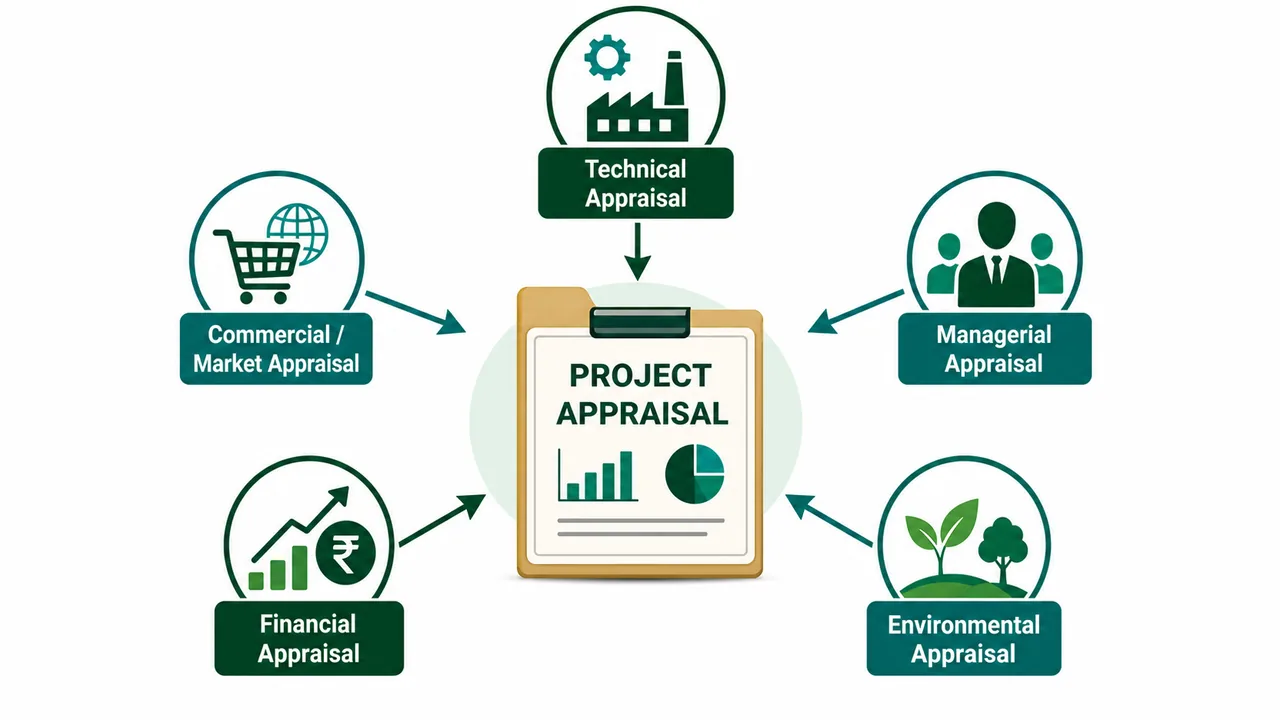
The Five Angles of Evaluation
Evaluating project viability involves the following angles — Historical is NOT an angle for evaluating project viability:
Pro Content Locked
Upgrade to Pro to access this lesson and all other premium content.
₹99 charged monthly · Cancel anytime
- All Agriculture & Banking Courses
- AI Lesson Questions (100/day)
- AI Doubt Solver (50/day)
- Glows & Grows Feedback (30/day)
- AI Section Quiz (20/day)
- 22-Language Translation (100/day)
- Recall Questions (20/day)
- AI Quiz (15/day)
- AI Quiz Paper Analysis (100/day)
- AI Step-by-Step Explanations (100/day)
- Spaced Repetition Recall (FSRS)
- AI Tutor
- Immersive Text Questions
- Audio Lessons — Hindi & English
- Mock Tests & Previous Year Papers
- Summary & Mind Maps
- XP, Levels, Leaderboard & Badges
- Generate New Classrooms
- Voice AI Teacher (AgriDots Live)
- AI Revision Assistant
- Knowledge Gap Analysis
- Interactive Revision (LangGraph)
🔒 Secure via Razorpay · Cancel anytime · No hidden fees
Project Appraisal / Term Loan Appraisal
Introduction
Project Appraisal
- Process of reviewing and evaluating a project to assess feasibility and potential return.
- Aims to approve or reject the project concept.
- Analyses the projected need and potential benefits, identifying stakeholders.
- Creates a decision package for project approval or rejection.
Term Loans
- Loans used to acquire fixed assets (e.g., buildings, machinery).
- Repaid over an extended period.
- Key classification:
- Beyond 36 months: Term loans.
- Up to 36 months: Demand loans.
- Used for new ventures (green field) or existing units (brown field).
- Can be for expansion, modernisation, or asset replacement.
Why Project Appraisal
Project Basics
- Projects organise resources.
- Appraisal reviews various aspects: technical, managerial, financial, market, etc.
Bank's Role & Appraisal
- Banks evaluate project viability before funding.
- Focus is on the project's return on investment.
- Shift from security-focused to purpose-oriented lending emphasises appraisal techniques.
- Project viability is primary; collateral is secondary.
Project Viability Concerns
- If reliant on collateral, main project security has likely failed.
- Questions arise on the accuracy of viability assessments.
Post-Appraisal Activities
- Proper appraisal isn't the only key to project success.
- Timely and appropriate fund disbursement is crucial.
- Regular supervision ensures on-schedule progress.
- Adherence to implementation schedules in large projects is vital.
Delays & Impact
- Delays cause cost escalations.
- Delays in funding amplify implementation setbacks.
- Any delay can create a cycle of further delays and rising costs, threatening viability.
Aspects of Project Appraisal
Banker's Initial Assessment
- A consulting pitch can be an initial validation for considering financial support.
- Evaluation criteria include:
- Technical Evaluation
- Market Analysis
- Costing & Management Review
- Examination of financial performance (for existing entities)
- Project cost and funding sources
- Key financial ratios
- Determination of breakeven point
- Evaluation using NPV, IRR, BCR, and other financial metrics
The Five Angles of Evaluation
Evaluating project viability involves the following angles — Historical is NOT an angle for evaluating project viability:
- Technical Appraisal
- Commercial / Market Appraisal
- Managerial Appraisal
- Financial Appraisal
- Environmental Appraisal
Technical Appraisal Overview
Infrastructure & Requirements
- Assess available infrastructure.
- Check licensing and registration needs.
- Choose appropriate technology and technical processes.
- Ensure availability of raw materials and skilled labour.
Production Aspects
- Understand manufacturing process and technical setup.
- Prepare plant cost, product quality, equipment procurement.
- Study project implementation timeline and input availability.
Location Factors
- Analyse factors: land, raw materials, utilities, transportation, labour, infrastructure.
Technology & Manufacturing
- In developing countries, reliance might be on foreign technology.
- Ensure updated and effective technology is adopted.
- Examine supply-chain terms and technology's life cycle.
- Certain processes may require collaboration or may be restricted.
- Different products might require diverse processes (e.g., oleic acid or soap production).
Human Resources
- Ensure qualified staff is available.
- Implement training, especially if know-how is foreign.
- Consider turnkey contracts for smooth project execution and covering initial operations.
Optimal Plant Size
- Ensure plant size is economically viable.
- Plant size can be defined by supply, input, or machinery constraints.
- Consider minimum economic size, market availability, capital needs, and market size.
- Larger units often have economic advantages, but market absorption is key.
- Consider local raw material sourcing for better flexibility (e.g., sugar plant example).
Plant Size and Market
- Determine plant size based on market absorption capacity.
- Avoid plants with excessive capacities that aren't economical.
- High production without market absorption can block funds in inventory.
Product Considerations
- Base product mix/range on market potential.
- Consider size, quality, and market segment differentiation.
- Ensure flexibility to adapt product line to market changes.
Plant & Machinery
- Choose between local and imported machinery.
- For local machinery, gather feedback on the supplier.
- For imports, check overseas supplier's credibility.
- For used machinery, evaluate condition, residual life, and performance guarantees.
- Some suppliers assist with installation and other performance guarantees.
Plant Layout
- Efficient layouts save time and costs.
- Ensure logical flow for materials and processes.
- Plan for storage and future expansion.
- For chemical units, have distant effluent treatment plants.
Raw Materials
- Ensure raw material availability and understand supply regulations.
- Consider multiple vendors for reliable supply and competitive pricing.
- Seek alternative or substitute materials.
Labour
- Ensure the availability of various labour skills.
- Plan for training and housing if needed.
Utilities
- Secure essential utilities: power, water, fuel, transportation.
- Have backup plans, such as generators, for power outages.
Implementation
- Create a realistic implementation schedule accounting for all milestones.
- Account for potential delays.
Licenses & Requirements
- Check necessary licences and permissions.
- Register with appropriate authorities depending on the industry and operations.
Commercial / Market Appraisal Overview
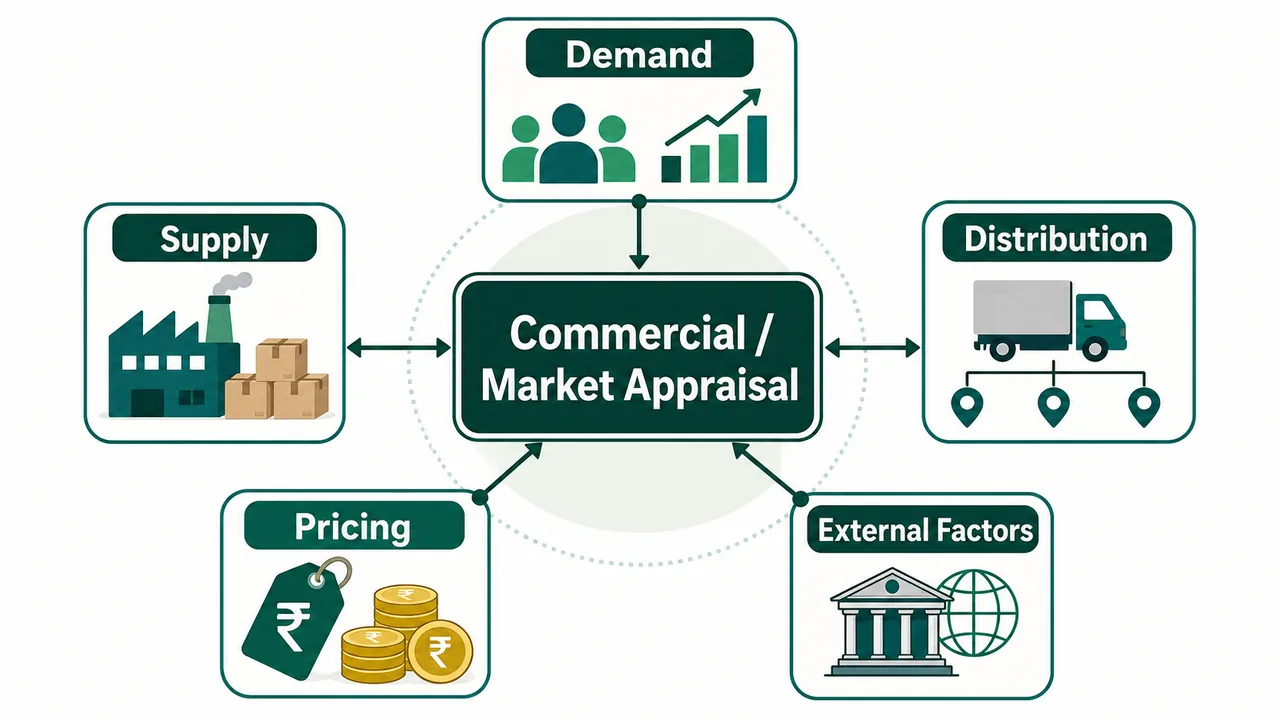
- Crucial for project evaluation.
- Involves studying demand, supply, distribution, pricing, and external factors.
- Market survey reports can be valuable.
Key Components
| Component | Details |
|---|---|
| Demand | Product details and its uses; current and future consumers; competition trends and export potential |
| Supply | Current production capacity and utilization; imports and future capacity predictions |
| Distribution | Channels used and associated costs; preferred transportation methods |
| Pricing | Local and global pricing trends; impact of duties, taxes, and price controls |
| External Factors | Government regulations on industrialisation, trade, collaborations; relevant economic plans |
Demand Forecasting Techniques
- Import substitution.
- Analysing past trends.
- End-use analysis.
- Correlation and regression studies.
- Evaluating export markets.
Commercial Appraisal Focus Areas
- Market outlook and competitor analysis.
- Market size and projected share of the unit.
- Pricing frameworks.
- Raw material considerations.
- Marketing strategies.
Market Relevance
- Selling capability is as crucial as production.
- A unique product with no competitors eases marketing, unless cheaper imports are available.
- Success factors: leadership, product quality, and effective sales strategy.
Managerial Appraisal Overview
- Focuses on evaluating the individuals or teams behind a business.
- Success heavily influenced by the competency of leaders.
- "The man behind the project" is crucial.
- Confidence in transactions based on:
- 5 C's: Character, Capacity, Capital, Collateral, Conditions.
- Additional factors: Reliability, Responsibility, Resources.
Elements of Managerial Appraisal
- The Entrepreneurs
- Directors/Partners
- The Management Team
- Managerial set-up
- Infrastructure of Liquidity, Integrity, Vision, Ethics & Abuse
- Operational transparency
- External relationships: banks-understanding, Sound micro environment
Key Points
- Competence is essential for each role.
- Evaluate past performance including long-term project consultations during assessment.
Financial Appraisal Overview
- Assesses the project's financial feasibility.
- Important factors: Project cost and execution timelines.
- Delays often lead to increased costs.
- Timely and adequate finance is crucial.
- Reliance on government subsidies should be minimised.
- Key tools: Profitability estimate, Break-even analysis, Debt service coverage ratio.
Environmental Appraisal Overview
- Examines the interplay between the project and the environment.
- Relevant environmental factors: Water, Air, Land, Sound, Conservation policies, Geographical location.
- Essential to secure clearances from pollution control and other relevant authorities.
Term Loan Appraisal
Purpose
- Acquisition of capital assets (Land, Building, Plant & Machinery, Modernisation, etc.).
Duration
- 3 to 10 years.
Feasibility Aspects
- Future earnings of the unit.
- Higher risk than working capital finance due to reliance on future savings.
Appraisal Focuses On
- Feasibility of physical, economic, technical aspects, future trends, cost returns, funds and management.
- Term Loan Appraisal does NOT examine historical loan amounts.
- In term loan appraisal, historical performance is NOT a primary focus — the focus is on technical feasibility, financial feasibility, and future trend analysis.
- The appraisal aspect that examines future trends of a project is the Term Loan appraisal.
Analysis for Existing Concerns
Evaluation Criteria
- Technical, managerial, commercial, financial aspects.
For Functioning Companies
- Review the last 3 years' audited Balance Sheet and Profit & Loss.
- Determine trends: profits/losses and their causes.
- Analyze proportion of borrowings to paid-up capital and reserves.
- Examine current liabilities vs. current assets.
- Check for proper asset depreciation, fund interlocking with associated concerns, profit reinvestment.
Key Principles
- Essential to evaluate if a project is viable.
- Anticipates unforeseen challenges and complexities.
Project Cost & Finance
Cost of the Project
| Cost of the project | Sources of Finance |
|---|---|
| Land, site development, building and other civil works | Share Capital (equity/preference), Reserves and Surplus, Internal accruals from existing cash accruals |
| Plant & Machinery | Term loans from FIs etc. |
| Misc. assets | Term loans, Capital subsidy |
| Electrical fittings | Term loans |
| Preliminary & pre-operative expenses | Debentures |
| Contingencies | Unsecured loans |
| Working capital margin | Own funds |
Technical Appraisal: Financial vs. Technical Angle
Cost & Its Components
- Includes raw materials, utilities, labour costs, and selling expenses.
- Output quality impacts pricing: reject rates and selling prices.
- Proper costing leads to accurate product pricing.
Cost & Its Estimation
- Requires technical expertise.
- Involves estimation of Processing & Manufacturing, Packaging & Despatch, Marketing & Distribution, Administration, Finance & Interest, Depreciation.
- Includes consumables (items that don't form part of product).
Working Assumptions
- Capacity utilization (often 60-75% in Year 1, stabilizing by Year 3).
- Capital outlay includes building, machinery, and net working capital requirement.
Technical Consultants & Fees
- If firm requires technical experts from within or outside the country.
- Sources: Project report creation, technology engineering.
- Costs: Components of the project.
- Royalty payments: Usually a percentage of output/production; considered in profitability projections.
Foreign Expertise
- Foreign expertise might be necessary for project implementation.
- Costs: Part of the project, also treated as operational expenses.
Consumables
- Encompasses goods not directly used in manufacturing.
- Examples: furniture, stationery, lab equipment, firefighting facilities, etc.
Preliminary & Pre-operative Expenses
- Costs incurred/borne before the company's formation in general.
- Examples: company registration "ROC" (initially separated as part of "cost" from preliminary expenses).
- Costs between company formation and the start of commercial production.
- Examples: salaries, insurance, rent, etc.
Escalation
- Price escalation "For" (literally speculated in expected and agreed upon "rate of escalation").
- Covers anticipated increases during construction/pre-commercial period of the project.
Sources of Finance
Share Capital
- Types: Equity (from owners/shareholders) or Preference shares.
Term Loans
- Offered by banks and financial institutions.
- Categories: Rupee loans (for domestic procurement) and Foreign Currency loans.
- Convertible: Can be changed to equity, either partially or fully.
- DFIs (Development Finance Institutions): specialized agencies promoting industrial and economic growth.
Incentive Sources
- Financial boosts from government/agencies.
- Forms: Seed Capital, capital subsidies, tax incentives/concessions.
Miscellaneous Sources
- All resources outside traditional sources.
- Includes: unsecured loans, deposits, fixed deposits, leasing, and hire purchase.
Key Points
- Equity and debt financing determined by debt-equity standards and promoter contributions.
- Require a separate demand-based planning, cost-benefit analysis, and potential GDR approvals.
Cost of Production & Profitability Estimation
Data Required for Estimation
| Category | Items |
|---|---|
| Capacity | Installed capacity |
| Working | Daily shifts & working days |
| Product | Product assortment |
| Quantity/Price | Input quantity & pricing; Output quantity & pricing |
| Raw material | Raw material and production mix |
| Labour | Labour expenses |
| Overheads | Plant operational costs, admin costs, packaging expenses, marketing costs, financial charges, depreciation, tax obligations, maintenance charges |
Key Steps
- Determine the project's running potential.
- Determine loan servicing capacity.
- Calculate internal rate of return.
- Ascertain break-even levels.
- Decide on minimum plant capacity.
- Make estimates for future growth.
Debt Service Coverage Ratio (DSCR)
- Represents a company's ability to handle its term liabilities.
Formula
DSCR = (Net Profit + Depreciation + Interest on Term Loan) / (Term Loan Instalment + Interest on Term Loan)
- DSCR above 1.5 indicates the project can comfortably service its debt.
- DSCR measures a company's capability to manage term liabilities.
Key Points
- DSCR and IRR values rely on factors like capacity utilization, raw material prices, and selling prices.
- It's wise to adjust key parameters by ±10%.
- Significant changes in DSCR and IRR due to a ±10% tweak in any factor denotes the project's sensitivity to that factor.
- DSCR is NOT directly used for measuring project profitability — it measures debt servicing capability.
- DSCR is NOT a primary tool for evaluating project profitability.
Sensitivity Analysis
- Sensitivity Analysis checks financial viability under adverse situations.
- It is used to check financial viability under challenges.
- Essential for assessing financial strength in challenging scenarios.
- The ability to check a project's financial health even during tough times is provided by Sensitivity Analysis.
Break-Even Analysis
- A tool for evaluating project profitability.
- Highlights the link between costs, revenue, and profit.
- Break-even analysis focuses on the no-profit-no-loss point.
- The break-even point indicates no-profit-no-loss.
- The level at which a unit neither makes a profit nor a loss is termed the break-even point.
- Break-even Analysis provides insight into a project's profitability without profit or loss.
Two main types
- Fixed Costs: Unchangeable in the short/medium term (e.g., depreciation, loan interest, maintenance).
- Variable Costs: Change with production levels.
Break-even point
Break-even analysis finds the sales volume where total costs equal total revenue.
Tabular Example
| Explanation | Parameters | |
|---|---|---|
| Fixed Cost per unit = ₹ 500 | Fixed Cost per unit = ₹ 500 | |
| Selling Price per unit = ₹ 2 | Selling Price per unit = ₹ 2 | |
| Contribution per unit = Selling Price – Variable Cost = ₹ 1 | Contribution per unit = ₹ 1 | |
| Breakeven Point (units) = Fixed Cost / Contribution per unit = 500 / 1 = 500 units | Contribution = 50% of Sales | |
| Breakeven Point (₹) = Selling Price per unit × 500 units = ₹ 1 × 500 = ₹ 500 | Contribution Value = ₹ 500 |
Examples of High Break-Even Units
| Industry | Characteristics |
|---|---|
| Airline Industry | High fixed costs (e.g., aircraft cost) versus variable costs; must fill seats (high load factor); opportunity cost — last-minute tickets might sell at discount |
| Hotel Industry | High fixed costs for wages, laundry, and cleaning; late-night room profitability — above the costs of laundry, the room is mostly profit; factors affecting discount: hotel's reputation and self-sufficiency; a motel charges for premium rate due to opportunity cost |
Capital Budgeting
- Entrepreneurs must weigh aims and costs of potential investments.
- Relevant for both new and existing businesses raising investment.
Capital Budgeting Techniques
- Pay Back Period
- Average Rate of Return (ARR)
- Net Present Value (NPV)
- Internal Rate of Return (IRR)
- Benefit-Cost Ratio (BCR)
Pay Back Period Method
- Goal: Determine how long it takes to recover the project's initial investment.
- Calculated by accumulating cash inflows until they match the initial cost.
- Cash inflows include: Net Profit (post-tax), depreciation, and other non-cash expenses.
- Decision rule: A shorter payback period signals a more attractive project.
- Pay Back Period Method specifically determines duration for investment recovery.
- Pay Back Period Method measures the period required for a project to recover its entire investment.
Example
A project with ₹ 1000 Lakh initial investment:
| Year | Annual Cash Inflow | Cumulative Cash Inflow |
|---|---|---|
| 1 | 100 | 100 |
| 2 | 150 | 250 |
| 3 | 250 | 500 |
| 4 | 300 | 800 |
| 5 | 300 | 1100 |
Payback period falls between Year 4 and Year 5.
Draw Backs of the Pay Back Period Method
- It considers cash flows only up to the point the original investment is recovered and ignores returns thereafter.
- It does not take into consideration the time value of money.
Average Rate of Return (ARR)
- Computes the average annual profit / total initial investment.
- Uses the average of yearly net profits after depreciation.
- ARR compares annual net profits to original and average investments.
- The tool that evaluates average annual net operating profits is the Average Rate of Return.
- The method that assesses the average of annual net profits to investments is the Average Rate of Return.
To determine the average investment
- Calculate yearly average between opening and closing book values of investments.
- Take the average of all yearly averages.
Formula
ARR = (Average investment over the project's life) / Average profit × 100
Key Point
- The payback and average rate of return methods overlook the time value of money.
- Average Rate of Depreciation is NOT a measure used in appraising a project's profitability.
Time Value of Money & Discounting Technique
- Money's value today differs from its future value.
- Immediate cash is more valuable because it can earn interest.
Key Concepts
| Concept | Definition |
|---|---|
| Compounding | Increases the current value over time; transforms today's cash flow to its expected future value |
| Discounting | Determines today's value from future value; converts future cash flow to its present value |
| Discounting Factors | Used to derive present value from future sums; found in tables based on return rates and periods |
For 10% Return
- 1 year's future ₹1 = ₹0.909 today
- 2 years' future ₹1 = ₹0.826 today
- 3 years' future ₹1 = ₹0.751 today
Formulas
- Present Value: PV = Discount Factor × Expected Payment (C1)
- Interest: INT = PV × r/100
- Cash Flow at end of Period 1: C1 = PV × (1 + r)
- For n periods: Cn = PV × (1 + r)^n
Where:
- PV = Present Value
- i = Interest rate per period
- r = Rate expressed as a fraction (i / 100)
- I = Principal plus Interest
- n = Number of periods
Net Present Value (NPV) Method
- Deals with multiple cash flows, including payouts and payins.
- Each cash flow is assigned a present value.
- Payins are marked with +ve signs; payouts with -ve signs.
- The sum of all present values is the Net Present Value (NPV).
- NPV involves discounting future cash flows at a pre-determined cut-off rate.
- If cash flows of all project years are discounted at a fixed rate, the method being used is NPV.
Example
| Amount | |
|---|---|
| Today: Payout | ₹ 10,000 |
| Year 1: Payin | ₹ 6,500 |
| Year 2: Payin | ₹ 9,000 |
| Year 3: Payout | ₹ 1,000 |
Given a 10% annual discount rate:
- Initial payout: PV1 = -10,000
- Year 1 Payin: PV2 = 6,500 ÷ 1.1 = +5,909
- Year 2 Payin: PV3 = 9,000 ÷ 1.21 = +7,438
- Year 3 Payout: PV4 = -1,000 ÷ 1.33 = -752
- NPV = (-10,000) + 5,909 + 7,438 - 752 = +2,595
NPV Decision Rules
| Condition | Interpretation |
|---|---|
| Positive NPV | Project's profit > marginal investment rate/cost of capital. Project can be accepted |
| NPV > 0 | Earnings from project > marginal investment rate |
| Negative NPV | Earnings < marginal investment rate/cost of capital |
NPV Summary Points
- Cut-off rate should be ≥ cost of funds.
- Use Excel's NPV formula: -NPV (rate, range of cash flows).
- Cash flow timing affects NPV.
- When investments are the same, choose project with higher NPV.
- Don't directly compare two projects with different investments using just NPV.
- NPV aids stakeholders in understanding a project's intrinsic financial strength.
- For determining financial viability, the most powerful tools for stakeholders are NPV and IRR.
Comparing Two Projects with Different Investments
Use the Present Value Index (PVI):
PVI = Present value of cash inflows / Present value of cash outflows
- The tool that evaluates the financial health of a project is the Present Value Index.
Pre-set Cut-off Rate or Minimum Return Rate
- Discount rate for NPV is ideally based on the opportunity cost of investment funds.
- Determining the exact opportunity cost is challenging.
- Alternative measures can be the entrepreneur's expected project return or the average capital cost.
- Due to complexities in determining the exact rates, many institutions use the term debt's interest rate as the discounting cut-off rate.
Internal Rate of Return (IRR)
- IRR stands for Internal Rate of Return.
- IRR is the discount rate making the Net Present Value zero.
- The discount rate where the project's NPV is zero is the IRR.
- It represents the annualized effective compounded return rate.
- IRR indicates the profitability of expected cash flows.
- Reflects the Time Value of money and investment risk.
- Banks evaluate a project on whether the minimum return can exceed cost of capital (DSFR) or rate of return (ROR).
- IRR is critical for determining the financial feasibility of a project.
Decision Rules
| Condition | Decision |
|---|---|
| IRR > Cost of Capital | Accept investment |
| IRR < Cost of Capital | Reject |
- IRR is used to determine if the cost of funds is lower than IRR — if yes, the project is viable.
- If a project's IRR exceeds its funding cost, the project is deemed financially viable.
- The gap between IRR and funding cost provides a financial safety margin.
- This safety margin doesn't address technical, commercial, or economic aspects of the project.
- The margin of safety for the viability of a project from a financial angle is the difference between IRR and the cost of funds.
- IRR isn't typically used to compare different projects.
- Viability from a financial angle is indicated when the cost of funds is lower than IRR.
How to Calculate IRR
- IRR is found by discovering the discount rate at which NPV = 0.
- Try an initial rate, observe if NPV is positive or negative, then adjust.
- Use interpolation between the two rates where NPV changes sign.
Data Required for NPV & IRR Calculation
General Requirements
- Project lifespan
- Cash outflow details (investment for capital & working capital)
- Cash inflow projections (project benefits)
- Net cash receipts and IRR computation
- Set cut-off rate or minimum return rate
Project Lifespan
- Defined by the period it remains economically productive.
- Determined by the shortest of: a. Physical lifespan, b. Technological lifespan (equipment aging), c. Market lifespan (product obsolescence).
- Not solely based on depreciation rates in accounting books.
- The life of a project should NOT be based on rate of depreciation in books.
- Industrial projects typically have a 12-year life; exceptions based on industry specifics.
Cash Outflow
- Used for obtaining fixed and current assets.
- Fixed assets = project cost – working capital margin; interest during construction.
- Cash for additions to fixed assets are logged in the year they occur.
- Working capital (current assets) = non-bank-borrowed liabilities with production.
- Project's "year zero" is its implementation or construction start. Subsequent years with production.
- Cash outflow includes all EXCEPT profit from operations.
- Cash outflow includes: requirement of working capital, cost of fixed assets, expenditure on fixed assets addition.
Cash Inflow
- Consists of operational profits and project's end-of-life residual value.
- Profits are considered before interest, lease, depreciation, and tax.
- For the lending bank's perspective, use profit before interest and after tax.
- For equity holders' perspective, use profit after tax but add back interest, lease, and depreciation.
- IRR from the equity holders' perspective should consider benefits after the deduction of tax.
- An essential aspect of the IRR from the equity holder's viewpoint is tax benefits post deductions.
- For broader economic analysis, adjust cash flow for societal impacts using shadow prices.
- Cash inflow includes all EXCEPT initial investment cost.
- Cash inflows include: operating profits, residual value of assets, profit after tax — but NOT initial investments.
Residual or Terminal Value
- This is the value of assets at the end of the project's lifespan.
- Include it in the final year's cash inflow.
- The residual value of assets should be added to the cash inflow of the last year of the project life.
- Land remains at its initial cost (non-depreciating), while other assets take their salvage value.
- Land does not undergo depreciation.
- Assets have a value even at the end of the estimated project life.
Net Cash Receipt & IRR Calculation
- Net receipt is the difference between cash inflow and outflow.
- Initial stages might show negative values due to high investments, but will turn positive with increased production and profitability.
- Use tools like Excel to determine IRR from net cash receipts.
Benefit-Cost Ratio (BCR) Overview
Calculation
BCR = Total Benefits / Total Costs
Example
- Project costs ₹ 100,000 and provides total benefits of ₹ 150,000.
- BCR = 150,000 / 100,000 = 1.5
Interpretation
| Condition | Meaning |
|---|---|
| BCR > 1 | Benefits outweigh costs — for every rupee spent, ₹ 1.50 of benefits gained |
| BCR = 1 | Benefits equal costs |
| BCR < 1 | Costs exceed benefits |
Banker's Point of View
- When BCR > 1: Accept
- When BCR = 1: Indifferent
- When BCR < 1: Reject
Quick Notes for Exam
- The shift from security-oriented to purpose-oriented lending emphasises appraisal techniques.
- Historical is NOT an angle for evaluating project viability — the valid angles are Technical, Commercial, Managerial, Financial, Environmental.
- Term Loan Appraisal does NOT examine historical loan amounts.
- DSCR measures a company's capability to manage term liabilities.
- The break-even point indicates no-profit-no-loss.
- The Pay Back Period Method determines the time needed to recover the initial project investment.
- ARR compares annual net profits to original and average investments.
- The discount rate where the project's NPV is zero is the IRR (Internal Rate of Return).
- Pay Back Period Method measures the period required to recover the entire investment.
- Sensitivity Analysis checks financial viability in adverse situations.
- IRR is used to determine if the cost of funds is lower than IRR.
- The life of a project should NOT be based on rate of depreciation in books — but on physical life, technological life, or product market life.
- Depreciation remains within a unit and does not involve cash flow.
- The residual value of assets should be added to the cash inflow of the last year of the project life.
- Land does not undergo depreciation.
- The margin of safety for financial viability is the difference between IRR and cost of funds.
- A project's technical feasibility is determined during Term Loan Appraisal.
- The NPV Method involves discounting future cash flows at a pre-determined cut-off rate.
- Sensitivity Analysis is essential for assessing financial strength in challenging scenarios.
- Cash inflow includes all EXCEPT initial investment cost.
- Cash outflow includes all EXCEPT profit from operations.
- Present Value Index evaluates the financial health of a project.
- DSCR is NOT a primary tool for evaluating project profitability — NPV, IRR, and Break-even Analysis are.
- The most powerful tools for determining financial viability for stakeholders are NPV and IRR.
- Average Rate of Return evaluates average annual net operating profits.
- In term loan appraisal, historical performance is NOT a primary focus.
- Net Present Value aids stakeholders in understanding a project's intrinsic financial strength.
- Break-even Analysis focuses on the no-profit-no-loss point.
- IRR is critical for determining the financial feasibility of a project.
- Industrial projects typically have a 12-year life.
- IRR from the equity holders' perspective considers benefits after deduction of tax.
Summary Cheat Sheet
| Parameter | Detail |
|---|---|
| Project Appraisal | Review and evaluate project feasibility and return |
| Term Loan | For fixed assets; repaid over 3–10 years |
| Term Loan vs Demand Loan | Term: >36 months; Demand: ≤36 months |
| Green Field | New venture |
| Brown Field | Existing unit (expansion/modernisation) |
| Lending Shift | Security-oriented → purpose-oriented (appraisal techniques) |
| 5 Appraisal Angles | Technical, Commercial, Managerial, Financial, Environmental |
| NOT an Appraisal Angle | Historical |
| 5 C's (Managerial) | Character, Capacity, Capital, Collateral, Conditions |
| Technical Appraisal | Infrastructure, production, location, technology, HR, plant size, machinery |
| Commercial Appraisal | Demand, supply, distribution, pricing, external factors |
| Demand Forecasting | Import substitution, past trends, end-use analysis, regression, export markets |
| Financial Appraisal | Project cost, execution timelines, profitability, break-even, DSCR |
| Environmental Appraisal | Water, Air, Land, Sound, Conservation, Geography; pollution clearances |
| Term Loan NOT Focus | Historical performance / historical loan amounts |
| Term Loan Focus | Future trends, technical feasibility, financial feasibility |
| Existing Concern Analysis | Last 3 years audited BS and P&L |
| Sources of Finance | Share capital, term loans, DFIs, incentives (seed capital, subsidies), misc (unsecured, deposits, leasing) |
| Capacity Utilization | Often 60–75% in Year 1, stabilizing by Year 3 |
| Project Lifespan | Shortest of: physical, technological, or market life; industrial = 12 years |
| NOT Lifespan Basis | Rate of depreciation in books |
| DSCR Formula | (Net Profit + Depreciation + Interest on TL) / (TL Instalment + Interest on TL) |
| DSCR Benchmark | Above 1.5 = comfortable debt servicing |
| DSCR Measures | Company's capability to manage term liabilities |
| DSCR NOT For | Measuring project profitability |
| Sensitivity Analysis | Tests financial viability under adverse situations; adjust parameters by ±10% |
| Break-even Point | No-profit-no-loss level; Fixed Cost / Contribution per unit |
| Break-even Focus | No-profit-no-loss point |
| Capital Budgeting Tools | Pay Back Period, ARR, NPV, IRR, BCR |
| Pay Back Period | Time to recover initial investment; shorter = better |
| PBP Drawback | Ignores returns after recovery; ignores time value of money |
| ARR | Average annual profit / total initial investment × 100 |
| ARR Drawback | Overlooks time value of money |
| ARR NOT a Measure | Average Rate of Depreciation |
| Compounding | Today's value → future value |
| Discounting | Future value → today's value |
| NPV | Sum of present values of all cash flows (payins +ve, payouts -ve) |
| NPV Discount Rate | Pre-determined cut-off rate (≥ cost of funds) |
| NPV > 0 | Project can be accepted |
| NPV < 0 | Project earnings < cost of capital |
| Present Value Index | PV of inflows / PV of outflows; evaluates financial health |
| IRR | Discount rate where NPV = 0 |
| IRR Full Form | Internal Rate of Return |
| IRR > Cost of Capital | Accept investment |
| IRR < Cost of Capital | Reject |
| IRR Determines | If cost of funds < IRR → project viable |
| Margin of Safety | IRR minus cost of funds |
| IRR NOT For | Comparing different projects |
| IRR Critical For | Determining financial feasibility |
| BCR > 1 | Accept (benefits outweigh costs) |
| BCR = 1 | Indifferent |
| BCR < 1 | Reject |
| Cash Inflow Includes | Operating profits, residual value, profit after tax |
| Cash Inflow EXCLUDES | Initial investment cost |
| Cash Outflow Includes | Working capital, fixed assets, fixed asset additions |
| Cash Outflow EXCLUDES | Profit from operations |
| Residual Value | Added to cash inflow of last year of project life |
| Land | Does NOT undergo depreciation |
| Depreciation | Remains within unit; no cash flow involved |
| Equity Holder IRR | Consider benefits after deduction of tax |
| Powerful Tools | NPV and IRR for financial viability |
| Net Receipt | Difference between cash inflow and outflow |
Lesson Doubts
Ask questions, get expert answers