💧 Operational Risk & Liquidity Standards
Revised Operational Risk Framework (June 2026) and Liquidity Standards (LCR & NSFR).
Operational Risk (Revised Framework)
What is Operational Risk? It is the risk of loss due to failed internal processes, people, systems, or external events (e.g., fraud, cyber-attack, earthquake). It does not include reputation risk or strategic risk.
RBI has introduced a Revised Framework (June 2023) to make capital calculation simpler and more comparable across banks.
Previous Approaches
Before this revision, banks could use three different methods depending on their complexity:
- Basic Indicator Approach (BIA)
- The Standardised Approach (TSA) / Alternative Standardised Approach (ASA)
- Advanced Measurement Approach (AMA)
The Big Change: These have been replaced by a single standardized method called the Basel III Standardised Approach to ensure consistency.
How is Capital Calculated? (3 Steps)
The new calculation follows a logical 3-step flow:
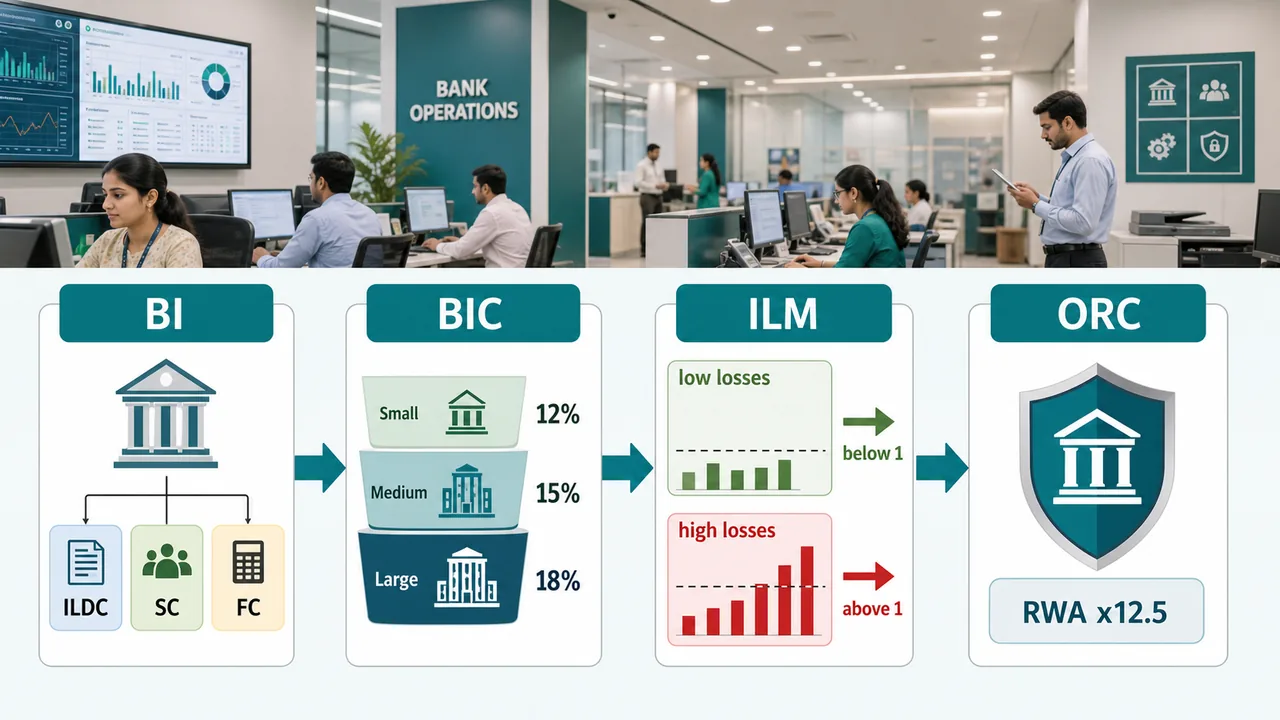
Step 1: Calculate "Business Indicator" (BI)
First, we measure the size of the bank's operations. We don't just look at revenue; we look at three specific components to get a holistic view. So, it is a financial-statement-based proxy for operational risk.
Interactive Preview
Try the embedded exercise below. Full lesson access still requires Pro.
Pro Content Locked
Upgrade to Pro to access this lesson and all other premium content.
₹99 charged monthly · Cancel anytime
- All Agriculture & Banking Courses
- AI Lesson Questions (100/day)
- AI Doubt Solver (50/day)
- Glows & Grows Feedback (30/day)
- AI Section Quiz (20/day)
- 22-Language Translation (100/day)
- Recall Questions (20/day)
- AI Quiz (15/day)
- AI Quiz Paper Analysis (100/day)
- AI Step-by-Step Explanations (100/day)
- Spaced Repetition Recall (FSRS)
- AI Tutor
- Immersive Text Questions
- Audio Lessons — Hindi & English
- Mock Tests & Previous Year Papers
- Summary & Mind Maps
- XP, Levels, Leaderboard & Badges
- Generate New Classrooms
- Voice AI Teacher (AgriDots Live)
- AI Revision Assistant
- Knowledge Gap Analysis
- Interactive Revision (LangGraph)
🔒 Secure via Razorpay · Cancel anytime · No hidden fees
Operational Risk (Revised Framework)
What is Operational Risk? It is the risk of loss due to failed internal processes, people, systems, or external events (e.g., fraud, cyber-attack, earthquake). It does not include reputation risk or strategic risk.
RBI has introduced a Revised Framework (June 2023) to make capital calculation simpler and more comparable across banks.
Previous Approaches
Before this revision, banks could use three different methods depending on their complexity:
- Basic Indicator Approach (BIA)
- The Standardised Approach (TSA) / Alternative Standardised Approach (ASA)
- Advanced Measurement Approach (AMA)
The Big Change: These have been replaced by a single standardized method called the Basel III Standardised Approach to ensure consistency.
How is Capital Calculated? (3 Steps)
The new calculation follows a logical 3-step flow:
Step 1: Calculate "Business Indicator" (BI)
First, we measure the size of the bank's operations. We don't just look at revenue; we look at three specific components to get a holistic view. So, it is a financial-statement-based proxy for operational risk.
A. Liquidity Coverage Ratio (LCR)
- Theme: "Surviving the Next 30 Days"
- Objective: To ensure the bank has enough High-Quality Liquid Assets (HQLA) (like gold or cash) to survive a 30-day severe stress scenario (e.g., a bank run).
- Scope: Applicable for Indian banks at standalone level including overseas operations through branches.
- Binding: With effect from 01.01.2015 (completed w.e.f 1.1.19).
Types of HQLA (High Quality Liquid Assets):
- Level 1 (Highest Quality): Cash, G-Secs, State Govt Securities. (Haircut: 0%).
- Level 2A: Securities issued by Pseudo-Govt entities (PSEs). (Haircut: 15%).
- Level 2B: Corporate bonds, Common Equity shares. (Haircut: 50%).
Requirement: Must be at least 100% (i.e., Cash on hand Cash leaving the bank).
B. Net Stable Funding Ratio (NSFR)
- Theme: "Long-Term Structural Health"
- Objective: To ensure the bank funds its long-term assets (like Housing Loans) with long-term liabilities (like Fixed Deposits or Equity), rather than relying on short-term borrowing.
- Goal: Reduce over-reliance on short-term wholesale funding and promote funding stability.
- Implementation: 01.10.2021.
- ASF (Sources): Equity, Long-term bonds, Retail deposits (Stable money).
- RSF (Uses): Long-term loans, Illiquid assets (Money tied up).
- Requirement: Must be at least 100%.
Summary Comparison
| Feature | LCR (Liquidity Coverage Ratio) | NSFR (Net Stable Funding Ratio) |
|---|---|---|
| Focus | Short-term Resilience | Long-term Stability |
| Time Horizon | 30 Days | 1 Year |
| Scenario | Acute Stress (Emergency) | Normal Business (Structure) |
| Key Metric | Cash vs. Outflows | Liabilities vs. Assets |
| Requirement |
Practice Questions
**Q1: Bucket for Small Bank**
A bank has a Business Indicator (BI) of ₹5,000 crore. What is the applicable marginal coefficient for calculating BIC?
Answer: Since ₹5,000 cr is less than ₹8,000 cr, the bank falls in Bucket 1. The coefficient is 12%.
**Q2: Purpose of LCR**
Which Basel III ratio ensures a bank can meet its liquidity obligations for a 30-day stress period?
Answer: Liquidity Coverage Ratio (LCR). (NSFR is for the long term/1 year).
**Q3: ILM Calculation Logic**
If a bank has had very low operational losses in the past 10 years (LC < BIC), how will it affect its capital requirement?
Answer: The Internal Loss Multiplier (ILM) will be less than 1. This means the bank's final capital requirement (ORC) will be lower than the baseline, rewarding its good risk management.
Summary Cheat Sheet
| Concept | Key Details | Formula / Limit |
|---|---|---|
| Op Risk Approach | Basel III Standardised Approach (Replaces BIA, TSA, AMA). | Depends on BI (Size) & ILM (History). |
| Business Indicator (BI) | Sum of 3 components (Interest, Services, Financial). | |
| BIC (Baseline Capital) | Size-based progressive calculation. | (12%, 15%, 18%) |
| ILM (Multiplier) | Adjusts capital based on 10-year loss history. | |
| Final Op Capital | ORC. Bucket 1 banks have ILM = 1. | |
| LCR | Short-term liquidity (30 Days). | |
| NSFR | Long-term stability (1 Year). | |
| HQLA Haircuts | Level 1 (0%), Level 2A (15%), Level 2B (50%). | - |
Lesson Doubts
Ask questions, get expert answers